
“Whose turn is it to drive?” “Who’s driving tonight?” Two sentences, two different words, one identical sound. Few pairs of English words cause as much quiet panic in writers as whose and who’s — they are homophones, they both come from the word who, and they look almost identical on the page. Yet they do completely different jobs in a sentence, and swapping them is one of the fastest ways to lose a careful reader’s trust.
The good news is that this is one of the easiest grammar mix-ups to fix permanently. The whole difference comes down to a single question: are you talking about ownership, or are you shortening who is (or who has)? Once you know which job you need, the choice between whose and who’s becomes automatic — no memorization tricks required, just one quick mental test you will learn in a few minutes.
In this guide, we break down exactly what whose means, what who’s means, and how the apostrophe in who’s fools even strong writers. You will get a side-by-side comparison table, real examples from everyday conversation, work emails, and formal writing, the most common mistakes to avoid, and tricky edge cases like “who’s been” and “whose turn.” Five FAQs and a simple one-second test round things out, so you never confuse the two again.
What Does “Whose” Mean?
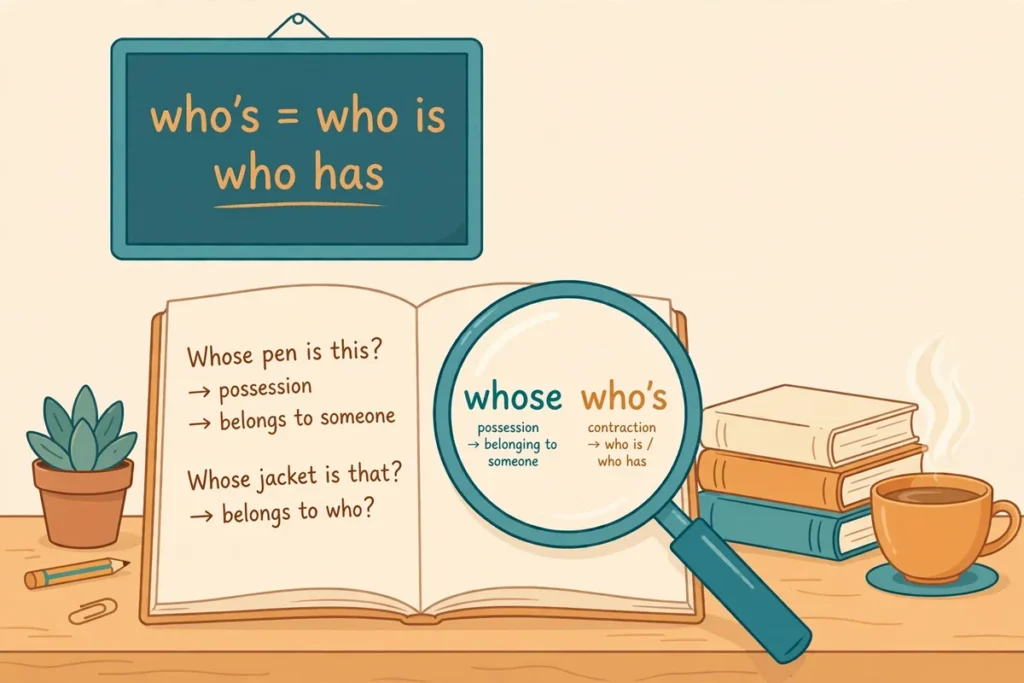
Whose is the possessive form of the pronoun who. It shows that something belongs to, is associated with, or relates to a person — or sometimes a thing. Think of it as the question-word version of his, hers, or its: just as he becomes his and she becomes her, who becomes whose. There is no apostrophe, and there never should be one.
Whose is doing possession work whenever it appears. In “Whose jacket is hanging on the chair?”, you are asking who owns the jacket. In “She is the writer whose books I read every summer,” the word connects the writer to the books that belong to her. If the sentence is about belonging, relationship, or association, whose is the word you want.
Whose in Questions
Whose appears at the start of direct questions about ownership or association, usually right before a noun.
- Whose phone keeps ringing in the back row?
- Whose idea was it to leave an hour early?
- Whose bag is this? It was left at the gym.
- Guess whose son is getting married next month?
Notice the pattern: whose is always followed by a noun (phone, idea, bag, son). If you can point at the word after it and ask “who does this belong to?”, the answer is whose. This is the single most common correct use of the word, and the one people most often misspell as “who’s.”
Whose in Relative Clauses
Whose also appears in the middle of sentences, inside relative clauses that connect a person (or thing) to something they own or are linked to.
- The customer whose order was lost received a full refund.
- He is a coach whose players trust him completely.
- We hired the designer whose portfolio stood out from the rest.
Here whose replaces a longer phrase like “of whom the” or “of which the.” Instead of the clunky “The customer of whom the order was lost,” we write “the customer whose order was lost.” It keeps the sentence smooth while still doing clear possession work.
Whose for People — and Things
Many learners are told that who words only refer to people, so they hesitate to write “the company whose products” or “the house whose roof.” Good news: whose can refer to things as well as people, and this is completely standard English. “The plane, whose pilot had safely ejected, crashed into the woods” is perfectly grammatical.
If you prefer a more formal alternative for things, of which works: “the company of which the products are eco-friendly.” But whose is natural, widely accepted, and much less stiff. Do not avoid it out of misplaced caution — the grammar books are on your side here.
What Does “Who’s” Mean?
Who’s is a contraction — a shortened form made by squashing two words together and marking the missing letters with an apostrophe. Specifically, who’s always expands to one of two phrases: who is or who has. It never shows possession, no matter how much the apostrophe tempts you to read it that way.
- Who’s coming to dinner tonight? (= Who is coming…)
- I don’t know who’s in charge of the schedule. (= who is in charge…)
- Who’s been to Paris? (= Who has been…)
Because a contraction is really two words hiding inside one, you can test who’s at any moment by expanding it. If “who is” or “who has” fits your sentence without changing the meaning, who’s is correct. This substitution test is the fastest route to certainty, and we will use it several times in this guide.
Who’s = Who Is
The most common job of who’s is standing in for who is. It usually asks about someone’s identity or describes what someone is doing.
- Who’s that man by the window? (= Who is that man…)
- Who’s responsible for this report? (= Who is responsible…)
- She is the one who’s leading the project. (= …who is leading…)
- Tell me who’s next in line. (= …who is next…)
In every example, the apostrophe marks the missing “i” from “is.” If you are describing who someone is or what someone is doing, reach for who’s.
Who’s = Who Has
The second, slightly less famous job of who’s is standing in for who has. This almost always appears with a past participle, in the present perfect tense.
- Who’s finished the quarterly review? (= Who has finished…)
- Who’s been eating my sandwiches? (= Who has been eating…)
- Ask anyone who’s worked here longer than a year. (= …who has worked…)
- I wonder who’s already seen the new season. (= …who has already seen…)
Here the apostrophe marks the missing “ha” from “has.” This is the usage that catches people off guard, because “who’s” next to a verb like “finished” or “been” looks unusual — but it is perfectly standard, in both speech and writing.
The Core Difference: Possession vs. Contraction
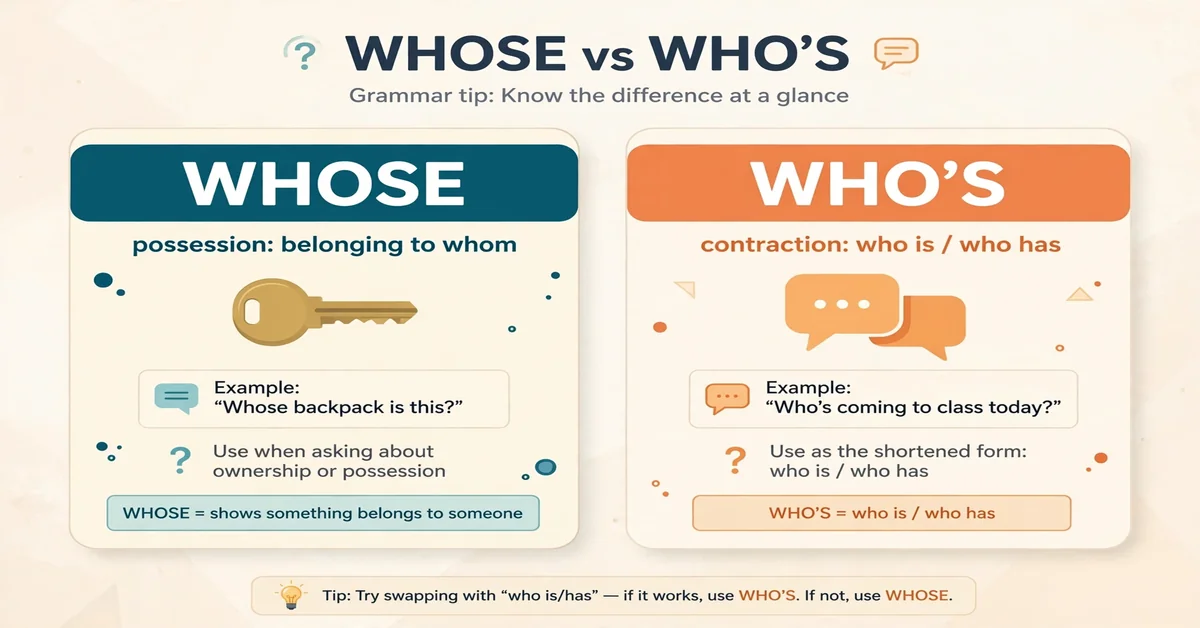
If you take one idea from this entire article, let it be this: whose shows possession; who’s is a contraction. Whose = belonging to whom. Who’s = who is / who has. Two words, two completely separate jobs, one identical pronunciation.
- Whose laptop is on the table? → belonging to whom?
- Who’s presenting first? → who is presenting?
- The author whose debut won an award… → the author’s debut…
- I wonder who’s bringing dessert. → who is bringing…
Before you write either word, say the sentence aloud in your head. If you are pointing at an owner, you need whose. If you could expand the word to “who is” or “who has,” you need who’s. Most confusion evaporates the moment you ask the right question.
The Apostrophe Trap
Here is why this pair confuses even confident writers: in English, apostrophes normally signal possession. Sarah’s keys. The team’s decision. My mother’s recipe. So when your eyes see who’s, your brain automatically reads it as “the possessive form of who” — exactly backwards.
In reality, possessive pronouns in English never take apostrophes: his, hers, ours, yours, theirs, its, and whose. That is the full list, and every one of them is apostrophe-free. The apostrophe in who’s always marks a contraction, just like in it’s (= it is) and don’t (= do not). Remember it this way: if a pronoun already ends in -s, the apostrophe-free version is the possessive one. Whose, its, yours — possession needs no apostrophe.
The One-Second Substitution Test
Whenever you hesitate, run this test: mentally replace the word with “who is” or “who has.”
- “_____ leading the workshop?” → “Who is leading the workshop?” Makes sense → who’s.
- “_____ notebook is this?” → “Who is notebook is this?” Nonsense → whose.
- “_____ been to the new office?” → “Who has been to the new office?” Makes sense → who’s.
- “_____ fault is it anyway?” → “Who has fault is it anyway?” Nonsense → whose.
Two expansions to try, one quick decision. If either “who is” or “who has” fits, use who’s (the apostrophe word). If neither fits, you are talking about possession, so use whose (the apostrophe-free word). Practice it ten times and it becomes reflex.
Whose vs. Who’s: Comparison Table
| Feature | Whose | Who’s |
|---|---|---|
| What it is | Possessive pronoun | Contraction |
| Meaning | Belonging to whom / of which | Who is / who has |
| Apostrophe | Never | Always |
| Expandable? | No — nothing to expand | Yes — “who is” or “who has” |
| Used in questions | Yes — “Whose turn is it?” | Yes — “Who’s coming?” |
| Used in statements | Yes — “the client whose payment arrived” | Yes — “she’s the one who’s late” |
| Follows with a noun | Usually (“whose car,” “whose idea”) | Never directly |
| Common error | Written as “who’s” | Written as “whose” |
Tape this table to your memory: if you can point to a noun right after the word, it is almost certainly whose. If you can expand it, it is who’s.
Usage Examples Across Contexts
The rule is simple, but confidence comes from seeing the words in real sentences. Here is how whose and who’s behave across everyday conversation, work writing, and formal prose.
Everyday Conversation
In casual speech and texting, both words appear constantly — usually in questions.
- Whose keys are these? They’re on the kitchen counter.
- Who’s up for pizza tonight?
- I have no idea whose turn it is to do the dishes.
- Do you know who’s picking us up from the airport?
- Whose dog is barking? It’s been going on for an hour.
- Who’s going to tell him the meeting was moved?
Casual tip: in quick texts people often type “whos” without any apostrophe at all. In informal chat that barely matters, but in anything you would reread — an email, a post, a school assignment — choose deliberately.
Work and Business Writing
In professional writing, the whose/who’s error stands out more, because readers judge polish. Emails about ownership (“whose approval do we need?”) and staffing (“who’s covering Friday?”) are exactly where the pair collides.
- Whose approval do we need before we publish this?
- Who’s handling the client call this afternoon?
- Please confirm whose budget this expense falls under.
- Do we know who’s presenting at the stakeholder review?
- The vendor whose invoice was delayed has been paid in full.
- I was wondering whose proposal the committee selected for the pilot.
When drafting, run the substitution test on every whose/who’s before you hit send — and if time permits, read the email back to yourself once. A thirty-second check catches the errors that spellcheck never will, because both spellings are real words.
Formal and Academic Writing
Formal writing leans heavily on whose in relative clauses, because precise attribution matters. Contractions like who’s are usually expanded to “who is” or “who has” in strict academic style — but whose appears everywhere.
- The researcher whose findings were cited most often led the panel.
- This is an economy whose growth has outpaced every forecast.
- The novelist, whose early work was overlooked, won the prize at sixty.
- Any employee whose access card is missing must report to security.
Notice how naturally whose attaches to non-human nouns — economy, findings, work, card. In academic prose this is not just acceptable, it is the elegant choice, often preferred over a wordy “of which” construction.
Common Mistakes to Avoid
Even writers who know the rule slip up under speed. These are the four errors to watch for.
Mistake 1: Putting an Apostrophe in the Possessive
The single most common error: writing “who’s” when you mean “whose.”
- Wrong: Who’s bag is this?
- Right: Whose bag is this?
- Wrong: The manager who’s team won the award…
- Right: The manager whose team won the award…
- Wrong: Guess who’s birthday it is today!
- Right: Guess whose birthday it is today!
In each wrong version, expanding “who’s” gives nonsense: “Who is bag is this?” The apostrophe belongs only to contractions — possession in pronouns never takes one.
Mistake 2: Dropping the Apostrophe in the Contraction
The mirror-image error: writing “whose” when you mean “who’s.”
- Wrong: Whose going to drive us home?
- Right: Who’s going to drive us home? (= Who is going…)
- Wrong: I don’t know whose been calling.
- Right: I don’t know who’s been calling. (= Who has been calling.)
- Wrong: Tell me whose in charge here.
- Right: Tell me who’s in charge here. (= Who is in charge…)
If “who is” or “who has” slots in cleanly, the apostrophe is mandatory.
Mistake 3: Confusing Them in Questions
Questions are the danger zone because both words start so many of them. The fix is to look at what comes after the word. A noun right after it — car, turn, responsibility, idea — means possession, so use whose. A verb or “been” right after it — coming, working, finished — means a contraction, so use who’s.
- Whose turn is it? (noun → whose)
- Who’s coming? (verb → who’s)
- Whose idea was that? (noun → whose)
- Who’s been here before? (verb → who’s)
This “noun or verb” glance takes a fraction of a second and resolves nearly every question-form confusion.
Mistake 4: Letting Spellcheck Decide
Spellcheck will not save you here — both words are correctly spelled, so no red squiggle ever appears. Grammar checkers catch some cases but miss others, especially in complex sentences. On the other hand, the substitution test never fails: expand “who’s” mentally, and if the sentence survives, the apostrophe stays.
Tricky Cases and Edge Cases
A few situations look like exceptions but follow the same rule once you see what is happening.
“Who’s Got” and “Who’s Been”
Phrases like “who’s got” and “who’s been” trip people up because the contraction sits next to a verb that is not “is.”
- Who’s got the charger? (= Who has got the charger?)
- Who’s been to the London office? (= Who has been…)
- Who’s finished already? (= Who has finished…)
Any time who’s is followed by a past participle (got, been, finished, seen, done), it is almost always “who has” in disguise. Expand it to check: “Who has got the charger?” works perfectly, so who’s is correct.
“Whose Turn” and “Whose Job”
Fixed expressions with whose never take an apostrophe, even though they feel like they could.
- Whose turn is it to present?
- Whose job was it to lock up?
- Whose responsibility is the final review?
- Whose round is it? (at the pub — a classic)
“Who is turn is it?” is nonsense, so whose wins every time. These phrases are worth memorizing as units: whose turn, whose job, whose idea, whose fault — all apostrophe-free.
“Whosever” — The Rare Cousin
You may occasionally meet whosever, the possessive form of whoever: “Give the prize to whosever essay the judges select.” It is rare, formal, and follows the same no-apostrophe rule as whose. Do not confuse it with the nonstandard “whoever’s” — in careful writing, whosever is the possessive form.
“Whose” vs. “Of Which”
In very formal writing about things, some style guides suggest of which instead of whose: “the policy, the terms of which were unclear.” Both are grammatical. But whose with inanimate nouns (“the policy whose terms were unclear”) is standard, natural English endorsed by major dictionaries — do not let anyone tell you it is wrong. Choose of which only when you want extra formality, not out of fear.
Whose in Indirect Questions
Whose also appears in reported or indirect questions, where the sentence is a statement but still asks about ownership.
- She asked whose coat was on her chair.
- We are still deciding whose design to approve.
- I was wondering whose name was called first.
These follow the same rule — possession, no apostrophe. (The phrase “I was wondering” is a polite softener worth knowing in its own right — see our guide on I was wondering for how to use it naturally.)
Frequently Asked Questions
Is it “whose” or “who’s” in “whose turn is it?”
It is whose — no apostrophe. You are asking about ownership of the turn (“to whom does this turn belong?”), not shortening “who is.” The expansion test proves it: “Who is turn is it?” makes no sense, so the possessive whose is correct. The same applies to “whose job,” “whose idea,” and “whose fault.”
Can “whose” be used for things, not just people?
Yes. Although whose comes from who, standard English freely uses it for things: “the company whose products are eco-friendly,” “a house whose roof needs repair.” Major dictionaries and style guides accept this. If you want a more formal alternative for inanimate nouns, you can use “of which,” but whose is never wrong here.
What does “who’s” stand for — “who is” or “who has”?
Both. Who’s is a contraction of “who is” (“Who’s coming tonight?”) or “who has” (“Who’s finished the report?”). The apostrophe replaces the missing letters in each case. To decide which expansion fits, look at what follows: if a past participle like “been,” “finished,” or “seen” comes next, it is almost always “who has.”
Why do people confuse whose and who’s?
Because they are homophones — pronounced identically — and because the apostrophe misleads. In English, apostrophes usually mark possession (“Sarah’s car”), so the eye expects who’s to be possessive. It is the opposite: possessive pronouns (whose, its, hers, theirs) never take apostrophes, while the apostrophe in who’s marks a contraction, just like in it’s and don’t.
How can I remember the difference between whose and who’s?
Use the one-second substitution test: replace the word with “who is” or “who has.” If the sentence still makes sense, write who’s (with the apostrophe). If it falls apart, you need the possessive whose (no apostrophe). A bonus shortcut: if a noun comes right after the word (“whose car,” “whose idea”), it is whose; if a verb follows (“who’s coming,” “who’s been”), it is who’s.
Conclusion
The whose-versus-who’s confusion looks intimidating only because the two words sound identical and the apostrophe points in the wrong direction. Strip that away, and you are left with one of the simplest rules in English: whose shows possession, who’s is a contraction of “who is” or “who has.” Possessive pronouns never take apostrophes, so whose is always apostrophe-free; the apostrophe in who’s always marks missing letters, never ownership. Run the substitution test whenever you hesitate, glance at whether a noun or a verb follows the word, and the right choice will feel automatic within days.
Get this pair right and your writing instantly looks more careful — in texts, emails, essays, and everything in between. Keep the comparison table above bookmarked, practice the test on the next ten whose/who’s sentences you write, and one of English’s most common mix-ups will simply stop happening to you.