
Few things make a writer second-guess themselves faster than a red squiggly line under a word they were sure was fine. Type “cancelling” into a document set to American English and the spell checker flags it. Switch to British English and suddenly “canceling” is the one with the warning. It feels like a spelling mistake either way, which is exactly why so many people search for “cancelling or canceling” every single day.
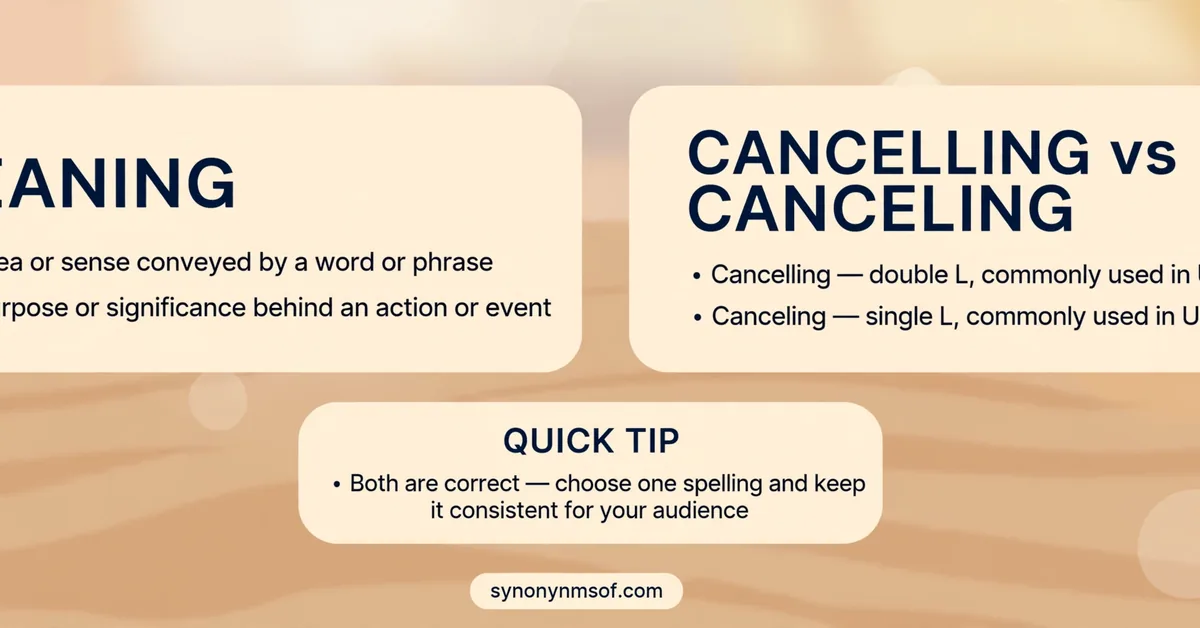
Here is the short answer that settles most of the confusion: both spellings are correct. They are the same word, carrying the same meaning, and the only real difference is geography. “Canceling” with one L is the preferred spelling in American English, while “cancelling” with two Ls is the preferred spelling in British English and in most other English-speaking countries. The trick is not choosing the “right” one in some absolute sense but choosing the right one for your audience and sticking with it.
In this guide, we will walk through what each spelling means, the grammar rule that created the split, what the major dictionaries and style guides say, and how to use each form across everyday conversation, business, and formal writing. By the end, you will never hesitate over that second L again.

What Does “Cancelling” Mean?
“Cancelling” is the present participle of the verb “cancel,” spelled with a doubled consonant. As a participle, it describes something happening right now or in progress — an action that is currently taking place rather than one that is already finished. When you say you are “cancelling” something, you are in the middle of calling it off.
More specifically, “cancelling” means deciding or announcing that a planned event, arrangement, or commitment will no longer take place. The meaning is active and ongoing: the plans are being stopped, the reservation is being withdrawn, the subscription is being ended. It carries the same meaning as its one-L sibling; the extra letter changes nothing about the definition.
How “Cancelling” Is Built
The double L comes from a long-standing English spelling habit called consonant doubling. When a word ends in a consonant after a short vowel and you add a suffix that starts with a vowel — like -ing or -ed — the final consonant is doubled to protect the vowel sound. Think of “run” becoming “running” or “stop” becoming “stopping”: without the doubled letter, readers might pronounce them as “runing” or “stoping,” which would stretch the vowel into a long sound.
“Cancelling” follows this pattern the traditional way. The base word “cancel” ends in L after a short vowel sound, so adding -ing doubles the L. This is the form that dominated English spelling for centuries, and it remains the standard in the United Kingdom, Ireland, Australia, New Zealand, Canada, and most of the rest of the world.
Examples of “Cancelling” in Sentences
- She is cancelling the meeting because the client could not make it.
- They are cancelling all outdoor events ahead of the storm.
- The airline is cancelling dozens of flights this weekend.
- He spent the afternoon cancelling subscriptions he no longer uses.
What Does “Canceling” Mean?
“Canceling” is the exact same word — the present participle of “cancel” — spelled the American way, with a single L. It means precisely the same thing: an action in progress that puts an end to something previously planned. If you are American or writing for an American audience, this is the standard spelling, and using it is not lazy or incorrect.
The one-L form is fully recognized by American dictionaries and style guides. Merriam-Webster lists “canceled” and “canceling” as the standard American forms, and major American publications — from The New York Times to The Chicago Manual of Style followers — use the single L. So if you live in Chicago, New York, or Los Angeles, “canceling” is simply how the word is spelled.
Why Americans Use One L
The single L traces back to the American spelling reforms of the early 19th century, associated with Noah Webster, the lexicographer behind the first American dictionaries. Webster believed English spelling should be simpler and more logical, so he trimmed letters that did not affect pronunciation: “colour” became “color,” “behaviour” became “behavior,” “travelling” became “traveling,” and “cancelling” became “canceling.”
The American rule for consonant doubling also works differently. In American English, a final consonant is generally only doubled when the stress falls on the last syllable of the base word — as in “remit,” which becomes “remitting” because the stress is on “mit.” In “cancel,” the stress falls on the first syllable (CAN-cel), not the last, so American spelling keeps a single L. British English, by contrast, doubles the L regardless of where the stress lands.
Examples of “Canceling” in Sentences
- She is canceling the meeting because the client could not make it.
- They are canceling all outdoor events ahead of the storm.
- The airline is canceling dozens of flights this weekend.
- He spent the afternoon canceling subscriptions he no longer uses.
The Difference Between “Cancelling” and “Canceling”
Now that we know both forms mean the same thing, let us pin down exactly what separates them — and, just as importantly, what does not.
There Is No Difference in Meaning
This is the point that matters most: “cancelling” and “canceling” are identical in meaning, grammar, and usage. Both are the present participle of “cancel.” Both can function as part of a progressive verb phrase (“we are cancelling the trip”) or as a gerund naming the activity itself (“cancelling the trip was the hardest part”). Neither is more formal, more casual, or more “proper” than the other. The choice is purely regional.
The Real Difference: Geography and Audience
The split is a regional spelling convention, part of the broader divide between American and British English. “Canceling” with one L is standard in the United States. “Cancelling” with two Ls is standard in the United Kingdom, Ireland, Australia, New Zealand, South Africa, and Canada — although Canadian usage can be mixed, since Canadians consume a great deal of American media while traditionally following British spelling conventions.
On the other hand, if you are writing for an international audience where you cannot be sure which variety readers expect, the double-L form is often the safer choice. More English speakers worldwide use British spelling conventions, and “cancelling” will not look wrong to American readers the way “canceling” might look off to British ones — at least, not as sharply.
The Grammar Rule Behind the Split
Understanding the rule helps you handle dozens of similar words, not just this one. Both varieties of English double a final consonant when a short vowel comes right before it and the suffix adds stress to that syllable — hence “remitting” in both. The difference appears only when the stress is on an earlier syllable, as in “cancel” (CAN-cel), “travel” (TRAV-el), “model” (MOD-el), or “level” (LEV-el).
British English doubles the consonant in these cases anyway: travelling, modelling, levelling, cancelling. American English does not: traveling, modeling, leveling, canceling. Once you see the pattern, you can spell the whole family of words correctly in whichever variety you are using, without memorizing each one individually.
What the Dictionaries Say
The major dictionaries agree on the regional split. Merriam-Webster, the authority on American English, lists “canceled” and “canceling” as the primary forms. The Oxford English Dictionary and Collins, representing British English, list “cancelled” and “cancelling.” Neither dictionary calls the other region’s form wrong — they simply label it by region.
One interesting exception unites both dictionaries: the noun “cancellation” is spelled with two Ls everywhere, including in American English. Americans write “canceling” but “cancellation,” a quirk that has no tidy explanation and simply has to be memorized. The same double L appears in “cancellable” and “canceller,” where both single-L and double-L variants exist but the double-L forms are far more common globally.
Quick Comparison Table
| Feature | Canceling | Cancelling |
|---|---|---|
| Spelling | Single L | Double L |
| Preferred in | United States | UK, Ireland, Australia, NZ, Canada |
| Part of speech | Present participle / gerund of “cancel” | Present participle / gerund of “cancel” |
| Meaning | Calling off or stopping something planned | Calling off or stopping something planned |
| Base rule | No doubling when stress is on first syllable | Traditional consonant doubling |
| Related past tense | Canceled | Cancelled |
| Noun form | Cancellation (double L in both) | Cancellation (double L in both) |
| Acceptable outside its region? | Yes, understood everywhere | Yes, understood everywhere |
Usage Examples Across Different Contexts
The spelling does not change with context — only with region. Still, it helps to see how the word behaves in real-life situations, because “cancel” shows up everywhere from casual chats to legal documents.
Everyday Conversation
In casual speech and texting, “cancel” usually refers to plans with friends and family. American speakers naturally write it one way; British speakers the other. The examples below use the American spelling, but every one is equally correct with the double L for a British audience.
- “Are you canceling on me again?” she laughed. “You always do this before movie night.”
- I am canceling my gym membership — I never go, and it is costing me a fortune.
- Sorry, we are canceling Friday’s dinner. The baby has a fever.
- He keeps canceling plans at the last minute, and it is getting annoying.
Notice how naturally the word slides into questions, apologies, and complaints. In everyday contexts, nobody pauses to consider the spelling — and that is fine, because both are right.
Work and Business
In professional settings, clarity and consistency matter more than ever. Emails about cancelled flights, postponed meetings, and terminated contracts carry real consequences, so pick the spelling your company or client expects and use it in every message. American companies will expect “canceling”; British, European, and most international firms will expect “cancelling.”
- The team is canceling the product launch until Q3, if time permits for a relaunch strategy review.
- We are canceling our vendor agreement effective at the end of the month.
- Please note we are canceling Thursday’s all-hands meeting due to the holiday.
- The client is canceling the project after the latest round of budget cuts.
A practical tip for business writing: check your company’s style guide before you send anything external. Many multinational companies standardize on one variety of English for all communications, and matching it keeps your emails, contracts, and reports consistent.
Formal and Academic Writing
Academic papers, dissertations, and formal reports follow the conventions of their publication or institution. American journals (following APA or Chicago style) expect “canceling,” while British journals (following Oxford style) expect “cancelling.” Because formal writing is read closely, an inconsistent spelling is far more noticeable here than in a text message — so this is exactly where consistency pays off.
- The study examines the effects of canceling elective procedures on hospital capacity.
- Several participants reported canceling their travel plans during the study period.
- The policy resulted in canceling more than two hundred scheduled interviews.
- Researchers attributed the drop in attendance to the repeated canceling of public events.
In formal writing, also watch out for the noun form: “cancellation” keeps its double L even in American English, so “the canceling of the event led to many cancellations” is a perfectly correct American sentence, however odd it looks.
Common Mistakes to Avoid
Even though both spellings are correct, writers still stumble over this word in predictable ways. Here are the traps to watch for.
Mixing both spellings in one document. This is the most common mistake and the only one that is genuinely wrong in context. Writing “canceling” in the introduction and “cancelling” in the conclusion of the same report looks careless, even though each spelling is fine on its own. Choose one and run a quick find-and-replace before you publish or submit.
Assuming one form is a typo. If you edit someone else’s work, do not “correct” their spelling to match your region. An American editor marking up a British author’s “cancelling,” or vice versa, creates unnecessary conflict. Respect the variety of English the document is written in.
Carrying the single L into “cancellation.” Writers who use “canceling” sometimes write “cancelation” with one L by analogy. While “cancelation” does appear occasionally in American usage, “cancellation” with two Ls remains the overwhelmingly preferred spelling on both sides of the Atlantic. When in doubt, use the double L for the noun.
Letting autocorrect decide for you. Word processors and phones default to one regional dictionary, and they will happily “fix” the other variety’s correct spelling into an error. If you write for a British audience on an American-configured device, add “cancelling” to your custom dictionary — and check your language settings in shared tools like Google Docs, where collaborators may have different defaults.
Inconsistent usage across a brand. Companies with blogs, help centers, and marketing emails should pick one variety of English and document it. Readers notice when the website says “canceling” but the confirmation email says “cancelling,” and it quietly undermines trust in the details.
Tricky Cases and Edge Cases
Some situations make even confident writers pause. Here is how to handle them.
“Cancellation” always takes two Ls. This is the quirk that breaks the pattern: Americans write “canceling” and “canceled,” but they still write “cancellation.” There is no reliable logic behind it — historical usage simply settled on the double L for the noun in both varieties. Memorize it as an exception and move on.
“Cancelable” versus “cancellable.” Both spellings of this adjective exist, meaning “able to be canceled.” “Cancellable” with two Ls is far more common worldwide, while “cancelable” appears mainly in American legal and technical writing. Unlike “canceling,” this one genuinely has a preferred global form: use “cancellable” unless your style guide says otherwise.
“Cancelling out” as a phrasal use. In phrases like “the two effects cancelled each other out,” the word takes its normal regional spelling — “canceled each other out” in American English. The meaning shifts slightly here toward neutralizing or offsetting rather than calling off an event, but the spelling rule does not change.
“Cancel culture” and modern coinages. The noun phrase “cancel culture” does not inflect, so it sidesteps the problem entirely. But related verb forms follow the rule: an American publication writes about “canceling a celebrity,” while a British one writes about “cancelling a celebrity.” The modern slang sense of “cancel” (withdrawing support from a public figure) uses the same spellings as the traditional sense.
Quoting sources from another region. When you quote an American article in a British publication — or the reverse — keep the original spelling inside the quotation marks. Changing a quoted author’s spelling is a misquotation, however well intentioned. You can add “[sic]” if you must, but most style guides prefer leaving the quote untouched.
The “canceller” agent noun. The person or thing that cancels is spelled “canceller” with two Ls in British English and “canceler” with one L in American English — the same regional split, applied to the -er suffix. Like “cancelable,” the double-L form dominates globally.
This shows why spell checkers are not arbiters of correctness. A spell checker enforces one regional dictionary, not the English language as a whole. When it flags a spelling that is correct in another major variety, the tool is not informing you — it is just showing its default settings.
Frequently Asked Questions
Is it cancelling or canceling?
Both are correct. “Canceling” with one L is the standard spelling in American English, while “cancelling” with two Ls is the standard spelling in British English and most other English-speaking countries. They mean exactly the same thing. Choose the spelling that matches your audience’s variety of English and use it consistently.
Why does “cancel” have two different spellings?
The split comes from 19th-century American spelling reforms that simplified many words by removing letters that do not affect pronunciation. In American English, a final consonant is generally doubled only when the stress falls on the last syllable of the base word (as in “remit” becoming “remitting”). Since “cancel” is stressed on the first syllable, American spelling keeps one L, while British English retains the traditional doubled L.
Is “cancellation” spelled with one L or two?
“Cancellation” is spelled with two Ls in both American and British English. This is a well-known exception: Americans write “canceling” and “canceled” with one L but still write “cancellation” with two. “Cancelation” with one L appears occasionally in American usage, but “cancellation” is the strongly preferred spelling everywhere.
Which spelling should I use in formal writing?
Use the spelling that matches the style guide or institution you are writing for. American academic and professional style guides (APA, Chicago) expect “canceling,” while British ones (Oxford style) expect “cancelling.” What matters most in formal writing is consistency: pick one form and use it throughout the entire document.
Can I use both spellings in the same document?
You should not. While each spelling is correct in its own region, mixing them in a single document looks sloppy and inconsistent. Decide which variety of English your document follows, then use find-and-replace to make every instance of the word match before you submit or publish.
Conclusion
The “cancelling or canceling” debate has one of the simplest resolutions in all of English usage: both spellings are correct, they mean the same thing, and the only thing that separates them is where your readers live. American English simplifies to one L; British English and most of the rest of the world keep two. Once you know your audience, the choice makes itself — and the grammar rule behind it even helps you spell similar words like “traveling,” “modeling,” and “leveling” correctly in either variety.
The real lesson is about consistency rather than correctness. A document that uses “canceling” throughout is perfectly correct American English, and one that uses “cancelling” throughout is perfectly correct British English — but a document that mixes the two looks careless in any variety. Pick your spelling, check your language settings, and keep the noun “cancellation” double-L in all cases. Do that, and the extra L will never trip you up again.