
If you have ever typed “jist” in an email and wondered whether it was right, you are far from alone. This is one of those small English spelling traps that catches native speakers, students, and professionals alike. The confusion feels completely reasonable, because the correct word is pronounced exactly like the wrong spelling.
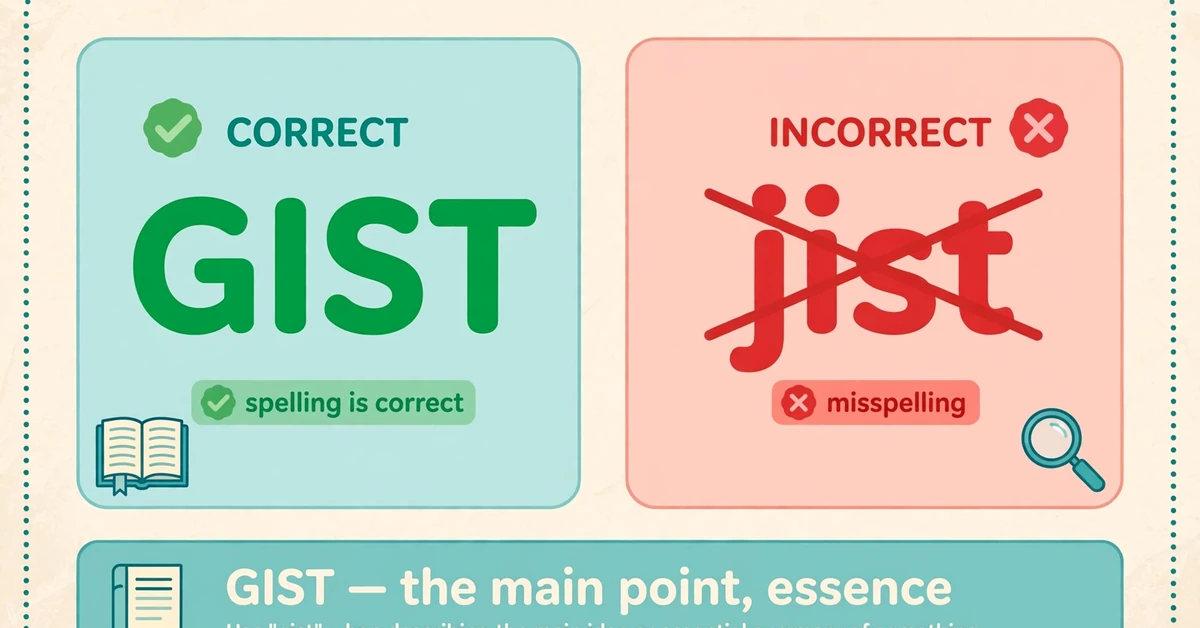
The short answer is simple: the correct spelling is gist, spelled with a G. It means the main point, the essence, or the central idea of something. The spelling jist, with a J, is not a recognized English word in standard usage, and using it in writing marks the text as a mistake. There is a small, interesting exception to that rule, but for everyday writing, “gist” is always the right choice.
Why does this mix-up happen so often, and how can you make sure you never get it wrong again? In this guide, we will unpack the meaning of “gist,” trace where the word came from, explain the pronunciation trick that causes the confusion, show you plenty of real examples, and give you simple memory aids that make the correct spelling stick.
What Does “Gist” Mean?
The Core Definition
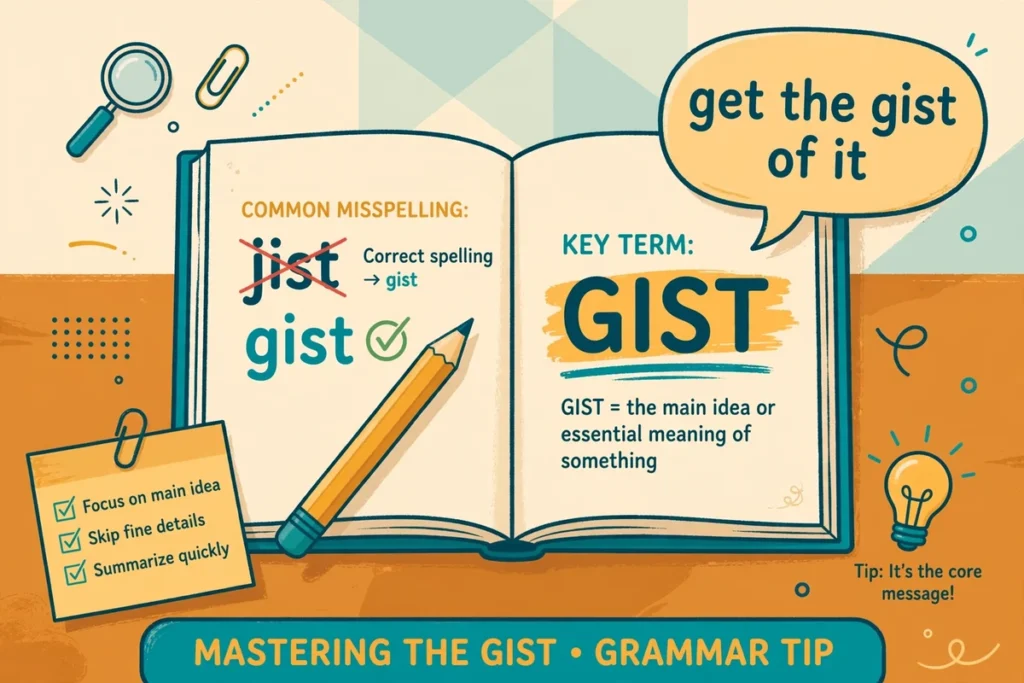
“Gist” is a noun, and it means the substance, essence, or most important idea of something. When someone asks you for the gist of a conversation, they want the main point — not every detail, just the heart of the matter. It is a word about summarizing: the gist is what remains when you strip everything else away.
In standard English, “gist” is almost always preceded by the definite article “the.” We say “the gist of the story,” “the gist of his argument,” or “the gist of the meeting.” You will rarely, if ever, see it used with “a” or “an” — “a gist of the plan” sounds wrong to a native ear, because the word refers to one specific central idea.
A few typical sentences show how natural the word feels in everyday language:
- “I missed the first half of the meeting, so could you give me the gist of what was decided?”
- “The gist of her complaint was that the instructions were never clear.”
- “I don’t need the full report — just give me the gist.”
Notice that in each case, “gist” points to the condensed version of something bigger. That summarizing function is exactly what the word is built for.
Where the Word Comes From
The history of “gist” is surprisingly interesting for such a short word. It entered English from Old French, where “gist” (also spelled “giste”) came from the verb meaning “to lie” or “to be situated.” That Old French verb, in turn, descended from the Latin “jacere,” which also meant “to lie” — and is the root of words like “adjacent” (lying next to) and “subjacent.”
In medieval Anglo-French legal language, there was a phrase, “cest action gist,” meaning “this action lies” — in other words, this lawsuit has grounds, it has a basis on which to proceed. From that legal sense of “the grounds on which something rests,” the word drifted over time toward a broader meaning: the foundation, then the essential point, and finally the main idea or substance of anything said or written.
So when you say “the gist of the argument,” you are using a word that once belonged in courtrooms. The path from a legal term about where a case “lies” to a everyday word for “the main point” took several centuries, but the connection is still there: the gist is what the matter rests on.
How “Gist” Is Pronounced
Here is the heart of the whole confusion: “gist” is pronounced “jist” — /dʒɪst/. It rhymes with “list,” “mist,” and “fist.” The initial sound is the soft “j” sound, the same one you hear at the start of “giant,” “gem,” and “gym.”
English has two ways of pronouncing the letter G. Sometimes it is hard, as in “gift,” “glory,” or “goat.” Other times it is soft, as in “gin,” “giraffe,” or “gist.” There is a rough pattern — G before E or I often goes soft — but English being English, the pattern has plenty of exceptions, which is why nobody can rely on the rule alone.
This pronunciation is precisely why “jist” feels so natural to write. Your ear tells you the word starts with a “j” sound, so your hand reaches for the J key. The spelling, however, follows the word’s history rather than its sound. Understanding this disconnect is the single most useful step toward spelling it correctly.
The Truth About “Jist”
Is “Jist” a Real Word?
In standard English, no. “Jist” is not listed in major dictionaries as a word in its own right. When it appears in writing, it is understood as a misspelling of “gist.” It carries no independent meaning, and every major style guide and grammar authority treats it as an error.
That is worth repeating clearly, because the misspelling is so common that some writers begin to doubt themselves: seeing “jist” written repeatedly — in text messages, social media posts, informal emails — can make it look like an accepted variant. It is not. Frequency of misuse does not make a spelling correct, and in any formal, academic, or professional context, “jist” will be read as a mistake.
If you write “jist,” readers will still understand what you meant, because the context usually makes the intended word obvious. But understanding is not the same as acceptance. The correct, dictionary-recognized spelling is always “gist,” and that is the form you should use.
The One Exception: Dialect Dialogue
There is one narrow context where “jist” legitimately appears in print: as a phonetic spelling of the word “just” in written dialogue. In representations of certain regional accents — most famously some varieties of American Southern speech — “just” can be pronounced “jist,” and fiction writers sometimes spell it that way to capture the sound of a character’s voice.
For example, a novelist might write: “I jist saw a coyote run across the road!” Here, “jist” is not a misspelling of “gist” at all; it is a deliberate rendering of “just” as spoken with a particular accent. In that role it functions exactly as “just” does, as an adverb or adjective.
This use is acceptable only in creative writing, where capturing authentic speech matters. It has nothing to do with the “main point” meaning, and it should never appear in essays, reports, emails, or any nonfiction prose. The rule is simple: outside of dialect dialogue, “jist” does not exist as a word.
Why the Confusion Is So Common
The Soft G Problem
The English letter G is a notorious shapeshifter. Children learn the hard “guh” sound first, and many adults never fully internalize the soft-G rule, especially since the rule is riddled with exceptions (think “give” and “get,” which keep the hard G before E). When a word sounds like it begins with J, writing J feels like the honest, logical choice.
“Gist” belongs to a small club of words where the G is soft and the spelling therefore surprises people: “gin,” “gist,” “gibe” (to mock), “giraffe.” Because these words are relatively uncommon, readers do not encounter them in print often enough to cement the spelling. Each time someone writes “gist” from memory without having seen it spelled out, the ear wins and “jist” appears.
We Hear It More Than We Read It
Another reason the error persists is that “gist” lives more in speech than in writing. People say “get the gist” constantly in conversation, but they write it far less often. Spelling is a visual skill — we spell words correctly largely because we have seen them spelled correctly many times. A word that is common in talk but rare in text never gets that visual reinforcement.
This is the same mechanism behind other stubborn misspellings: “supposably” for “supposedly,” “expresso” for “espresso,” “irregardless” (which many still insist is not a word at all). In each case, the wrong version sounds plausible, and the speaker rarely sees the right version in print to correct the mental image.
Spell-Check Does Not Always Save You
You might expect modern spell-checkers to catch “jist” every time, but they do not always do so. Some tools flag it; others, especially on phones, quietly accept it as slang or as a name. Autocorrect can even work against you: if you have ever typed “jist” and tapped “accept” on the suggestion, your device may now treat it as a word you use, and it will stop correcting it.
Speech-to-text tools add another wrinkle. Dictate “get the gist” and some transcription engines will render it as “get the jist,” because the engine matches sounds to the most statistically common letter pattern. The result is a written error born from a spoken sentence — one more way the wrong spelling spreads.
Gist vs Jist: The Difference at a Glance
Sometimes the clearest explanation is the simplest one. Here is everything that matters, side by side:
| Feature | Gist | Jist |
|---|---|---|
| Correct spelling | Yes — always | No — misspelling |
| Meaning | The main point; the essence | None (intended meaning is “gist”) |
| Part of speech | Noun | Not a standard word |
| Pronunciation | “jist” (/dʒɪst/) | — |
| Recognized by dictionaries | Yes | No |
| Use in formal writing | Correct and expected | A spelling error |
| Origin | Old French “gist,” from Latin “jacere” | No etymology — a phonetic mistake |
The takeaway fits in one sentence: if you mean “the main point,” write gist. There is no context in standard English where “jist” is the right choice for that meaning.
A useful memory trick used by many teachers: gist starts with G, just like good. It is good to spell it with a G. By contrast, “jist” is just wrong — which conveniently reminds you that the J spelling belongs, if anywhere, only to the dialect pronunciation of “just.”
How to Use “Gist” Correctly
“Gist” is a flexible word that fits naturally in almost any register, from casual chats to boardrooms to academic papers. The key is knowing the phrases it travels with and the tone each setting calls for.
Everyday Conversation
In casual speech, “gist” usually appears in requests for a quick summary. Nobody wants the full story when they ask for the gist — that is the whole point of the word.
- “I missed the episode — what’s the gist?”
- “He talked for twenty minutes, but the gist was simple: we’re leaving early.”
- “I didn’t read the whole article, but I got the gist of it.”
- “Could you give me the gist of the argument — if time permits, I’d love the details later.”
The idiom “get the gist” deserves special attention. It means to understand the essential idea of something without necessarily knowing every detail: “My Spanish is rusty, but I got the gist of what she was saying.” It is informal, warm, and conversational — perfect for everyday talk, but best avoided in formal documents where precision matters.
Work and Business
In professional settings, “gist” is a workhorse word for meetings, emails, and reports. It signals efficiency: you are asking for or offering the substance without the padding.
- “The gist of the client’s feedback is that they want a simpler design.”
- “Let me summarize the gist of today’s discussion for the minutes.”
- “I was wondering if you could send me the gist of the proposal before Thursday’s call.”
- “We reviewed a large amount of data, but the gist is that viewership is up.”
A word of caution for business writing: make sure “gist” is actually spelled with a G before you hit send. A misspelled “jist” in a client email or a board report undermines the professional tone you are trying to project, and unlike a casual text, a business email is exactly the kind of document people judge.
Formal and Academic Writing
“Gist” is perfectly acceptable in academic and formal writing, though it tends to appear in slightly less formal passages — literature reviews, discussion sections, and summaries rather than in definitions or theorem statements.
- “The gist of the author’s argument is that urbanization accelerated the shift.”
- “This paragraph captures the gist of the theory without its mathematical detail.”
- “The gist of the findings suggests a correlation worth investigating further.”
In formal writing, prefer full constructions like “the gist of the argument” over the casual idiom “get the gist.” And never let “jist” slip into an essay or paper — in academic contexts, a spelling error like this one can genuinely affect how your work is evaluated.
Common Collocations Worth Knowing
Certain phrases pair with “gist” so often that they are worth learning as units:
- Get the gist — to understand the main idea (“I think I get the gist.”)
- The gist of the matter — the central point of an issue (“Let’s focus on the gist of the matter.”)
- Grasp the gist — to successfully comprehend the essence (“It took a while, but I finally grasped the gist.”)
- Catch the gist — to quickly pick up the main idea (“Even without hearing every word, I caught the gist.”)
- Miss the gist — to fail to understand the point (“He talked so fast that I missed the gist entirely.”)
Common Mistakes to Avoid
Beyond the headline error of writing “jist,” a few related mistakes are worth flagging.
Using “jist” because it “looks right.” Trust the dictionary, not your instincts, on this one. Your ear is telling the truth about the sound and lying about the spelling.
Writing “gyst.” A rarer variant, “gyst,” also appears as a misspelling. It has no more legitimacy than “jist.” The correct form has an I, not a Y.
Using “gist” as a verb. In standard English, “gist” is a noun only. You cannot “gist” a document or “gist” your thoughts in the way you might “summarize” them. (There is an obscure historical verb “gist” related to grazing rights for cattle, recorded in some regional dictionaries, but it has nothing to do with the modern word and you will never need it.)
Pairing “gist” with “a.” As noted earlier, the word strongly prefers “the.” “Give me a gist of the meeting” sounds off; “give me the gist of the meeting” is natural. This is a small point, but it is one of those details that separates fluent writing from slightly awkward writing.
Overusing “get the gist” in formal writing. The idiom is informal by nature. In a research paper or a legal brief, “the central argument is” or “the essence of the claim is” will serve you better than “you get the gist.”
Tricky Cases and Edge Cases
Is There an Adjective Form Like “Gistful”?
Writers sometimes wonder whether there is an adjective built on “gist” — something like “gistful” to mean “full of main points,” parallel to “insightful.” There is not. No standard adjective derives from “gist,” and coining “gistful” will only confuse readers. If you need an adjective, use “essential,” “central,” “key,” or “fundamental” instead: “the essential point,” “the key argument.”
The Legal Meaning
Remember the word’s courtroom origins: in legal contexts, “gist” can still mean “the grounds of a legal action” — the essential basis on which a claim rests. Merriam-Webster and other major dictionaries list this as a separate sense. You will encounter it in phrases like “the gist of the action” in older case law. For everyday purposes you can ignore this sense, but it is a nice reminder of how far the word has traveled.
Autocorrect and Speech-to-Text Traps
As mentioned earlier, technology can quietly introduce the wrong spelling. A few practical defenses: add “gist” to your phone’s text-replacement shortcuts if you use the word often; proofread dictated text before sending; and if your spell-checker underlines “jist” in red, do not dismiss it — the checker is right.
“Get the Jist” — The Idiom Spelled Wrong
The single most common place the error appears is inside the idiom “get the gist.” Because the phrase is overwhelmingly spoken rather than written, many people have simply never seen it spelled out, and “get the jist” has become one of the most frequently misspelled phrases in informal English. Now that you know better, the correct form — “get the gist” — should feel automatic.
Similar Sound-Spelling Traps
“Gist” is not the only word where a soft G misleads the ear. Watch out for the same trap in “gin” (the spirit, not the name “Jin”), “gibe” (to taunt — often misspelled “jibe,” though that variant has gained some acceptance), and “giraffe.” Noticing the pattern across words makes each individual spelling easier to remember, because you start to expect the soft G rather than being surprised by it.
Frequently Asked Questions
Is it “jist” or “gist”?
The correct spelling is gist, with a G. “Jist,” with a J, is a misspelling and is not recognized as a standard English word. The confusion is understandable because “gist” is pronounced “jist,” but the spelling always uses G.
What does “gist” mean?
“Gist” is a noun meaning the main point, essence, or central idea of something — what remains when all the details are stripped away. For example, “the gist of the story” is the core of what the story is about. In legal contexts, it can also mean the grounds of a legal action.
How do you pronounce “gist”?
“Gist” is pronounced “jist” (/dʒɪst/), rhyming with “list” and “mist.” The G is soft, like the J sound at the start of “giant” or “gem.” This pronunciation is exactly why so many people misspell the word with a J.
Is “jist” ever correct?
Only in one narrow case: as a deliberate phonetic spelling of “just” in written dialogue representing certain regional accents, as in “I jist got here.” In that use it means “just,” not “main point,” and it belongs in creative writing only — never in formal, academic, or business prose.
How can I remember to spell it “gist” and not “jist”?
Use the G-for-good trick: gist starts with g, just like good — it is good to spell it with a G. Alternatively, remember that “jist” is “just wrong.” Seeing the word in print a few times will also cement the spelling, since spelling is largely a visual memory skill.
Conclusion
The “jist or gist” question has one of the simplest answers in all of English spelling: it is always gist. The J spelling is a phonetic illusion — your ears hear a “j” sound, but the word’s history, from Old French legal language through Latin “jacere,” fixed its spelling with a G centuries ago. Once you know that the pronunciation is the trap, the spelling stops being a mystery and becomes a habit.
Getting small distinctions right is what separates polished writing from careless writing, and “gist” is a perfect example. It is the kind of word mix-up that sits alongside other sound-alike confusions, such as then and than — tiny on the page, but noticeable to every careful reader. Spell it with a G, use it with confidence, and you will never have to wonder about “jist” again.