
The word then serves as a versatile anchor in the English language, primarily functioning as an adverb to denote a specific point in time. Whether you are narrating a sequence of events or establishing a logical consequence, understanding how to use it correctly prevents common grammatical slips.
Mastering this term allows you to clarify your writing and ensure your ideas flow logically from one point to the next. By examining its various roles, you will gain the confidence to integrate it into your daily communication, ensuring your sentences remain precise and easy to follow.
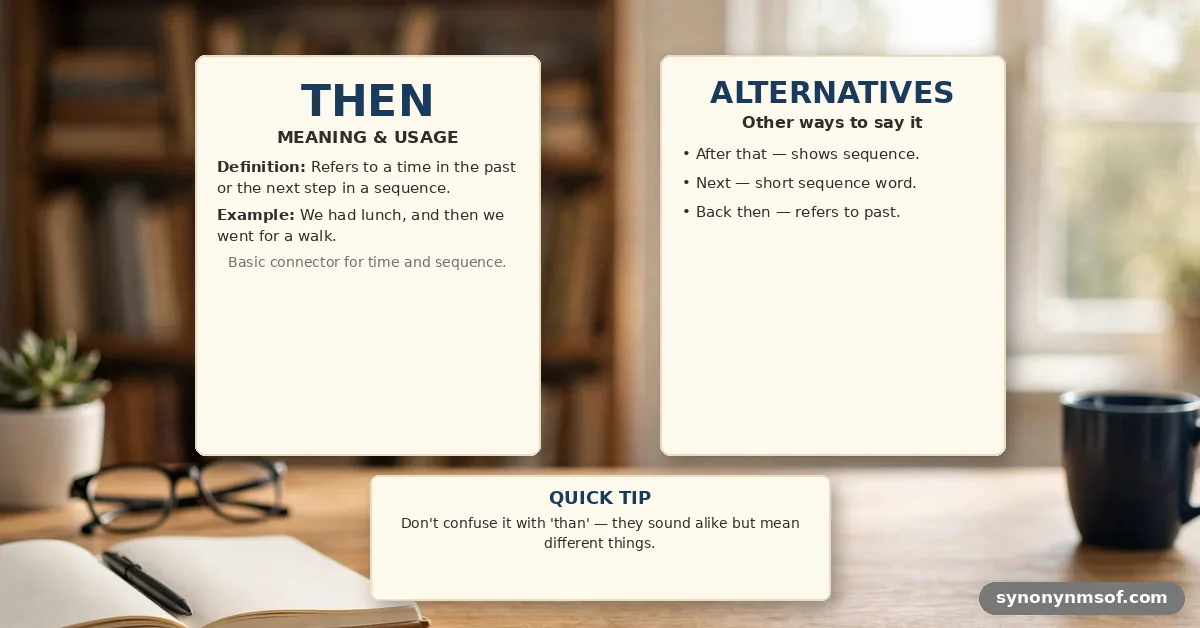
At its core, the word functions as a temporal marker. It signals to the reader that an action or state occurred at a specific moment in the past or will occur at a specific moment in the future.
The Temporal Adverb

When used to indicate time, it acts as a bridge between moments. It tells the reader when something happened relative to another event. For example, if you say, “I finished my work and then I went home,” you are establishing a clear chronological order.
The word also serves as a logical connector. In this capacity, it suggests a result or consequence, often following an “if” clause. If you say, “If you finish your chores, then you can watch television,” the word functions as an indicator of a conditional outcome.
Common Grammatical Functions
Understanding the grammatical architecture of the word helps you place it correctly within a clause. It is frequently employed to link two independent thoughts or to modify a verb phrase.
- Temporal sequence: Indicating what happened next in a timeline.
- Logical consequence: Showing what follows from a stated condition.
- Adjectival use: Describing a person or thing in a specific past role.
- Reference to the past or future: Pointing to a specific non-present moment.
When used as an adjective, it takes on a slightly different shape. You might hear someone refer to a “then-president” or a “then-colleague.” In this context, it describes the subject’s status at a past time, rather than their current position.
Then vs. Than: Avoiding the Confusion
One of the most frequent errors in English writing involves swapping the word with its near-homophone, than. While they sound similar, their functions are entirely distinct.
| Term | Primary Function | Example |
|---|---|---|
| Then | Time or consequence | We ate dinner, then we left. |
| Than | Comparison | She is taller than him. |
Using the word correctly requires remembering that it relates to time, not comparison. If you are comparing two objects or qualities, you must use than. If you are describing the next step in a process, reach for then.
Using Then in Narrative Writing
Writers often rely on the word to maintain the momentum of a story. It provides a simple way to guide the reader through a series of actions without needing complex transitions.
Creating Sequential Flow
In narrative prose, the word keeps the timeline moving. It prevents the reader from feeling lost when a character performs multiple actions in quick succession.
Consider a sentence like, “The detective opened the door, looked inside, and then stepped cautiously into the room.” Without the word, the sequence feels flat and disconnected. It provides a necessary rhythmic pause that emphasizes the progression of the scene.
Logical Implications and Conditional Clauses
Beyond time, the word plays a vital role in formal logic and everyday reasoning. It connects premises to their conclusions.
When you structure a sentence as a conditional statement, you are creating a “then” relationship. This is common in both casual conversation and technical documentation. It ensures that the reader understands the specific dependency between two ideas.
The Adjectival Shift
Using the word as an adjective provides a concise way to explain history. It replaces longer, more cumbersome phrases that would otherwise be necessary to convey the same information.
Instead of saying, “the person who was the manager at the time,” you can simply say “the then-manager.” This stylistic choice is common in journalism and historical accounts. It keeps the prose tight and avoids unnecessary wordiness.
Avoiding Overuse in Professional Writing
While the word is helpful, relying on it too heavily can make your writing feel repetitive. If every sentence begins with “then,” your prose will lose its variety and natural cadence.
Strategies for Variety
To keep your writing fresh, look for other ways to indicate time or sequence. You might use words like “subsequently,” “afterward,” or “next” to achieve a similar effect.
Mixing these transitions improves the flow of your work. It shows that you have a command of the language beyond the most common temporal markers.
FAQ
What is the primary difference between then and than?
The word then is used to discuss time or logical consequences, while than is strictly used for making comparisons between two things.
Can then be used as an adjective?
Yes, it functions as an adjective when describing someone or something in a past capacity, such as a “then-governor” or “then-employee.”
Is it grammatically correct to start a sentence with then?
It is acceptable, though you should use it sparingly. It often serves as a transition to move the narrative forward or to introduce a logical conclusion.
Does then always imply a sequence of events?
Usually, yes, but it can also refer to a non-sequential point in time, such as in the phrase “back then,” which refers to a general period in the past.
Refining Your Usage
Mastering the use of the word helps you communicate with greater clarity and precision. Whether you are writing a complex report or a casual email, knowing how to place it correctly ensures your message lands exactly as intended. By distinguishing it from comparative terms and using it to structure both time and logic, you improve the overall quality of your English sentences.
As you continue to write, pay attention to how you sequence your thoughts. You will likely find that a well-placed word creates the perfect bridge between your ideas. Feel free to experiment with different transitions to keep your prose engaging and dynamic as you refine your personal writing style.