
Of all the word pairs that torment English writers, few cause as much quiet panic as this one. You are halfway through an email when you freeze: is it “this will affect our timeline” or “this will effect our timeline”? The two words look almost identical, sound almost identical, and both seem to hover around the idea of change. Guessing feels risky, and looking it up for the hundredth time feels embarrassing. Other spelling pairs, like engrained or ingrained, are just as tricky.
The confusion is no accident. Affect and effect share a Latin ancestor, overlap in meaning, and — to make matters worse — each one can occasionally play the other’s grammatical role. Even professional editors pause over sentences like “the new policy will effect change,” wondering whether that verb is a mistake or a masterstroke. (It is correct, as you will see.)
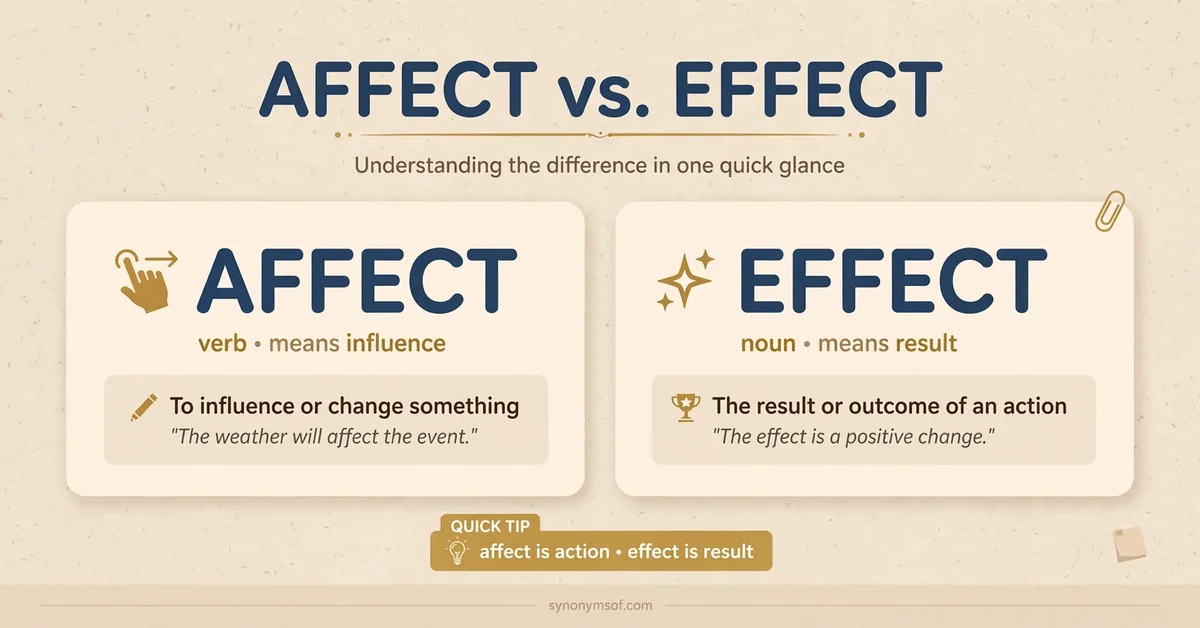
The core rule, though, is beautifully simple: affect is usually the verb (to influence something), and effect is usually the noun (the result of that influence). Something affects you; it has an effect on you. This guide builds everything from that foundation: what each word means in all its senses, how to handle the plural and third-person forms (affects vs effects), the rare exceptions, foolproof memory tricks, and real examples across everyday, business, and academic writing.

What Does “Affect” Mean?
Affect is most commonly a verb meaning “to act on, influence, or change someone or something.” When one thing affects another, it produces a difference in it — large or small, welcome or not.
- “The drought affected crop yields across the region.”
- “Lack of sleep affects your concentration.”
- “The new tax law will affect small businesses.”
- “Her words deeply affected him.”
Notice the pattern: affect is the action. The drought does something; sleep does something; the tax law does something. If you can substitute “influence” or “change” and the sentence still works, “affect” is your word.
Affect as a Verb: The Everyday Workhorse
In roughly 95 percent of real-world uses, affect is a straightforward action verb, conjugated like any other: affect, affects, affected, affecting.
- “Cold weather affects my joints.” (present)
- “The delay affected our plans.” (past)
- “Rising prices are affecting everyone.” (continuous)
It pairs naturally with adverbs describing the kind of influence: “positively affected,” “negatively affected,” “directly affected,” “seriously affected.” And it appears constantly in fixed professional phrases: “affected parties,” “affected regions,” “adversely affected.”
Affect’s Second Verb Sense: “To Put On”
Affect has a rarer, fancier verb meaning: “to put on a false appearance of something” — to pretend or assume. “He affected a British accent” means he faked one. “She affected indifference” means she pretended not to care.
This sense is uncommon in everyday writing but appears in literature and journalism. The giveaway is the object: you affect an accent, an attitude, a manner — something performed rather than something changed. Do not confuse it with “effected,” which means something entirely different (see below).
Affect as a Noun: The Psychology Exception
In one specialized field, affect is a noun. In psychology and psychiatry, a person’s affect (pronounced with the stress on the first syllable, AFF-ekt) means their observable emotional expression — the face, voice, and gestures that accompany feeling. “The patient displayed a flat affect” means their emotional expression was dulled.
Unless you are writing about psychology, you will never need this noun. But knowing it exists explains why dictionaries list it — and it is a favorite trick question in grammar quizzes.
What Does “Effect” Mean?
Effect is most commonly a noun meaning “a change that results when something is done or happens” — the outcome, consequence, or result of a cause.
- “The second cup of coffee had no effect on her.”
- “The new policy had a positive effect on morale.”
- “What are the long-term effects of this diet?”
- “The law goes into effect next Monday.”
The relationship between the two words is almost poetic: when something affects you, it produces an effect on you. The verb creates the action; the noun names what the action left behind.
Effect as a Noun: Results and Consequences
As a noun, effect is endlessly useful and appears in a family of fixed phrases worth memorizing:
- “in effect” — in operation or essence: “The rule is still in effect.” / “In effect, he admitted defeat.”
- “take effect” / “come into effect” / “go into effect” — to become operative: “The ban takes effect on Friday.”
- “with immediate effect” — starting now: “She resigned with immediate effect.”
- “for effect” — for dramatic impact: “He paused for effect.”
- “special effects” — the movie industry’s famous plural: illusions created for film.
- “personal effects” — a formal term for someone’s belongings: “The hotel returned his personal effects.”
- “to good/great effect” — used skillfully: “She used silence to great effect in the negotiation.”
If you wonder whether the word you need can follow “the,” “an,” “this,” or “no” — “the effect,” “an effect,” “no effect” — then you need the noun, and the noun is “effect.” Articles and adjectives attach to nouns, never to verbs.
Effect as a Verb: “To Bring About”
Here is the exception that breaks the simple rule: effect can be a verb meaning “to bring into being, to accomplish, to cause to happen.” It is formal and relatively uncommon, but it is completely correct.
- “The committee was formed to effect change in the district.” (to bring about change)
- “The new management effected a complete turnaround.” (accomplished a turnaround)
- “Diplomats worked to effect a ceasefire.” (to bring a ceasefire into being)
Notice the difference from “affect”: to affect change would mean to influence existing change; to effect change means to create it. The distinction is real and meaningful: “The manager affected the reorganization” (influenced it) versus “The manager effected the reorganization” (made it happen).
This verb sense survives mainly in formal phrases — “effect change,” “effect a repair,” “effect an escape,” “effect payment.” In everyday writing you will rarely need it, but recognizing it will save you from “correcting” someone else’s correct usage.
Affect vs Effect: The Core Difference
Strip away the exceptions and the rule fits in one line: affect is the action, effect is the result. Rain affects the parade (verb — it does something to the parade); the rain’s effect is a soggy crowd (noun — the result). Learn to feel that cause-and-result relationship and the pair becomes intuitive.
The Substitution Test
When you hesitate, try these swaps:
1. Can you replace the word with “influence”? → Use affect. “The news will influence/affect the markets.”
2. Can you replace the word with “result” or “outcome”? → Use effect. “The result/effect was immediate.”
3. Can you put “the,” “an,” or “this” in front of it? → Use effect (nouns take articles). “The effect was dramatic” works; “the affect was dramatic” does not — unless you are a psychologist.
If the word sits right before a noun doing descriptive work (“the affecting story,” “the affected area”), it is a form of the verb. Then the choice is made: verb forms belong to affect, noun forms to effect.
The RAVEN Mnemonic
Students have used this memory aid for decades: Remember Affect = Verb, Effect = Noun. RAVEN. It covers the common cases — the ones you will meet 95 percent of the time. Just remember that, like most mnemonics, it describes the usual pattern, not the rare exceptions (the psychology noun “affect” and the formal verb “effect”).
Pronunciation: A Small Clue
The two words are near-homophones but not quite identical. “Affect” as a verb is pronounced uh-FEKT, with the stress on the second syllable. “Effect” is pronounced ih-FEKT — also stressed on the second syllable, but with a slightly different first vowel. In rapid speech the difference nearly vanishes, which is exactly why the confusion persists in writing. Do not rely on your ear; rely on the grammar.
Affects vs Effects: The Plural and Third-Person Forms
Writers also stumble over the inflected forms — and the task explicitly asks us to settle them. The good news: the same verb/noun rule governs them.
“Affects” — Third-Person Singular Verb
Affects is simply the present-tense verb “affect” with a third-person singular subject (he, she, it, or any singular noun).
- “Cold weather affects my joints.”
- “She affects everyone she meets.” (influences)
- “The policy affects how we work.”
There is no noun “affects” in general writing. If your sentence needs a plural noun, you want “effects” instead.
“Effects” — Plural Noun (Usually)
Effects is most commonly the plural of the noun “effect” — multiple results or consequences.
- “The effects of the storm were visible for weeks.”
- “Side effects include drowsiness and nausea.”
- “Scientists studied the effects of sleep deprivation.”
Rarely, “effects” can be the third-person singular of the formal verb “to effect” (to bring about): “The new policy effects major savings” — meaning it brings about savings. This is correct but formal; in most workplaces, “produces” or “creates” would be the more natural choice.
Quick Reference
- affect (verb) → affects (he/she/it affects), affected, affecting
- effect (noun) → effects (plural: many results)
- effect (rare formal verb) → effects, effected, effecting
Affect vs Effect: Comparison Table
| Feature | Affect | Effect |
|---|---|---|
| Usual part of speech | Verb | Noun |
| Core meaning | To influence or change | A result or consequence |
| Pronunciation | uh-FEKT | ih-FEKT |
| Third-person singular | affects (“it affects me”) | (rare verb) effects (“it effects change”) |
| Plural | — (no plural; it is a verb) | effects (“the effects”) |
| Follows “the / an / this” | No | Yes (“the effect”) |
| Synonyms | influence, change, impact, alter | result, outcome, consequence |
| Example | “Stress affects health.” | “Stress has effects on health.” |
| Rare exception | Noun in psychology (observable emotion) | Verb meaning “to bring about” |
Usage Examples in Real Life
Everyday Conversation
- “The rainy weather is really affecting my mood.”
- “Moving to a new city had a big effect on her confidence.”
- “Caffeine affects people differently — it wires me but calms my brother.”
- “What was the effect of the price cut? Did sales go up?”
- “Don’t let one bad grade affect how you feel about the whole semester.”
In speech, people sometimes blur the two — but in texts and emails the distinction shows. “This will effect our plans” in a message to your team quietly signals uncertainty; “this will affect our plans” signals command.
Work and Business Writing
Business writing is the natural habitat of both words, and precision here builds credibility.
- “The supply chain disruption affected Q3 revenue.”
- “The effect on Q3 revenue was a 4% decline.”
- “We analyzed the effects of the new pricing model before launch.”
- “The merger is expected to affect staffing levels in both offices.”
- “Management took steps to effect cost savings across departments.” (formal verb: to bring about savings)
- “The policy change goes into effect on January 1.”
Notice how naturally the pair cooperates in professional prose: the disruption affected revenue; the effect was a decline. Cause and result, verb and noun, working side by side.
Academic and Formal Writing
Academic writing leans on both words heavily — and examiners notice mistakes.
- “The study measured how sleep deprivation affects cognitive performance.”
- “Researchers observed significant effects on memory retention.”
- “The intervention effected measurable improvements in literacy rates.” (formal: brought about improvements)
- “Adverse effects were reported in 12% of participants.”
- “This chapter examines the effects of urbanization on local dialects.”
In formal writing, the rare verb “effect” appears more often than in casual prose — “to effect change,” “to effect a transition.” If you use it, be sure you mean “bring about,” not “influence”; your readers will know the difference.
Affect vs Effect Across Different Types of Writing
Different kinds of writing put different pressure on this pair. Headlines favor punchy verbs, job applications favor impressive nouns, and social media favors speed over precision. Knowing where each word tends to appear — and where writers most often slip — makes the rule stick.
News and Journalism
Headlines love strong verbs, so “affect” appears constantly: “How the new tariff will affect holiday shoppers.” Reporters also lean on the noun for outcomes: “The effect of the ruling was felt within hours.” One newsroom slip is using “effect” as a verb for drama — “Mayor vows to effect sweeping reform.” Technically correct, but readers often misread it as an error, so most copy desks rewrite it as “bring about.”
Resumes and Cover Letters
Applications are a minefield because writers reach for impressive words. “Positively affected team morale” is correct but weak — “improved” or “boosted” works harder. The noun earns its place, though: “Delivered a measurable effect on customer retention” sounds precise. Rule of thumb: when you catch yourself writing “affected,” ask whether a stronger verb exists. It usually does.
Fiction and Creative Writing
Novelists use “affect” for emotional influence — “The letter affected her more than she cared to admit” — and “effect” for plot-driving consequences — “The effect of his confession hung over the dinner table.” Beware the psychology noun “affect” in narration; unless a character is a clinician, “her flat affect” yanks readers out of the story. When in doubt, paraphrase: “her face gave nothing away.”
Social Media and Casual Online Writing
Online, speed beats precision. “This song really effected me” appears in comments daily — always wrong. The song affected the listener; its effect was emotional. Autocorrect rarely helps since both are valid spellings. Before posting, run the five-second RAVEN check; your future self, quoted out of context, will thank you.
Common Mistakes to Avoid
Mistake 1: “Effect” as a verb when you mean “influence.” “The new schedule will effect our delivery times” is wrong if you mean the schedule will influence them. Use “affect” — unless the schedule will literally bring new delivery times into existence, which it will not. This is the single most common error with the pair.
Mistake 2: “Affect” as a noun. “The affect of the medicine was quick” is wrong in general writing — you want “the effect of the medicine.” (The psychology noun “affect” does not rescue this sentence outside a clinical context.)
Mistake 3: Mixing up “affects” and “effects.” “The effects of stress on health” (noun, plural — correct) versus “stress affects health” (verb — correct). A quick test: if you can put “the” before it, it is “effects”; if a subject is doing it, it is “affects.”
Mistake 4: “Effect change” vs “affect change.” Both are grammatical — but they mean different things. To effect change is to bring change about (create it); to affect change is to influence change that already exists. Political writing uses “effect change” deliberately. Know which one you mean.
Mistake 5: Using “impact” to dodge the decision. Many writers substitute “impact” for both words to avoid choosing. But “impact” as a verb (“this impacts sales”) is itself debated in formal style, and dodging the pair means never learning it. The RAVEN rule takes five seconds — use it.
Mistake 6: “Affected” vs “effected” in the past tense. “The policy affected thousands” (influenced them) versus “the policy effected savings” (brought savings about). In the past tense the formal verb “effected” is a legitimate word — do not “correct” it to “affected” without checking the meaning. Other verbs have two accepted past-tense forms, like burned or burnt.
Tricky Cases
“The drug’s effects” vs “the drug affects.” Both correct, different jobs. “The drug affects blood pressure” (verb — it does something). “The drug’s effects on blood pressure” (noun — the results). The possessive “drug’s” must attach to a noun, so “effects” is the only option there.
“Personal effects.” This fixed phrase means belongings — “the hospital returned his personal effects.” It has nothing to do with influencing anyone. Do not “correct” it to “personal affects.”
“To good effect.” “She used humor to good effect” means she used it skillfully, to produce a good result. “Effect” is the noun (the result). This idiom never uses “affect.”
“Take effect” vs “affect.” “The law takes effect” (noun — becomes operative). Never “takes affect.” The phrase is frozen; memorize it as a unit.
Emotional “affected.” “She was deeply affected by the news” uses the verb’s past participle (influenced emotionally). This is standard and correct — “affected” here does not mean “fake,” even though the rarer verb sense (“affected an accent”) can mean pretended.
“Side effects” vs “side affects.” Always “side effects” — the noun. “Affects” is never a noun in general writing, so “side affects” is always wrong.
British vs American usage. There is no transatlantic split here — affect and effect work identically in all English varieties. This pair is pure grammar, not regional spelling, unlike gray/grey or toward/towards.
Frequently Asked Questions
What is the difference between affect and effect in simple words?
Affect is usually the verb meaning “to influence”: “Rain affects traffic.” Effect is usually the noun meaning “the result”: “Rain had an effect on traffic.” When something affects you, it produces an effect on you — action first, result second.
What is the difference between affects and effects?
“Affects” is the third-person singular verb: “He affects everyone he meets” (he influences them). “Effects” is usually the plural noun: “the effects of the policy” (the results). Rarely, “effects” can be the formal verb “to bring about”: “the policy effects savings.”
Can “effect” ever be a verb?
Yes. As a verb, “effect” means “to bring about” or “accomplish”: “to effect change,” “effected a turnaround.” It is formal and much less common than the noun, but it is correct. Do not confuse it with “affect,” which means “to influence.”
Can “affect” ever be a noun?
In general writing, no. The noun “affect” exists only in psychology, where it means observable emotional expression (“a flat affect”). Outside clinical contexts, if you need a noun, use “effect.”
How can I remember which one to use?
Use RAVEN: Remember Affect = Verb, Effect = Noun. Or try the substitution test: if “influence” fits, use affect; if “result” fits, use effect; if “the” or “an” comes before it, use effect. These cover nearly every real sentence.
Conclusion
Affect and effect look like twins, but they do opposite jobs in the sentence’s economy: affect is the action, effect is the result. One influences; the other is what the influence leaves behind. The RAVEN mnemonic — affect is the verb, effect is the noun — will carry you correctly through the vast majority of sentences you will ever write.
The exceptions are few and dignified: the psychologist’s noun “affect,” the formal verb “to effect change,” and the inflected forms “affects” and “effects” that obey the same underlying rule. Master the core distinction, respect the exceptions, and this famously tricky pair becomes one of the most reliable tools in your grammar kit — a small daily proof that you write with precision.