
It is the tiniest punctuation mark in English, and it causes some of the biggest arguments. A single apostrophe — present or absent — separates “its” from “it’s,” and mixing them up is one of the most common errors in written English. Resumes, business proposals, novels, news headlines: no text is immune. Even experienced writers pause over “the company released its/it’s annual report” and have to think twice.
The confusion has a simple source. In English, apostrophes usually signal possession: the dog’s bone, Maria’s car, the company’s profits. So when writers need the possessive form of “it,” their instinct screams for an apostrophe — “it’s bone,” “it’s profits.” But “it” is a rebel: its possessive form takes no apostrophe at all. Meanwhile “it’s” — with the apostrophe — is not possessive in any sense. It is a contraction, a shortcut for two words.
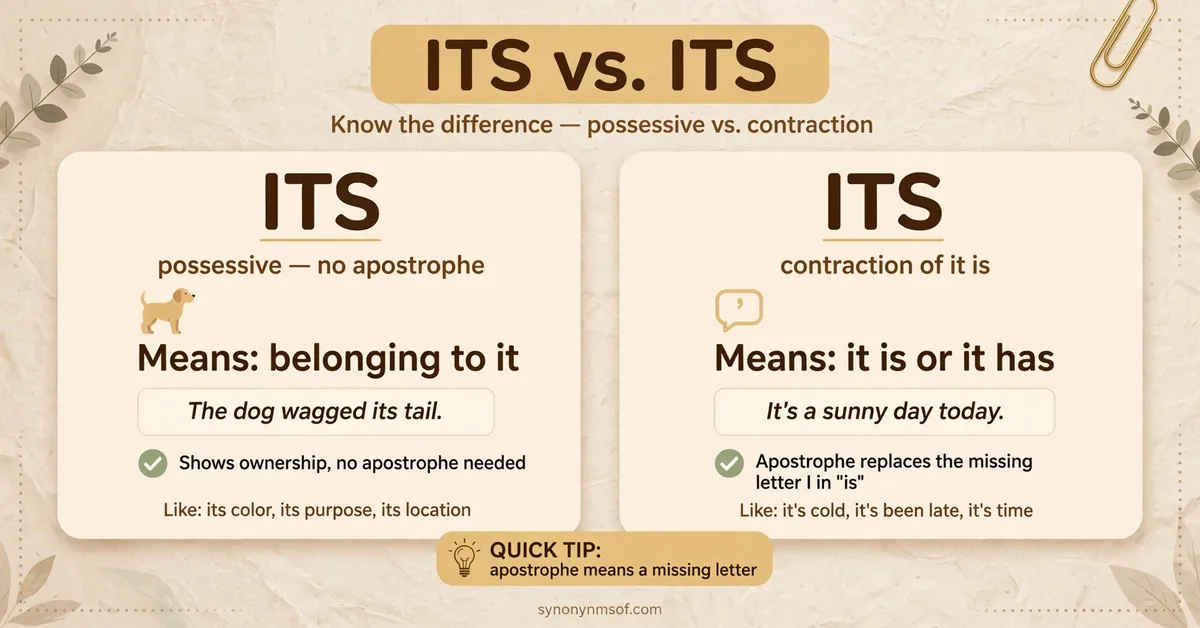
The rule, once learned, is permanent: “its” shows possession (belonging to it), and “it’s” means “it is” or “it has.” This guide explains both forms completely — what each means, how the apostrophe actually works, the famous expansion test, examples across every register, the mistakes to avoid, and answers to the five questions people ask most.
What Does “Its” Mean?
“Its” (no apostrophe) is the possessive form of the pronoun “it.” It means “belonging to it” or “associated with it” — the same job that “his,” “her,” “their,” and “your” do for other pronouns.
- “The dog wagged its tail.”
- “The company released its annual report.”
- “The tree lost its leaves in October.”
- “Each app has its own settings menu.”
In every case, “its” sits before a noun and tells you whose noun it is: the tail belongs to the dog, the report belongs to the company, the leaves belong to the tree. It is a possessive determiner — a small word that points at ownership.
Its and the Possessive Pronoun Family
“Its” belongs to a family of possessive words, and every member of this family refuses apostrophes:
| Person | Possessive determiner | Example |
|---|---|---|
| I | my | my book |
| you | your | your car |
| he | his | his phone |
| she | her | her keys |
| it | its | its lid |
| we | our | our house |
| they | their | their team |
Notice: not one of these takes an apostrophe. “Hers,” “theirs,” “yours,” “ours” — all apostrophe-free. “Its” follows the family rule. The apostrophe in “it’s” is doing a completely different job (marking a contraction), which is why the two forms must never be swapped.
Why “Its” Has No Apostrophe
The no-apostrophe rule for “its” exists because English possessive pronouns never use apostrophes — only possessive nouns do. “The dog’s tail” needs an apostrophe because “dog” is a noun. But once you replace the noun with the pronoun “it,” you enter pronoun territory, where the rule changes: “its tail,” no apostrophe, just like “his tail” and “their tails.”
Think of it this way: the pronoun already contains its possessiveness. Adding an apostrophe would be like writing “his’s” or “theirs’s” — doubling a job that is already done. If you wonder why “it” gets special treatment, it does not: it follows exactly the same rule as every other possessive pronoun.
What Does “It’s” Mean?
“It’s” (with an apostrophe) is a contraction — two words squeezed into one, with the apostrophe marking the spot where letters were removed. It always stands for either “it is” or “it has.” Nothing else. Never possessive.
It’s = “It Is”
The most common expansion. Whenever “it’s” can be unfolded into “it is,” the apostrophe belongs there.
- “It’s raining outside.” → “It is raining outside.”
- “It’s a beautiful day.” → “It is a beautiful day.”
- “It’s time to leave.” → “It is time to leave.”
- “I think it’s going to be expensive.” → “I think it is going to be expensive.”
This covers the vast majority of “it’s” uses — weather, time, opinions, descriptions, and exclamations.
It’s = “It Has”
Less common but equally correct: “it’s” can contract “it has,” almost always before a past participle or in perfect-tense constructions.
- “It’s been a long week.” → “It has been a long week.”
- “It’s got a scratch on the door.” → “It has got a scratch on the door.”
- “It’s been raining since morning.” → “It has been raining since morning.”
The test is the same: if you can expand it to “it has” and the sentence still makes sense, the apostrophe is correct.
How Contractions Use the Apostrophe
In contractions, the apostrophe is a stand-in for missing letters — a little flag that says “something was removed here.” “It’s” removes the space and the “i” from “it is.” The same logic governs “don’t” (do not), “can’t” (cannot), “we’ll” (we will), and “she’s” (she is / she has).
This is the deep reason the pair confuses people: the apostrophe is doing two completely different jobs in English — marking possession in nouns (“the cat’s whiskers”) and marking omission in contractions (“it’s raining”). With “it,” those two jobs collide on a single word, and only the meaning tells you which job the apostrophe is doing. Spoiler: with “it,” the apostrophe always marks a contraction. It never marks possession.
Its vs It’s: The Core Difference
The whole distinction reduces to one question: can you expand it to “it is” or “it has”?
- Yes → write it’s (with the apostrophe).
- No → write its (no apostrophe — it shows possession).
Test it on real sentences:
- “The team celebrated its/it’s victory.” → “The team celebrated it is victory” makes no sense → its.
- “Its/It’s a victory worth celebrating.” → “It is a victory worth celebrating” works perfectly → it’s.
- “The phone lost its/it’s signal.” → “it is signal” is nonsense → its.
- “Its/It’s been a great season.” → “It has been a great season” works → it’s.
This expansion test resolves nearly every case. If the expanded version sounds wrong, the apostrophe does not belong. Professional editors use this test daily — it is fast, mechanical, and almost never fails.
The Apostrophe Decision in Three Steps
1. Find the word. Is it “its” or “it’s” in your draft?
2. Expand it. Read the sentence aloud with “it is” (or “it has”) in place of the word.
3. Judge the result. If the sentence still makes sense, keep the apostrophe: it’s. If it collapses into nonsense, drop the apostrophe: its.
Two cautions. First, make sure you are expanding the right word — in “it’s raining, and its gutters are overflowing,” the two instances need opposite treatment. Second, the test assumes standard grammar; in quoted dialogue or deliberate informality, people still follow it.
Why Spellcheckers Cannot Save You
Both “its” and “it’s” are real words, so no spellchecker will ever flag the wrong one. Grammar checkers catch some cases but miss others, especially in complex sentences. The expansion test lives in your head, works offline, and takes two seconds — which is why it remains the gold standard long after every software update.
Its vs It’s: Comparison Table
| Feature | Its | It’s |
|---|---|---|
| Apostrophe | No | Yes |
| What it is | Possessive determiner | Contraction |
| Meaning | Belonging to it | It is / it has |
| Pronunciation | Identical | Identical |
| Stands for | — (one word) | “it is” or “it has” |
| Followed by | A noun (“its tail”) | Adjective, verb, or noun phrase (“it’s raining”) |
| Family | his, her, their, your (no apostrophes) | don’t, can’t, we’ll (contractions) |
| Expansion test | “It is tail” ✗ nonsense | “It is raining” ✓ works |
| Example | “The cat licked its paws.” | “It’s time for dinner.” |
| Common error | Writing “it’s paws” | Writing “its time for dinner” |
Usage Examples in Real Life
Everyday Conversation
- “The restaurant is famous for its wood-fired pizza.” (possession: the pizza belongs to the restaurant’s menu)
- “It’s freezing in here — can we close the window?” (it is)
- “My laptop died; its battery won’t hold a charge anymore.” (possession)
- “It’s been ages since we last met!” (it has)
- “The movie lived up to its hype.” (possession)
- “It’s not what you think — let me explain.” (it is)
In casual writing — texts, chats, social posts — the error rate is highest, because speed wins over care. Slowing down for the two-second expansion test is the entire fix.
Work and Business Writing
Professional documents are where the mistake costs the most credibility.
- “The company updated its privacy policy last quarter.” (possession)
- “It’s our pleasure to announce the new partnership.” (it is)
- “Each department submitted its budget on time.” (possession)
- “It’s been a challenging year for the industry.” (it has)
- “The software reached its end of life in June.” (possession)
- “It’s important that we meet the deadline.” (it is)
This shows how much weight a single punctuation mark carries in professional prose: “its annual report” reads as polished; “it’s annual report” reads as careless — even though the two sound identical when the email is read aloud.
Academic and Formal Writing
Formal writing uses “its” heavily (institutions, studies, theories all “possess” things) and “it’s” sparingly (contractions are often discouraged in the most formal styles).
- “The study confirmed its initial hypothesis.” (possession)
- “The theory has its critics, but the data support it.” (possession)
- “Each variable retained its significance after controls.” (possession)
- In strict academic style, “it is” is usually written out rather than contracted — but when the contraction appears, the apostrophe rule is identical.
Its vs It’s in the Wild: Autocorrect, Headlines, and Everyday Traps
Knowing the rule is one thing; surviving the places where the rule gets tested is another. Modern writing throws curveballs at this pair — autocorrect that “corrects” you into an error, rushed headlines, and fixed phrases where the possessive hides in plain sight. Here are the traps to know.
Autocorrect and Swipe-Typing Traps
Most keyboards default to it’s — the contraction is more common in casual typing, so the software guesses it first. Type “its” quickly and many phones will “fix” it to “it’s” without asking.
- You type: “The app updated its interface.” Your phone suggests: “The app updated it’s interface.” Decline the suggestion.
- Swipe-typing “its” often produces “it’s” or something stranger — always glance at the result before hitting send.
The fix: before sending anything important, search for “it’s” and run the expansion test on each hit. Technology is fast, but it doesn’t know what you meant.
Headlines, Titles, and Signs
Headlines are written fast, set in big type, and read by thousands — the worst place for this error, and the most common place to see it. A banner reading “Company Celebrates It’s 10th Anniversary” turns a celebration into a typo visible from across the street.
“The Park Reopened: It’s Gates Are Open” should be “Its Gates Are Open” — the gates belong to the park. Headlines drop small words for punch, so writers sometimes grab the contraction shape out of rhythm rather than meaning. Read the headline aloud with “it is” in the slot; if it sounds absurd, drop the apostrophe.
Fixed Phrases That Always Take “Its”
English is full of set phrases where “its” quietly does possessive work. Memorize these and you will never hesitate:
- “The committee, for its part, declined to comment.”
- “The novel stands in its own right as a classic.”
- “The startup survived on its own for two years.”
- “To its credit, the airline rebooked everyone.”
- “The flood took its toll on the valley.”
- “She read the report in its entirety.”
- “A gadget of its kind had never existed before.”
- “The old theater has lost its shine, but not its charm.”
Every one of these is possessive — no “it is” expansion survives. Spot one of these frames and the spelling is decided.
“Its” Before a Gerund: The Formal Construction
In formal writing, a possessive comes before a gerund (an -ing word acting as a noun): “I appreciate its being on time” treats “being on time” as a noun phrase belonging to “it.” The trap is “it’s being on time” — “it is being on time,” a different sentence entirely.
- Formal: “Do you mind its taking so long?” (the taking belongs to it)
- Casual: “Do you mind it taking so long?” (common in speech, less formal in writing)
- Wrong: “Do you mind it’s taking so long?” (“it is taking” makes no sense here)
You’ll meet this in contracts, academic prose, and careful business writing. When an -ing word follows, slow down: if the meaning is possessive, the apostrophe stays out.
Common Mistakes to Avoid
Mistake 1: Using “it’s” for possession. “The dog wagged it’s tail” is the classic error — and the most common one. The tail belongs to the dog, so the word is possessive: its. Run the expansion test: “the dog wagged it is tail” is nonsense, so the apostrophe must go.
Mistake 2: Using “its” for “it is.” “Its raining outside” is wrong in the other direction. Expand it: “it is raining outside” works perfectly, so the apostrophe belongs: it’s.
Mistake 3: Writing “its'” — with the apostrophe at the end. Some writers, sensing that possession “needs” an apostrophe, produce “its'” (as in plural possessives like “dogs'”). This form does not exist. There is no such word as “its’.” Ever. The choice is always binary: “its” or “it’s.”
Mistake 4: Trusting the “possession means apostrophe” instinct. That instinct is correct for nouns (“the company’s logo”) but wrong for pronouns (“its logo,” “their logo,” “your logo”). Train yourself to switch rules when the owner is a pronoun.
Mistake 5: Inconsistency in long documents. A 20-page report might use “its” correctly nineteen times and slip once — and readers will find the one. Before finalizing, search your document for both “its” and “it’s” and test each instance. It takes a minute and catches the strays.
Mistake 6: Confusing “its” with “it self”/”itself.” “Itself” (one word) is the reflexive pronoun: “The cat cleaned itself.” It never takes an apostrophe either. “It’s self” (two words) is always wrong.
Tricky Cases
“Its'” does not exist. Worth repeating because it appears so often: there is no word “its’.” Plural nouns form possessives with a trailing apostrophe (“the dogs’ owner”), but “it” has no plural, so the pattern never applies. Delete it from your mental dictionary.
The who’s/whose parallel. “Who’s” (who is / who has) versus “whose” (possessive) follows the exact same logic as “it’s” versus “its.” If you master one pair, you get the other free: apostrophe = contraction, no apostrophe = possession. “Who’s coming?” (who is) vs “whose coat is this?” (possessive).
“Its” at the start of a sentence. Possessive “its” rarely opens sentences in practice (“Its tail was fluffy” is grammatical but unusual), while “it’s” opens them constantly (“It’s late”). If your sentence starts with the word and you mean “it is,” the apostrophe is almost certainly correct.
Possession by organizations and abstractions. “The committee released its findings,” “the storm spent its fury,” “the idea had its moment.” Inanimate and abstract owners still take plain “its” — possession is not limited to living things.
“Its” before a gerund. “Its raining the parade out” is wrong — but note the real issue is the contraction: the sentence means “it is raining,” so write “it’s.” The gerund (“raining”) does not change the test.
Quoted speech and dialogue. Characters in fiction make the same mistakes real people do — but the author should not. Unless you are deliberately writing a character’s error (a child’s note, a funny sign), keep the rule intact in dialogue.
British vs American usage. There is no regional split. “Its” and “it’s” work identically in every English variety — this pair is pure grammar, unlike the spelling pairs gray/grey and toward/towards.
Practice: Test Yourself
The fastest way to lock in the rule is to use it. For each sentence below, choose “its” or “it’s” — then check your answers. Cover the answers with your hand (or scroll slowly) and run the expansion test on each one.
1. The museum updated ___ website last week.
2. ___ going to be a long meeting, I can tell.
3. The storm had lost ___ force by midnight.
4. ___ been three years since the last reunion.
5. Each team submitted ___ proposal on Friday.
6. I think ___ the best pizza in town.
7. The kitten chased ___ own tail in circles.
8. ___ important to read the instructions first.
9. The company is proud of ___ safety record.
10. ___ a shame the concert was cancelled.
Answers: 1. its (the website belongs to the museum — “it is website” is nonsense). 2. It’s (“it is going to be”). 3. its (the force belongs to the storm). 4. It’s (“it has been three years”). 5. its (the proposal belongs to each team). 6. it’s (“it is the best pizza”). 7. its (the tail belongs to the kitten). 8. It’s (“it is important”). 9. its (the record belongs to the company). 10. It’s (“it is a shame”).
How did you do? Eight or more correct means the rule is sticking. If you missed several, re-read the expansion test section — it is the one habit that fixes this pair permanently.
Frequently Asked Questions
What is the difference between its and it’s?
“Its” (no apostrophe) is the possessive form of “it” — it means “belonging to it,” as in “the dog wagged its tail.” “It’s” (with an apostrophe) is a contraction of “it is” or “it has,” as in “it’s raining” or “it’s been a week.” They sound identical but do completely different jobs.
When should I use “its” vs “it’s”?
Use the expansion test: replace the word with “it is” (or “it has”). If the sentence still makes sense, write “it’s.” If it becomes nonsense, write “its.” “The cat licked it is paws” is nonsense → “its.” “It is time to go” works → “it’s.”
Is “its'” ever correct?
No. The form “its'” does not exist in English. Plural nouns can take a trailing apostrophe for possession (“the dogs’ leashes”), but “it” has no plural, so the pattern never applies. The only two options are “its” and “it’s.”
Why doesn’t “its” have an apostrophe if it shows possession?
Because “its” is a possessive pronoun, and possessive pronouns never take apostrophes — just like “his,” “hers,” “theirs,” “yours,” and “ours.” Apostrophes mark possession only in possessive nouns (“the dog’s tail”). When the noun “dog” becomes the pronoun “it,” the rule switches: “its tail.”
Is it “the company released its report” or “it’s report”?
“The company released its report.” The report belongs to the company, so the word is possessive — no apostrophe. Expand to check: “the company released it is report” is nonsense, which confirms “its” is correct.
Conclusion
Its and it’s are a perfect miniature of how English actually works: a tiny mark carrying a large meaning. “Its” quietly claims ownership — the tail, the report, the leaves — while “it’s” does the brisk work of two words, “it is” or “it has,” compressed into one. The apostrophe is never decoration; it always stands for something missing.
Keep the expansion test in your pocket and you will never hesitate again. Read the sentence with “it is” in the slot: if it survives, the apostrophe stays; if it collapses, the apostrophe goes. Two seconds, one question, zero doubt — and one of the most visible marks of careful writing, secured for good.