
It is one of the most embarrassing mistakes a single letter can cause. Picture a travel blogger posting this caption under a photo of endless sand dunes: “After three days crossing the dessert, we finally reached water.” Every reader pictured her wading through a sea of chocolate cake. The Sahara is a desert, not a dessert — but one extra S turned an arid wasteland into a giant pastry, and nobody scrolling past missed it. That is the power of this tiny spelling difference: it does not create a typo, it creates a completely different word.
Desert and dessert are among the most commonly confused word pairs in English, and for good reason. They look nearly identical on the page, they sound almost the same in fast speech, and your spellchecker will not always save you because both are real, correctly spelled words. In this guide, I will walk you through every meaning of both words — including the lesser-known fact that “desert” is not only a noun for dry land but also a verb meaning to abandon — show you exactly how pronunciation and word stress separate them, and hand you memory tricks that make the right choice automatic.
Whether you are a student polishing an essay, a professional proofreading a report, or a non-native speaker who wants to get it right the first time, this guide has you covered. We will compare the two words side by side, see them in everyday, business, and academic contexts, flag the classic mistakes writers keep making, and untangle tricky edge cases like “just deserts,” the verb that sounds like the sweet course, and British “pudding.” Let us clear this up once and for all.

What Does “Desert” Mean as a Noun?
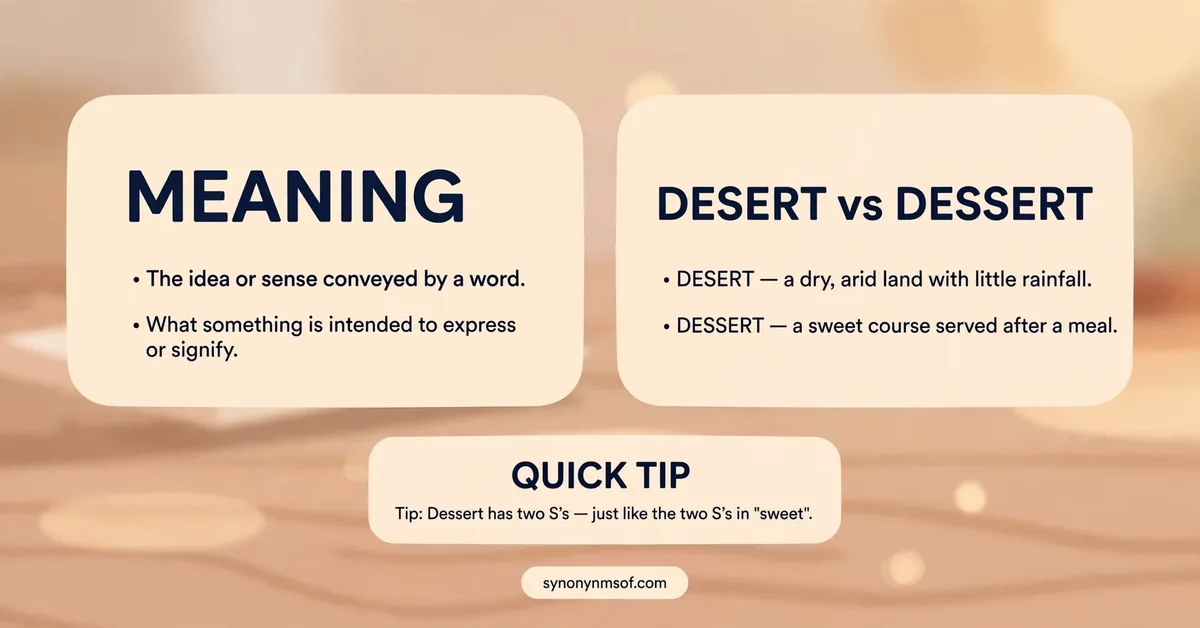
As a noun, “desert” — spelled D-E-S-E-R-T with a single S — means a large area of land that receives very little rain and supports very little plant or animal life. Think of towering sand dunes, rocky plains, and cacti. The Sahara in North Africa is the most famous example, but deserts exist on every continent and cover roughly one-third of the Earth’s land surface.
What Makes a Place a Desert
What defines a desert is not heat — it is dryness. Geographers generally classify a region as a desert when it receives less than 250 millimeters (about 10 inches) of precipitation per year. That single fact explains one of the most surprising edge cases in geography: Antarctica, a frozen continent of ice, is technically the largest desert in the world. A place can be bitterly cold and still be a desert if almost no rain or snow ever falls there. The Gobi in Central Asia is another cold desert, while the Atacama in Chile is a coastal desert where some weather stations have never recorded a single drop of rain. So when you read “desert,” do not automatically picture camels and heat — picture a landscape starved of water.
“Desert” Used Figuratively
Writers love to borrow “desert” for anything empty or lifeless: a “cultural desert” (a town with no theaters or galleries), a “food desert” (a neighborhood where fresh groceries are hard to find), or a “news desert” (a community with no local journalism left). In each case the word keeps its single-S spelling, because the meaning still traces back to emptiness.
- “The Sahara is the largest hot desert on Earth.”
- “The explorers nearly ran out of water in the middle of the desert.”
- “Without a library or a theater, the town felt like a cultural desert.”
What Does “Desert” Mean as a Verb?
Here is where many learners get tripped up: “desert” is also a verb, and it means to abandon someone or something — to leave without any intention of returning. It is spelled with one S, just like the noun, but here is the trap: as a verb, it is pronounced exactly like “dessert” (di-ZERT). That means anyone who relies on sound alone has no way to tell them apart, and in writing the single-versus-double S is the only thing standing between “he deserted his post” and a sentence about cake.
How the Verb Is Used
The verb “desert” usually carries a tone of broken loyalty or broken duty. A soldier who leaves the army without permission deserts. A friend who disappears the moment you need help deserts you. The common forms are straightforward: desert, deserts, deserted, deserting. Because the verb is about leaving, you will often see it paired with people, causes, positions, and places — someone deserts a friend, a party, a post, or a town.
Deserted and Deserter: The Word Family
Two useful relatives grow out of the verb. “Deserted” is an adjective meaning empty of people: a deserted beach, a deserted street, a deserted village. Be careful here — a “deserted island” is a lonely, uninhabited island, while a “dessert island” would be an island made of cake, which exists only in daydreams (and, honestly, sounds more fun). A “deserter” is a noun for a person who deserts, most often a soldier who abandons military service. Both words keep the single S of their parent verb.
- “He would never desert his friends in a crisis.”
- “The captain ordered the crew not to desert the ship.”
- “She felt hurt when her closest friend deserted her.”
- “After the factory closed, the streets felt deserted.”
What Does “Dessert” Mean?
“Dessert” — spelled D-E-S-S-E-R-T with two S’s — has exactly one meaning: the sweet course served at the end of a meal. Cake, ice cream, pie, brownies, fruit salad — if it is sweet and it comes last, it is dessert. Unlike “desert,” the word “dessert” is never a verb and never refers to a place. It is a noun, always and only. The double S is the signature: two letters for the sweet stuff.
A Countable Noun
Dessert is a countable noun, so you can talk about one dessert or many desserts. “I ordered two desserts” is perfectly natural — you would never write “two deserts” unless you were a geographer comparing arid regions. In menus and everyday speech, dessert appears in both forms: “What is for dessert?” at home, “The desserts were the highlight of the evening” in a restaurant review.
Desserts Around the World
What counts as dessert changes beautifully from culture to culture. In the United States it might be apple pie or cheesecake; in France, crème brûlée; in Pakistan and India, gulab jamun or kheer; in the Middle East, baklava dripping with honey. But the English word itself never changes — it is the sweet ending to a meal everywhere English is spoken.
- “We skipped dessert because the main course was so filling.”
- “Chocolate cake is my favorite dessert in the world.”
- “The restaurant changes its dessert menu every season.”
- “For dessert, they served fresh mango with sticky rice.”
Desert or Dessert: The Key Differences
Now that you have met both words properly, let us put them head to head. The difference between desert and dessert is not subtle once you see it clearly — it is a difference of meaning, spelling, and (usually) pronunciation. The confusion only survives because the words are one letter apart and because the verb form of “desert” borrows the sweet word’s pronunciation.
Difference in Meaning
The meaning gap is the widest one. “Desert” is about dryness and emptiness: an arid region with almost no rain, or the act of leaving something empty behind. “Dessert” is about sweetness: the final, sugary course of a meal. A simple rule covers nearly every sentence you will ever write: if the sentence is about sand, heat, camels, drought, or abandoning someone, you want the single-S “desert.” If the sentence is about cake, ice cream, chocolate, or anything you eat with a spoon after dinner, you want the double-S “dessert.” Desert is spelled with one S for the barren land — on the other hand, dessert doubles the letter for the sweet treat.
Difference in Pronunciation and Stress
Pronunciation is where this pair gets genuinely sneaky. The noun “desert” (the dry land) stresses the first syllable: DES-ert — your voice lands hard at the start and fades at the end. The sweet course “dessert” stresses the second syllable: di-ZERT — the emphasis arrives at the finish. Say them out loud a few times and you can feel the difference: DES-ert, di-ZERT. Here is the twist that makes this pair famous: the verb “to desert” (to abandon) is also pronounced di-ZERT, exactly like “dessert.” So when someone says “they deserted the camp,” your ears cannot tell you which spelling they mean — only the surrounding context can. That is why this is a writing problem more than a speaking problem.
- desert (noun, dry land): DES-ert — stress on the first syllable
- desert (verb, to abandon): di-ZERT — stress on the second syllable
- dessert (noun, sweet course): di-ZERT — stress on the second syllable
Side-by-Side Comparison
This table puts everything in one place. Bookmark it mentally — it is the fastest way to check yourself before you hit send.
| Feature | Desert (noun) | Desert (verb) | Dessert (noun) |
|---|---|---|---|
| Spelling | One S | One S | Two S’s |
| Pronunciation | DES-ert | di-ZERT | di-ZERT |
| Word stress | First syllable | Second syllable | Second syllable |
| Part of speech | Noun | Verb | Noun |
| Meaning | Dry, barren land | To abandon or leave | Sweet course after a meal |
| Example | “The Sahara is a vast desert.” | “She refused to desert her team.” | “We had pie for dessert.” |
Desert or Dessert in Real Life: Usage Examples
Knowing the dictionary definitions is one thing; recognizing the right word in a real sentence is another. Context is your best friend with this pair, because the words live in completely different worlds — one in geography, travel, and loyalty, the other in kitchens, restaurants, and dinner tables. Here is how both words show up across everyday life.
Everyday Conversation
In casual speech, “dessert” comes up constantly — it is one of the happiest words in a family’s vocabulary. “Desert” appears when people talk about travel, weather, or dramatic breakups with friends who stopped showing up.
- “What is for dessert tonight? The kids asked before they had even finished dinner.”
- “We got completely lost driving through the desert outside the city.”
- “He deserted the group chat the moment the argument started.”
- Polite questions often open with a soft phrase like “I was wondering” — for example, “I was wondering if we could order dessert before the kitchen closes?” Notice how the whole sentence lives in the world of food, which is your signal that the double S belongs.
Work and Business Writing
In professional writing, this mix-up looks worse than an ordinary typo because it signals that nobody proofread the document. A logistics proposal that mentions a “dessert region” will not inspire confidence, and a restaurant’s catering email that promises “fresh desert” will get laughed at in the group thread. Business writing is also where the verb form appears most: projects get deserted, clients get deserted, strategies get deserted.
- “The report covers water scarcity in desert regions of the Middle East.”
- “The team refused to desert the project despite the funding delays.”
- “We will serve dessert and coffee after the keynote speech.”
- When time permits, read important emails aloud before sending them — your ears will catch a misplaced “desert” where your eyes only saw what you meant to type.
Formal and Academic Writing
Academic writing uses all three forms — the noun, the verb, and the sweet course — which makes it the ultimate test of this distinction. Geography papers discuss desertification and desert climates; history and political science papers discuss soldiers and allies who desert; nutrition and hospitality research discusses dessert consumption. Precision matters here because the reader cannot ask you what you meant.
- “Desertification now threatens nearly one-third of the planet’s land surface.”
- “The study examines the factors that lead soldiers to desert in prolonged conflicts.”
- “The researchers compared dessert consumption patterns across three countries.”
- “Antarctica, the world’s largest desert, receives almost no precipitation.”
Common Mistakes to Avoid
Now for the error gallery. These are the mix-ups that show up in student essays, business emails, and social media posts every single day. Each one is followed by the corrected version, so you can see exactly where the single S and the double S belong.
Mistake 1: Writing “desert” when you mean the sweet course. Wrong: “After dinner, we enjoyed a delicious chocolate desert.” Right: “After dinner, we enjoyed a delicious chocolate dessert.”
Mistake 2: Writing “dessert” when you mean the dry land. Wrong: “The camel trekked across the hot dessert for days.” Right: “The camel trekked across the hot desert for days.”
Mistake 3: Using “dessert” as a verb. Wrong: “He dessserted his post during the storm.” (Some writers even add a third S for good measure.) Right: “He deserted his post during the storm.” Remember: “dessert” is never a verb. Only “desert” can be an action.
Mistake 4: Misspelling the phrase “just deserts.” Wrong: “The thief finally got his just desserts.” Right: “The thief finally got his just deserts.” This one deserves its own section below, because almost everyone gets it wrong.
Here is a quick test that never fails: mentally replace the word with “seconds.” If the sentence still makes sense — “we had chocolate cake for seconds” — you need “dessert” with two S’s. If the sentence is about food, then the correct choice is dessert, every time. And the memory trick worth its weight in gold: “dessert” has two S’s because you always want seconds of something sweet. One more helping, one more S.
Tricky Cases and Edge Cases
The basics are settled. Now let us handle the cases that trip up even confident writers — the phrases and usages where the rules seem to bend.
“Just Deserts”: Getting What You Deserve
“He got his just deserts” has nothing to do with cake. This phrase means someone received exactly what they deserved — usually a punishment or an unpleasant consequence. It is spelled with ONE S (deserts), it comes from an old word related to “deserve,” and it is pronounced like “desserts” (di-ZERTS). It is one of the most misspelled phrases in English precisely because almost every writer’s instinct says to double the S. Memorize this one separately: just deserts, one S, no sweetness involved.
The Verb “Desert” Sounds Exactly Like “Dessert”
Because “to desert” (to abandon) and “dessert” (the sweet course) are pronounced identically — both di-ZERT — spoken English gives you zero clues about the spelling. In writing, context is everything: if the sentence is about leaving, loyalty, or duty, it is the single-S verb. If it is about food, it is the double-S noun. When in doubt, check the part of speech — that check alone resolves nearly every ambiguous case.
“Pudding” vs. “Dessert” in British English
Here is a cultural curveball. In British English, “pudding” is often used to mean any dessert course at all — “What’s for pudding?” can be answered with cake, pie, ice cream, or fruit. In American English, “pudding” is a specific creamy dish (like chocolate pudding), so the question would sound odd. If a British friend asks about pudding, they are asking about dessert — not the desert. And in some British households you will hear “afters” too. None of this changes the spelling rules, but it explains why English learners sometimes hear a third word in the mix.
Not All Deserts Are Hot
Cold deserts surprise almost everyone. The Gobi Desert in Central Asia endures freezing winters, and Antarctica — a continent of ice — is the largest desert on Earth. If your writing mentions a “frozen desert” or a “polar desert,” that is not a contradiction; it is geography. The Sahara is hot, the Gobi is cold, and both are deserts because both are starved of precipitation. This is a favorite trick in quizzes and exams, so it is worth remembering.
“Desert” as an Adjective
“Desert” can also work like an adjective meaning empty or uninhabited: a desert island, a desert highway, a desert outpost. A “desert island” is a lonely island with no people — very different from a “dessert island,” which exists only in daydreams and children’s stories. The adjective keeps the single S and the first-syllable stress of the noun (DES-ert island), so it patterns with the dry land, not with the sweet course.
Frequently Asked Questions
Is it spelled “desert” or “dessert” when talking about the sweet course?
It is “dessert” with two S’s — D-E-S-S-E-R-T. Whenever the sentence is about the sweet food served at the end of a meal, such as cake, ice cream, or pie, the double S is required. The single-S “desert” always means either the dry, arid land or the verb “to abandon,” so “chocolate desert” would technically mean a wasteland made of chocolate.
How do you pronounce “desert” and “dessert”?
The noun “desert” (dry land) is pronounced DES-ert, with the stress on the first syllable. Both the sweet course “dessert” and the verb “to desert” (to abandon) are pronounced di-ZERT, with the stress on the second syllable. The verb and the sweet course sound identical, so only context — or the spelling, in writing — tells them apart.
What does “just deserts” mean, and how is it spelled?
“Just deserts” means receiving exactly what one deserves, usually as a punishment — for example, “After years of cheating customers, the company got its just deserts.” It is spelled with ONE S, comes from an old word related to “deserve,” and is pronounced like “desserts.” Writing “just desserts” with two S’s is one of the most common spelling errors in English.
Can “desert” be used as a verb?
Yes. As a verb, “desert” means to abandon someone or something, often in a disloyal way — “She refused to desert her team.” Its forms are desert, deserts, deserted, and deserting. Related words include “deserted” (empty of people, as in “a deserted street”) and “deserter” (a person who abandons duty, especially a soldier). Note that “dessert,” the sweet course, is never a verb.
What is the easiest way to remember the difference between desert and dessert?
Remember that “dessert” has two S’s because you always want seconds of something sweet — one extra S for one extra helping. For “desert,” think of the single S as the single, lonely landscape: one S for the vast, empty sand. You can also use the stress test: DES-ert (first-syllable stress) is the dry land, while di-ZERT (second-syllable stress) is either the sweet course or the act of abandoning.
Conclusion
Desert and dessert will probably keep tricking writers for as long as English is written, because the difference between them is a single letter and a syllable of stress. But now you know the full picture: “desert” is the dry, arid land (DES-ert) or the act of abandoning someone (di-ZERT), while “dessert” is the sweet course at the end of a meal (di-ZERT) — spelled with two S’s, because you always want seconds of something sweet.
Keep the memory tricks close, proofread the words your spellchecker ignores, and remember that context is the real judge whenever pronunciation overlaps. Write “desert” for sand and abandonment, “dessert” for sweetness, and “just deserts” with a single S when someone gets what they deserve — and you will never serve your readers sand for pudding again.