
You’ve probably done this before: you’re typing a sentence, and your fingers hover over the keyboard because you’re not sure whether to write “leafs” or “leaves.” It feels like it should be a simple plural — the kind of thing you learned years ago — yet something makes you pause. The truth is, you’re not alone. This tiny spelling choice trips up native speakers and English learners alike, and it shows up in emails, essays, and social media posts every single day.
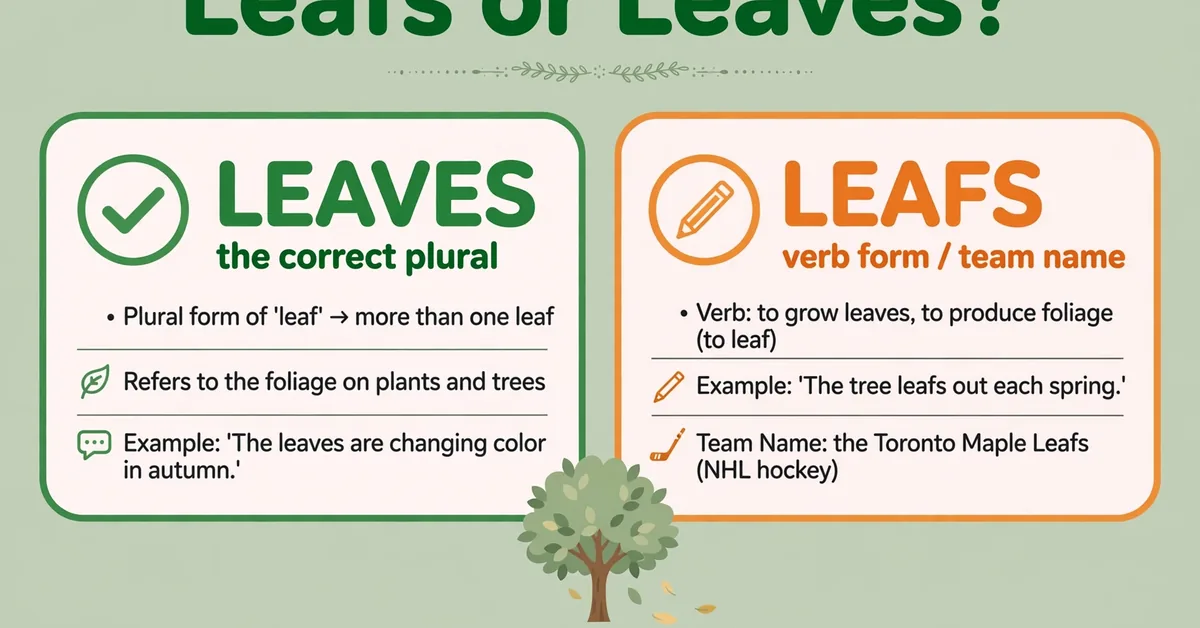
Here’s the short answer: “leaves” is the standard plural of the noun “leaf.” In almost every sentence you’ll ever write about trees, plants, paper, or anything else with more than one leaf, “leaves” is the word you want. But the confusion is completely understandable. English has a quirky habit of changing *f to v in certain plurals (think knife → knives and wolf → wolves*), and to make matters worse, “leafs” is a real word with its own legitimate job — just not the job most people think it has. Add the Toronto Maple Leafs hockey team to the picture, and you have a perfect recipe for doubt.
In this guide, we’ll break down exactly what each word means, how to tell them apart in a split second, and when each one is correct. You’ll get plenty of real-world examples from everyday conversation, office writing, and formal academic prose, plus the mistakes people make most often and the tricky edge cases that even confident writers stumble over. By the end, you’ll never second-guess yourself on “leafs or leaves” again.

What Does “Leaves” Mean?
“Leaves” is the word you’ll reach for in the vast majority of sentences. It carries two separate grammatical identities, and understanding both is the key to using this pair correctly. Let’s look at each one.
Leaves as the Plural of “Leaf”
The noun “leaf” refers most commonly to the flat, usually green part of a plant or tree — the things that turn gold in autumn and crunch under your boots in October. Like a small family of English nouns ending in *f or fe, “leaf” forms its plural by swapping the f for a v and adding -es*: leaf → leaves. This same pattern shows up in knife → knives, wife → wives, life → lives, and wolf → wolves. It’s a leftover from Old English, where the *f sound naturally became voiced (sounded like v*) when it sat between two vowels, and the spelling eventually followed the pronunciation.
This rule is consistent and reliable. Once you know “leaf” belongs to the *f-to-v* family, you’ll never be tempted by “leafs” as a plural again:
- The maple tree outside my window drops its leaves every October.
- She pressed a few dried leaves between the pages of her journal.
- The gardener raked the fallen leaves into neat piles along the fence.
And “leaves” isn’t limited to trees and plants. The noun “leaf” also describes any thin sheet or layer, and the plural works exactly the same way in all of these senses:
- A few loose leaves of paper slipped out of the folder. (sheets of a book or manuscript)
- The artist decorated the frame with delicate gold leaves. (thin sheets of gold used in art)
- We added two extra leaves to the dining table for the holiday dinner. (hinged extension panels)
- The lettuce leaves in the salad were crisp and fresh. (edible plant parts)
In every one of these senses — botanical, paper, decorative, furniture — the plural is “leaves.” There is no context in standard English where “leafs” works as the plural of the noun.
Leaves as a Verb Form of “To Leave”
Here’s where things get genuinely interesting. “Leaves” is also the third-person singular present tense of the verb “to leave,” which means to go away from a place, to depart, or to allow something to remain:
- She leaves for work at eight every morning.
- The train leaves the station at noon sharp.
- He always leaves his desk spotless before heading home.
- The new policy leaves several important questions unanswered.
So “leaves” does double duty in English: it’s both a plural noun and a verb form. Context is the only thing that tells you which one you’re looking at. In “the leaves fell from the branches,” it’s the noun. In “she leaves early on Fridays,” it’s the verb. This double life is one of the reasons the “leafs or leaves” question causes so much hesitation — your brain senses that “leaves” is doing something complicated, and it is.
What Does “Leafs” Mean?
“Leafs” is a real, dictionary-recognized English word, but it has a much narrower job than most people assume. It is not the plural of “leaf,” and using it that way is the single most common mistake with this word pair. Let’s be precise about where “leafs” actually belongs.
Leafs as a Verb: “To Leaf” Through Something
“Leafs” is the third-person singular present tense of the verb “to leaf,” which means to turn pages quickly or casually — the action you’d naturally describe as flipping or thumbing through a book, magazine, newspaper, or report. The verb also has a secondary botanical sense, “to put forth leaves,” as when a tree leafs out in spring.
- He leafs through the morning newspaper while his coffee cools.
- The researcher leafs through stacks of documents, hunting for one crucial piece of evidence.
- She leafs through the old photo album, smiling at memories from years ago.
- Every spring, the oak trees in the park leaf out almost overnight. (base form, botanical sense)
This is the correct, standard use of “leafs.” If the word in your sentence is an action — someone flipping through pages or a plant producing foliage — then “leafs” is exactly right, and “leaves” would be wrong. Notice the past tense, too: “she leafed through the report before the meeting.” That -ed ending is another clue that you’re dealing with a verb, not a plural noun.
Leafs in Proper Nouns: The Toronto Maple Leafs
The other place you’ll encounter “Leafs” is in the name of the Toronto Maple Leafs, the well-known Canadian ice hockey team. This is a deliberate naming choice — reportedly made to echo the style of other team names — and proper nouns always keep their official spelling, no matter what the general grammar rules say:
- The Toronto Maple Leafs played a strong game last night.
Note the capital L: as part of a proper name, it’s “Leafs,” not “leafs.” Outside of this team name, “Leafs” as a noun plural is simply wrong, and the team’s spelling doesn’t give anyone permission to write “leafs” for ordinary foliage.
Why “Leafs” Is Not a Standard Plural
Some writers arrive at “leafs” by analogy with regular nouns: one cat, two cats; one book, two books — so surely one leaf, two leafs. It’s a reasonable guess, but English reserves the *f-to-v* shift for a specific family of nouns, and “leaf” firmly belongs to it. No dictionary or style guide accepts “leafs” as a plural noun. If you’re talking about more than one leaf of any kind — plant, paper, gold, or table — write “leaves,” every single time, without exception.
The Difference Between Leafs and Leaves
Put side by side, the difference between these two words comes down to a single question: is the word describing a thing, or an action?
When the word refers to things — foliage on a tree, sheets of paper, hinged table panels, lettuce in a salad — the noun plural is always “leaves.” There are no exceptions to this in standard English. If you can point at it, count it, or rake it into a pile, it’s “leaves.”
When the word is an action, you have two completely different verbs to keep apart, and this is where the real confusion lives. The verb “to leaf” (to flip through pages) gives you “he leafs through the report.” On the other hand, the verb “to leave” (to depart or go away) gives you “she leaves for work at noon.” So the leafs/leaves pair actually mirrors two unrelated verbs: leaf → leafs and leave → leaves.
Here’s a quick test you can run on any sentence in about two seconds. Try substituting “flips through”: if the sentence still makes sense (“he flips through the magazine”), you want “leafs.” Now try substituting “departs from”: if that works (“she departs from the office”), you want “leaves.” And if neither verb fits — if you’re talking about things with stems and veins — you want “leaves” as the plural noun. One test, three possible answers, zero guesswork.
Leafs vs Leaves: Comparison at a Glance
Sometimes it helps to see the whole picture in one place. This table puts every legitimate use of both spellings side by side:
| Word | Part of Speech | Meaning | Example |
|---|---|---|---|
| leaves | Plural noun | More than one leaf (foliage, sheets of paper, table panels, gold leaf) | The autumn leaves covered the path in gold and red. |
| leaves | Verb (3rd-person singular) | Third-person singular of “to leave” — to depart or go away | She leaves the office at six every evening. |
| leafs | Verb (3rd-person singular) | Third-person singular of “to leaf” — to flip through pages or put forth leaves | He leafs through the magazine while waiting. |
| Leafs | Proper noun | Part of the official name “Toronto Maple Leafs” (hockey team) | The Maple Leafs won in overtime. |
Notice the pattern: three of the four rows belong to “leaves,” and the single “leafs” row that matters for ordinary writing is the verb. When in doubt, the odds heavily favor “leaves” — which is exactly why it’s worth learning the one narrow situation where “leafs” is right.
Usage Examples in Different Contexts
The same words can feel very different depending on where they appear. Here are natural examples of “leafs” and “leaves” across everyday speech, workplace writing, and formal academic prose.
Everyday Conversation
In casual speech and writing, “leaves” as a plural noun dominates. You’ll hear it constantly in autumn, in gardening talk, and in cooking:
- “The leaves are changing color already — fall came early this year.”
- “I love the smell of the leaves after it rains in October.”
- “These tea leaves make a much stronger brew than the bagged kind.”
The verb “to leave” is just as common in daily life:
- “He leaves for the gym right after dinner most nights.”
- “She always leaves a note on the fridge when she goes out.”
And the verb “to leaf” shows up in relaxed, descriptive moments:
- “He just sat there leafing through the menu for ten minutes.”
- “She was leafing through old magazines at the dentist’s office.”
Work and Business Writing
Professional writing demands precision, and this is exactly where a “leafs or leaves” slip can quietly undermine your credibility. Here are examples that sound natural in office emails, reports, and meetings:
- “Our manager leaves for the client site on Thursday morning.”
- “Please review the attached proposal — the director leafs through it before every board meeting, so the executive summary needs to be sharp.”
- “The new policy leaves several compliance questions unanswered, so legal is reviewing it.”
- “We ordered a conference table with two extra leaves for all-hands meetings.”
- “She leafed through the contract one final time before signing.”
That last example is worth a second look: “leafed” is the past tense of the verb “to leaf.” In a business context, sentences like “the auditor leafed through the receipts” are perfectly standard — and they prove, once again, that “leaf(s)” is verb territory.
Formal and Academic Writing
Academic and formal writing favors precise vocabulary, and both words appear in scholarly contexts — just in very different roles:
- “The study examined how the leaves of deciduous trees respond to reduced sunlight.”
- “The author leaves the central question open for future research.”
- “Several leaves of the original manuscript were missing from the archive.” (sheets of a manuscript)
- “The committee chair leafs through the submitted appendices during the review session.”
- “Botanists noted that the specimens’ leaves varied significantly in both size and shape.”
In academic writing, the manuscript sense of “leaves” (sheets of paper) appears more often than in everyday speech, and it’s always spelled with the *v*. A sentence like “the damaged leafs of the codex” would be flagged by any careful editor.
Common Mistakes to Avoid
Even writers who know the rule still slip up. Here are the five mistakes that cause the most trouble, with corrections.
1. Writing “leafs” as the plural of “leaf.” This is by far the most common error, and it usually comes from over-applying the regular plural rule.
- ❌ “The garden was full of green leafs.”
- ✅ “The garden was full of green leaves.”
2. Overcorrecting — swapping a correct “leafs” for “leaves.” Once people learn that “leafs” is usually wrong, some start “fixing” it everywhere, including the one place it’s right: the verb.
- ❌ “She leaves through the catalog every Sunday morning.” (if she flips through it)
- ✅ “She leafs through the catalog every Sunday morning.”
3. Confusing “leaves” the verb with “leafs.” Because the two verbs sound similar and both end in an *s*, writers sometimes attach the wrong one to the wrong action.
- ❌ “He leafs the office at five o’clock.”
- ✅ “He leaves the office at five o’clock.”
4. Letting the Maple Leafs license “leafs” everywhere. The hockey team’s name is a proper noun with its own official spelling. It changes nothing about ordinary English. “Leafs” on a jersey is correct; “leafs” on a tree is not.
5. Trusting spellcheck to catch the error. Most spellcheckers accept “leafs” because it is a valid word — the verb form. So the red squiggly line you rely on will stay silent while “the autumn leafs” sails through. The fix is simple: proofread by meaning, not by spellcheck. Read the sentence, ask whether the word is a thing or an action, then choose the spelling with confidence.
Tricky Cases and Edge Cases
Once the basics are solid, a handful of edge cases can still cause hesitation. Here’s how to handle each one.
The Toronto Maple Leafs — always “Leafs,” always capitalized. Proper nouns keep their official spelling. Write “the Maple Leafs won,” never “the Maple Leaves won,” even though every grammar instinct screams otherwise. The same principle applies to any brand or title that uses the spelling officially.
Botanical verbs: “leafing out.” In spring, gardeners say trees are “leafing out” — the present participle of the verb “to leaf” in its “produce leaves” sense. “The maples are leafing out early this year” is correct, and it has nothing to do with the plural noun.
Extended senses of “leaf” all pluralize to “leaves.” Gold leaf becomes gold leaves. A table leaf becomes table leaves. A leaf torn from a notebook becomes “several leaves were torn from the notebook.” The *f-to-v* rule follows the word through every meaning.
Possessives follow the plural. The singular possessive is “the leaf’s shape” (one leaf), and the plural possessive is “the leaves’ colors” (many leaves). The apostrophe goes after the *s in “leaves'” because the plural already ends in s* — this shows how the spelling you choose ripples into the rest of the sentence.
The idiom “take a leaf out of someone’s book.” This expression — meaning to imitate someone’s good behavior — always uses the singular “leaf.” “She took a leaf out of her mentor’s book and started keeping a daily journal.” Don’t pluralize idioms; they’re frozen in their traditional form.
“Leafed” vs. “leaved.” The past tense of the verb “to leaf” is “leafed” (“she leafed through the pages”). Don’t confuse it with “leaved,” which is an adjective meaning “having leaves,” used in compounds like “broad-leaved trees.” Different word, different spelling, different meaning.
Frequently Asked Questions
Is “leafs” ever correct?
Yes — in two narrow cases. “Leafs” is correct as the third-person singular of the verb “to leaf,” meaning to flip through pages (“he leafs through the book before buying it”). It’s also correct in the proper noun “Toronto Maple Leafs.” As the plural of the noun “leaf,” however, “leafs” is always wrong; the plural is “leaves.”
Why isn’t the plural of “leaf” simply “leafs”?
Because “leaf” belongs to a family of nouns ending in *f that form their plurals by changing f to v and adding -es: knife → knives, wolf → wolves, wife → wives, life → lives. This pattern goes back to Old English, where the f sound was naturally pronounced as v* between vowels. English kept the spelling change even though the original pronunciation reason faded, so “leaves” became the fixed, standard plural centuries ago.
What’s the difference between “he leafs” and “he leaves”?
They come from two completely different verbs. “He leafs through the report” means he flips through its pages — that’s the verb “to leaf.” “He leaves the office at five” means he departs from the office — that’s the verb “to leave.” Same sentence shape, entirely different meanings, so always check which action you intend.
How do you pronounce “leaves”?
“Leaves” is pronounced /liːvz/ — “leevz,” rhyming with “sleeves,” with a clearly voiced *v sound. That v is the audible fingerprint of the f-to-v plural rule, and it distinguishes “leaves” from the singular “leaf” (/liːf/, with an unvoiced f). Saying the word aloud can actually help you remember the spelling: if you hear the v, write the v*.
Should I write “Maple Leafs” or “Maple Leaves” for the hockey team?
Always “Maple Leafs.” It’s the team’s official name, and proper nouns keep their registered spelling regardless of grammar rules. Writing “Maple Leaves” would be like misspelling someone’s surname — technically more “correct” by the rules, but wrong in fact. Everywhere else, though, the ordinary plural of leaf is “leaves.”
Final Thoughts
The “leafs or leaves” question looks tricky, but it collapses into one simple habit: ask whether the word is a thing or an action. Things — foliage, paper, table panels — are always “leaves.” Actions split into two verbs: “to leaf” (flip through pages) gives “leafs,” and “to leave” (depart) gives “leaves.” Add the Toronto Maple Leafs as the one famous proper-noun exception, and you have the complete picture.
With that rule in your pocket, the hesitation disappears. You’ll write “leaves” with confidence in nearly every sentence, recognize the rare moments when “leafs” is right, and spot other people’s mistakes with a knowing smile. That’s the difference between memorizing a rule and actually owning it — and on this one, ownership takes about ten seconds.