
You have seen both spellings, probably within the same week. A sitcom character snaps, “Stop being so nosy!” A friend texts, “Don’t be nosey, but are you two dating?” The word sounds identical either way, means the same thing either way — yet that single extra “e” makes writers pause. If you have ever hovered over the word, deleted it, and retyped it with a different spelling just to feel safer, you are far from alone. This is one of the most-searched spelling questions in English, and the uncertainty is completely understandable.
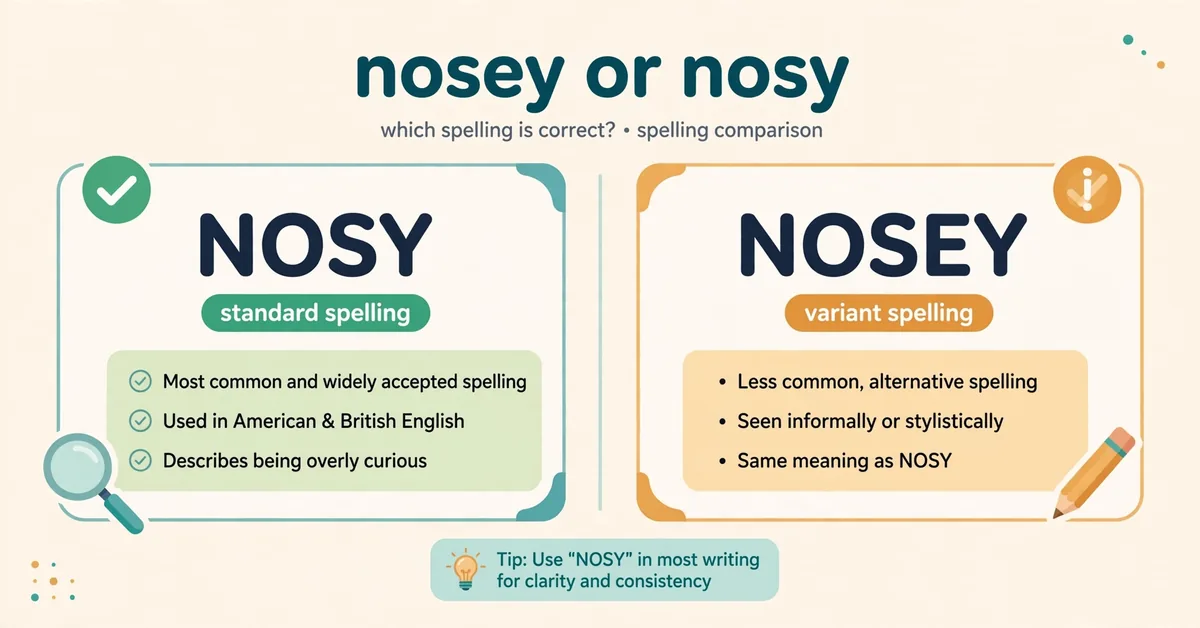
The short answer will settle your nerves: nosy is the standard, dictionary-first spelling in both American and British English, while nosey is a recognized variant of the exact same word. Same meaning, same pronunciation, one tiny spelling difference. The confusion exists for a good reason — “nosey” keeps the word’s root, “nose,” perfectly visible, which makes it feel like the more logical choice. English spelling, however, has a long-standing rule about what happens when you attach “-y” to a word ending in a silent “e,” and that rule is why dictionaries give top billing to “nosy.”
Below: what “nosy” means and why it is rarely a compliment, where “nosey” comes from, which spelling to use and when, real examples, the mistakes that trip writers up (including “nosy” vs “noisy”), and answers to the five most-asked questions.
What Does “Nosy” Mean?
Nosy is an adjective — informal in tone and usually disapproving — that describes someone who is excessively curious about other people’s private affairs. A nosy person asks questions that are none of their business, reads what they were not meant to read, listens at doors, or simply cannot resist commenting on choices that do not concern them. “Our nosy neighbor tracks every car that parks on the street.” “Stop being nosy about her wedding plans.” The word packs a small social judgment into four letters: it says the curiosity itself is the problem, not just the questions it produces.
The Negative Edge: Why “Nosy” Is Almost Never a Compliment
Here is where learners sometimes stumble. “Curious” and “inquisitive” can be positive — a curious child is delightful, an inquisitive scientist is admirable. “Nosy” has no such warm side. It always suggests curiosity that crosses a line: prying, meddling, intruding. Calling someone nosy is calling out bad behavior, even if you say it with a laugh among friends. “She’s just nosy” is not a neutral observation; it is a mild accusation.
On the other hand, curiosity about ideas rarely earns the label: a coworker asking how a new tool works is curious; one asking what you paid for your house is nosy. The target — other people’s private business versus the world in general — is why dictionaries tag the word as informal with disapproval.Word Forms: Nosier, Nosiest, Nosily, Nosiness
Like most short adjectives, “nosy” takes nosier (“He’s getting nosier every year”) and nosiest (“the nosiest guest at the party”). The adverb is nosily, and the noun is nosiness (“His nosiness finally drove his roommates to set boundaries”). Every derived form is built on “nosy,” never “nosey” — dictionaries standardize the whole word family around the shorter spelling, which is your first practical clue about which form wins in edited writing.
Synonyms and Opposites
When “nosy” feels too blunt, try prying or snoopy (same negative charge), meddlesome (emphasizes interfering), or inquisitive (can sound admiring). For the opposite meaning: discreet, reserved, or unobtrusive. In formal writing — HR documents, academic papers — these alternatives usually beat “nosy” itself, since the word is informal at its core even in its standard spelling.
What Does “Nosey” Mean — and Why Do Both Spellings Exist?
Nosey means exactly the same thing as “nosy”: overly curious, prying, intrusive about others’ affairs. It is not a different word, a different pronunciation, or a different shade of meaning. Major dictionaries — Merriam-Webster, Oxford, Collins — list “nosey” as a variant spelling of “nosy,” full stop. If someone tells you “nosey” is simply wrong, they are overstating the case; if someone tells you it is the better spelling, they are ignoring how dictionaries and style guides actually treat it.
The Etymology: It All Starts With “Nose”
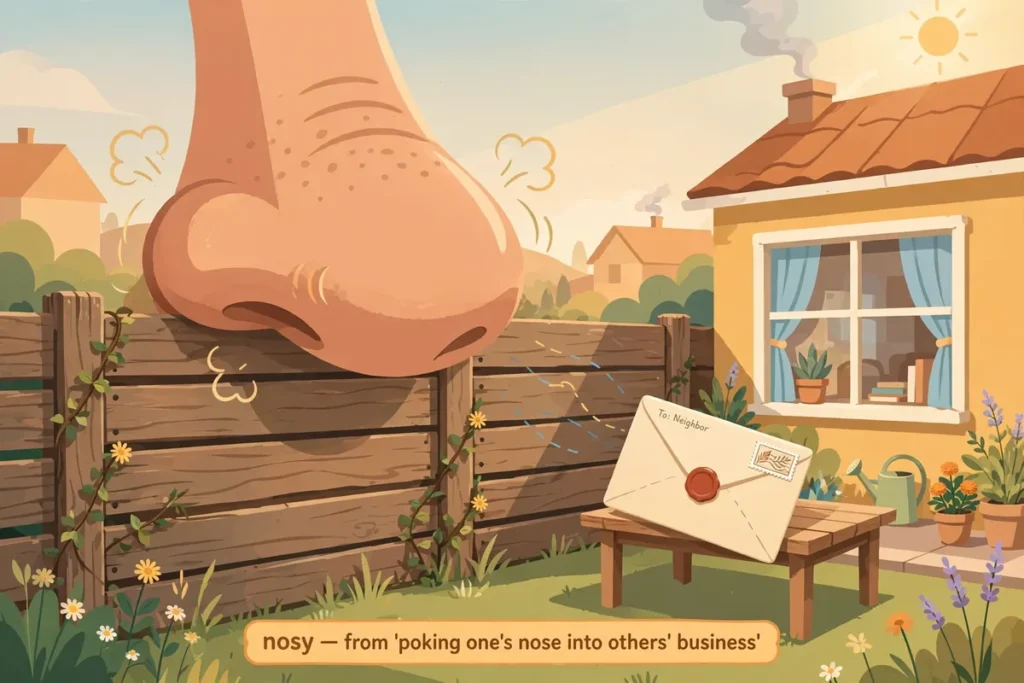
The word’s origin is refreshingly literal. “Nosy” first appeared in American English in the 1880s, formed from nose plus the adjective-forming suffix -y — the image of someone sticking their nose where it does not belong, as in the idiom “poke your nose into other people’s business.” That vivid picture is exactly why the “nosey” spelling refuses to die: keeping the full root “nose” visible preserves the logic and the visual pun.
The Spelling Rule That Crowned “Nosy”
So why does standard English prefer the shorter form? Because of one of the most consistent rules in English orthography: when you add a suffix beginning with a vowel sound to a word ending in a silent “e,” you drop the “e.” Nose plus -y becomes nosy, exactly as shine becomes shiny, spice becomes spicy, haze becomes hazy, and craze becomes crazy. The suffix -y behaves as a vowel-starting suffix, so the silent “e” does its usual disappearing act.
This is not a quirk invented for one word — it is a pattern applied across hundreds of words, which is why dictionaries treat “nosy” as the headword. “Nosey” breaks the pattern to preserve the root’s look; emotionally satisfying, but standard spelling rewards consistency. Think “shiny,” “spicy,” “hazy” — “nosy” belongs in the same tidy family.
Which Spelling Should You Use: Nosy or Nosey?
For the vast majority of writing, the answer is simple: use “nosy.” It is the spelling every major dictionary lists first, the one spell-checkers accept without complaint, and the one editors expect in published work. “Nosey” is not wrong, but it marks your writing as casual or old-fashioned, and in American edited prose it can look like a simple misspelling to a strict reader. If you were wondering which spelling a teacher, an employer, or an exam grader expects, that is your answer: “nosy,” every time.
What the Dictionaries Actually Say
The dictionary evidence is consistent and worth knowing. Collins lists “nosy” as the headword with “also nosey” as the variant, giving word forms nosier and nosiest and derived forms nosily and nosiness. The American Heritage Dictionary (via The Free Dictionary) enters it as “nos·y or nos·ey,” again leading with the shorter form. Webster’s New World traces it to “nose + -y” and dates it to 1880–85. No major dictionary reverses the order or prefers “nosey.” In corpus studies of published books and newspapers, “nosy” outnumbers “nosey” by a wide margin, and the gap has grown in recent decades as spell-checkers have standardized the shorter form.
Matching the Spelling to the Situation
Use nosy in formal and professional contexts without exception: academic papers, business reports, legal documents, published journalism, exams, and résumés. In everyday writing — emails, blogs, messages to friends — “nosy” is still the safer default, but “nosey” will not raise eyebrows in genuinely informal settings, especially in British English, where the variant has a stronger foothold in casual writing. Creative writers sometimes choose “nosey” deliberately for voice: a chatty narrator, a period piece, or dialogue for a character who would spell things their own way. That is a style choice, not an error — just make it on purpose and stay consistent.
The Consistency Rule
Whichever spelling you choose, do not mix them. A document that says “nosey” in paragraph two and “nosy” in paragraph five looks careless, because it signals that the writer never actually decided. Pick one form for the whole piece. In mixed-audience writing — a blog with American and British readers, for instance — default to “nosy,” since no reader in any region will mark it wrong, while some will mark “nosey” as a mistake.
Nosy vs Nosey at a Glance
Unlike a true word pair where each word means something different, there is no condition under which “nosy” and “nosey” diverge in meaning — they are one word wearing two spellings. The table below puts every practical difference side by side.
| Feature | Nosy | Nosey |
|---|---|---|
| Meaning | Overly curious, prying about others’ affairs | Identical — overly curious, prying about others’ affairs |
| Status | Standard spelling, listed first in all major dictionaries | Recognized variant spelling |
| Spelling logic | Follows the silent-e-drop rule (nose + -y) | Keeps the full root “nose” visible |
| Preferred in | American and British English, all formal writing | British informal writing, casual contexts |
| Formality | Correct everywhere, from texts to academic papers | Best kept to informal, conversational writing |
| Dictionary forms | nosier, nosiest, nosily, nosiness | Uses the same derived forms (nosier, nosiness) |
| Spell-checker | Accepted everywhere | Sometimes flagged in strict US settings |
| Frequency | Far more common in published writing | Noticeably rarer in edited prose |
Usage Examples in Real Life
The right spelling matters most when you can picture the sentence. Here is how “nosy” (and, in the right register, “nosey”) behaves across the three kinds of writing you do most.
Everyday Conversation
In speech, texts, and social media, either spelling passes unnoticed — pronunciation is identical, and nobody proofreads a voice message. Still, building the habit with “nosy” costs nothing and protects you everywhere else.
- “Stop being so nosy and mind your own business.”
- “My aunt is lovely, but she gets a little nosy about my love life at every family dinner.”
- “Sorry if this sounds nosy — I couldn’t help noticing the moving boxes. Are you leaving?”
- “The kids aren’t being nosy; they’re just curious about how the engine works.”
- “He asked, in that nosy way of his, exactly how much the renovation cost.”
Work and Business Writing
At work, prefer “nosy” and consider whether the word belongs at all. In a formal report, “The client’s questions were inquisitive” sounds professional; “The client was nosy” sounds like a complaint. Save the word for informal internal contexts: a Slack message (“our nosy competitor keeps asking about the launch date”), a lighthearted team email, or quoted speech.
- “Our nosy competitors keep fishing for details about the launch date.”
- “The survey responses suggest customers find the checkout questions a bit nosy — we should trim them.”
- “She gave him a nosy look when he mentioned the promotion.” (better in fiction than in an HR file)
If you must document prying behavior formally — say, in a workplace conduct note — choose neutral language: “asked repeated personal questions after being told the topic was private.” It says what happened without the slang.
Formal and Academic Writing
“Nosy” does appear in academic writing, usually when researchers describe social behavior: “Participants who scored higher on nosiness measures were more likely to seek personal information about strangers.” Even here, scholars often prefer “prying” or “intrusive curiosity” for a more neutral register. “Nosey” has no place in formal writing at all — an academic paper, a legal brief, or a published article should always use “nosy,” or better yet, a more formal synonym. In exams, the rule is absolute: write “nosy.” Graders match what dictionaries list first, and the variant spelling can cost you a mark with a strict reader.
Common Mistakes to Avoid
Mistake 1: Confusing “Nosy” With “Noisy”
This is the heavyweight error, and it is worth taking seriously. Nosy (pronounced NOH-zee) means prying and overly curious. Noisy (pronounced NOY-zee) means making a lot of sound. They look similar, they sound somewhat similar, and mixing them up produces sentences that confuse everyone: “The noisy neighbor kept asking about my salary” describes a loud neighbor, not a prying one — probably not what you meant.
- Nosy: “a nosy coworker” (asks too many personal questions)
- Noisy: “a noisy coworker” (types loudly, takes calls on speakerphone)
The fix is a two-second pronunciation check. If you can replace the word with “prying,” you want “nosy.” If you can replace it with “loud,” you want “noisy.” Spell-checkers will not save you here — both are valid words, so only your own attention catches the swap. This is the single most common error involving “nosy,” far ahead of any spelling debate.
Mistake 2: Writing “Noseyness” Instead of “Nosiness”
The noun form trips up careful writers: because “nosey” looks like a complete word, “noseyness” seems plausible — but the standard noun is nosiness. “Her nosiness eventually wore out everyone’s patience.” “Noseyness” appears rarely and informally; editors will correct it on sight. The same goes for the adverb nosily (not “noseyly”). Derive every form from “nosy” — nosier, nosiest, nosily, nosiness — and you will match every dictionary.
Mistake 3: Mixing Both Spellings in One Document
A subtler mistake is inconsistency. A blog post that uses “nosey” in the second paragraph and “nosy” in the fifth looks unfinished, as though two people wrote it or nobody proofread it. Readers may not consciously spot the switch, but the text feels slightly off — and a careful reader or editor will notice immediately. The fix is mechanical: after drafting, search your document for both spellings and standardize on one. In professional or academic work, that one should be “nosy.” Think of it like any other style decision — serial commas, date formats, “email” versus “e-mail” — where consistency matters more than which option you picked.
Tricky Cases and Edge Cases
Proper Nouns, Brand Names, and Pet Names
Never “correct” a proper noun. If a business is called “Nosey’s Bakery” or your dog is named Nosey, the spelling stays exactly as the owner wrote it — proper names play by their own rules. The British idiom “nosy parker” (a chronically prying person: “He’s a proper nosy parker, always asking about salaries”) is traditionally spelled with “nosy.” Quoting a title, username, or brand? Copy it letter for letter.
Informal and Creative Writing
Dialogue, text messages, social media captions, and first-person narration with a strong voice are the natural habitat of “nosey.” A teenager texting “ur so nosey lol” sounds authentic precisely because the spelling is informal. A historical novel set in the 1920s might use “nosey” for period flavor, since the variant was relatively more common in older writing. These are legitimate artistic choices. The key is intention: use “nosey” because the voice demands it, not because you are unsure which is standard. And keep it consistent within the voice — a narrator who writes “nosey” on page one should not switch to “nosy” on page fifty unless the narration itself changes.
British vs American Preferences
Here is where the regional nuance lives. In both American and British English, “nosy” is the standard spelling — that part is not regional. What is regional is tolerance for the variant: British informal writing uses “nosey” noticeably more often than American writing does, and British readers are less likely to flag it as an error in a casual context. American edited prose, by contrast, treats “nosey” almost as a misspelling. So the practical rule: if your audience is international or unknown, “nosy” is the only safe choice. If you are writing a casual piece specifically for a British audience — a personal blog, a chatty newsletter — “nosey” will read as friendly rather than wrong. Formal British writing, though, still prefers “nosy,” just like formal American writing.
Frequently Asked Questions
Is “nosey” a real word, or is it just a misspelling of “nosy”?
“Nosey” is a real word — a recognized variant spelling listed in major dictionaries including Collins, Merriam-Webster, and Oxford. It is not a typo or a mistake. However, it is the secondary spelling: “nosy” is the standard form that dictionaries list first and that style guides recommend. Think of it the way you think of “cancelled” versus “canceled” — both exist, but one is the default.
Which is correct: “nosey” or “nosy”?
“Nosy” is correct in the standard sense — it is the preferred spelling in American and British English and the one to use in formal, professional, and academic writing. “Nosey” is acceptable as an informal variant, especially in casual British writing. When you need one answer for an exam, a job application, or a published article, the answer is “nosy.”
Why do so many people spell it “nosey” instead of “nosy”?
Because “nosey” keeps the word’s root, “nose,” fully visible — and the word literally comes from the image of someone sticking their nose into other people’s business. That makes “nosey” feel like the logical spelling. What it misses is English’s silent-e rule: when you add the vowel-starting suffix “-y” to a word ending in silent “e,” the “e” drops, just as “shine” becomes “shiny” and “spice” becomes “spicy.” Logic favors “nosey”; the rulebook favors “nosy.”
What is the noun form — “nosiness” or “noseyness”?
The standard noun is nosiness: “His nosiness made every conversation exhausting.” All major dictionaries list “nosiness” as the derived noun, alongside the adverb “nosily” and the comparatives “nosier” and “nosiest.” “Noseyness” is occasionally seen in informal writing but is not the standard form, and editors will usually change it to “nosiness.”
What is the difference between “nosy” and “noisy”?
They are completely different words that happen to look alike. Nosy (NOH-zee) means prying or overly curious about others’ affairs: “a nosy neighbor.” Noisy (NOY-zee) means making a lot of sound: “a noisy neighbor.” Confusing them changes your sentence’s meaning entirely, so do the quick substitution test: if “prying” fits, write “nosy”; if “loud” fits, write “noisy.”
Conclusion
“Nosey” and “nosy” are not rivals — they are the same word in two outfits. One follows English’s silent-e rule into every dictionary’s headword slot; the other keeps its “nose” visible and survives on charm. For almost every sentence you will write, “nosy” is the right choice: standard on both sides of the Atlantic, accepted by every spell-checker, safe in every register from texts to dissertations.
The practical rule fits on a sticky note: write “nosy” by default, derive every form from it (nosier, nosiest, nosily, nosiness), never mix the two spellings in one document, and never confuse “nosy” with “noisy.” Save “nosey” for the moments when informality is the point — a playful text, a character’s voice, a pet’s name. Master that, and the hesitation that brought you to this guide will never slow you down again.
Explore more on Synonynmsof.