
Type the words “insure” and “ensure” out loud and you will hear the problem immediately: in everyday speech, they sound almost identical. Spell them on a page and the difference is a single letter. Yet that one letter separates two very different jobs in English. Choose the wrong one and your sentence quietly changes meaning, from promising that something will happen to buying financial protection against it going wrong. It is no wonder learners, native speakers, and even professional writers hesitate over this pair.
The confusion has deep roots. Both verbs grew out of the same Latin ancestor, “securus,” meaning free from care, and both passed through Old French on their way into English. For centuries the two words overlapped freely in print, with writers using “insure” where modern ears would expect “ensure.” That shared history is why dictionaries still list overlapping senses and why older books can look sloppy to a modern eye. Today, though, the distinction has hardened, especially in American English, where careful writers treat the two as separate tools with separate purposes.
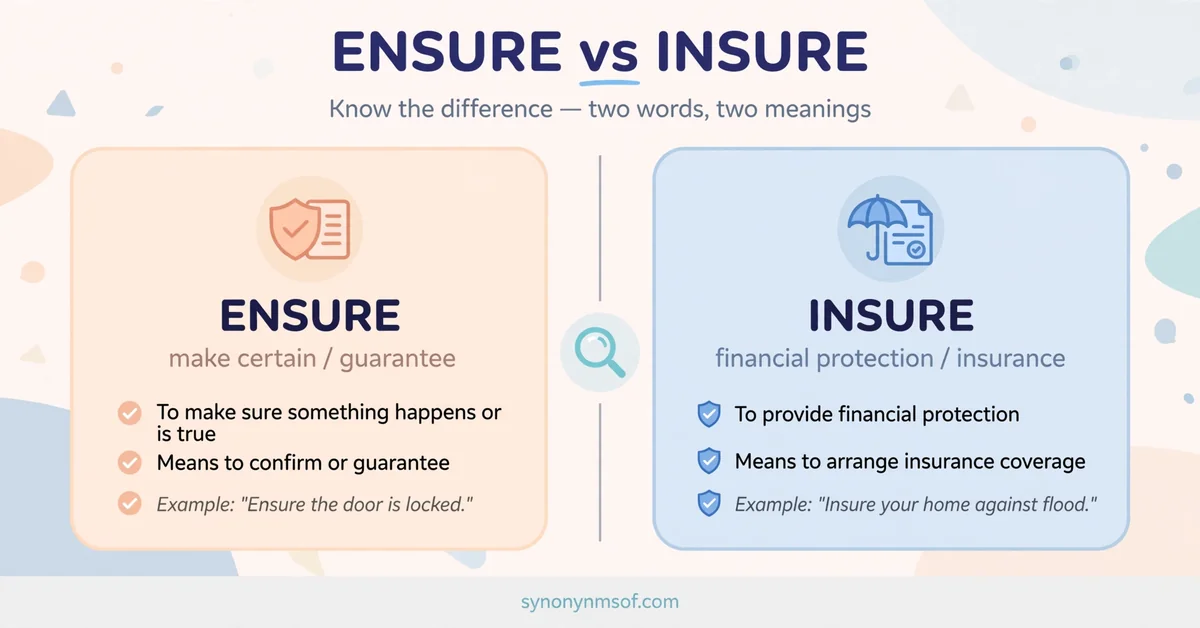
The practical rule is refreshingly simple once you see it. Use “ensure” when you mean to make certain or guarantee that something happens. Use “insure” when you mean to provide or obtain insurance, the financial safety net that compensates you after a loss. And if a third lookalike sneaks into your thoughts, that would be “assure,” the word you use when promising or reassuring a person. This guide unpacks each word with its own meaning, shows how they behave across everyday, business, and academic contexts, flags the common mistakes people make, and hands you a memory trick that makes the right choice nearly automatic.
What Does “Ensure” Mean?
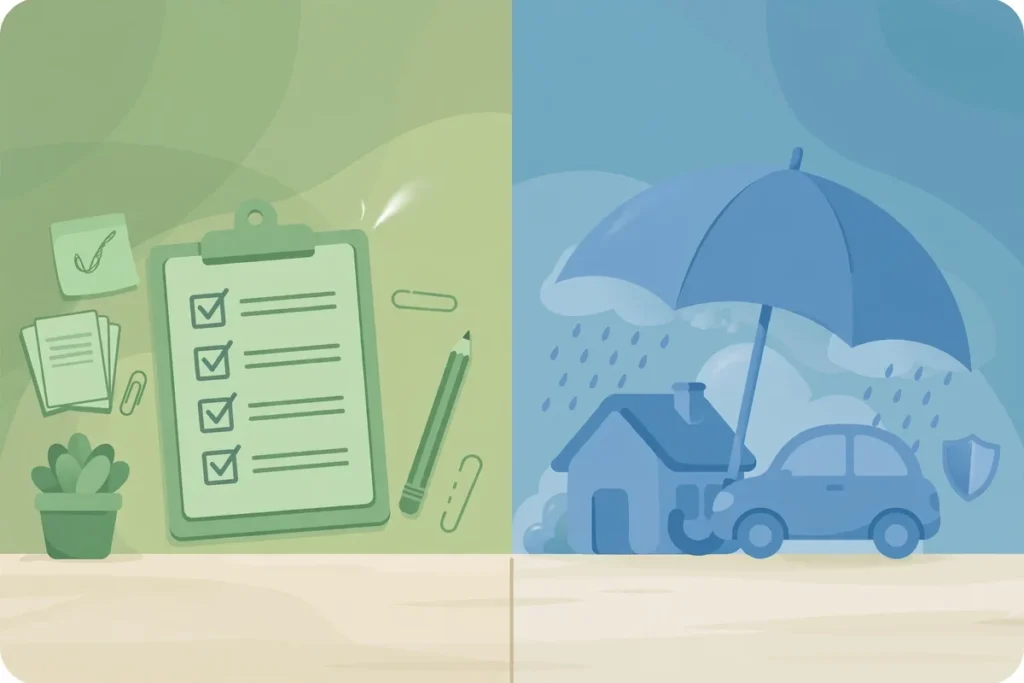
“Ensure” is the guarantee word. When you ensure something, you take action to make certain it happens, or you state with confidence that a result is certain. The word points forward to an outcome, a process, or a condition you want to lock in. “Please ensure the gate is locked before you leave.” “Regular backups ensure that no work is lost.” In both cases the subject is not buying anything or protecting anyone’s money; it is simply making sure of a result.
The grammar of “ensure” is flexible and friendly to long sentences. It commonly appears with a “that” clause: “The manager ensured that every invoice was paid on time.” It also takes a direct object or an infinitive phrase: “Double-check your answers to ensure accuracy.” You will often see it in instructions, policies, and procedures, because those are the places where people care most about guaranteed outcomes. Product manuals, safety checklists, and office emails are full of “ensure.”
It is worth noting that “ensure” never touches money. If an insurance policy, a premium, or a payout is involved, “ensure” is the wrong word. That is the sharpest edge of the distinction, and it settles most questions by itself. When you read a sentence and find yourself asking “is there an insurance contract here?” the answer tells you whether “ensure” belongs. No contract, no coverage, no claim form? Then “ensure” is your word, and you can move on with confidence.
What Does “Insure” Mean?
“Insure” belongs to the world of insurance. To insure something means to obtain, provide, or arrange insurance coverage for it — a financial agreement in which an insurer promises compensation if a specified loss occurs. “We insured the house against fire and flood.” “You cannot legally drive until you insure the car.” Here the word does not mean guaranteeing an outcome; it means buying a backstop in case the outcome goes badly.
The typical companions of “insure” give it away. It travels with objects like cars, houses, health, life, luggage, cargo, jewelry, and businesses, and with phrases like “against” a risk or “for” a sum of money. “The gallery insured the painting for two million dollars.” “The company insures its fleet against theft.” You will also meet its passive forms constantly in business writing: “Are your valuables insured?” “The shipment was fully insured.” Whenever those companions appear, “insure” is the right call.
A useful check is to ask whether the sentence still makes sense if you substitute the phrase “take out insurance on.” If “We need to insure the new office” becomes “We need to take out insurance on the new office” without changing the meaning, you have picked the right verb. If the substitution sounds absurd — “Please take out insurance on the gate being locked” — you actually meant “ensure.” That little test resolves the vast majority of borderline cases in a single second.
The Third Lookalike: What Does “Assure” Mean?
No guide to this pair would be complete without “assure,” the third sibling that keeps crashing the conversation. To assure someone is to promise them something confidently in order to remove doubt or worry. The crucial difference is that “assure” takes a person — or something that can feel anxiety — as its object. “She assured me that the flight would land on time.” “The doctor assured the worried parents that the procedure was routine.” You assure people, not outcomes.
That person-focused habit is what keeps “assure” out of the main rivalry. “Ensure” guarantees events and conditions; “assure” reassures people. “I ensure the payment is sent” means I make sure the payment goes through. “I assure you the payment is sent” means I promise you it went through. Both can be true at once, but they describe different acts: one is doing the guaranteeing, the other is giving the reassurance. Many careful writers keep this separation strict, and readers subconsciously expect it.
“Assure” also appears in a few fixed phrases worth knowing. In finance you may meet “assurance” as the noun, especially in British English, where life insurance policies are sometimes called “assurance” products. In everyday speech, the phrase “rest assured” survives as a set expression: “Rest assured, your reservation is confirmed.” None of these change the basic rule. If the sentence is about calming someone’s worry with a confident statement, “assure” is the word, full stop.
Insure or Ensure: The Key Difference
Strip away the history and you are left with one question to ask of any sentence: is insurance involved? If the answer is yes — a policy, a premium, a payout, protection against financial loss — write “insure.” If the answer is no, and the sentence is about making certain that something happens or is true, write “ensure.” That single question is the whole distinction, and it works in nearly every real sentence you will meet. “Ensure the figures are accurate” (no insurance involved). “Insure the figures against loss” — well, nobody writes that, but if they did, the policy would demand “insure.”
A Memory Trick That Actually Sticks
Two tiny hooks will carry this distinction for life. First, “insure” contains the letters “in-” at the start, exactly like the word “insurance.” Money words live in that “in-” family: insurance, income, investment, indemnity. If the sentence smells like money and risk, let that “in-” steer you to “insure.” Second, “ensure” is basically the word “sure” wearing a prefix. Think of it as “en-sure,” to make sure. If the sentence is about certainty, let “sure” steer you to “ensure.” Certainty starts with the letter S? Then “enSure” — with its S — is your guarantee word. Money starts with “in-“? Then “inSure” is your insurance word.
Side-by-Side Comparison
| Aspect | Ensure | Insure | Assure |
|---|---|---|---|
| Core meaning | To make certain, to guarantee | To provide or obtain insurance | To promise, to reassure a person |
| Typical object | An outcome, process, or condition | A person, property, or asset covered by a policy | A person who feels doubt or worry |
| Money involved? | Never | Always, directly or indirectly | Never |
| Example | “Please ensure the report is accurate.” | “They insured the car against theft.” | “She assured him it would be fine.” |
| Related noun | Assurance (certainty) | Insurance (financial protection) | Assurance (a promise) |
| Quick test | Substitute “make certain” | Substitute “take out insurance on” | Substitute “reassure” |
Usage Examples Across Real Contexts
In Everyday Conversation
Daily life offers the cleanest examples because the context is usually obvious. “Can you ensure the kids do their homework before dinner?” Nothing is being insured; a parent wants a guaranteed outcome. “Did you remember to insure your phone when you bought it?” That is a question about a protection plan, plain and simple. Notice how each sentence would break if you swapped the words: “ensure your phone” would mean guaranteeing the phone’s existence, which makes no sense, and “insure the kids do their homework” would suggest a homework insurance policy, which is comic rather than correct.
Mistakes in casual speech rarely cause harm, but they are exactly where the habit forms. People who say “just insure it gets done” in conversation will eventually write “insure” in an email where precision matters. Training your ear in low-stakes talk — noticing the word the moment it leaves your mouth — is the easiest way to make the written form automatic. The distinction, after all, is one you make hundreds of times a year without realizing it.
In Work, Business, and Legal Writing
Professional writing is where the two words most often collide, because both appear constantly. Contracts and policies guarantee outcomes with “ensure”: “The supplier shall ensure delivery within ten business days.” “The bank takes steps to ensure the security of customer data.” Insurance departments, on the other hand, protect assets with “insure”: “The company insures its inventory against fire, theft, and flood.” “Employees are insured under the group health plan.”
Legal documents are especially strict, because a single wrong letter can shift liability. “The contractor shall ensure compliance with all safety regulations” places a duty to make compliance happen. “The contractor shall insure the project against third-party claims” places a duty to buy a policy. Lawyers, editors, and compliance officers treat this as non-negotiable, which is why the distinction shows up in style guides for banks, law firms, and government agencies. If your career touches formal documents, mastering this pair is not decorative; it is part of the job.
In Formal and Academic Writing
Academic writers favor “ensure” and use it heavily: “Random sampling ensures that the results are representative.” “The study design ensures the validity of the findings.” Here the word carries the weight of methodological certainty — the researcher is claiming that a procedure guarantees the reliability of a result. Reviewers and examiners notice when this word is misused, because academic prose is read with unusual care.
“Insure” appears in academic writing too, but only where finance and risk enter the topic: economics papers on insurance markets, public policy studies of health coverage, actuarial research. “Most homeowners in flood zones fail to insure their properties adequately.” The rule does not change with the register; it only becomes more visible. Whether the sentence wears a suit or a lab coat, ask the insurance question and the answer is still the answer.
Common Mistakes to Avoid
The most frequent error is using “insure” where “ensure” belongs: “Please insure that all forms are signed before submission.” There is no policy, no premium, and no payout involved — the writer simply means “make certain.” The fix is one letter: “Please ensure that all forms are signed before submission.” This mistake is so common that many editors keep a standing instruction to search every document for “insure” and check each one.
The reverse error happens too, though less often: “We ensured our luggage before the trip.” You cannot guarantee your luggage; you can only protect it financially if it goes missing. The correct verb is “insured.” A good proofreading pass catches both by running the substitution tests: “make certain” for “ensure,” “take out insurance on” for “insure.” If the substituted sentence sounds wrong, the original word is wrong.
A subtler trap is the phrase “ensure success” versus “insure success.” Because success is an outcome, not a financial asset, the correct form is “ensure success” — taking steps to guarantee it. “We redesigned the process to ensure success.” Writing “insure success” suggests a success insurance policy, which is metaphorical at best and confusing at worst. I was wondering how many writers have fallen into this one over the years; the answer, judging by published errors, is a great many.
Another persistent mistake involves the passive voice. “The documents are ensured” is wrong if the meaning is that the documents are covered by a policy — that should be “the documents are insured.” But be careful going the other way: “The result is insured” is wrong if you mean the result is guaranteed — that should be “the result is ensured.” The passive form does not change the rule; it only hides it behind an extra verb.
Finally, watch out for spell-check complacency. Both words are correctly spelled, so no red squiggle will save you. This is a meaning error, not a spelling error, which means only knowledge — or a careful editor — catches it. Reading the sentence aloud and asking the insurance question remains the most reliable defense.
Tricky Cases and Edge Cases
British vs. American Usage
History left its fingerprints here. In older and some contemporary British writing, “insure” has traditionally done double duty, covering both the insurance sense and the guarantee sense. You may still find British authors writing “insure the success of the project” where an American editor would insist on “ensure.” Modern British style guides increasingly recommend keeping the two separate, but the older habit has not vanished, so encountering it in British publications does not always mean the writer made a mistake.
American English, by contrast, draws the line sharply: “ensure” for certainty, “insure” for insurance, with very little tolerance for crossover. International writers and non-native speakers face a small dilemma as a result. The safest choice for global readers is the strict American-style distinction — “ensure” for guarantees, “insure” for policies — because it is understood correctly on both sides of the Atlantic. Nobody will mark it wrong; at worst, a few traditionalists will find it fussy, and fussiness is a forgivable sin.
Insurance vs. Assurance: The Nouns
The nouns follow the same logic with one extra wrinkle. “Insurance” is the financial product: car insurance, health insurance, travel insurance. “Assurance,” in most contexts, means a promise or a confident statement: “He gave me his assurance that it would be done.” But British financial English adds a curveball — “assurance” is sometimes used for life insurance products, as in “life assurance” or “assurance company.” So a British “assurance policy” may in fact be an insurance policy. When you meet “assurance” in a financial text, check the context before translating it as “a promise.”
Set Phrases and Idioms
Fixed expressions deserve special attention because they fossilize one choice. “Ensure success” is correct; “insure success” is not, for the reasons already covered. The phrase “rest assured” is correct with “assure,” and substituting either of the other words breaks it. In formal writing you will meet constructions like “measures were taken to ensure compliance,” “the agreement ensures continuity of service,” and “we insured the cargo for its full value.” Notice that each picks its verb according to the insurance question, even though the sentences are otherwise very similar. The pattern holds: outcome or condition, “ensure”; policy or premium, “insure”; a person being calmed, “assure.” If time permits, read through your own recent writing and check each occurrence against this pattern — most people find at least one that needs fixing.
Frequently Asked Questions
What is the difference between insure and ensure?
“Ensure” means to make certain or guarantee that something happens, while “insure” means to provide or obtain insurance, which is financial protection against loss. You ensure that the report is finished on time; you insure your car against accidents. The quick test is to ask whether an insurance policy is involved: if yes, use “insure”; if no, use “ensure.”
Can insure and ensure be used interchangeably?
In modern American English, no — the two words have distinct meanings and careful writers keep them separate. Some older British usage allowed “insure” to cover both senses, and dictionaries may still note that overlap, but using them interchangeably today confuses readers. The clearest practice everywhere is to reserve “ensure” for certainty and “insure” for insurance.
Where does assure fit in?
“Assure” means to promise or reassure a person in order to remove doubt or worry: “She assured me everything would be fine.” Unlike the other two, it takes a person as its object. Remember it this way: you ensure outcomes, you insure assets, and you assure people.
Is it “ensure success” or “insure success”?
It is “ensure success.” Success is an outcome you want to guarantee, not a financial asset you can buy a policy for, so the guarantee word applies. Writing “insure success” would suggest a literal insurance policy covering success, which is not what anyone means.
How do I remember the difference between insure and ensure?
Use two hooks. “Insure” begins with “in-,” just like “insurance,” “income,” and “investment” — the money family. “Ensure” contains the word “sure,” so think of it as “en-sure,” to make sure. When you see money and risk, pick “inSure”; when you see certainty and guarantees, pick “enSure.” This shows how a tiny spelling clue can carry a whole distinction.
Conclusion
The insure-or-ensure question looks intimidating because the two words share a sound, a shape, and a family history, but the working rule is one of the simplest in English. Insurance involved? Write “insure.” No insurance, just a guaranteed outcome? Write “ensure.” A person who needs reassuring? That is “assure,” then step back and let the promise do its work. One question, asked of every sentence, resolves nearly every case.
Making that question a reflex is the real prize. Once the insurance test becomes automatic, the right word arrives without hesitation, in emails and essays alike, and your writing gains a quiet precision that readers feel even when they cannot name it. So run the test on your next draft, fix the one letter that needs fixing, and enjoy the small, solid satisfaction of a word pair finally under control.
Explore more on Synonynmsof.