
Drier or dryer? It is one of those questions that makes confident writers freeze. You are describing the weather, or the towel, or the machine in the laundry room — and suddenly you cannot remember which spelling is which. One letter changes everything: an “i” in one, a “y” in the other, and the two words belong to completely different parts of speech. It is a small trap hiding in plain sight.
The confusion is understandable because the two words sound identical and sit side by side in the dictionary. For most of English history they were even spelled interchangeably. But modern English has settled the matter: each spelling now has its own job, and mixing them up is the kind of small error that editors, teachers, and hiring managers notice. A single wrong letter can make a polished document look careless.
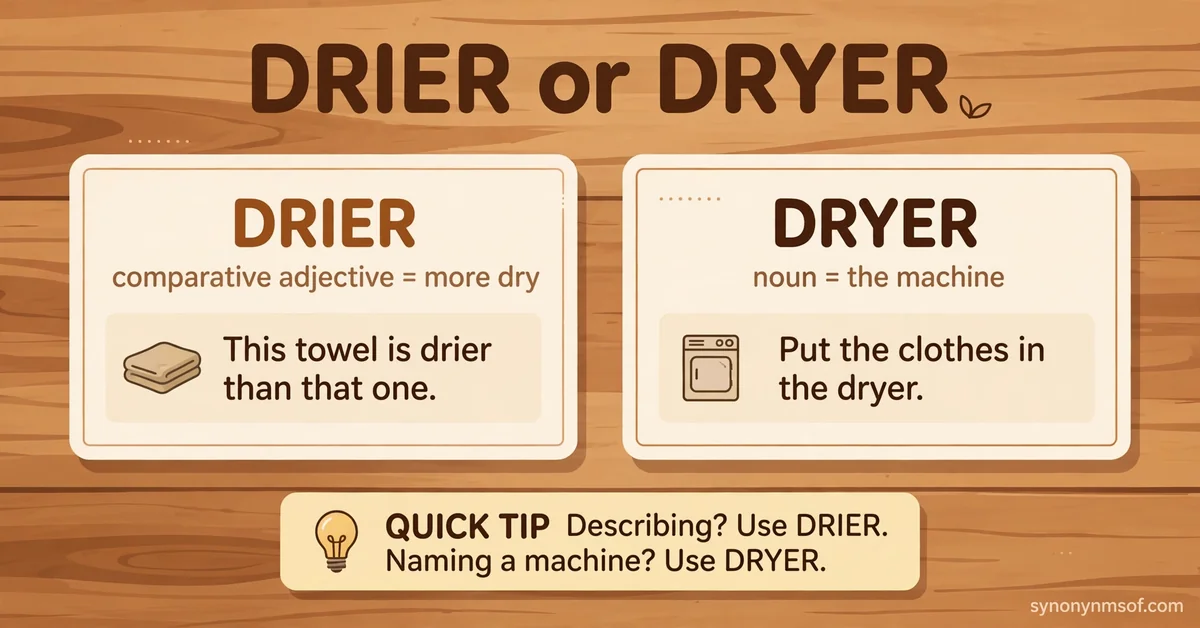
Here is the quick answer before we go deep. Drier (with an “i”) is a comparative adjective meaning “more dry” — as in “this towel is drier than that one.” Dryer (with a “y”) is a noun meaning a machine or device that removes moisture — as in “put the clothes in the dryer.” Remember that pairing, and you will get it right nearly every time. The rest of this guide explains exactly why, shows you real examples from everyday life, work, and formal writing, walks through the common mistakes, and answers the five questions people ask most about this tricky pair.
What Does “Drier” Mean?
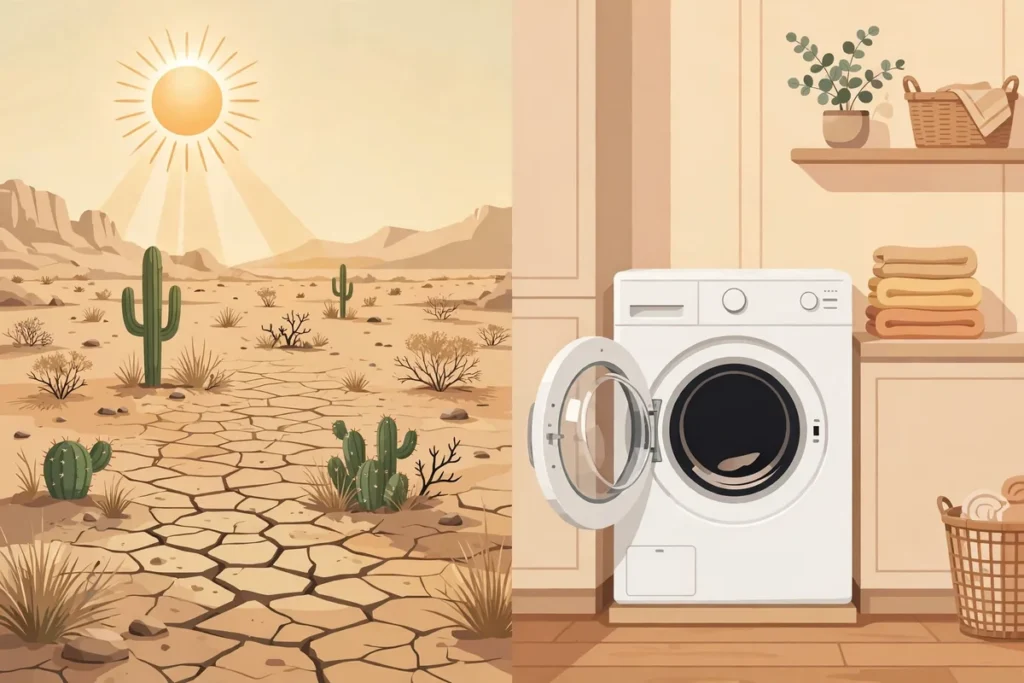
Drier is the comparative form of the adjective “dry.” It describes something that has less moisture than something else. When you say “this towel is drier than that one,” you are comparing two towels and reporting that one contains less water. The word answers the question “which one is more dry?” — nothing more, nothing less. It is a pure describing word, doing the classic job of an adjective: telling us about the quality of a thing.
The base adjective “dry” simply means free from moisture or liquid: dry clothes, dry weather, dry soil. To compare two things, English adds “-er” to short adjectives — tall becomes taller, fast becomes faster, and dry becomes drier. Because “dry” ends in a consonant plus “y,” the “y” changes to “i” before the ending is added, giving us the spelling “drier.” That little “i” is doing real grammatical work: it is the fingerprint of the comparative form.
You will meet “drier” most often in physical comparisons of moisture. “The air gets drier in winter.” “This cake came out drier than the last one.” “The western side of the mountain is drier than the eastern side.” In each case, the word compares two levels of dryness, and swapping in “dryer” would change the part of speech — and usually the meaning.
The Comparative Adjective in Action
Comparative adjectives like “drier” always imply a comparison, even when the other side of the comparison is left unsaid. “It feels drier today” really means “drier than yesterday” or “drier than usual.” The comparison can be explicit with “than” — “Sahara air is drier than coastal air” — or implied by context. This is the standard pattern for one-syllable adjectives, and “drier” follows it perfectly.
Note that for longer or more formal constructions, English also allows “more dry”: “a more dry climate.” Both are grammatical, but “drier” is far more common and natural in everyday use. Style guides overwhelmingly prefer “drier” for the comparative, reserving “more dry” for special emphasis. The superlative follows the same pattern: “driest,” as in “August is the driest month of the year.”
“Drier” Beyond Moisture: Figurative Uses
Like many physical adjectives, “drier” has grown figurative meanings. A “drier sense of humor” means humor that is understated, deadpan, and delivered without obvious emotion — the opposite of broad, slapstick comedy. A “drier” novel or essay is one written in a restrained, matter-of-fact style. A “dry” wit is subtle; a “drier” wit is subtler still.
You will also meet “drier” in specialized fields. Wine descriptions use “dry” for wines low in sugar, so “a drier wine” has less sweetness than another. In painting, “drier” (the noun sense, which we will untangle below) can also mean a substance added to paint to speed drying — but as an adjective, “drier paint” simply means paint that has lost more moisture. The key habit is the same: whenever the word is describing a quality — literal or figurative — the “i” spelling is the right call.
What Does “Dryer” Mean?
Dryer is a noun. It names a thing — specifically, a machine or device that removes moisture from something. The clothes dryer in your laundry room, the hair dryer on your bathroom counter, the hand dryer on the restroom wall: all of them are “dryers” with a “y.” The word does not describe a quality; it identifies an object you can point at, buy, plug in, and (eventually) replace.
The logic behind the spelling is simple and worth memorizing. A “dryer” is a thing that dries — just as a “washer” is a thing that washes, a “printer” is a thing that prints, and a “toaster” is a thing that toasts. English builds these agent nouns by adding “-er” to the verb, and here the “y” stays put because there is no comparative happening. Washer and dryer go together as a pair; if you can remember that household duo, you will never misspell the machine again.
Types of Dryers You Will Meet
The most familiar dryer is the clothes dryer (called a “tumble dryer” in British English), the large appliance that tumbles wet laundry in hot air. Then there is the hair dryer (often written as one word, “hairdryer,” in British usage), the handheld device that blows warm air to dry and style hair. Public restrooms have hand dryers, wall-mounted units that blast air to dry your hands. Beyond the home, industry uses grain dryers for harvested crops, paint dryers and industrial dryers in manufacturing, and freeze dryers in food processing and laboratories. Every one of these is spelled with a “y.”
The “-er” Noun Pattern: Why It Helps
The “-er” ending is one of English’s most productive noun builders: it turns an action into the thing that performs it. Teach becomes teacher, write becomes writer, bake becomes baker. “Dryer” fits the pattern exactly: dry (the action) + -er (the thing that does it) = dryer (the thing that dries). This is a genuinely useful memory trick. When you mean the machine, think of its partner “washer” — and spell it with the “y,” just like washer keeps its spelling unchanged.
One more detail worth knowing: dictionaries do list “drier” as a secondary noun variant for a drying device or substance (a paint drier, for instance). This is a leftover from the centuries when the spellings were interchangeable. In modern standard usage, though, style guides and editors strongly prefer “dryer” for any machine — Merriam-Webster notes that a drying device is “usually dryer.” Stick with the modern split and you will always look correct.
Drier or Dryer: The Key Difference
Strip away the history and the fine print, and the difference is a clean one: part of speech. “Drier” is an adjective (a describing word); “dryer” is a noun (a naming word). They answer different questions. “Drier” answers “how dry is it compared to something else?” “Dryer” answers “what is that machine called?”
This is why the pair produces such satisfying test sentences. “My hair is drier now, thanks to my new hair dryer.” Both spellings appear, each doing its own job: “drier” describes the hair, “dryer” names the device. Try swapping them — “My hair is dryer now, thanks to my new hair drier” — and the sentence wobbles. The first “dryer” now looks like a misspelled adjective, and the second “drier” looks like an old-fashioned machine. A reader might still understand you, but the polish is gone.
The practical rule could not be simpler. If you can replace the word with “more dry” and the sentence still works, write “drier.” If you can replace it with “the machine” or “the appliance” and the sentence still works, write “dryer.” “This towel is more dry than that one” works, so “drier” it is. “Put the clothes in the machine” works, so “dryer” it is. Run that two-second test every time and the confusion disappears.
Drier vs Dryer: Comparison at a Glance
| Feature | Drier | Dryer |
|---|---|---|
| Part of speech | Adjective (comparative) | Noun |
| Core meaning | More dry; less moist than something else | A machine or device that removes moisture |
| Pronunciation | “DRY-er” | “DRY-er” (identical) |
| Base word | dry (adjective) | dry (verb) + -er |
| Example (typical) | “The air is drier in winter.” | “The dryer stopped mid-cycle.” |
| Can it describe something? | Yes — that is its whole job | No |
| Can it name a machine? | Only as an old dictionary variant — avoid | Yes — the standard modern spelling |
| Superlative partner | driest | — |
| Memory hook | The “i” is for “comparative,” like bigger, thinner | Think “washer and dryer” — the pair rhymes |
| Common in compounds | — | hairdryer, tumble dryer, washer-dryer |
Why Do Both Spellings Exist?
The two spellings exist because they were once the same word. For most of English history, “drier” and “dryer” were simply interchangeable variants — writers used whichever looked right, and no one distinguished an adjective from a noun by spelling. Dictionaries of the 19th and early 20th century listed them as alternatives without assigning different meanings.
The split happened gradually through the 20th century. As household appliances like the clothes dryer and hair dryer became everyday objects, writers needed a clean way to separate the machine from the description — and the “y” spelling attached itself to the noun while the “i” spelling kept the comparative. Grammarist notes that the distinction “crept into the language through the 20th century and has only recently solidified.” By the 21st century, the separation was the standard in published writing on both sides of the Atlantic.
Dictionaries still carry the history: most list each spelling as a variant of the other. But modern usage guides are nearly unanimous — “drier” for the adjective, “dryer” for the machine. This is the classic life cycle of an English spelling distinction: chaos, then convention. Your job is simply to follow the convention that won.
Usage Examples Across Contexts
Seeing the pair in real sentences across different registers cements the difference faster than any rule.
Everyday Conversation
In daily speech, both words appear constantly. “It’s much drier today than it was yesterday — good day to hang the laundry.” “Can you grab the clothes out of the dryer?” “Her sense of humor is drier than mine; I never know when she’s joking.” “The hair dryer is in the top drawer.” Notice how naturally the two spellings coexist in ordinary talk — one describing, one naming.
Work and Business Writing
Professional writing rewards precision, and this is exactly where the distinction pays off. A facilities email might read: “The hand dryer in the second-floor restroom is out of order.” A product description: “Our new model is 20% drier on delicates than the previous version.” A weather-dependent logistics note: “Conditions will be drier on Thursday, so outdoor work can proceed.” In each case, the wrong spelling would look like a typo to a careful reader — and in business, careful readers are the ones who matter.
Academic and Formal Writing
Formal prose uses “drier” for precise comparisons and “dryer” for technical equipment. A climate paper: “The region became progressively drier during the late Holocene.” A lab report: “Samples were placed in the freeze dryer for 48 hours.” An art-history essay: “His later prose is drier and more detached than the exuberance of his early work.” Academic style guides expect the modern split without exception, so getting it right here is non-negotiable.
Common Mistakes to Avoid
Mistake 1: Using “dryer” as an adjective. “The weather is dryer today” is the single most common error with this pair. The weather is being described, so the adjective “drier” is required: “The weather is drier today.” If you were wondering which spelling the dictionary prefers for a description, it is always the one with the “i.”
Mistake 2: Using “drier” for the machine. “Put the clothes in the drier” reads as old-fashioned or simply wrong to modern readers. The appliance is a “dryer” with a “y”: “Put the clothes in the dryer.” Then move on — no one will ever question it.
Mistake 3: Mixing them up in the same sentence. “After using the drier, my hair feels dryer than ever” gets both wrong at once. The correct version shows the pair working properly: “After using the dryer, my hair feels drier than ever.” When both appear together, slow down and assign each its role.
Mistake 4: Assuming they are interchangeable. Because dictionaries list them as variants, some writers conclude it does not matter. It does — at least to editors, teachers, and style guides. “Interchangeable in the dictionary” and “interchangeable in good writing” are very different things. This shows how a technically listed variant can still be the wrong choice in practice.
Mistake 5: Misspelling the comparative as “dryer” in comparisons with “than.” Any time you see “than” nearby — “drier than,” “much drier than,” “even drier than” — the adjective is at work and the spelling must be “drier.” The word “than” is your flashing signal.
Mistake 6: Writing “more drier.” Doubling the comparative is a classic error: “This is more drier than that.” Pick one — “drier” or “more dry” — never both. “This is drier than that” is the natural choice.
Mistake 7: Forgetting the “y-to-i” pattern. Some writers produce “dryer” for the comparative because they simply add “-er” to “dry” without changing the “y.” The rule for consonant + y is firm: the “y” becomes “i” — dry to drier, just as happy becomes happier and heavy becomes heavier.
Tricky Cases and Edge Cases
“Drier” as a noun for paint additives. In painting and chemistry, a “drier” (with an “i”) is a substance added to paint or varnish to speed up drying — cobalt drier, for example. This is the legitimate surviving noun use of the “i” spelling, and it is the one place where “drier” names a thing. Outside of paint chemistry, though, treat it as a curiosity, not a license.
British vs American English. There is no meaningful transatlantic split here. Both American and British English use “dryer” for the appliance (Brits say “tumble dryer” and often write “hairdryer” as one word) and “drier” for the comparative. Dictionaries on both sides list the same variants. This is one spelling question where the Atlantic changes nothing.
Compound words: hairdryer, washer-dryer, tumble dryer. Compounds built on the machine always use the “y”: hairdryer, washer-dryer, spin dryer, tumble dryer. If you are ever unsure about a compound, ask whether it names equipment. If yes, it is “dryer” territory.
“More dry” vs “drier.” Both are grammatical, but “drier” is the default in modern prose. “More dry” survives mainly for rhythm or emphasis, or when the adjective is part of a longer phrase. In 95% of cases, write “drier.”
Comparatives of “dry” in negative comparisons. “Less dry” is the natural opposite of “drier”: “This towel is less dry than that one” means the same as “that one is drier.” Writers sometimes tangle these; keep the direction of the comparison straight and the spelling follows.
The “dryest” trap. The superlative of “dry” is “driest,” not “dryest.” The same y-to-i rule applies before “-est.” “Driest” pairs with “drier” the way “happiest” pairs with “happier.”
When spellcheck will not save you. Both “drier” and “dryer” are valid dictionary words, so no spellchecker will flag a mix-up. This is exactly the class of error — the wrong-but-real word — that only knowledge catches. Proofread these two by meaning, not by red underlines.
Frequently Asked Questions
Is it “drier” or “dryer” for the weather?
Use “drier.” Weather is being described, so you need the comparative adjective: “Today is drier than yesterday.” The “i” spelling compares levels of dryness, which is exactly what a weather report does.
Is it “hair drier” or “hair dryer”?
Use “hair dryer” (or “hairdryer” as one word in British English). It is a machine — a thing that dries hair — so the noun spelling with a “y” is correct. The same goes for clothes dryer, hand dryer, and tumble dryer.
Can “drier” ever be a noun?
Yes, but only in narrow technical use: a “drier” is a chemical added to paint to speed drying. Dictionaries also list it as an older variant for drying machines. In everyday modern writing, use “dryer” for any machine and keep “drier” for the adjective.
What is the difference between “drier” and “more dry”?
Almost nothing — both are grammatical comparatives. “Drier” is the standard, natural choice in nearly all writing. “More dry” is reserved for special emphasis or rhythm. When in doubt, write “drier.”
How do I remember which is which?
Two tricks. First, the substitution test: if “more dry” fits, write “drier”; if “the machine” fits, write “dryer.” Second, the pair test: think of “washer and dryer” — the machine rhymes with washer and keeps its “y,” while the adjective changes its “y” to “i” like happy to happier.
Conclusion
Drier and dryer look like a coin flip, but they are really a clean division of labor. “Drier” with an “i” does the describing — it is the comparative adjective that tells you one thing holds less moisture than another, whether that thing is a towel, the weather, or someone’s sense of humor. “Dryer” with a “y” does the naming — it is the noun for the machine that does the drying, from the laundry room to the salon to the factory floor. One letter, two jobs, zero overlap in modern standard usage.
The habit that fixes this pair for good takes two seconds. Before you write the word, ask what it is doing in your sentence. Describing? Write “drier.” Naming a machine? Write “dryer.” Run that test, remember “washer and dryer,” and watch for “than” as the adjective’s signal — and this particular spelling trap will never catch you again.
Explore more on Synonynmsof.