
Few one-letter spelling differences cause as much quiet confusion as gases or gasses. They sound exactly the same when spoken, they look nearly identical on the page, and both spellings are technically real English words — yet they do completely different jobs in a sentence. Swap one for the other and your writing can look careless, especially in science writing, business documents, and academic work where precision matters.
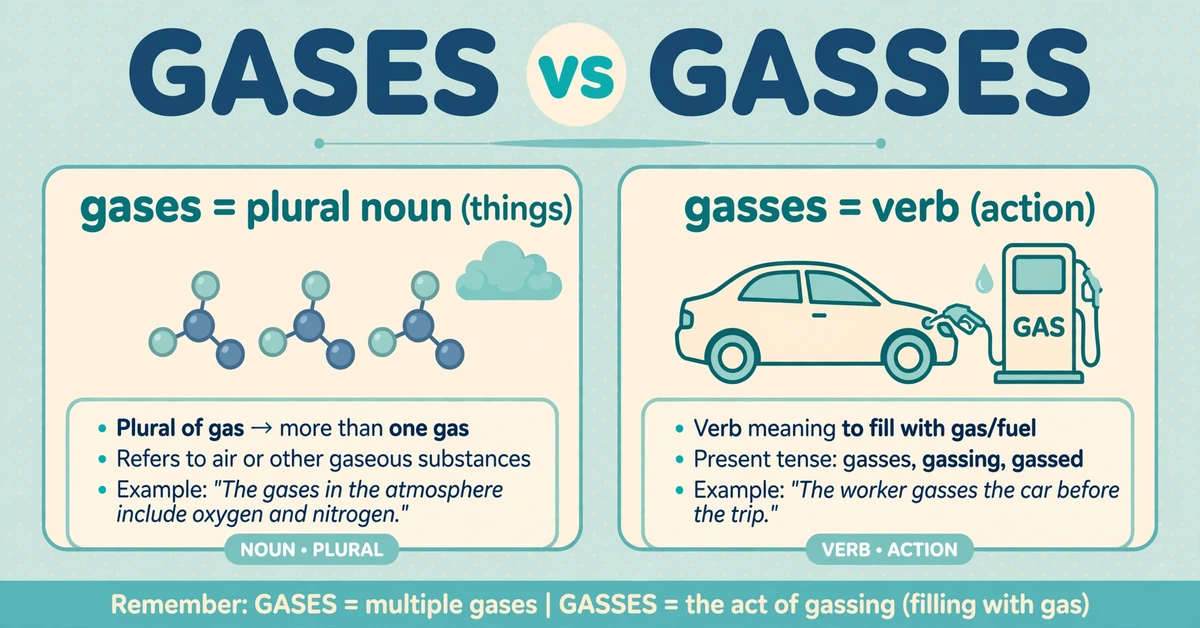
The short answer is refreshingly simple: gases is the plural noun form of “gas” (more than one type of gas), while gasses is a verb — the third-person singular present form of “to gas,” as in “he gasses up the car.” One letter really does change everything here, and once you learn the rule behind it, you will never mix them up again.
But there is a little more going on beneath the surface. English spelling rules for plurals and verbs work differently, style guides have weighed in, and there are a few tricky edge cases — from chemistry labs to old newspaper headlines — that make this pair worth understanding properly. This guide walks through the meaning of each spelling, the difference between them, plenty of real usage examples, the mistakes most people make, and answers to the most common questions.
What Does “Gases” Mean?
“Gases” is the standard plural form of the noun “gas.” Whenever you are talking about more than one gas — more than one type, kind, or instance of it — “gases” with a single “s” is the correct choice. This is the spelling used across science, medicine, journalism, business, and everyday writing, in both American and British English.
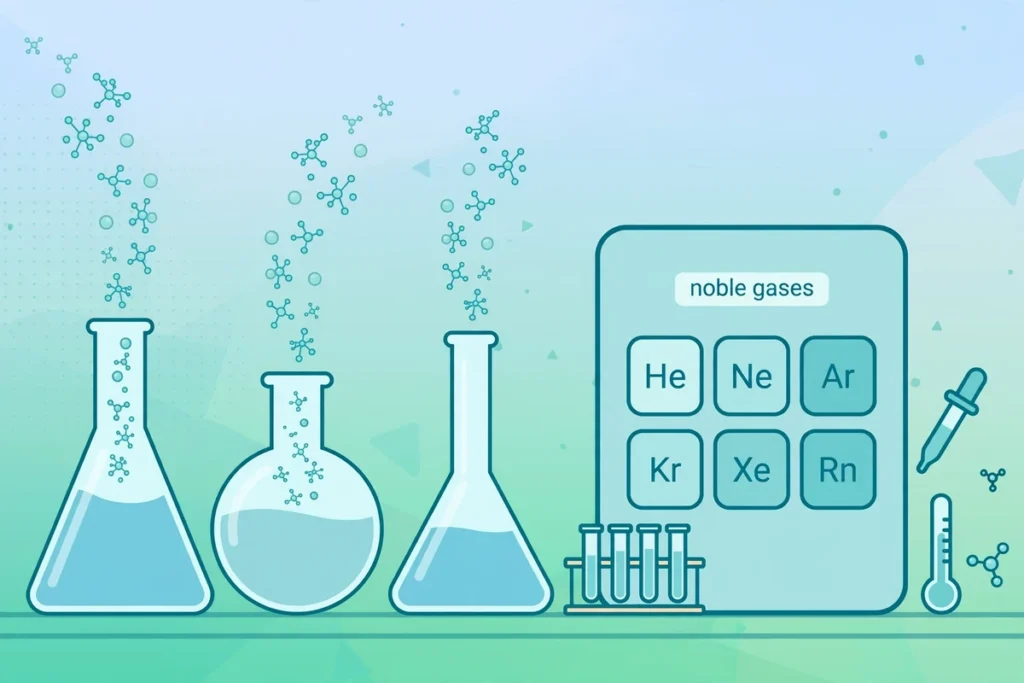
The word “gas” itself entered English in the 17th century, adapted from the Greek word khaos (meaning “void” or “empty space”), and its plural spelling settled long ago as “gases.” Modern dictionaries, including Merriam-Webster and the Oxford English Dictionary, list gases as the standard plural noun. It appears in famous phrases like “greenhouse gases,” “noble gases,” and “natural gases” — spellings you will see in every textbook and research paper.
When to Use “Gases”
You reach for “gases” whenever “gas” is a thing, not an action. That covers a surprisingly wide range of contexts:
- Physical substances and states of matter: oxygen, carbon dioxide, helium, and methane are all gases. The atmosphere is a mixture of gases, and the noble gases on the periodic table have unique properties.
- Environmental and industrial contexts: greenhouse gases trap heat in the atmosphere, exhaust gases leave a vehicle’s tailpipe, and industrial gases are used in welding, food packaging, and medicine.
- Medical and biological uses: doctors monitor blood gases, anesthesiologists administer anesthetic gases, and the human digestive system produces — well — gases that are best discussed politely.
- The shortened form of “gasoline” (American English): “Only certain gases work well in my old truck,” meaning grades of gasoline. This use is informal but common in American speech.
Examples of “Gases” in Sentences
- The atmosphere contains a mixture of gases, mostly nitrogen and oxygen.
- Different gases expand at different rates when heated.
- Scientists measured the release of volcanic gases after the eruption.
- Greenhouse gases are the main driver of climate change.
- The hospital stores medical gases in clearly labeled cylinders.
- Some noble gases, like argon and neon, rarely react with anything.
Why It Is “Gases” (Not “Gasses”)
Here is the spelling logic: when you make a noun plural in English, you generally just add “-s” or “-es” without doubling anything. The word “gas” ends in “s,” and words ending in s, x, z, ch, or sh need an extra syllable to be pronounceable, so we add “-es.” That gives us gases — pronounced with a short “a,” just like “buses” (the plural of “bus”).
It is true that English has a consonant-doubling rule, but that rule applies to verbs being conjugated, not to nouns being pluralized. This is why the noun keeps a single “s” while the verb form doubles it — a distinction we will unpack fully in the next section.
What Does “Gasses” Mean?
“Gasses” is a verb form: the third-person singular present tense of “to gas.” In other words, it describes what he, she, it, or a singular noun does. You will meet it in sentences about filling something with gas, exposing someone or something to gas, or — in informal speech — chatting at length.
The verb “to gas” has several distinct meanings, and “gasses” covers all of them in the he/she/it form:
- To fill or supply with gas: “She gasses up the car before every long trip.” This is the most common everyday use.
- To expose to gas or fumes: “The exterminator gasses the warehouse to kill the termites,” or, grimly, in historical and military contexts, “the troops were gassed” (note the past tense).
- To talk excessively or boast (slang): “He gasses on about his fantasy team for hours.” This informal use is mostly American.
- To attack with chemical gas: a darker, military usage that shows up in history books and news archives.
The Verb Family: Gas, Gasses, Gassed, Gassing
Because “gas” as a verb ends in a single vowel followed by a single consonant, English applies its standard consonant-doubling rule when adding endings: the final “s” doubles before “-es,” “-ed,” and “-ing.” So the verb family looks like this:
- Base form: gas — “They gas the engine before the race.”
- Third-person singular present: gasses — “He gasses the engine before the race.”
- Past tense: gassed — “He gassed the engine before the race.”
- Present participle: gassing — “He is gassing the engine before the race.”
This doubling keeps the vowel short. Without it, “gased” would look like it should rhyme with “phased.” The same pattern shows up in many short verbs: hop → hops/hopped/hopping, stop → stops/stopped/stopping, pass → passes/passed/passing.
Examples of “Gasses” in Sentences
- She gasses up the SUV every Monday morning.
- The heating system gasses the entire building from a single boiler.
- He gasses on about politics until everyone quietly leaves the room.
- The exterminator gasses the attic to get rid of the wasp nest.
- That old truck gasses like crazy — it burns through fuel on the highway.
- The factory gasses the chamber before the experiment begins.
The Key Difference Between Gases and Gasses
Strip away everything else and the difference comes down to grammar: one is a noun, the other is a verb. “Gases” names things. “Gasses” describes an action. If you can remember that single distinction, you will get the spelling right almost every time.
Noun Plural vs. Verb Form
Think of it this way. A noun answers the question “what is it?” and its plural just needs to be pronounceable: gas → gases, bus → buses, glass → glasses. A verb answers the question “what does it do?” and its conjugation follows the doubling rule for short vowel-plus-consonant words: gas → gasses/gassed/gassing, just like hop → hops/hopped/hopping.
This is why the “extra s” feels so natural to writers who get it wrong. Words like “pass” become “passes,” and it is tempting to assume “gas” works the same way. But “pass” is a verb, and in the noun sense, “gas” simply does not follow that pattern. The doubling only happens when the word is doing something.
Comparison Table
| Feature | Gases | Gasses |
|---|---|---|
| Part of speech | Noun (plural) | Verb (third-person singular present) |
| What it does | Names more than one gas | Describes an action involving gas |
| Core meaning | Multiple types or instances of gas | He/she/it fills with, exposes to, or emits gas — or talks excessively |
| Pronunciation | Same as “gasses” (GASS-ez) | Same as “gases” (GASS-ez) |
| Other verb forms | None — it is not a verb | gassed, gassing |
| Typical contexts | Science, environment, medicine, everyday speech | Automotive, military, slang, industrial |
| Example | “Greenhouse gases trap heat in the atmosphere.” | “She gasses up the car every Monday.” |
| Acceptability in formal writing | Always correct as the plural noun | Only correct when used as a verb |
A Simple Memory Trick
Gases are things; gasses are actions. Or, if you prefer a shorter version: nouns stay single, verbs double. When you are proofreading, find the word in its sentence and ask what job it is doing. If it names something — “the gases escaped” — it takes one “s.” If something is performing an action — “he gasses the car” — it takes two.
Usage Examples Across Contexts
Everyday Conversation
In daily speech, “gases” shows up more often than “gasses,” simply because people talk about things more than they describe gas-related actions. Still, both appear naturally:
- “The plumber said the furnace was leaking dangerous gases, so we left the house immediately.”
- “I hate flying with gasses building up in my stomach.” (Yes, even this — politely put.)
- “Dad gasses up the minivan every Sunday night so it is ready for the school run.”
- “My brother gasses on about his new workout routine nonstop.” (Slang for talking excessively.)
One common informal slip: people writing restaurant or home advice sometimes type “trapped gasses” when they mean “trapped gases.” On the other hand, in the phrase “gasses up,” the double “s” is always right, since it is clearly the verb.
Work and Business Writing
In professional writing, using the right spelling signals attention to detail — and readers in technical fields notice. Safety reports, facilities emails, and product documentation all need the noun form right:
- “The facility’s ventilation system filters industrial gases before release.”
- “Please review the material safety data sheets for all compressed gases in Building C.”
- “Our fleet driver gasses up each vehicle and logs the mileage at the end of every shift.”
- “The report attributes the delay to a shortage of specialty gases from the supplier.”
In business writing, “gasses” almost always appears in the “gasses up” sense — refueling — which is straightforward. The risky move is reaching for “gasses” as a plural noun in a report or proposal, which reads as a careless error to anyone reviewing closely.
Formal and Academic Writing
This is where the distinction matters most, because academic and scientific readers have the least patience for spelling slips. Every major style guide — AP, Chicago, and the dictionary editors at Merriam-Webster and Oxford — prefers gases as the plural noun in formal prose:
- “The study measured concentrations of greenhouse gases across four continents.”
- “Ideal gases obey the ideal gas law under standard conditions.”
- “Noble gases are chemically inert because their outer electron shells are full.”
- “Blood gases were analyzed within ten minutes of collection.”
If you are writing a paper, a thesis, or a lab report, “gasses” as a noun will almost certainly get flagged by a supervisor or reviewer. In formal writing, the verb “gasses” appears rarely — “the chamber was gassed” (past tense) is the more typical scientific phrasing — but when the present-tense verb is needed, spell it with the double “s” confidently.
Common Mistakes to Avoid
Mistake 1: Using “gasses” as the plural noun. This is by far the most common error. Writers see the verb pattern (“pass → passes”) and apply it to the noun.
- Wrong: “The factory releases dangerous gasses into the air.”
- Right: “The factory releases dangerous gases into the air.”
Mistake 2: Using “gases” as the verb. The reverse error is less common but still appears, especially in quick drafts.
- Wrong: “He gases up the car before work.”
- Right: “He gasses up the car before work.”
Mistake 3: Assuming the two are interchangeable. They are not, and treating them as variants of each other creates sentences that are wrong in both directions. Each spelling serves exactly one grammatical role, and mixing them signals to readers that the writer does not know the rule.
Mistake 4: Trusting spellcheck alone. Because gasses is a genuine English word, spellcheckers will not flag it when you use it as a noun — the software sees a correctly spelled word in the wrong job. This is exactly why the mistake survives into published writing. Only context, or a grammar checker that analyzes parts of speech, will catch it.
Mistake 5: Overcorrecting in the other direction. Once writers learn that “gasses” is usually wrong, some start “fixing” legitimate verb uses. “He gasses the engine” is correct — do not change it to “gases” out of caution.
Tricky Cases and Edge Cases
“Gasses” in Chemistry and Industry
Chemistry and industrial writing use the verb “to gas” more than most fields, which is where “gasses” legitimately appears in technical contexts: “the operator gasses the chamber to remove oxygen before the reaction.” This is correct — an action is being described. What you should never see in a chemistry text is “gasses” as the plural of gas itself: “the evolved gasses were collected” is an error that copy editors at science journals fix routinely.
“Gasses Up” and Phrasal Uses
“Gas up” is a phrasal verb meaning to refuel (or, informally, to fill with gas), and its conjugations follow the doubling rule: “she gasses up,” “they gassed up,” “we are gassing up.” Because this phrase is so common in American English — especially in automotive contexts — it is the single most frequent correct use of “gasses” you will encounter. It is also a useful test case: if your sentence can swap in “fills up” or “refuels,” the verb spelling is the right one.
Style Guide and Regional Notes
American and British English agree completely on this pair: gases for the noun, gasses for the verb. The AP Stylebook reserves “gasses” strictly for the verb form. The Chicago Manual of Style treats “gasses” as a nonstandard plural noun. Merriam-Webster lists “gases” as the plural noun and “gasses” as the verb, and the Oxford English Dictionary records “gasses” as a historical variant of the plural — but not the preferred one.
One interesting data point: usage guides tracking real-world frequency find gases outnumbering gasses as a noun by roughly forty to one. The plural with the double “s” survives mainly as a persistent misspelling, not as an accepted alternative.
Historical and Literary Uses
Older writing occasionally shows “gasses” where modern standards demand “gases,” and wartime journalism famously used “gassed” (past tense verb) in contexts like poison-gas attacks. When quoting historical sources, keep the original spelling — but in your own prose, follow the modern rule. If time permits, it is worth checking an older text’s date before “correcting” its spelling; if time permits you will often find the usage made sense under older conventions.
The Pronunciation Trap
Both words are pronounced identically — roughly “GASS-ez.” Your ears cannot help you here; only the sentence’s grammar reveals which spelling fits. This is the same trap that catches writers with pairs like “then” and “than” or “your” and “you’re.” Reading the sentence aloud will not settle the question, but asking “is it a thing or an action?” will. I was wondering which form readers find harder, and I was wondering about my own drafts too — the answer is almost always the noun, because people pluralize nouns far more often than they conjugate this particular verb.
Frequently Asked Questions
Is “gasses” ever correct as the plural of gas?
No — not in modern standard English. While a few dictionaries note “gasses” as a historical variant of the plural, every major style guide and dictionary today lists “gases” as the correct plural noun of “gas.” Use “gasses” only as the third-person singular verb (“he gasses”), never when you mean more than one gas.
What is the difference between gases and gasses in simple terms?
“Gases” is a noun — it names things, as in “greenhouse gases.” “Gasses” is a verb — it describes an action, as in “she gasses up the car.” The memory trick is: gases are things, gasses are actions. One letter changes the word’s entire grammatical job.
Why does “gasses” have a double “s” but “gases” does not?
It comes down to two different English spelling rules. Noun plurals simply add “-es” to words ending in “s” (gas → gases, bus → buses) with no doubling. Verb conjugations, however, double a final consonant after a short vowel before adding endings (gas → gasses/gassed/gassing, like hop → hopped). The double “s” marks the verb, and its absence marks the noun.
How do you use “gasses” in a sentence?
Use it as the third-person singular present of the verb “to gas”: “He gasses up the truck before dawn.” It can mean filling with gas, exposing to gas, or (in slang) talking excessively: “She gasses on about her vacation for an hour.” The past tense is “gassed” and the continuous form is “gassing.”
Which spelling do scientists and style guides prefer?
Scientists, journalists, and academics universally use “gases” for the plural noun — it appears in terms like “greenhouse gases” and “noble gases” in every textbook and journal. The AP Stylebook, the Chicago Manual of Style, Merriam-Webster, and the Oxford English Dictionary all agree: “gases” is the noun, and “gasses” is reserved for the verb form.
Conclusion
The gases or gasses question looks tricky only until you see the pattern underneath it. Gases, with one “s,” is the plural noun — the standard spelling for more than one gas in every variety of English and every field of writing. Gasses, with two, is the verb — what he, she, or it does when filling, exposing, or talking at length. Nouns stay single; verbs double. That one rule covers nearly every sentence you will ever write.
So the next time your fingers hesitate over the keyboard, ask the sentence what job the word is doing. If it names things — greenhouse gases, noble gases, exhaust gases — keep it single. If it describes an action — he gasses up the car — double the “s” and move on with confidence. Your spellchecker will not catch this one for you, but now you do not need it to.
Explore more on Synonynmsof.