
Few spelling debates in English cause as much quiet head-scratching as this one. You write the sentence, you stare at the word, and suddenly you are no longer sure whether the plural of bus has one s or two. Is it buses or busses? Both look plausible at a glance, both have appeared in print over the years, and both are defended somewhere on the internet with impressive confidence.
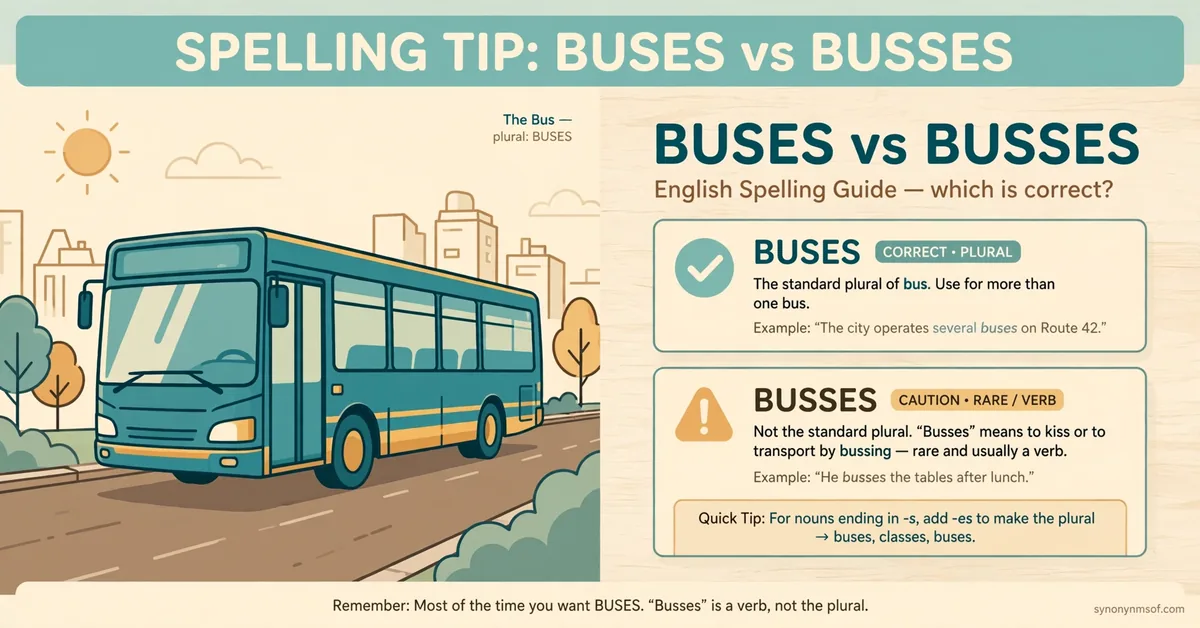
The short answer is that buses is the correct, standard plural of the noun bus in modern English. It is the spelling used by nearly every major dictionary, style guide, newspaper, and school textbook today. Busses, meanwhile, is not exactly wrong — dictionaries still list it as a variant plural — but it is so rare in current writing that most readers will assume it is a typo, and in some contexts it means something entirely different from what you intended.
The long answer is more interesting, because busses also shows up as a real word with real uses: it is a form of the verb to buss (meaning to kiss), and it appears in some inflected forms of the verb to bus (as in transporting by bus or clearing restaurant tables). This guide walks through every meaning, the difference between the two spellings, the history of how buses won the spelling contest, and the mistakes to avoid — so you never hesitate over this word again.
What Does “Buses” Mean?
The Standard Plural of the Noun
Buses is the ordinary plural of the noun bus — the large motor vehicle that carries passengers along fixed routes. When there is more than one vehicle, you write buses: “The school ordered three new buses,” “The buses were running late,” or “City buses are free on weekends.” This follows the regular English rule for nouns ending in -s, -x, -z, -ch, or -sh: add -es to form the plural, just as gas becomes gases, class becomes classes, and watch becomes watches.
Merriam-Webster, Dictionary.com, Oxford, and Cambridge all give buses as the primary plural. Every major style guide — including AP, Chicago, and Oxford — recommends it, and frequency data tells the story clearly: in modern edited writing, buses appears roughly fifteen times for every single appearance of busses. If you remember only one thing from this article, make it this: when you mean more than one bus, write buses.
Buses as a Verb Form
Buses also serves as the third-person singular present tense of the verb to bus, which means to transport someone by bus (“The hotel buses guests to the airport every half hour”) or, in American restaurant slang, to clear dirty dishes from tables (“She buses tables after school”). The preferred past and continuous forms of this verb are bused and busing with a single s: “They bused the team to the stadium,” “He spent last summer busing tables at a diner.”
So in the verb family, the single-s spellings are also the modern standard. Buses as a verb reads naturally in sentences like “Our company buses employees in from the suburbs,” where the doubled-s variant (“busses”) would look unusual to most readers even though dictionaries still recognize it.
What Does “Busses” Mean?
A Variant Plural of “Bus”
Busses does exist in dictionaries as a secondary, variant plural of the noun bus. Collins lists “plural buses or busses,” and Merriam-Webster still notes it as a recognized variant. This is a leftover from an earlier era: when bus (short for omnibus) was still a new word in the 1800s, buses and busses competed for dominance in print for several decades, and busses was actually Merriam-Webster’s preferred plural until 1961.
But the contest was decided long ago. Buses pulled ahead in frequency during the 1930s and has been the overwhelming choice of writers and editors ever since. Today busses as a plural has become so rare that many readers — and quite a few spellcheckers — flag it as an error. Using it for vehicles is not grammatically wrong in the strictest dictionary sense, but it will make your writing look dated or unedited, which is why style guides advise against it.
The Third-Person Singular of “To Buss” (to Kiss)
Here is where busses has a fully legitimate, current life of its own: it is the third-person singular present of the verb to buss, an old-fashioned word meaning to kiss. “She busses her baby on the cheek,” “The grandmother busses each child goodnight.” Buss itself is a synonym of kiss, thought to have evolved from the sound of a kiss, and its full conjugation runs buss, busses, bussing, bussed.
This separate meaning is a real hazard for the plural spelling. A sign reading “no busses beyond this point” could technically be read as a ban on kisses rather than vehicles — amusing in theory, but the kind of ambiguity good writing avoids. The same collision is part of why editors settled on buses for the vehicles: it keeps the two words visually distinct.
A Variant Verb Form of “To Bus”
Finally, busses, bussed, and bussing appear as recognized variant forms of the verb to bus (transport by bus / clear tables). Dictionary.com notes that the verb “can take the forms buses/busing/bused or busses/bussing/bussed,” and unlike the noun plural — where the single-s form dominates overwhelmingly — the verb variants are used with roughly similar frequency. Even so, most modern style guides recommend the single-s set (buses, bused, busing) as the cleaner default, reserving the doubled forms for writers who consciously prefer them.
Busses or Buses: The Key Difference
Noun Plural vs. Verb Forms
The cleanest way to keep the two spellings straight is to ask what part of speech you need. If you need the plural noun — more than one vehicle — write buses. If you need the verb to buss meaning to kiss (he/she/it busses), write busses. And if you need any form of the verb to bus (transport by bus, clear tables), prefer the single-s spellings (buses, bused, busing) even though the doubled-s variants are recognized.
Think of it as a traffic system with two lanes. The noun lane runs on a single s almost without exception: bus, buses. The buss lane — the kissing verb — always runs on a double s: buss, busses, bussing, bussed. Most confusion comes from drifting into the wrong lane.
Why “Buses” Won
The history here is genuinely fun. English has a doubling convention: when a short word ends in a single consonant and you add a suffix, you often double that consonant to keep the vowel short — nag becomes nagged, dot becomes dotted, fuss becomes fusses. By that logic, bus “should” become busses, which rhymes neatly with fusses and trusses rather than looking like fuses (which it does not rhyme with).
So why did buses win? Two reasons. First, buse is not a common word, so there was no risk of readers misreading buses as rhyming with fuses in practice — unlike dot/doted, where the single-t spelling creates a genuinely different word. Second, and more decisively, the competing buss (kiss) made busses permanently ambiguous. Editors gradually chose the form that could not be misread, and by the mid-20th century the shift was complete. On the other hand, the transport verb never fully settled, which is why bused and bussed still coexist in dictionaries today.
Comparison Table: Busses vs. Buses
| Spelling | Part of Speech | Meaning | Standard Today? |
|---|---|---|---|
| Buses | Noun (plural of bus) | More than one passenger vehicle | Yes — the only recommended plural |
| Buses | Verb (3rd-person singular of to bus) | Transports by bus / clears tables | Yes — preferred verb spelling |
| Bused / Busing | Verb (past / -ing of to bus) | Transported by bus / clearing tables | Yes — preferred forms |
| Busses | Noun (variant plural of bus) | More than one passenger vehicle | Listed but rare — avoid |
| Busses | Verb (3rd-person singular of to buss) | Kisses | Yes — the correct spelling of this verb |
| Bussed / Bussing | Verb (past / -ing of to bus) | Transported by bus / clearing tables | Accepted variant — single s preferred |
Usage Examples Across Contexts
Everyday English
In daily conversation and casual writing, buses is the only spelling you will ever need for vehicles. Nobody at the bus stop says busses, and writing it would immediately mark your text as odd to native readers.
- “I take two buses to get to work every morning.”
- “The buses in this city are always packed at rush hour.”
- “We missed the last bus, so we waited for one of the night buses instead.”
- “Do the buses still run after midnight?”
Notice how naturally the single-s form sits in ordinary sentences. This is the register where the standard spelling matters most: texting a friend, posting on social media, writing a review of a transit app. There is no everyday context in which busses reads as more natural for vehicles.
Work and Business Writing
Professional writing raises the stakes, because spelling inconsistencies signal carelessness to clients, managers, and readers. Transport companies, schools, event planners, and travel agencies all deal with fleets of vehicles, and every one of them should standardize on buses.
- “The company buses employees from three pickup points each morning.” (verb, third person)
- “We have added four new buses to the shuttle fleet.” (noun plural)
- “All airport buses now depart from Level 2 of the terminal.” (noun plural)
- “The contractor bused the crew to the site and bused them back at six.” (verb, past tense)
In memos, schedules, and signage, consistency is the rule. Pick buses / bused / busing as your house standard for everything related to the vehicles, and you will match what AP style, corporate editors, and every major dictionary expect.
Formal and Academic Writing
Academic and formal registers are where the variant spellings cause the most damage, because graders and editors in these settings are the least forgiving. A student essay that writes “the city’s busses” will likely earn a red mark; a thesis or published paper should never contain it.
- “Public buses reduced average commute times by twelve percent.” (research report)
- “The district bused students across attendance zones throughout the 1970s.” (history paper — note the sensitive “busing” context discussed below)
- “Municipal buses emit fewer pollutants per passenger than private cars.” (policy brief)
Formal writing also favors precision about which verb you mean. If a sociology paper discusses school desegregation, busing (single s) is the standard term; using bussing there risks both a spelling correction and an unintentionally comical reading. When in doubt in academic work, the single-s forms are the safe choice every time.
Common Mistakes to Avoid
Mistake 1: Doubling the S in the Plural
The most common error is treating bus like fuss: since fuss becomes fusses, writers assume bus must become busses. But fuss already ends in a double s, so the analogy fails — the correct parallel is gas → gases, not fuss → fusses.
- Incorrect: “There are three busses waiting outside the hotel.”
- Correct: “There are three buses waiting outside the hotel.”
Fixing it is easy: if the word ends in a single s and you are pluralizing a vehicle, just add -es. One s at the end of the root, one at the start of the suffix — never a doubled pair.
Mistake 2: Using “Busses” as a Verb for Transport
Even writers who get the plural right sometimes write “The school busses children across town,” using the doubled form for the verb. It is not the worst error — dictionaries accept it — but it looks inconsistent next to the buses plural and can momentarily suggest kissing.
- Awkward: “The airline busses passengers to the remote terminal.”
- Better: “The airline buses passengers to the remote terminal.”
If you are ever unsure which form of the verb to use, then fall back to the single-s set across the board: buses, bused, busing. It is always safe, always standard, and never ambiguous.
Mistake 3: Confusing “Buss” (Kiss) with “Bus” (Vehicle)
Because buss and bus are pronounced identically, writers occasionally drift between them. Writing “he bussed the children to school” when you mean transport is at best a variant spelling and at worst reads as something alarming. Conversely, writing “she buses him on the cheek” for a kiss is simply wrong — the kissing verb demands the double s throughout: buss, busses, bussing, bussed.
Mistake 4: Apostrophe Errors
A rarer but real mistake is writing bus’s or buses’ where no possession exists: “The buses’ were late” is wrong on two counts — it adds an apostrophe to a plain plural. The plural is buses, full stop. Only add an apostrophe when something belongs to the vehicles: “The buses’ engines were serviced” (plural possessive) or “The bus’s door jammed” (singular possessive).
Mistake 5: Inconsistency Within One Document
Perhaps the most professional-looking mistake is mixing forms: buses in paragraph one, busses in paragraph three, bussed in the conclusion. Readers may not consciously spot it, but the inconsistency quietly erodes trust. Before submitting any document that mentions these words more than once, run a search for “buss” and “bus” and standardize everything to your chosen forms.
Tricky Cases and Edge Cases
“Bus” as a Verb: Two Different Verbs, Two Different Spellings
English actually has two distinct verbs spelled almost identically. The verb to bus (from the vehicle) means to transport by bus or to clear tables: “They bus tourists to the resort,” “She bused tables through college.” The verb to buss (of imitative origin, from the sound of a kiss) means to kiss: “He bussed her forehead.”
Because the kissing verb always doubles its s, any doubled-s form in a sentence about vehicles risks a double take. “The district bussed students” is a recognized variant, but “The district bused students” is clearer, standard, and free of unintended comedy. When the two verbs could collide in a reader’s mind, the single-s spelling is doing real work.
“Busing” and School Desegregation History
One context deserves special care: busing as the American term for transporting students between school districts to achieve racial integration, a major civil-rights-era policy. The standard historical spelling is busing with one s: “court-ordered busing,” “the busing controversy of the 1970s.”
Writing bussing here is more than a spelling slip — it replaces a serious historical term with a word that looks like it derives from kissing. History textbooks, encyclopedias, and legal writing uniformly use busing. If you are writing about this topic, the single-s form is not just preferred; it is the only respectful choice.
The “Buss” (Kiss) Confusion in Real Life
The Merriam-Webster editors themselves have joked about this: “Confusing the issue is the word buss, a synonym of kiss, which could make for some funny interpretations of parking signs for buses.” They are right — “BUSSES ONLY” on a parking sign is technically legible as “kisses only,” which is exactly why the vehicle spelling moved to buses in the first place. Any time you catch yourself writing busses in a vehicle context, picture that sign. It is the fastest memory aid there is: vehicles get one s, kisses get two.
British vs. American English
Unlike some spelling pairs (-our/-or, -ise/-ize), this one does not split along Atlantic lines. Both American and British English overwhelmingly prefer buses as the plural today. Grammarist’s usage data confirms the single-s form dominates “in all main varieties of English,” and the Oxford English Dictionary gives buses as the primary form. Older British texts may show busses more often — it hung on longer in the UK — but no modern British style guide recommends it. On this question, the two varieties agree.
Technical Uses: The Computer “Bus”
Bus also lives in engineering: a bus is a data pathway connecting components inside a computer, and a busbar is a heavy conductor carrying electrical current. The plurals follow the same rule — buses, never busses: “The processor manages multiple data buses simultaneously.”
Frequently Asked Questions
Is “busses” ever correct as the plural of “bus”?
Technically, yes — major dictionaries still list busses as a variant plural of the noun bus, a legacy of the 19th century when both spellings competed in print. In practice, however, it is so rare in modern writing that most readers, editors, and spellcheckers will treat it as a mistake. For the plural of the vehicle, always write buses; it is the only form recommended by current style guides.
Is it “bused” or “bussed” for the past tense of the verb “to bus”?
Both are recognized by dictionaries, but bused (single s) is the preferred and more common form in modern standard English. Use bused and busing in any edited, professional, or academic writing: “They bused the team to the stadium.” The doubled forms bussed and bussing are accepted variants, so you will see them in the wild, but standardizing on the single-s set keeps your writing consistent and unambiguous.
Why do some dictionaries still list “busses” as a plural?
Because it genuinely was the preferred spelling for a long time. When bus emerged as an abbreviation of omnibus in the 1800s, buses and busses competed for decades, and Merriam-Webster listed busses as the preferred plural until 1961. Buses overtook it in frequency during the 1930s and never looked back. Dictionaries record the variant for historical accuracy, but every modern usage guide points writers to buses.
Does “busses” have anything to do with kissing?
Yes — this is busses’ most legitimate modern job. It is the third-person singular present of the verb to buss, meaning to kiss: “She busses the baby goodnight.” Buss is an old-fashioned synonym of kiss, pronounced exactly like bus. If your sentence is about affection rather than vehicles, busses is not just acceptable — it is the correct spelling.
Is there a difference between British and American English on this question?
No. Unlike pairs such as colour/color or organise/organize, the buses vs. busses question is settled the same way on both sides of the Atlantic. American and British dictionaries and style guides all give buses as the standard plural, and usage data shows it dominant in every major variety of English. Older British texts used busses more often, but no current guide recommends it.
Conclusion
The rule is wonderfully simple once the history is out of the way: more than one vehicle is always buses, and busses belongs to the kissing verb to buss — with the doubled-s forms of the transport verb (bussed, bussing) surviving only as accepted variants you are better off avoiding. This shows how a little etymology can defuse a lifetime of spelling anxiety: the confusion was never about a hard rule, only about two different words that happen to sound identical and nearly spell identically.
So the next time you hesitate mid-sentence, run the one-second test: are you writing about vehicles? Write buses. Are you writing about kisses? Write busses. Everything else — the 1961 dictionary change, the doubling convention, the fuses rhyme problem — is interesting background, but the test is all you need to get it right every time.
Explore more on Synonynmsof.