
Few English word pairs cause as much quiet embarrassment as pass and past. They sound nearly identical in most accents, separated by a single letter and a whisper of breath, and they are even cousins — one of them is literally born from the other. Yet grammatically they belong to completely different families. Mix them up in the wrong sentence and the meaning shifts from tender to absurd: “She passed away last spring” is a respectful announcement of a death, while “She past away last spring” is a typo that makes readers wince. One letter, one universe of difference.
The confusion is built into the words themselves. Pass is a busy verb with more than a dozen meanings — moving by, handing over, succeeding, approving, letting time elapse. Its past tense is spelled passed, with a double “s,” which sounds exactly like past, the word for time that has already happened. So your ear hears the same sound in “the years passed” and “the past years,” and your fingers must choose the right spelling from sound alone — a genuinely unfair task.
This guide untangles the pair completely in plain, human language. You will learn exactly what pass means, what past means, the one simple test that reveals which word any sentence needs, a side-by-side comparison table, real examples from conversation, business writing, and academic prose, the most common mistakes, and the tricky edge cases where even careful writers stumble.
What Does “Pass” Mean?
At its heart, pass is a verb of movement and completion. Something passes when it moves from one side of something to the other, when it is handed along, when it clears a bar, or when time itself slips away. It can also be a noun — a ticket, a mountain route, a single attempt. What it is not: a word for “the time that has already happened” as a concept. That job belongs entirely to past.
“Pass” as a Verb: Moving By or Through
The oldest and most common sense of pass is physical movement: to go by, through, or beyond something. “The express train passes through our station without stopping.” “She passed me a note during class.” “Could you pass the salt, please?” In each case something travels from one place or person to another. Time uses the same verb: “The afternoon passed slowly.” Whenever you describe something going by, through, along, or across, pass is your verb — and in the past tense it becomes passed: “The storm passed overnight,” “We passed the museum on foot.”
“Pass” as a Verb: Succeeding, Approving, and Allowing
Pass also means to clear a threshold — to meet a standard and be allowed through. “She passed her driving test on the first try.” “The committee passed the new budget unanimously.” “The new drug passed every safety trial.” A student passes an exam, a law passes a vote, a product passes inspection. Closely related is letting something go by unchallenged: “Let it pass this once,” and “I will have to pass on dessert.” If “get through” or “succeed at” fits, you are looking at pass, never past.
“Pass” as a Noun
Pass can also be a thing rather than an action. A mountain pass is a route through high peaks. A boarding pass, a backstage pass, or a season pass is a ticket granting entry. In exams, a pass is the passing grade itself — “a pass, not a distinction.” All these noun senses share one idea: a pass gets you through, across, or beyond a barrier.
What Does “Past” Mean?
Past never describes an action. It is the word for time that has already happened, for position on the far side of something, and for things gone by. It wears four grammatical hats — noun, adjective, preposition, adverb — but every one of them points backward: to earlier time or beyond a point. If you are describing movement happening right now, past cannot be your word; you need pass or passed.
“Past” as a Noun: The Time That Has Gone By
As a noun, past names the whole of earlier time: “the past,” “in the past,” “a distant past.” “She has learned to leave her failures in the past.” “In the past, people wrote letters by hand.” It can also name a personal history: “a troubled past,” “his past as a jazz musician.” It takes articles and adjectives like any noun — “the recent past,” “from the past” — and it never takes tense endings. If the word could be replaced by “history,” it is past.
“Past” as an Adjective: Gone By in Time
As an adjective, past sits before nouns and means “already finished” or “no longer current.” “The past week was exhausting.” “A past president attended the ceremony.” Think of it as the opposite of “future” or “current”: past presidents versus the sitting president, the past decade versus the coming one. Job applications use it constantly — “past experience,” “past employers” — and here the spelling matters: “passed experience” on a résumé signals carelessness. If “former” or “previous” can replace the word, it is the adjective past.
“Past” as a Preposition: On the Far Side Of
As a preposition, past describes position or movement beyond a point: “We walked past the bakery,” “The car sped past the exit,” “It’s ten past four.” In “We walked past the bakery,” the action is “walked” — past merely gives the direction, beyond the bakery. Time expressions are this word’s home turf: “a quarter past noon,” “half past nine.” They describe where the minute hand sits relative to the hour — a position, not an action — so they are always past, never “passed.”
“Past” as an Adverb: So as to Go By
As an adverb, past modifies a verb and means “in a direction beyond something”: “The parade marched past,” “She hurried past without a word.” The verb carries the action (marched, hurried); past adds the “went by” flavor. This is the trickiest hat because it sounds exactly like passed. Remember: the -st ending flags a word of position and time, while -ssed flags the verb.
The Key Difference Between “Pass” and “Past”
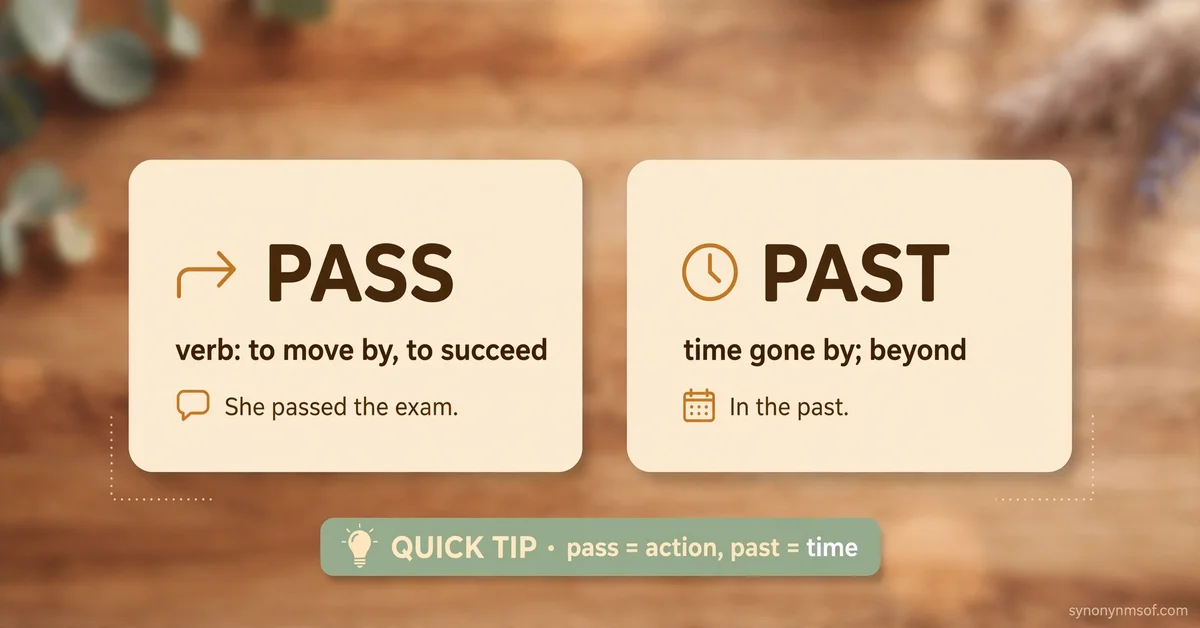
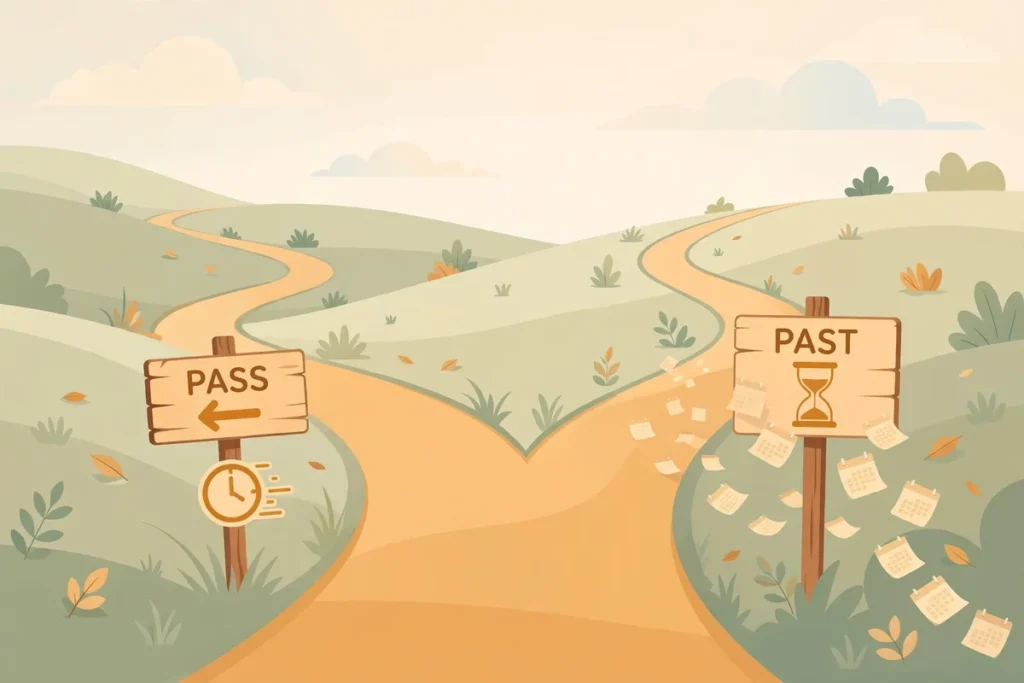
Strip away the details and the difference is almost beautifully simple: pass is about action — moving, handing, succeeding, approving — while past is about time and position — what has already happened, or what lies on the far side of a point. Pass does things; past describes when or where things are. If your sentence needs a verb, use pass or passed; for time or position, use past. On the other hand, past covers time that has already gone by, so any sentence looking backward — “in the past,” “the past month,” “ten past five” — wants the -st spelling every time.
Almost all the confusion comes from one word: passed. Because passed sounds identical to past, writers substitute the familiar time-word for the verb form. “The hours past slowly” feels right to the ear and is wrong on the page — hours do something (they pass), so passed is required. The fix is a quick tense test: rewrite the sentence in the present tense, then the right choice becomes obvious. “The hours past slowly” becomes “The hours pass slowly” — the present tense works, so it is the verb, and the past tense must be passed. If the present-tense version sounds like nonsense (“In the pass, people wrote letters”), you are dealing with the time-word, and past is correct.
One more memory hook: pass has a double “s” like “success” — the verb for passing a test. Past ends in “-st” like “history” — the word for earlier time. And the hard rule: past is never a verb. Anything that verbs in your sentence is pass or passed, no exceptions.
Pass or Past: Comparison Table
| Feature | Pass | Past |
|---|---|---|
| Core meaning | To move by, hand over, succeed, approve; or a ticket/route (noun) | Time gone by; on the far side of a point |
| Parts of speech | Verb (mostly); also a noun | Noun, adjective, preposition, adverb — never a verb |
| Past tense form | Passed (“the storm passed”) | Has none — it is not a verb |
| About time as a concept? | Only as elapsing: “time passed” | Yes: “the past,” “past years” |
| About position or direction? | Only as movement: “pass the station” | Yes: “walk past the station,” “ten past four” |
| Example: success | “She passed the exam.” | Not used |
| Example: earlier time | Not used | “In the past, we used maps.” |
| Example: movement by | “The bus passed us.” | “The bus drove past us.” |
| Pronunciation | /pæs/ — “pas” | /pɑːst/ — “pahst” (with a soft “t”) |
| Fixed phrases | “pass away,” “pass the time,” “let it pass” | “in the past,” “half past nine,” “past tense” |
Using “Pass” and “Past” in Everyday Conversation
In ordinary speech the two words trade places constantly, which is why the ear learns them as one sound. Writing those sentences down exposes the choice — these three settings show how each word behaves where you actually use it.
Everyday Conversation
Casual talk is full of both words, and the tense test settles nearly every case. “Could you pass me the remote?” — handing something over, an action, so the verb. “We drove past your street twice” — “drove” is already the verb; past gives the direction, beyond the street. “This whole year has just passed me by” — the year is doing something (elapsing), so passed. Clock phrases belong to past: “The movie starts at quarter past seven, so hurry up.” Memories use it too: “We rented DVDs back in the past.” And the famous awkward one: “My grandmother passed last winter” uses the gentle verb form of dying — never “past.”
Work and Business Writing
Professional writing is where this pair carries the most weight, because a slip reads as carelessness. “She passed the bar exam in July” — the verb. “His past experience in logistics makes him ideal” — the adjective, describing previous jobs; “passed experience” here would embarrass the writer. Deadlines use the verb: “The deadline passed without a word from the client.” But arrears use the adjective: “the account is three months past due.” Meeting times use the preposition: “The call starts at half past nine; then we will review the agenda.” In workplace email, one phrase deserves special care: “He passed away on Friday” is the standard respectful announcement; “past away” is a painful misspelling at a painful moment.
Formal and Academic Writing
Academic prose leans heavily on past as noun and adjective — it is, after all, the study of what came before. “As documented in past research, the effect persists.” “The past decade has seen rapid change.” The verb pass appears in its approval sense: “The amendment passed with a two-thirds majority.” Note the construction “has passed” with time as subject: “Five years have passed since the original study.” If you are tempted by “five years have past,” run the tense test — “Five years pass” works in the present, so the verb is confirmed and passed is the only correct choice.
Common Mistakes to Avoid
Writing “Past” for the Past Tense of “Pass”
This is the number-one error, and it is purely the fault of identical pronunciation. “The storm past quickly,” “The years past without notice,” “She past me a note” — all wrong, all in need of passed. The rule is mechanical: whenever the word does the verb’s work — moving, succeeding, approving, elapsing — the past tense is passed. The tense test never fails: “The storm passes quickly” works in the present, so the past is passed.
Writing “Past Away” Instead of “Passed Away”
The gentlest euphemism in English is also its most mangled. “To pass away” means to die, softly; the past tense is “passed away.” But because “past away” sounds identical, obituaries and sympathy cards regularly print the wrong version — at exactly the moment when precision matters most. Dying is an action, and actions take the verb: “He passed away peacefully” is correct, and “past away” is always wrong.
Using “Passed” in Time Expressions
The mirror-image mistake puts the verb where the preposition belongs: “It’s ten passed four,” “half passed nine.” Clock phrases describe a position — where the minute hand sits relative to the hour — so they take past, never passed. Think of the minute hand standing beyond the hour marker: it has gone “past” the four. “Ten minutes beyond four” makes sense; “ten minutes succeeded four” is nonsense — so past wins.
Writing “In the Passed” or “Passed Experience”
Phrases built on the noun or adjective past sometimes inherit the verb’s spelling by contagion: “in the passed,” “her passed experience,” “the passed few months.” All wrong. “In the past” names a span of earlier time — a noun phrase, no verb in sight. “Past experience” uses the adjective meaning “former” — and “former” can never become “formered.” When the word modifies a noun (past president, past month) or follows “the” as a thing (the past), the -st spelling is mandatory.
Tricky Cases and Edge Cases
“Passed Away” vs. “Past” — Why the Euphemism Traps Everyone
“Passed away” breaks the beginner’s instinct. Your ear hears “past,” your brain thinks “she is in the past now,” and your fingers type “past away.” But the phrase is verb-based: to “pass away” is to depart, to pass from one state to another — the same family as “let it pass.” That is why the past tense keeps the double “s”: “He passed away,” “She has passed away.”
“Let It Pass” vs. “Leave It in the Past”
These two fixed phrases sit side by side and use different words for good reason. “Let it pass” uses the verb — let the moment move by, let the comment go unchallenged: “The insult was petty; just let it pass.” “Leave it in the past” uses the noun — let the event join the archive of earlier time: “That argument is over; leave it in the past.” If “let it go by” fits, you need pass; if “leave it in history” fits, you need past.
“Move Past It” (Preposition) vs. “Move On”
“He needs to move past his anger” uses past as a preposition — move to the far side of the anger, get beyond it. The verb form never fits here — “move passed it” is nonsense, because “moved” already carries the action. Whenever the pattern is “verb + past + noun” (walk past, drive past, think past), you are looking at the preposition.
“Past It” and “Past His Prime” — the Idioms of Being Done
English has a family of idioms where past means “beyond the point of”: “past it,” “past his prime,” “past saving,” “past caring.” “At seventy, he insists he is not past it yet.” “The bread is past its best.” “She is past caring what they think.” All of these use past in the sense of “on the far side of a limit” — and the verb can never substitute without changing the meaning entirely.
British and American Time-Telling: “Half Past” Everywhere
“Half past nine,” “quarter past the hour,” “ten past” — these clock phrases are the same in British and American English and always use past. Related fixed phrases like “just past midnight” and “gone past eleven” are prepositional too. If your sentence tells the time by placing minutes relative to an hour, past is automatic.
“Pass By” vs. “Walk Past” — Same Scene, Different Grammar
“He passed by the house” and “He walked past the house” describe the same scene but build it differently. In the first, passed is the main verb — the passing is the action. In the second, “walked” is the main verb and past is the preposition showing direction. Both are correct; they simply assign the grammatical jobs differently. This shows the pair at its most flexible — one scene, two valid constructions. When in doubt, find the sentence’s main action: if the word itself is the action, write passed; if another verb is already doing the work, write past.
Frequently Asked Questions
Is it “passed away” or “past away”?
“Passed away” is correct. “To pass away” is a verb phrase meaning to die gently, so its past tense follows the verb’s spelling. “Past away” is a misspelling — past is never a verb, and it appears most often in obituaries and sympathy messages, where accuracy matters most.
What is the past tense of “pass”?
The past tense — and the past participle — of the verb pass is passed, with a double “s.” “Yesterday the hours passed slowly.” “She has passed every exam so far.” Do not confuse it with past, which sounds the same but is a different word — it names earlier time (“the past“) or a position beyond something (“walk past the gate”) and is never a verb.
Should I write “in the past” or “in the passed”?
Always “in the past.” The phrase names a span of earlier time, which makes past a noun here — and nouns do not take verb endings. Quick test: replace the word with “history.” If that roughly works, you need the time-word, not the verb form.
Is it “ten past six” or “ten passed six”?
“Ten past six” is correct. Clock expressions describe where the minute hand sits — a position, not an action — so they take the preposition past. Think “ten minutes beyond six.” The verb form “passed” makes no sense in a time phrase.
Can “past” ever be used as a verb?
No — never. Past can be a noun (“the past“), an adjective (“past mistakes”), a preposition (“drive past the exit”), or an adverb (“the crowd marched past“), but never a verb. Whenever your sentence needs an action, use pass (“I pass“) or passed (“I passed“).
Conclusion
Pass and past only pretend to be twins. One is a verb of action — moving by, handing over, succeeding, approving, letting time slip away — and its past tense is spelled passed. The other is a word of time and position — the noun for earlier time, the adjective for what is gone by, the preposition and adverb for “beyond” — and it is never a verb. Keep those two jobs separate: verbs get pass and passed, time and position get past.
When hesitation strikes, run the quick tests: rewrite in the present tense — if “pass” fits, you need passed. Substitute “history” — if it fits, you need past. Substitute “beyond” — if it fits, you need past again. With these checks, “she passed away,” “in the past,” “ten past six,” and “the years passed” will all come out right the first time.
Explore more on Synonynmsof.