
When you include the phrase you can reach me at in your professional correspondence, you are providing a direct gateway for others to initiate communication. This expression serves as a functional bridge, signaling that you are open to dialogue and providing the specific channels—whether phone, email, or a messaging platform—required to make that happen.
Mastering this simple but vital piece of business etiquette ensures that your availability is clear and your tone remains welcoming. Whether you are finalizing a project or introducing yourself to a new lead, knowing how to frame your contact information correctly helps you build stronger professional relationships from the very start.
Understanding the Mechanics of Contact Phrases

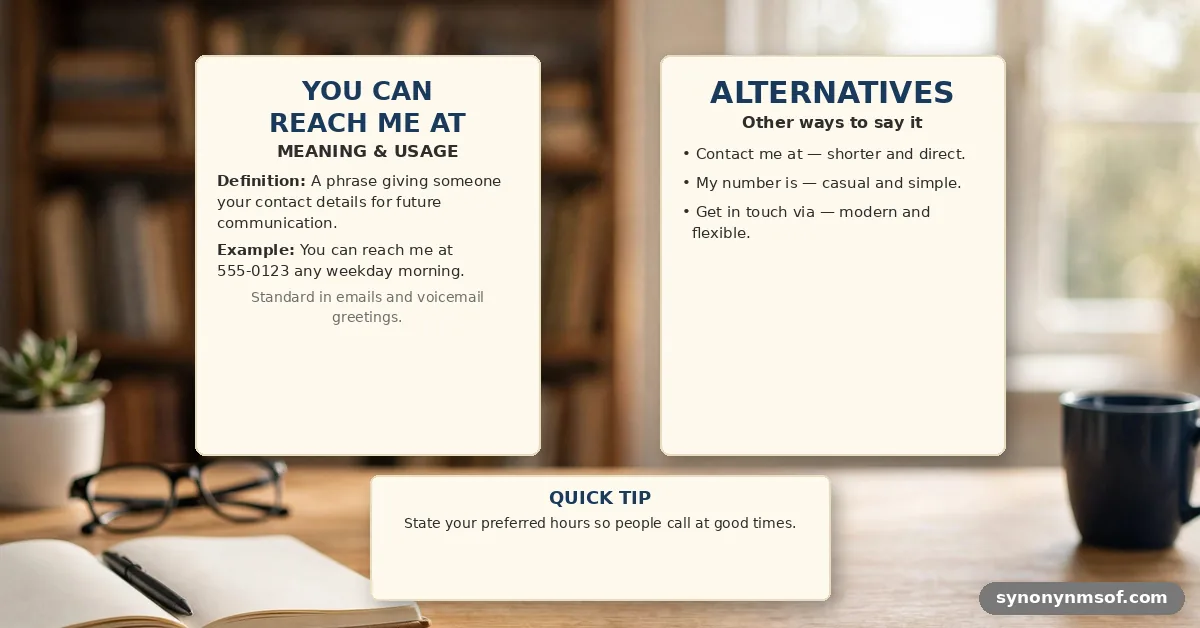
The expression you can reach me at is a standard, declarative way to share your preferred contact methods. It functions by identifying a location—in this case, a virtual or telephonic space—where a colleague or client can find you. While it may seem straightforward, its effectiveness relies on the clarity of the details that follow.
When you use this phrasing, you establish a boundary and a pathway. You are telling the recipient exactly where your attention is focused and how they can best interrupt your workflow to discuss business matters. Using this correctly eliminates ambiguity, which is the primary enemy of efficient professional communication.
Professional Alternatives for Different Contexts
Sometimes, you might want to vary your language to better suit the formality of a specific situation. While the standard phrase works in most scenarios, shifting your vocabulary can change the perceived warmth or urgency of your message.
Polite and Inviting Options
- Please feel free to contact me via email at…
- I am available for a quick call at…
- Should you have further questions, please get in touch through…
- You are welcome to reach out to me at…
Direct and Efficient Options
- My direct line is…
- The best way to contact me is…
- I can be reached at…
- Direct inquiries to…
The Importance of Context in Communication
Choosing the right way to share your contact details depends heavily on who is on the receiving end. If you are emailing a high-level executive, brevity and clarity are your best allies. You want to provide the information without taking up unnecessary space in their inbox.
For clients, you might lean toward more inviting language. Phrases like “feel free to reach out” suggest that you are accessible and service-oriented. This builds rapport and makes the client feel prioritized rather than just another ticket in your queue.
Comparing Methods of Contact
Different channels require different introductions. You would not use the same phrasing for a casual text message as you would for a formal project proposal. The following table illustrates how to adjust your language based on the medium and the formality of the situation.
| Channel | Best Phrasing | Formality Level |
|---|---|---|
| Business Email | You can reach me at [email] | Standard |
| LinkedIn Message | Feel free to connect via… | Casual/Professional |
| Project Proposal | Direct inquiries may be directed to… | High |
| Internal Chat | Ping me at… | Low |
Common Pitfalls to Avoid
One common error is the awkward construction “reach me out.” This is grammatically incorrect and can sound jarring to native speakers. Always remember that you “reach out to” someone else, but you are “reached at” a specific number or address.
Another mistake is providing too many contact points at once. If you list three phone numbers, a personal email, and a fax number, you create decision fatigue for the recipient. Stick to your primary, most reliable method of communication to ensure you actually receive the message.
Clarity and Professionalism
Your goal when sharing your contact info is to minimize friction. If you say you can reach me at, make sure the following information is accurate and easy to copy. Nothing frustrates a contact more than a broken phone link or an email address with a typo.
Being professional also means managing expectations regarding response time. You might pair your contact information with a brief note about your typical availability. This manages the other person’s expectations and prevents them from feeling ignored if you do not respond instantly.
Refining Your Email Signature
Your email signature is often where you place these contact details permanently. Because this is a static space, you have more room to be descriptive. Use clear labels like “Mobile:” or “Office:” to help the reader understand which number is best for urgent matters.
Keep the formatting clean and avoid excessive graphics or quotes that distract from the contact info. A professional signature should be a functional tool, not a creative project. When someone needs to find you, they should be able to scan your signature and extract the data in under two seconds.
The Role of Digital Availability
In our modern workflow, we are often connected through multiple platforms simultaneously. It is helpful to specify which platform is for what purpose. For instance, you might note that a specific number is for urgent calls only, while email is for general inquiries.
This level of detail respects the other person’s time and your own. It prevents the wrong types of communication from hitting your most sensitive channels. By clearly defining your contact parameters, you maintain control over your professional presence.
Frequently Asked Questions
Is it professional to say you can reach me at?
Yes, it is perfectly professional and widely used in business environments. It is a clear, direct, and neutral way to provide your contact information to colleagues and clients alike.
What is the best way to express urgency when sharing contact info?
If you need a quick response, it is better to be specific. For example, you might say, “For urgent matters, please reach me at my mobile number,” which signals that this specific channel is reserved for time-sensitive issues.
Can I say reach me out?
No, you should avoid this phrasing. It is grammatically incorrect. Instead, use “reach out to me” if you are asking someone to contact you, or “you can reach me at” if you are providing your details.
What is the difference between reach me and contact me?
They are largely interchangeable, but “contact me” sounds slightly more formal. “Reach me” implies a sense of finding you wherever you are, which fits well in a fast-paced or mobile work environment.
Conclusion
Selecting the right words when you need to provide your contact details is a small but meaningful way to demonstrate your professional polish. By using clear, accurate language, you ensure that your connections are easy to maintain and that your availability is never in question. Whether you choose to say you can reach me at or prefer a slightly more formal alternative, the key is consistency and ease of use for the recipient.
Take a moment to audit your email signature and common templates to see if your contact information is as accessible as it should be. Staying thoughtful about these details helps you build a reputation for being both approachable and organized in your daily interactions.