
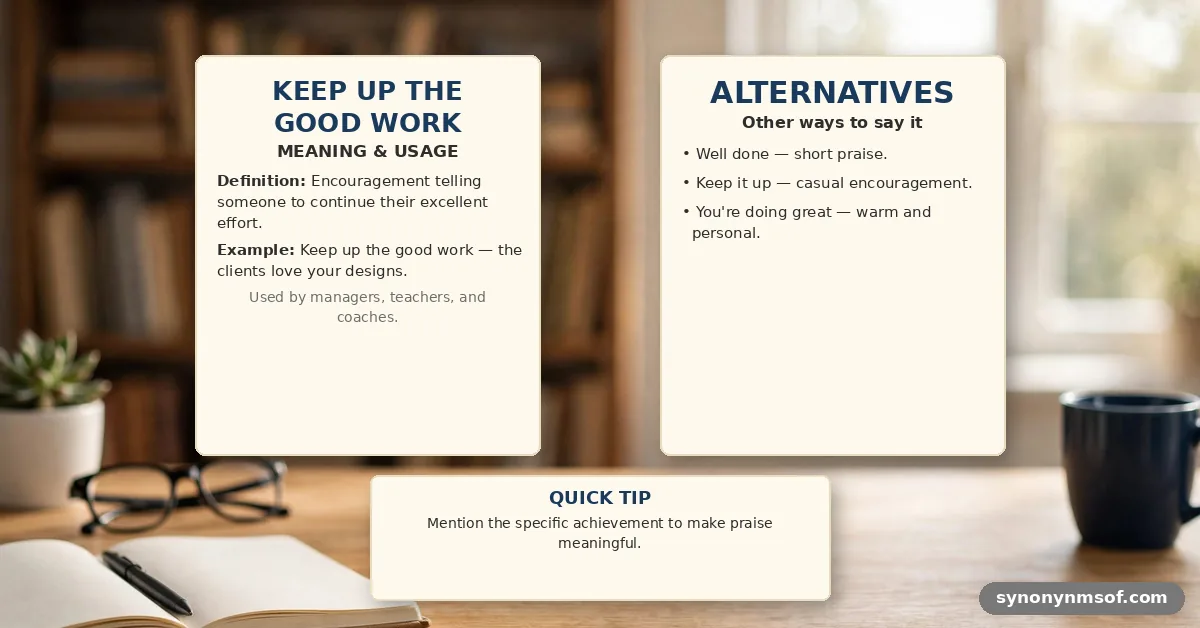

When someone tells you to keep up the good work, they are offering a simple yet powerful validation of your recent performance. It is a common idiom used to encourage the continuation of high-quality effort, signaling that your current output meets or exceeds expectations. Understanding the nuance behind this phrase helps you gauge how others perceive your contributions, whether in a classroom, an office, or personal projects.
This article explores the precise meaning of the phrase, how to use it effectively in professional settings, and how to identify when it might sound patronizing rather than supportive. You will learn how to move beyond generic praise to offer meaningful feedback that actually helps people grow.
What the Phrase Really Means
At its core, the phrase functions as both an observation and a directive. By using the word “keep,” the speaker is acknowledging that a specific standard of quality has already been established. When you hear this, you know your recent actions have been noticed and approved by someone else.
The “good work” portion of the phrase acts as the object of that approval. It implies that the recipient is not just working hard, but is specifically producing results that are helpful, accurate, or valuable. It is a shorthand way of saying, “Whatever you are doing right now, keep doing exactly that.”
The Grammatical Construction
The phrase is a standard English imperative sentence. Grammatically, it is correct because it uses the base form of the verb “keep” to issue a polite command or suggestion. You don’t need to change the verb form to match the subject because the implied subject is always “you.”
While some people might find it repetitive, it is a staple of workplace communication. You can find more linguistic context on phrases like this at Merriam-Webster’s dictionary entry for idioms. It remains one of the most reliable ways to sustain morale without needing an elaborate speech.
Professional Applications and Context
In a professional environment, this phrase is a staple of performance feedback. It is most effective when delivered immediately after a successful task or a positive project milestone. When a manager says it to an employee, it validates the effort put into a specific report, a presentation, or a client interaction.
However, the phrase has a reputation for being somewhat generic. If you use it every time you speak to your team, it loses its weight. It works best when it is paired with a specific detail about what exactly the person is doing well.
Improving Your Feedback Delivery
To make the phrase more impactful, always attach a specific observation to it. Instead of just saying “keep up the good work,” try mentioning the outcome of that work. This shows that you are actually paying attention to the details of their performance.
- Specific: “Your analysis on the Q3 budget was excellent. Keep up the good work.”
- Specific: “The way you handled that difficult client today was professional. Keep up the good work.”
- Generic: “You’re doing great. Keep up the good work.”
When the Phrase Can Be Patronizing
There are scenarios where this encouragement can backfire. If a supervisor uses this phrase to someone who is clearly performing at a much higher level than the supervisor themselves, it can sound condescending. It implies that the superior is in a position to judge the quality of work that they might not fully understand.
The tone of voice and the power dynamic play a huge role here. If the phrase is used to dismiss a deeper conversation about professional growth, the recipient may feel overlooked. It can feel like a “pat on the head” rather than genuine recognition of skill or innovation.
Signs Your Feedback Is Falling Flat

If you find that your employees or colleagues seem uninspired after you offer praise, you may be relying on this phrase too heavily. People want to know that their unique strengths are being seen. When you use the same phrase for every person, it signals that you are not viewing them as individuals with specific talents.
| Context | Is it Effective? | Why? |
|---|---|---|
| Quick email after a task | Yes | It provides immediate, low-stakes validation. |
| Annual performance review | No | It is too vague for a formal evaluation. |
| Repetitive daily usage | No | It becomes white noise and loses meaning. |
| To a long-term veteran | Maybe | Only if paired with specific career progress. |
Alternatives for Better Communication
If you feel the phrase has become stale, there are many other ways to express the same sentiment. Using varied language makes your feedback feel more sincere and tailored to the situation. You want to focus on the impact the person’s work had on the team or the business.
Consider these alternatives for when you want to signal that someone is doing well:
- “I am really impressed by the consistency you are showing.”
- “Your contributions have made a clear difference in our project timeline.”
- “I appreciate the level of detail you brought to this task.”
- “You have set a high bar for the rest of the team.”
These alternatives require you to think about what the person actually did. They force you to be present and observant. When you acknowledge the specifics, the recipient is much more likely to feel a sense of pride in their work.
The Role of Encouragement in Growth
Encouragement acts as a catalyst for sustained effort. When people feel that their work is noticed, they are more likely to maintain a high level of output. This is a basic psychological principle of positive reinforcement that applies to almost every collaborative environment.
However, encouragement must be grounded in reality to be effective. If you tell someone to “keep up the good work” when they are actually struggling, you create a disconnect. They will assume you are not paying attention, which can lead to a loss of trust in your leadership.
Balancing Praise with Constructive Criticism
The best leaders know how to balance encouragement with necessary adjustments. You can praise the effort while still suggesting a different direction for the next phase. This keeps the relationship honest and productive.
Never let a “keep up the good work” comment serve as a shield against having a difficult conversation. If there are problems, address them directly. Use praise to anchor the person in their strengths, then move into the areas that require improvement.
Cultural Nuances and Language
In different English-speaking cultures, the intensity of this phrase can vary. In some high-context cultures, direct praise like “keep up the good work” might be viewed as slightly aggressive or overly informal. In other cultures, it is the standard way to maintain a positive, high-energy work environment.
If you are working with international teams, pay attention to how they respond to direct feedback. Some people prefer written recognition, while others prefer public acknowledgement. Adapt your delivery to suit the preferences of the individual rather than forcing a one-size-fits-all approach.
Learning the Local Norms
Observe how your peers give feedback to one another. If you see that your colleagues use more formal language, you might want to adjust your own style. The goal is to make the other person feel appreciated, not to follow a rigid script of what you think “professional” sounds like.
Tracking Your Own Progress
Sometimes you need to apply this phrase to your own life. If you are working on a long-term goal, like training at the gym or learning a new skill, you have to be your own motivator. Keeping a log of your efforts helps you recognize when you are actually doing good work.
When you look back at your progress, tell yourself that you are doing well. It sounds simple, but self-validation is a crucial part of mental resilience. Don’t wait for someone else to tell you to keep going if you can already see the results for yourself.
FAQ
Is saying keep up the good work patronizing?
It depends on the power dynamic and the frequency of use. If you say it to someone more experienced than you, or if you use it as a way to avoid giving real, substantive feedback, it can definitely come across as patronizing.
What is a better way to say keep up the good work?
Try being specific. Instead of the general phrase, highlight a specific action or result, such as “I really appreciated how you handled that meeting” or “Your attention to detail on this project has been excellent.”
Is this phrase grammatically correct?
Yes, it is a standard imperative sentence in English. It is a polite command or suggestion that is widely accepted in both professional and casual contexts.
How do I use this phrase for students?
For students, it is most effective when tied to the learning process rather than just the grade. You might say, “Your persistence in solving these math problems is great; keep up the good work and you’ll master this topic soon.”
Final Thoughts
Mastering the art of encouragement is about more than just knowing a few common idioms. It is about understanding that your words carry weight and can influence how others perceive their own value. When you decide to tell someone to keep up the good work, make sure it is a genuine reflection of your appreciation for their specific efforts.
By moving past generic comments and focusing on the unique contributions of those around you, you build stronger, more honest relationships. Start by noticing one specific thing someone did well today and sharing that feedback with them.
You will find that your words are far more effective when they are backed by real observation and sincere intent. Keep up the good work in your own communication, and you will see the quality of your professional interactions improve significantly.