
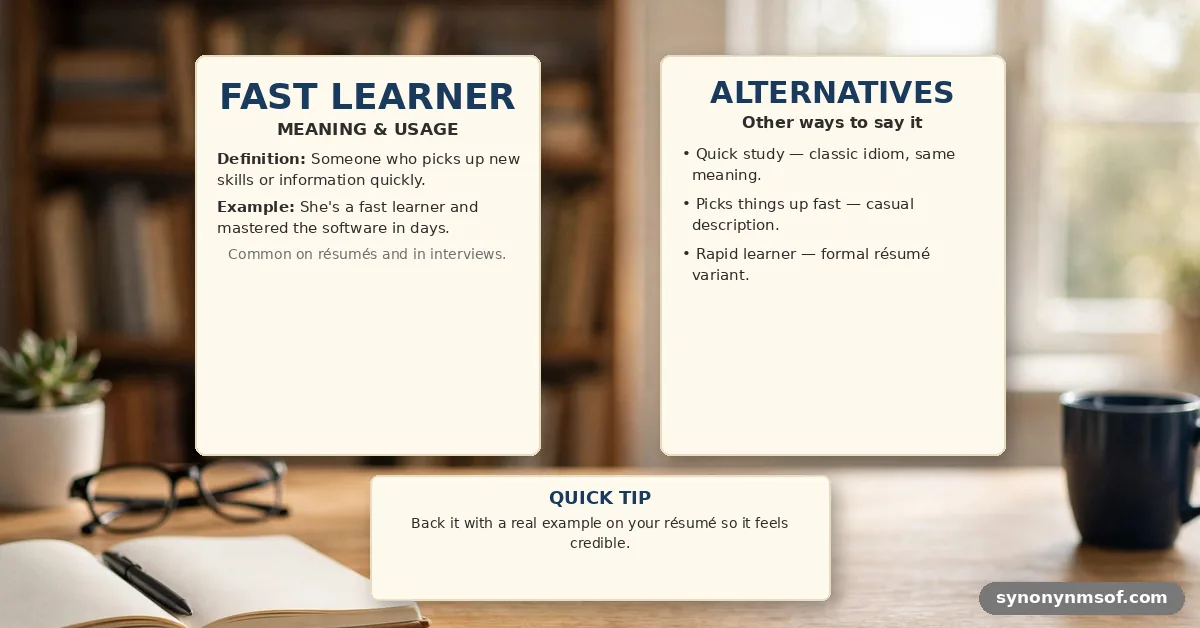

Being a fast learner means you possess the ability to acquire new information, skills, or workflows significantly quicker than the average person. It is not just about raw intelligence; it is about cognitive flexibility, pattern recognition, and an effective approach to processing feedback. Employers value this trait because it reduces training time and allows teams to adapt to shifting market demands.
By understanding the mechanisms behind rapid acquisition, you can move from merely observing others to actively cultivating these habits yourself. This article breaks down how to apply this skill in professional and personal settings to improve your long-term growth.
Defining the Fast Learner
At its core, a fast learner is someone who identifies the underlying structure of a new task or subject quickly. Rather than memorizing isolated facts, they look for connections and principles that tie the information together. This process is often called mental modeling.
When you encounter a new system, you are likely looking for the “rules of the game.” Once those are clear, you can fill in the specific details later. This prevents cognitive overload and allows you to reach a functional level of competence in a fraction of the usual time.
Distinguishing Speed from Depth

There is a common misconception that being quick means being superficial. In reality, the most efficient learners are those who know when to go deep and when to skim. They prioritize the 20 percent of information that yields 80 percent of the results.
This principle, often known as the Pareto Principle, is a hallmark of high-level performance. If you are learning a new language, you don’t start with obscure grammar rules. You start with the most common verbs and sentence structures that allow you to communicate immediately.
The Mechanics of Rapid Acquisition
Learning is essentially the process of encoding information into long-term memory through repetition and association. To accelerate this, you must engage in active recall rather than passive review. If you are reading a manual, stop every few minutes to explain the concept to an empty chair.
If you cannot explain it simply, you do not understand it well enough. This is often referred to as the Feynman Technique. By forcing yourself to articulate the logic, you expose the gaps in your knowledge immediately.
Creating Feedback Loops
Real-time feedback is the engine of improvement. Without it, you are practicing mistakes and reinforcing bad habits. A fast learner seeks out objective data points to measure their progress against established goals.
- Set clear, measurable objectives before starting a new skill.
- Record your performance or work to identify deviations from the standard.
- Find a mentor or peer who can provide honest, critical input on your process.
- Iterate on your methods daily based on the results you observe.
Fast Learner Usage in Professional Contexts
In a job interview, claiming to be a “fast learner” is a cliché unless you back it up with concrete evidence. Hiring managers hear this phrase constantly, so you must provide the context that makes it meaningful. Instead of stating your speed, describe a specific instance where you had to master a complex tool or process under a tight deadline.
For example, mention a time you had to learn a new software platform in 48 hours to complete a client project. Explain the steps you took to prioritize the most critical features and how you validated your understanding. This turns a generic claim into a demonstration of competence.
Comparing Learning Styles
Different roles require different types of learning agility. Technical roles might demand a high capacity for rote logic and syntax, while creative roles require the ability to synthesize disparate ideas.
| Skill Type | Primary Focus | Learning Method |
|---|---|---|
| Technical | Logic and Syntax | Pattern Recognition |
| Creative | Synthesis and Nuance | Iterative Experimentation |
| Operational | Efficiency and Workflow | Process Mapping |
Overcoming Learning Barriers
Many people struggle because they approach new information with a fixed mindset. They believe their intelligence is static, which leads to anxiety when they encounter difficulty. A fast learner views confusion as a signal that the brain is actively building new neural pathways.
When you hit a wall, it is often a sign that you are moving from the “conscious incompetence” phase to the “conscious competence” phase. This is the most uncomfortable part of the process, but it is also where the most significant growth occurs.
Managing Cognitive Load

If your browser doesn’t support the specific media or software you are trying to use, you don’t give up on the project. You find a work-around or a compatible tool. Apply this same logic to your learning process.
If you struggle with text-heavy manuals, look for multimodal learning resources like video tutorials or interactive simulations. The format of the information matters as much as the content itself. Don’t force yourself to use a medium that doesn’t align with how your brain processes data.
Tools for Faster Information Retention
To store information for the long term, you need to use spaced repetition. This involves reviewing material at increasing intervals, which prevents the “forgetting curve” from wiping out your progress. Apps that automate this process are powerful allies for the modern student.
Beyond digital tools, physical environment plays a role. A dedicated, distraction-free space signals to your brain that it is time to focus. Even minor changes in your routine can have an outsized impact on how much you retain in a single session.
Using Dictionaries and Resources
Whether you are studying English, Chinese, or French, the quality of your reference materials is paramount. A good dictionary or thesaurus is more than a list of words; it is a map of relationships between concepts.
When you look up a word, don’t just read the definition. Look for synonyms, antonyms, and example sentences. This creates a richer neural network around the new term, making it easier to recall later.
The Role of Curiosity in Speed
Curiosity is the fuel that keeps the process moving when the material becomes dry or difficult. If you are genuinely interested in why a system works, you will naturally spend more time investigating it. This intrinsic motivation is far more powerful than external pressure.
Try to find the “hook” in every subject. Even in mundane tasks, there is usually an element of efficiency or strategy that can be optimized. Once you find that hook, the learning process shifts from a chore to a game.
Maintaining Momentum
Consistency beats intensity every time. It is better to study for 30 minutes every day than for five hours once a week. The brain needs time to consolidate information during sleep and periods of rest.
If you find yourself stuck, take a break. Engage in a completely unrelated physical activity. Often, the solution to a complex problem appears when you stop staring at it directly.
Common Misunderstandings
One major myth is that fast learners are born, not made. While genetics play a role in cognitive speed, neuroplasticity allows anyone to improve their learning rate throughout their life. Your brain is not a fixed asset; it is a muscle that responds to the demands you place on it.
Another misunderstanding is that high-speed learning leads to high-speed burnout. If you are learning effectively, you should actually feel less stressed, not more. Efficiency reduces the time spent struggling with ineffective methods.
Addressing the Speed-Quality Tradeoff
There is a point of diminishing returns where rushing leads to errors. A true expert knows when to slow down to ensure accuracy. If you are learning to code, for example, speed is secondary to the stability of the final program.
Use your speed to get through the basics quickly, but reserve the necessary time for deep testing and refinement. This “fast start, slow finish” approach is the secret to high-quality results produced in record time.
FAQ
How can I prove I am a fast learner in an interview?
Instead of just saying it, use the STAR method. Describe a specific Situation, the Task you faced, the Action you took to learn the new skill, and the Result you achieved. Giving a concrete example of a time you mastered a tool or workflow in a short period provides the evidence recruiters need.
Does being a fast learner mean I have a high IQ?
Not necessarily. While cognitive ability helps, learning speed is often a result of specific habits and techniques. Anyone can improve their learning rate by using active recall, spaced repetition, and by identifying the core principles of a subject rather than trying to memorize everything.
Can I use the term fast learner on my resume?
Yes, you can, but it is more effective to frame it around a specific accomplishment. Instead of just listing it as a skill, write “Quickly learned X software to lead a team of Y,” or “Mastered new compliance regulations in two weeks to ensure project continuity.” This shows the impact of your learning ability.
What if I am a slow learner?
Everyone has different cognitive strengths. If you feel slow, it might be that you are using a learning method that doesn’t fit your style. Try switching from reading to listening, or from abstract study to hands-on practice. Often, changing the input method makes the entire process feel faster and more intuitive.
Conclusion
Developing the ability to acquire new knowledge quickly is one of the most reliable ways to advance your career and personal life. By focusing on mental models, active recall, and consistent practice, you can transform your approach to any subject.
Remember that being a fast learner is less about innate talent and more about the deliberate systems you put in place to process information efficiently. Start by identifying one area where you want to improve, apply these techniques, and measure your results over time.
As you sharpen your ability to learn, you will find that the world becomes more accessible and less intimidating. Whether you are picking up a new language or mastering a complex technical workflow, the principles of rapid acquisition remain the same.
Continue to challenge yourself with new subjects, and you will find your capacity for growth is far greater than you once imagined. Embrace the process, stay curious, and keep refining your methods for a lifetime of success.