
If you’ve ever received a reply that simply says “Well noted,” you probably understood the message—but you may not have known how to feel about it.
In today’s workplace, every email, chat message, and business conversation contributes to the way people perceive you. While “well noted” is a common phrase used to acknowledge information, it doesn’t always create the impression you intend. Depending on the context, it can sound professional and efficient—or cold, distant, and even slightly passive-aggressive.
This is why understanding when and how to use “well noted” matters. Modern business communication isn’t just about confirming you’ve read a message; it’s about showing respect, clarity, and professionalism while maintaining positive working relationships.
In this guide, you’ll learn exactly what “well noted” means, whether it’s grammatically correct, when it’s appropriate to use, when you should avoid it, and 30 professional alternatives that sound more natural in emails, meetings, and workplace conversations. You’ll also find practical examples, communication tips, and expert advice to help you choose the right phrase for every situation.
Quick Answer
“Well noted” means that you’ve received, understood, and acknowledged someone’s message or information. It’s widely used in professional emails and workplace communication to confirm that you’ve taken note of the details. Although the phrase is grammatically correct and professional, many people now prefer warmer alternatives like “Understood,” “Thanks for the update,” or “I appreciate the clarification” because they sound more natural and personable.
What Does “Well Noted” Mean?
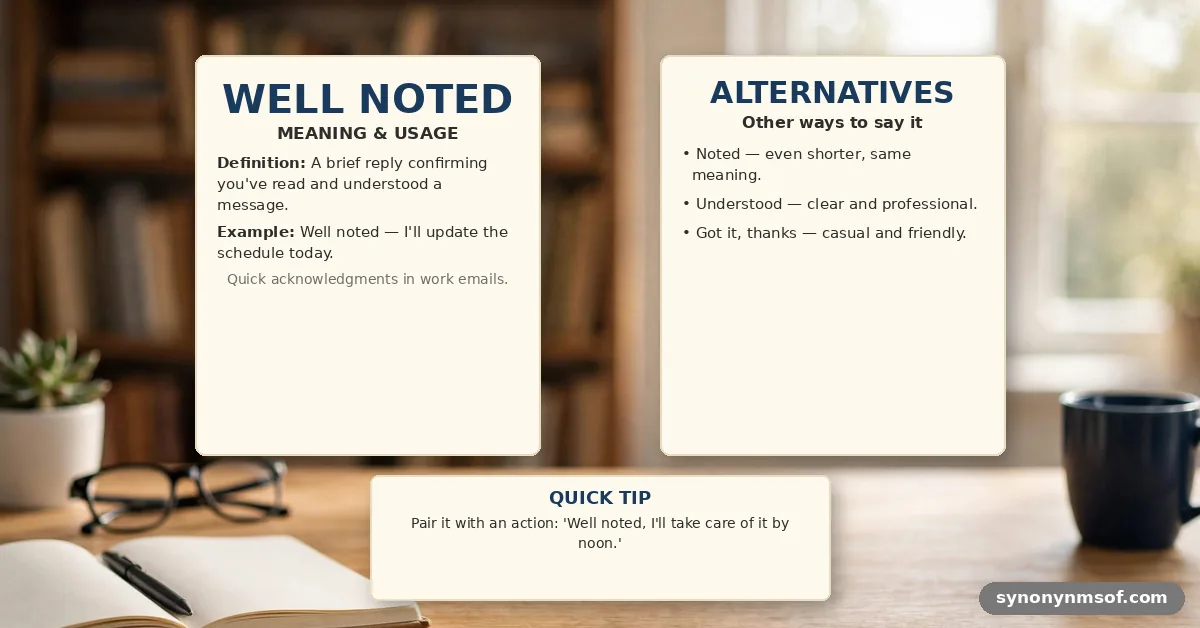
The phrase “well noted” is used to acknowledge that you’ve received and understood a message. It’s a concise way of telling someone that you’ve taken note of the information and, in many cases, will act on it if necessary.
In professional settings, it often serves as a confirmation that communication has been received without requiring a lengthy response.
In simple words, “well noted” means:
- I understand your message.
- I’ve received the information.
- I’ve taken note of what you said.
- I’ll remember this.
- I’ll act on it if needed.
For example:
Well noted. I’ll update the presentation before tomorrow’s meeting.
Your feedback is well noted. We’ll incorporate the suggested changes into the next revision.
Well noted, and thank you for letting me know.
Although the phrase is short, its meaning can vary slightly depending on the context and tone. When paired with appreciation or a follow-up action, it feels polite and professional. Used alone, however, it may come across as impersonal.
See Also: Please Feel Free: Meaning, 30 Professional Alternatives & Examples
Is “Well Noted” Grammatically Correct?
Yes. “Well noted” is grammatically correct.
The phrase combines:
- Well (an adverb that modifies the adjective)
- Noted (the past participle of note, used adjectivally)
Together, they indicate that something has been properly observed, acknowledged, or recorded.
From a grammar standpoint, there’s nothing wrong with the phrase. It has been used in business correspondence for many years and remains acceptable in formal writing.
However, grammar and communication are not always the same thing.
A phrase can be perfectly correct while still sounding outdated, overly formal, or emotionally distant. That’s one reason many professionals are choosing friendlier alternatives in modern workplace communication.
Is “Well Noted” Professional?
Absolutely. “Well noted” is considered a professional expression and is commonly used in:
- Business emails
- Corporate communication
- Project management
- Client correspondence
- Administrative work
- Customer support
- Government and legal communication
It demonstrates that you’ve acknowledged the information without writing a lengthy response.
However, professionalism today is about more than being concise. Strong communicators also consider tone, empathy, and clarity.
For example, compare these two replies:
Reply 1
Well noted.
Reply 2
Well noted. Thank you for the update. I’ll make the requested changes this afternoon.
Both responses are professional, but the second feels warmer, more collaborative, and more reassuring because it combines acknowledgment with appreciation and a clear next step.
Why Can “Well Noted” Sound Cold?
One of the biggest misunderstandings about “well noted” is that people assume it’s always polite. In reality, its tone depends almost entirely on context.
When used by itself, the phrase may feel abrupt because it acknowledges information without expressing appreciation, empathy, or engagement.
Imagine you’ve spent twenty minutes writing a detailed email explaining an issue. Receiving only:
Well noted.
might leave you wondering:
- Did they actually read everything?
- Do they agree?
- Will they take action?
- Are they annoyed?
The phrase doesn’t answer any of these questions.
Now compare it with:
Thanks for the detailed explanation. Well noted—I’ll review everything this afternoon and get back to you tomorrow.
This response communicates the same acknowledgment while also showing appreciation and outlining the next step. The difference is subtle, but it creates a much stronger impression.
See Also: For Your Reference: Meaning, 30+ Professional Alternatives, and How to Use It Naturally
When Should You Use “Well Noted”?
Despite its mixed reputation, “well noted” still has an important place in professional communication. The key is using it in the right situations.
1. Acknowledging Instructions
When a manager, colleague, or client provides instructions, “well noted” confirms that you’ve understood what needs to be done.
Example
Well noted. I’ll complete the requested revisions before Friday.
2. Confirming Receipt of Information
If someone sends updated details, schedules, or project changes, the phrase works well as a brief acknowledgment.
Example
Well noted. I’ve updated my calendar accordingly.
3. Responding to Client Updates
Clients appreciate knowing that their information has been received.
Example
Well noted, and thank you for informing us. We’ll review your request and respond shortly.
4. Internal Team Communication
Within project teams, quick acknowledgments help keep conversations moving.
Example
Well noted. I’ll update the shared document today.
5. Administrative Communication
Administrative professionals often use the phrase to confirm appointments, requests, or documentation.
Example
Your request has been well noted and is currently being processed.
When Should You Avoid Using “Well Noted”?
Although it’s professional, there are situations where a different response is more appropriate.
When Someone Shares Personal News
If someone says:
My father has been admitted to the hospital.
Replying with:
Well noted.
would feel emotionally detached.
Instead, choose something more compassionate:
I’m sorry to hear that. Thank you for letting me know. I hope everything goes well.
During Difficult Conversations
If someone raises a concern or complaint, a simple acknowledgment may appear dismissive.
Instead of:
Well noted.
Try:
Thank you for raising this concern. I understand your perspective, and I’d like to discuss it further.
In Friendly Workplace Conversations
Among close colleagues, “well noted” can sound unnecessarily formal.
A more natural response might be:
- Got it!
- Sounds good.
- Thanks for the update.
- I’ll take care of it.
When Building Client Relationships
Clients appreciate responses that feel genuine.
Rather than writing:
Well noted.
Consider:
Thank you for the update. I appreciate you keeping us informed, and we’ll take the necessary steps.
This small change creates a friendlier and more customer-focused experience.
Read Also: See You Tomorrow: Meaning, Professional Alternatives, and Better Ways to Say It Naturally
Why Tone Matters More Than Ever
Modern workplaces place increasing value on emotional intelligence. People don’t just want confirmation that you’ve seen their message—they want to know they’ve been heard.
A response that includes appreciation, empathy, or a clear next step helps build trust, reduces misunderstandings, and strengthens professional relationships.
For this reason, many communication experts recommend combining acknowledgment with action whenever possible. Instead of relying on a standalone “well noted,” add a brief sentence that shows what you’ll do next or expresses gratitude for the information.
Doing so makes your communication feel more human while remaining concise and professional.
30 Other Ways to Say “Well Noted”
| Phrase | Tone | Best Used For |
|---|---|---|
| Understood | Neutral | Emails, meetings, workplace communication |
| Got it | Casual Professional | Team chats, Slack, Microsoft Teams |
| Thanks for the update | Warm | Business emails |
| Noted with thanks | Formal | Client communication |
| I understand | Friendly | Clarifications |
| Acknowledged | Formal | Technical or corporate settings |
| Message received | Casual | Internal communication |
| Thanks for letting me know | Warm | Everyday workplace emails |
| I appreciate the update | Professional | Client communication |
| Duly noted | Formal | Official correspondence |
| Consider it done | Confident | Task assignments |
| I’ll take care of it | Helpful | Action-oriented responses |
| I’ll handle it | Professional | Project management |
| Thanks for the clarification | Appreciative | Follow-up emails |
| I appreciate the information | Respectful | Business communication |
| I’ll keep that in mind | Friendly | Suggestions or advice |
| Sounds good | Casual | Team conversations |
| Makes sense | Conversational | Informal discussions |
| That’s clear | Neutral | Meetings and instructions |
| I’ve taken note | Formal | Business correspondence |
| Your message has been received | Formal | Customer support |
| I’ll proceed accordingly | Professional | Business emails |
| Thank you for informing me | Polite | Client communication |
| I appreciate you keeping me informed | Warm | Workplace relationships |
| Thanks for the heads-up | Friendly | Early warnings or reminders |
| I’ll follow up | Professional | Action confirmation |
| Thanks for bringing this to my attention | Appreciative | Problem-solving |
| I appreciate the reminder | Friendly | Deadlines and follow-ups |
| I’ve made a note of it | Neutral | Everyday communication |
| Thank you. I’ll act on this | Professional | Action-oriented emails |
1. Understood
Tone: Neutral and Professional
“Understood” is one of the safest replacements for “well noted.” It’s concise, clear, and works in almost every professional situation.
Best for: Emails, meetings, project discussions, and client communication.
Example:
Understood. I’ll submit the revised proposal by tomorrow afternoon.
2. Got It
Tone: Casual Professional
“Got it” sounds more conversational than “well noted.” It’s widely used in internal team communication and instant messaging platforms like Slack and Microsoft Teams.
Best for: Team chats and informal workplace conversations.
Example:
Got it! I’ll update the spreadsheet before lunch.
3. Thanks for the Update
Tone: Warm and Professional
Instead of simply acknowledging information, this phrase also expresses appreciation.
Best for: Workplace emails and project updates.
Example:
Thanks for the update. I’ll adjust the project timeline accordingly.
4. Noted with Thanks
Tone: Formal
This phrase is especially common in business correspondence and client-facing communication.
Best for: Formal emails and customer communication.
Example:
Noted with thanks. We’ll begin processing your request immediately.
5. I Understand
Tone: Friendly
This response feels more personal and reassuring than “well noted.”
Best for: Clarifying conversations.
Example:
I understand. I’ll make the requested changes.
6. Acknowledged
Tone: Formal
“Acknowledged” is frequently used in corporate environments, technical industries, and project management.
Best for: Official communication.
Example:
Acknowledged. The issue has been assigned to our development team.
7. Message Received
Tone: Casual
This is a straightforward way to confirm you’ve received someone’s message.
Best for: Internal communication.
Example:
Message received. Thanks!
8. Thanks for Letting Me Know
Tone: Warm
This phrase acknowledges the information while showing appreciation.
Best for: Everyday workplace communication.
Example:
Thanks for letting me know. I’ll update the schedule.
9. I Appreciate the Update
Tone: Professional
This alternative helps create a positive and respectful tone, especially with clients.
Example:
I appreciate the update. I’ll review everything this afternoon.
10. Duly Noted
Tone: Formal
“Duly noted” is a traditional business expression. While professional, it can sound overly formal or even sarcastic if used carelessly.
Example:
Duly noted. We’ll consider your suggestions during our next review.
11. Consider It Done
Tone: Confident
This response not only acknowledges the request but also reassures the sender that you’ll complete it.
Example:
Consider it done. I’ll send the finalized report today.
12. I’ll Take Care of It
Tone: Helpful
Perfect when someone assigns you a task.
Example:
I’ll take care of it and keep you updated on the progress.
13. I’ll Handle It
Tone: Professional
This phrase communicates confidence and responsibility.
Example:
I’ll handle it before tomorrow’s meeting.
14. Thanks for the Clarification
Tone: Appreciative
Use this when someone explains something or answers your question.
Example:
Thanks for the clarification. Everything is clear now.
15. I Appreciate the Information
Tone: Respectful
This phrase works particularly well in formal workplace communication.
Example:
I appreciate the information. I’ll review it carefully.
16. I’ll Keep That in Mind
Tone: Friendly
A great response to advice or recommendations.
Example:
I’ll keep that in mind for future projects.
17. Sounds Good
Tone: Casual
Simple, friendly, and commonly used between coworkers.
Example:
Sounds good! I’ll see you at the meeting.
18. Makes Sense
Tone: Conversational
This confirms both understanding and agreement.
Example:
Makes sense. I’ll follow that approach.
19. That’s Clear
Tone: Neutral
Useful after receiving instructions or explanations.
Example:
That’s clear. Thank you for explaining.
20. I’ve Taken Note
Tone: Formal
This phrase is slightly more traditional than “well noted.”
Example:
I’ve taken note of your recommendations.
21. Your Message Has Been Received
Tone: Formal
Often used in customer service or administrative communication.
Example:
Your message has been received and will be reviewed shortly.
22. I’ll Proceed Accordingly
Tone: Professional
Shows that you’ve understood the information and know what action to take next.
Example:
I’ll proceed accordingly and update you once everything is complete.
23. Thank You for Informing Me
Tone: Polite
This is an excellent alternative for client communication.
Example:
Thank you for informing me. I’ll make the necessary arrangements.
24. I Appreciate You Keeping Me Informed
Tone: Warm
A thoughtful response that strengthens professional relationships.
Example:
I appreciate you keeping me informed. I’ll continue monitoring the situation.
25. Thanks for the Heads-Up
Tone: Friendly
Ideal when someone warns you about a potential issue or upcoming change.
Example:
Thanks for the heads-up. I’ll prepare accordingly.
26. I’ll Follow Up
Tone: Professional
This response confirms you’ll take the next step after acknowledging the information.
Example:
I’ll follow up after reviewing the documentation.
27. Thanks for Bringing This to My Attention
Tone: Appreciative
Best used when someone reports a problem or highlights an important issue.
Example:
Thanks for bringing this to my attention. I’ll investigate it right away.
28. I Appreciate the Reminder
Tone: Friendly
Perfect when someone follows up about an upcoming deadline or meeting.
Example:
I appreciate the reminder. I’ll complete it today.
29. I’ve Made a Note of It
Tone: Neutral
This phrase indicates you’ll remember the information for future reference.
Example:
I’ve made a note of it and will revisit it during next week’s planning session.
30. Thank You. I’ll Act on This
Tone: Professional and Action-Oriented
This alternative combines gratitude with a clear commitment to take action.
Example:
Thank you. I’ll act on this immediately and keep you updated on the outcome.
How to Choose the Right Alternative
Choosing the best alternative depends on who you’re communicating with and the context of the conversation.
- For managers or supervisors: Use phrases like Understood, I’ll proceed accordingly, or Noted with thanks.
- For clients: Choose warmer responses such as Thank you for informing me or I appreciate the update.
- For coworkers: Casual options like Got it, Sounds good, or Thanks for the heads-up work well.
- For customer service: Professional acknowledgments such as Your message has been received or Acknowledged are appropriate.
By matching your wording to the situation, your responses will feel more genuine and help build stronger professional relationships.
“Well Noted” vs. Similar Phrases
Many people use “well noted,” “duly noted,” “noted,” and “acknowledged” interchangeably. While they all confirm that you’ve received information, each phrase creates a slightly different impression.
Choosing the right one depends on your audience, your relationship with the recipient, and the tone you want to convey.
| Phrase | Tone | Best For | Potential Drawback |
|---|---|---|---|
| Well noted | Professional | Business emails and workplace communication | Can sound cold if used alone |
| Noted | Neutral | Internal chats and quick acknowledgments | May feel abrupt |
| Duly noted | Very Formal | Official correspondence | Can sound sarcastic in disagreements |
| Acknowledged | Formal | Technical teams, legal, military, customer support | Less conversational |
| Understood | Friendly Professional | Almost every workplace situation | None in most contexts |
| Thanks for the update | Warm | Client emails and team communication | Slightly less formal |
| Got it | Casual | Internal team chats | Too informal for clients |
Which One Is Best?
There isn’t a single “best” phrase. The right choice depends on the situation.
- If you’re writing to a client, choose something warm such as “Thank you for the update” or “Noted with thanks.”
- If you’re responding to a manager, “Understood” or “I’ll proceed accordingly” sounds confident and professional.
- If you’re chatting with a coworker, “Got it” or “Sounds good” feels more natural than “Well noted.”
The goal isn’t to eliminate the phrase “well noted” from your vocabulary—it’s to avoid relying on it for every response.
Professional Email Examples
Seeing the phrase in context makes it much easier to understand when it works well.
Example 1: Project Update
Subject: Re: Updated Project Timeline
Hi Sarah,
Well noted. Thank you for sharing the revised timeline.
I’ll review the updated milestones this afternoon and adjust my tasks accordingly. If I have any questions, I’ll let you know before tomorrow’s meeting.
Best regards,
James
Example 2: Client Request
Subject: Re: Website Revision Request
Hello Mr. Ahmed,
Thank you for your email.
Your requested changes have been well noted, and our team has already started reviewing them.
We’ll share an updated version for your approval by Thursday.
Kind regards,
Emily
Example 3: Internal Team Chat
Manager:
The client meeting has been moved to 3:00 PM.
Employee:
Got it. I’ll update my calendar and prepare the presentation.
Example 4: Customer Support
Hello Maria,
Thank you for contacting us.
Your request has been received and noted. Our support team is currently reviewing your account, and we’ll provide an update within one business day.
We appreciate your patience.
Best regards,
Customer Support
Example 5: Responding to Feedback
Hi Daniel,
Thank you for taking the time to review the proposal.
Your comments are well noted, and I’ll incorporate your suggestions before submitting the final version.
I appreciate your valuable feedback.
Best,
Anna
Common Mistakes to Avoid
Although “well noted” is widely accepted, there are a few mistakes that can make your communication sound less effective.
1. Using It as a One-Word Reply
A reply that only says:
Well noted.
may feel abrupt.
Instead, add appreciation or explain what you’ll do next.
For example:
Well noted. Thank you for the update. I’ll review the document this afternoon.
2. Overusing the Phrase
Repeating “well noted” in every email can make your writing feel repetitive.
Mix it with alternatives like:
- Understood
- Thanks for the update
- I appreciate the clarification
- I’ll take care of it
- Message received
Using different expressions makes your communication sound more natural.
3. Using It During Emotional Conversations
Imagine a coworker says:
My family member is seriously ill.
Replying:
Well noted.
would sound insensitive.
Instead, acknowledge both the information and the person’s feelings.
For example:
I’m sorry to hear that. Thank you for letting me know. I hope everything goes well.
Empathy is just as important as acknowledgment.
4. Forgetting to Mention the Next Step
Acknowledgment is helpful, but action builds confidence.
Instead of writing:
Well noted.
consider:
Well noted. I’ll complete the requested changes before the deadline.
This reassures the sender that you’ve understood the request and know what happens next.
Tips for Making “Well Noted” Sound More Natural
If you still prefer using “well noted,” you can make it sound warmer with a few small changes.
Add Appreciation
Instead of:
Well noted.
Try:
Well noted. Thank you for letting me know.
Mention Your Next Step
For example:
Well noted. I’ll update the report and send the revised version this afternoon.
Personalize Your Response
Rather than sending the same reply to everyone, adjust your wording based on the situation.
Clients often appreciate:
Thank you for the update.
Coworkers may prefer:
Got it!
Managers may appreciate:
Understood. I’ll proceed accordingly.
These small adjustments make your communication feel more genuine.
Why Modern Workplace Communication Is Changing
Business communication has evolved significantly over the past decade.
While professionalism remains important, today’s workplaces also value:
- Clear communication
- Emotional intelligence
- Collaboration
- Authenticity
- Respectful language
As remote work, hybrid teams, and instant messaging become more common, people expect communication to feel more human.
That’s why many professionals are replacing rigid expressions with warmer alternatives.
Compare these responses:
❌ Well noted.
✅ Thanks for the update. I’ll review it this afternoon.
Both communicate the same message, but the second builds trust and encourages better collaboration.
The most effective communicators understand that how they respond can be just as important as what they say.
Frequently Asked Questions
Is “well noted” professional?
Yes. It’s widely accepted in business communication, emails, and workplace conversations. However, adding a short thank-you or follow-up action often makes it sound friendlier.
Is “well noted” grammatically correct?
Yes. The phrase is grammatically correct and has been used in professional English for many years.
Can “well noted” sound rude?
Not intentionally. However, if it’s used by itself without appreciation or context, some readers may perceive it as cold or dismissive.
Is “well noted” better than “understood”?
Both are correct, but “understood” usually sounds more natural and conversational in modern workplace communication.
What’s the difference between “well noted” and “duly noted”?
“Well noted” is slightly softer, while “duly noted” is more formal. Depending on the situation, “duly noted” may also sound sarcastic if used during disagreements.
What are the best alternatives to “well noted”?
Some of the most natural alternatives include:
- Understood
- Got it
- Thanks for the update
- I appreciate the clarification
- I’ll proceed accordingly
- Thank you for informing me
- Message received
- I’ll take care of it
Should I use “well noted” in client emails?
Yes, but it’s generally better when combined with appreciation.
For example:
Well noted. Thank you for sharing these details.
Is “well noted with thanks” correct?
Yes. It’s a common and polite variation used in professional emails, especially in international business communication.
Can I use “well noted” in casual conversations?
You can, but it often sounds overly formal. In casual situations, phrases like “Got it,” “Sounds good,” or “Thanks for letting me know” are usually more natural.
Why do some people dislike the phrase “well noted”?
Some people associate it with short, impersonal email replies. While the phrase itself isn’t rude, overusing it or sending it without any context can make communication feel distant.
Final Thoughts
“Well noted” has been a standard phrase in professional communication for decades, and for good reason. It’s concise, grammatically correct, and effectively acknowledges that you’ve received and understood a message.
However, great communication goes beyond simply confirming information. The words you choose influence how others perceive your professionalism, attentiveness, and willingness to collaborate.
Rather than relying on “well noted” every time, consider the context and your audience. A warm acknowledgment, a brief expression of appreciation, or a clear next step can transform an ordinary reply into one that builds trust and strengthens professional relationships.
The 30 alternatives in this guide give you the flexibility to respond naturally in a variety of situations—from formal client emails to quick team chats—while maintaining a professional tone.
Ultimately, the best response is one that is clear, respectful, and appropriate for the conversation. By varying your language and focusing on thoughtful communication, you’ll leave a stronger impression in every email, meeting, and workplace interaction.