
Have you ever finished writing an email and ended it with “Please feel free to contact me if you have any questions”?
If so, you’re in good company. This phrase appears in countless business emails, customer support messages, job applications, and professional conversations because it sounds polite, respectful, and welcoming.
However, using the same expression repeatedly can make your writing feel predictable or overly formal. Modern business communication values clarity and authenticity just as much as politeness. Choosing the right alternative can help your message sound warmer, more confident, or more conversational without losing professionalism.
In this guide, you’ll learn exactly what “please feel free” means, when it’s appropriate to use it, and when a different phrase might work better. You’ll also discover 30 professional alternatives, complete with tone, best-use scenarios, and example sentences to help you communicate naturally in every situation.
Whether you’re writing to a client, colleague, customer, manager, or recruiter, you’ll find practical phrases you can start using immediately.
What Does “Please Feel Free” Mean?
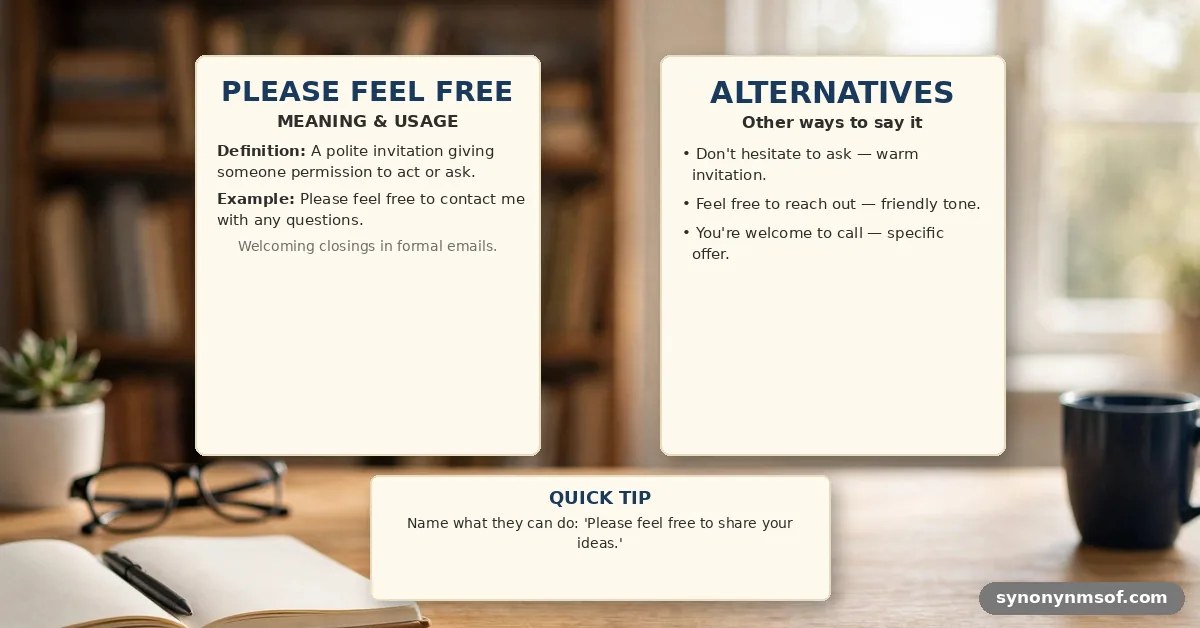
“Please feel free” is a polite expression that encourages someone to take an action without worrying about inconveniencing you.
It gives the other person permission to ask questions, request help, share feedback, or contact you whenever necessary.
For example:
- Please feel free to contact me if you have any questions.
- Please feel free to ask for clarification.
- Please feel free to reach out anytime.
In simple words, it means:
“You’re welcome to do this, and I encourage you to do so if needed.”
The phrase helps create an open and approachable tone, which is why it’s commonly used in professional communication.
Is “Please Feel Free” Professional?
Yes.
“Please feel free” is considered both professional and courteous. It works well in:
- Business emails
- Customer support
- Workplace communication
- Academic correspondence
- Client interactions
- Job applications
- Professional networking
Because it expresses openness without sounding demanding, it helps build trust and encourages communication.
That said, modern writing often favors simpler alternatives such as “Let me know” or “Reach out anytime”, especially in less formal workplaces.
When Should You Use “Please Feel Free”?
This phrase works best when you want the other person to feel comfortable taking action.
Common situations include:
Inviting Questions
After explaining something, you can encourage further discussion.
Example
Please feel free to ask if anything needs clarification.
Offering Assistance
Show that you’re available to help.
Example
Please feel free to contact me if you need additional support.
Encouraging Feedback
Create an open environment for suggestions.
Example
Please feel free to share your thoughts with the team.
Building Client Relationships
Clients appreciate knowing help is available.
Example
Please feel free to reach out if you’d like to discuss your project further.
Ending Professional Emails
Many professionals use it as a friendly closing invitation.
Example
Please feel free to get in touch if you need anything else.
Quick Comparison Table
| Phrase | Professional | Friendly | Best For |
|---|---|---|---|
| Please feel free | ⭐⭐⭐⭐⭐ | ⭐⭐⭐⭐☆ | General business emails |
| Don’t hesitate to | ⭐⭐⭐⭐⭐ | ⭐⭐⭐☆☆ | Formal communication |
| Reach out anytime | ⭐⭐⭐⭐☆ | ⭐⭐⭐⭐⭐ | Clients and networking |
| Let me know | ⭐⭐⭐⭐☆ | ⭐⭐⭐⭐⭐ | Everyday workplace communication |
| I’m happy to help | ⭐⭐⭐⭐☆ | ⭐⭐⭐⭐⭐ | Customer service |
| You’re welcome to | ⭐⭐⭐⭐☆ | ⭐⭐⭐⭐☆ | Team collaboration |
| Contact me anytime | ⭐⭐⭐⭐☆ | ⭐⭐⭐⭐☆ | Professional relationships |
| Ask away | ⭐⭐☆☆☆ | ⭐⭐⭐⭐⭐ | Informal conversations |
30 Other Ways to Say “Please Feel Free”
1. Don’t Hesitate To
Tone: Formal and Professional
Best For: Business emails, client communication, and follow-ups.
Example
Don’t hesitate to contact me if you need any further information.
2. You’re Welcome To
Tone: Friendly
Best For: Team discussions and collaborative projects.
Example
You’re welcome to share your suggestions during the meeting.
3. Reach Out Anytime
Tone: Warm and Modern
Best For: Clients, coworkers, and networking.
Example
Reach out anytime if you’d like to discuss the proposal.
4. Let Me Know
Tone: Conversational
Best For: Daily workplace communication.
Example
Let me know if you’d like me to make any changes.
5. I’m Happy to Help
Tone: Supportive
Best For: Customer service and colleague support.
Example
I’m happy to help if you have any questions.
6. Please Ask If You Need Anything
Tone: Polite
Best For: New employees, students, and clients.
Example
Please ask if you need anything while getting started.
7. Contact Me Anytime
Tone: Professional
Best For: Long-term client relationships.
Example
Contact me anytime if another issue comes up.
8. You Can Always…
Tone: Friendly
Best For: Ongoing communication.
Example
You can always reach out if something isn’t clear.
9. I’d Be Glad to Help
Tone: Warm and Professional
Best For: Service-oriented communication.
Example
I’d be glad to help you with the next steps.
10. Feel Free to Reach Out
Tone: Professional Yet Relaxed
Best For: Networking, interviews, and customer communication.
Example
Feel free to reach out whenever you have additional questions.
Why These Alternatives Matter
Using different expressions doesn’t just make your writing more interesting—it helps you match the tone to your audience.
For example, “Don’t hesitate to contact me” works well in a formal email to a client, while “Let me know” feels more natural when writing to a teammate you’ve worked with for years.
The best communicators don’t rely on a single phrase. Instead, they adapt their language based on the relationship, purpose, and level of formality. This flexibility makes messages sound more genuine and helps build stronger professional connections.
11. Feel Free to Contact Me
Tone: Professional and approachable
Best For: Clients, vendors, and external partners.
Example:
Feel free to contact me if you need additional documentation.
This is one of the closest direct replacements for please feel free, but it sounds slightly cleaner and more modern.
12. Ask Away
Tone: Casual and friendly
Best For: Team chats, mentoring, and informal conversations.
Example:
Ask away if anything about the process is unclear.
Use this only when you already have a comfortable relationship with the other person.
13. Just Let Me Know
Tone: Conversational
Best For: Everyday workplace communication.
Example:
Just let me know if you’d like another revision.
This is often the most natural choice in modern business writing.
14. I’m Here If You Need Me
Tone: Warm and reassuring
Best For: Supportive leadership and colleague communication.
Example:
I’m here if you need me while you’re settling into the new role.
This phrase adds a stronger sense of personal support.
15. Please Don’t Hesitate to Ask
Tone: Formal and encouraging
Best For: Customer service, education, and client communication.
Example:
Please don’t hesitate to ask if you need clarification.
Compared with don’t hesitate to, adding please makes the invitation feel softer.
16. You Are More Than Welcome To
Tone: Warm and gracious
Best For: Hospitality, client relations, and networking.
Example:
You are more than welcome to schedule a follow-up call.
This phrase sounds especially generous and accommodating.
17. I’d Appreciate Hearing From You
Tone: Professional and engaged
Best For: Feedback requests and collaborative work.
Example:
I’d appreciate hearing from you once you’ve reviewed the proposal.
Notice that this invites communication while also expressing genuine interest.
18. We’d Be Delighted to Assist
Tone: Formal and service-oriented
Best For: Customer support and client-facing communication.
Example:
We’d be delighted to assist with any additional requests.
This works well for organizations and support teams.
19. Our Team Is Here to Help
Tone: Reassuring and professional
Best For: Customer service and onboarding.
Example:
Our team is here to help if you run into any issues.
It emphasizes availability without sounding overly formal.
20. You’re Invited to Ask Questions
Tone: Encouraging and inclusive
Best For: Training sessions, workshops, and educational settings.
Example:
You’re invited to ask questions throughout the presentation.
This phrase is especially effective when you want to encourage participation.
How to Choose the Right Alternative
The biggest mistake people make is using the same phrase for every audience. The best choice depends on who you’re writing to.
Clients & Executives
Use more formal options
- Don’t hesitate to contact me
- Please don’t hesitate to ask
- Feel free to contact me
- We’d be delighted to assist
These phrases communicate professionalism and reliability.
Coworkers & Team Members
Use conversational options
- Let me know
- Just let me know
- Reach out anytime
- I’m here if you need me
These sound collaborative rather than corporate.
Students, New Employees, or People Seeking Guidance
Use encouraging language:
- Please ask if you need anything
- You’re invited to ask questions
- Ask away
- You are more than welcome to
These phrases reduce anxiety and make people more comfortable speaking up.
Real Email Examples
Example 1: Client Follow-Up
Project Timeline Update
Project Timeline Update
Hi Sarah,
I’ve attached the revised project timeline and updated deliverables for your review.
Please don’t hesitate to ask if you’d like to discuss any changes in more detail. I’d be happy to walk through the timeline together.
Best regards,
Daniel
Why it works: The phrase sounds professional, supportive, and confident without being overly formal.
Example 2: Team Communication
Hi everyone,
I’ve uploaded the latest presentation to the shared folder. Just let me know if you spot anything that should be updated before tomorrow’s meeting.
Thanks!
Why it works: Just let me know feels natural and collaborative.
Example 3: Customer Support
Support Request
Support Request
Hello Michael,
Thank you for contacting us about your account settings.
Our team is here to help if you have any additional questions or need further assistance. We’re happy to guide you through the next steps.
Kind regards,
Customer Support Team
Why it works: The wording reassures the customer that help is available and ongoing.
Example 4: Networking Message
Hi Priya,
It was great speaking with you today. Reach out anytime if you’d like to continue the conversation or discuss potential collaboration opportunities.
Looking forward to staying connected!
Why it works: Reach out anytime sounds modern, friendly, and genuinely open.
A Small Change That Makes Emails Sound More Human
Compare these two sentences:
Corporate: Please feel free to contact me should you require additional information.
Human: Feel free to reach out if you’d like more details—I’m happy to help.
Both are professional. The second simply sounds like a real person wrote it.
That distinction matters. In a world full of automated messages, people respond better to communication that feels clear, warm, and genuine.
21. Keep in Touch
Tone: Friendly and Professional
Best For: Networking and long-term professional relationships.
Example
Keep in touch if you hear about any future opportunities.
Why it works
Rather than simply inviting communication, this phrase encourages an ongoing professional relationship.
22. Connect With Me Anytime
Tone: Modern and Friendly
Best For: LinkedIn, networking events, and professional communities.
Example
Connect with me anytime if you’d like to continue the conversation.
Why it works
This phrase feels approachable while remaining professional, making it ideal for networking.
23. Share Your Thoughts Anytime
Tone: Collaborative
Best For: Team meetings, brainstorming sessions, and leadership communication.
Example
Share your thoughts anytime if you have ideas that could improve the project.
Why it works
Instead of merely allowing communication, it actively encourages participation.
24. Let Me Know How I Can Help
Tone: Helpful and Supportive
Best For: Customer service, colleagues, and clients.
Example
Let me know how I can help if you run into any issues.
Why it works
This shifts the focus from permission to support, making your message sound more personal.
25. I’m Available If Needed
Tone: Calm and Professional
Best For: Managers, consultants, and project leaders.
Example
I’m available if needed during the implementation process.
Why it works
It reassures people without sounding overly formal.
26. Feel Comfortable Reaching Out
Tone: Encouraging
Best For: Mentoring, coaching, and onboarding.
Example
Feel comfortable reaching out whenever something isn’t clear.
Why it works
This wording helps reduce hesitation, especially for new employees or students.
27. I’d Love to Hear From You
Tone: Warm and Personal
Best For: Networking, creative work, and community engagement.
Example
I’d love to hear from you after you’ve had a chance to review the proposal.
Why it works
It expresses genuine interest rather than simply allowing communication.
28. If Anything Comes Up, Let Me Know
Tone: Natural and Conversational
Best For: Everyday workplace communication.
Example
If anything comes up, let me know before Friday.
Why it works
This is one of the most commonly used alternatives in modern workplaces because it sounds effortless and friendly.
29. We’re Only an Email Away
Tone: Customer-Focused
Best For: Customer support and client communication.
Example
If you need assistance, we’re only an email away.
Why it works
This creates reassurance while reinforcing accessibility.
30. Please Get in Touch Whenever Needed
Tone: Professional
Best For: Formal business communication.
Example
Please get in touch whenever needed if additional documentation is required.
Why it works
This phrase remains polite while sounding slightly more modern than “please feel free.”
Common Mistakes People Make
Even though “please feel free” is a helpful expression, it’s easy to misuse. Here are some common mistakes to avoid.
1. Using It in Every Email
If every message ends with:
Please feel free to contact me.
the phrase starts to lose its impact.
Instead, rotate between different expressions such as:
- Let me know
- Reach out anytime
- I’m happy to help
- Don’t hesitate to ask
Using a variety of phrases makes your writing feel more natural.
2. Sounding Too Formal
Many workplaces have adopted a more conversational communication style.
Instead of writing:
Please feel free to message me regarding today’s meeting.
you could simply say:
Just let me know if you have any questions.
The second version feels friendlier without sacrificing professionalism.
3. Making Sentences Too Long
Avoid combining several polite expressions into one sentence.
For example:
Please feel free to kindly contact me at your earliest convenience should you require any additional assistance.
This sounds unnecessarily complicated.
A clearer version would be:
Please feel free to contact me if you need any further assistance.
Simple writing is usually stronger writing.
4. Using It When Action Is Required
“Please feel free” suggests that an action is optional.
If something is mandatory, be direct.
Instead of:
Please feel free to submit the report today.
write:
Please submit the report by 3:00 PM today.
Clear instructions prevent misunderstandings.
When You Should Avoid “Please Feel Free”
Although it’s a versatile phrase, there are situations where another approach works better.
During Urgent Requests
Urgent situations require direct language.
Less Effective
Please feel free to respond today.
Better
Please respond by 5 PM today.
When Giving Instructions
Instructions should sound clear rather than optional.
Less Effective
Please feel free to complete the training module.
Better
Please complete the training module before Friday.
Very Casual Conversations
Among close coworkers or friends, the phrase can sound overly formal.
Instead of:
Please feel free to call me.
Most people would naturally say:
Give me a call anytime.
How Different Industries Use “Please Feel Free”
One reason this phrase remains popular is that it adapts well to many professional settings.
Customer Service
Support teams use it to reassure customers that help is always available.
Example
Please feel free to contact us if you have any questions about your order.
Education
Teachers and instructors often use the phrase to encourage students to seek clarification.
Example
Please feel free to email me if you’d like additional resources.
Leadership
Effective managers create an open environment where employees feel comfortable sharing concerns.
Example
Please feel free to share your feedback during our one-on-one meeting.
Sales
Sales professionals use it to continue conversations without sounding pushy.
Example
Please feel free to reach out if you’d like a personalized demonstration.
Human Resources
HR professionals often include the phrase during onboarding and recruitment.
Example
Please feel free to contact me if you have questions about your benefits package.
Is “Please Feel Free” Becoming Outdated?
Not at all.
However, workplace communication has become noticeably more conversational over the last decade.
Many professionals now prefer phrases like:
- Let me know
- Reach out anytime
- Happy to help
- Just ask
- If anything comes up, let me know
These alternatives often feel more natural in emails, instant messaging platforms, and virtual meetings.
That doesn’t mean “please feel free” is outdated—it simply means you should match your wording to your audience. A formal client may appreciate the traditional phrase, while a close colleague may respond better to a simpler expression.
Best Practices for Using “Please Feel Free”
Although “please feel free” is a professional and widely accepted phrase, using it thoughtfully can make your communication feel more genuine. Here are a few best practices to keep in mind.
1. Be Specific About the Action
Instead of ending your email with a vague invitation, tell the reader exactly what they’re welcome to do.
Less Effective
Please feel free.
Better
Please feel free to contact me if you have any questions about the proposal.
Specific language provides clear direction and encourages a response.
2. Match the Tone to Your Audience
The phrase you choose should reflect your relationship with the recipient.
- Clients and executives: Use formal expressions like Don’t hesitate to contact me or Please feel free to reach out.
- Coworkers: Simpler phrases such as Let me know or Reach out anytime often feel more natural.
- Friends or close colleagues: Casual options like Just ask or Give me a call anytime work better.
Adjusting your tone shows emotional intelligence and helps build stronger professional relationships.
3. Avoid Overusing the Same Phrase
If every email ends with “please feel free,” your writing can begin to sound repetitive or templated.
Rotating between different alternatives keeps your communication fresh while maintaining a professional tone.
4. Keep Your Writing Simple
Professional writing doesn’t have to be complicated.
Instead of:
Please feel free to contact me should you require any additional information regarding this matter.
Try:
Feel free to reach out if you need more information.
The second version is shorter, clearer, and easier to read.
5. Show Genuine Willingness to Help
Adding a brief sentence after your invitation makes it sound more sincere.
For example:
Please feel free to reach out if you have any questions. I’d be happy to explain anything in more detail.
This small addition makes your message feel warmer and more personal.
The Psychology Behind Polite Language
Polite expressions like “please feel free” do more than make an email sound courteous—they help create psychological safety.
When people believe their questions are welcome, they’re more likely to:
- Ask for clarification instead of making assumptions.
- Share honest feedback.
- Report problems early.
- Participate in discussions.
- Build stronger working relationships.
Imagine a new employee joining your team. If your email simply says:
Review the handbook.
they may hesitate to ask questions.
Now compare it with:
Review the handbook, and please feel free to reach out if anything is unclear.
The second version reassures the employee that asking questions is expected, not inconvenient. Small wording changes like this can make communication feel more supportive and inclusive.
How to Sound More Human in Emails
Many professionals believe that formal language automatically sounds professional. In reality, the most effective business communication is respectful and conversational.
Compare these examples:
Formal
Please feel free to contact me should you require additional information.
More Natural
Feel free to reach out if you’d like more details. I’m happy to help.
The second version sounds like it was written by a real person rather than copied from a template.
Here are a few additional ways to make your emails feel more human:
- Use contractions like I’m or we’re when appropriate.
- Keep sentences short and easy to read.
- Replace overly formal words with plain English.
- Show empathy by acknowledging the reader’s needs.
- End with a genuine offer of assistance.
Professional doesn’t have to mean robotic.
Frequently Asked Questions
1. Is “please feel free” professional?
Yes. It’s considered a professional and polite phrase that’s commonly used in business emails, customer service, education, and workplace communication.
2. What does “please feel free” mean?
It means you’re encouraging someone to do something—such as ask a question or contact you—without hesitation.
3. What can I say instead of “please feel free”?
Some excellent alternatives include:
- Don’t hesitate to
- Reach out anytime
- Let me know
- I’m happy to help
- Feel free to contact me
- Just let me know
- You can always…
- Contact me anytime
4. Is “please feel free” too formal?
Not usually. It strikes a balance between formal and friendly. However, in casual conversations, shorter phrases like let me know often sound more natural.
5. Can I use “please feel free” in business emails?
Absolutely. It’s widely accepted in professional correspondence and works well when inviting questions, feedback, or further discussion.
6. Is “feel free” polite without “please”?
Yes. Feel free is already polite, but adding please makes the invitation slightly warmer and more courteous, especially in formal writing.
7. When should I avoid using “please feel free”?
Avoid it when giving mandatory instructions or communicating urgent deadlines. In those situations, direct language is more effective.
8. Is “don’t hesitate to” more formal than “please feel free”?
Yes. Don’t hesitate to generally sounds a bit more formal and authoritative, making it a common choice for client communication and official emails.
9. Which alternative sounds the most natural today?
For many workplaces, phrases like let me know, reach out anytime, and I’m happy to help feel more conversational while remaining professional.
10. Can I use “please feel free” with clients?
Yes. It’s an excellent choice for client communication because it reassures clients that you’re available to answer questions or provide additional support.
11. Is “please feel free” suitable for customer service?
Definitely. Customer support teams often use this phrase to encourage customers to seek assistance whenever they need it.
12. How can I make “please feel free” sound less repetitive?
Vary your language by using alternatives such as contact me anytime, don’t hesitate to ask, share your thoughts anytime, or let me know how I can help. Rotating your phrasing keeps your writing engaging and authentic.
Final Thoughts
“Please feel free” has remained a trusted phrase in professional communication because it conveys openness, respect, and a willingness to help. Whether you’re writing to a client, colleague, customer, or hiring manager, it creates an inviting tone that encourages conversation.
That said, effective communication isn’t about relying on a single expression. The strongest writers adapt their language to the situation. Sometimes “please feel free” is the perfect choice. Other times, a simpler phrase like “let me know” or “reach out anytime” sounds more natural and conversational.
The key is to focus on your reader. Think about who you’re writing to, what action you want them to take, and how formal the situation is. Choosing the right phrase shows confidence, empathy, and professionalism—qualities that build trust in every interaction.
By using the 30 alternatives in this guide and applying the practical tips we’ve covered, you’ll write emails and messages that sound polished, approachable, and genuinely helpful rather than repetitive or robotic.