
If you’ve ever written a professional email, chances are you’ve used the phrase “for your reference.” It’s one of the most common expressions in business communication because it politely tells someone that you’re sharing information they may need now or later.
You’ll find it in:
- Business emails
- Internal memos
- Project updates
- Client communication
- Reports
- Meeting notes
- Attachments
- Academic correspondence
Although it’s a perfectly acceptable phrase, using it too often can make your writing feel repetitive or overly formal. In some situations, it may even sound distant or passive-aggressive if the context isn’t right.
Modern workplace communication has shifted toward language that is clear, friendly, and collaborative. Instead of relying on the same expression every time, it’s helpful to know alternative ways to communicate the same idea while matching the tone of your audience.
In this guide, you’ll learn:
- What “for your reference” really means
- When you should use it
- When to avoid it
- 30+ professional alternatives
- Real email examples
- Common mistakes
- Frequently asked questions
Let’s begin by understanding the phrase itself.
What Does “For Your Reference” Mean?
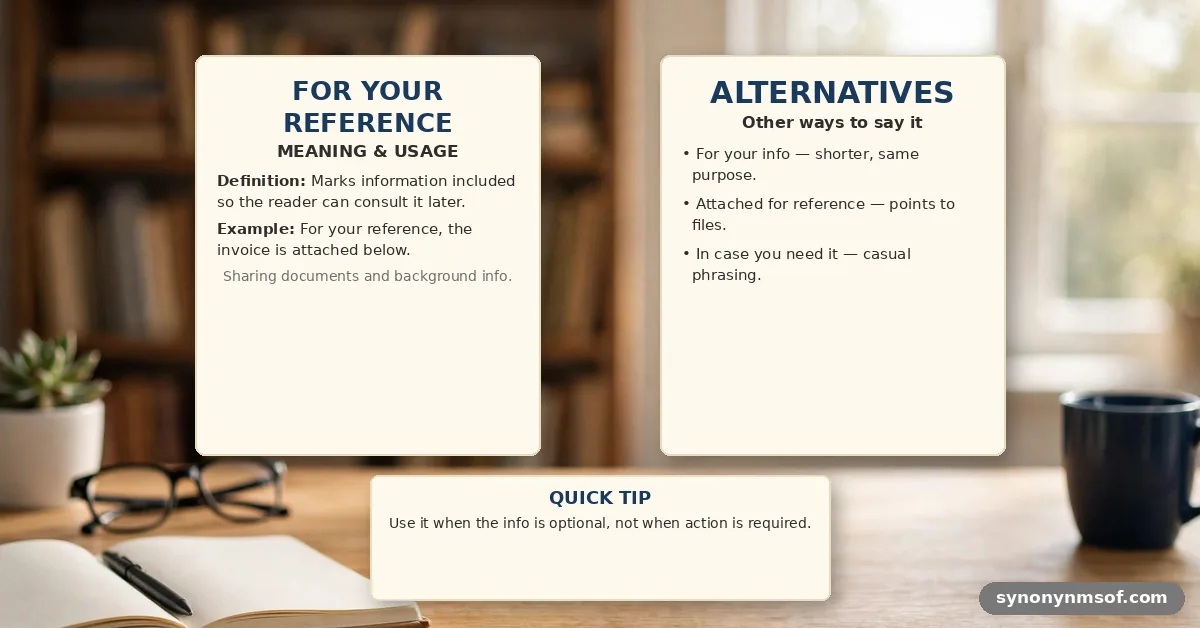
For your reference means:
“I’m sharing this information so you can review or use it whenever necessary.”
It usually indicates that the recipient isn’t expected to take immediate action. Instead, the information is being provided simply because it may become useful.
For example:
- For your reference, I’ve attached last year’s sales report.
- For your reference, here’s the meeting agenda.
- For your reference, I’ve included the previous email thread.
The phrase acts as a polite introduction to supporting information rather than a request or instruction.
Why Professionals Use “For Your Reference”
This expression has remained popular because it serves several useful purposes.
It helps you:
- Share background information
- Provide supporting documents
- Keep colleagues informed
- Reduce misunderstandings
- Maintain proper documentation
- Give additional context
- Organize communication clearly
Rather than demanding action, it simply tells the reader,
“Here’s something that may help you.”
That’s why it’s commonly used in business environments.
Is “For Your Reference” Professional?
Yes.
It is considered a professional and widely accepted phrase across many industries, including:
- Corporate offices
- Government organizations
- Universities
- Healthcare
- Legal firms
- Finance
- Project management
- Customer support
However, professionalism isn’t just about grammar.
It’s also about tone.
While “for your reference” is technically correct, repeating it in every email can make your communication sound mechanical.
Why Tone Matters
The exact same phrase can communicate completely different emotions depending on the situation.
Helpful
For your reference, I’ve attached the updated guidelines.
This sounds supportive.
Neutral
For your reference, here are the meeting notes.
This simply shares information.
Passive-Aggressive
For your reference, this issue was already addressed in my previous email.
Although grammatically correct, this version may sound defensive or critical.
The words haven’t changed.
The tone has.
That’s why choosing the right wording is just as important as choosing the right information.
30+ Other Ways to Say “For Your Reference”
If you want your writing to sound more natural, here are over 30 excellent alternatives.
| Alternative | Best Used For |
|---|---|
| For your information | General updates |
| For your review | Documents requiring attention |
| Please see attached | Email attachments |
| I’ve attached this for context | Background information |
| Sharing this in case it’s helpful | Friendly workplace communication |
| Thought this might be useful | Casual professional emails |
| For background | Project discussions |
| Attached for your review | Reports and proposals |
| Here are the details | General communication |
| Just sharing this with you | Team updates |
| For future reference | Information to save |
| For your convenience | Helpful resources |
| As discussed | Follow-up emails |
| As requested | Responding to requests |
| Please find attached | Formal business emails |
| I’ve included this below | Email explanations |
| Here’s the document we discussed | Follow-up conversations |
| Sharing for context | Collaborative projects |
| Included for your records | Administrative communication |
| In case you need it | Friendly communication |
| This may be helpful | Offering assistance |
| You may find this useful | Client communication |
| Here’s some additional information | Explanations |
| For completeness | Reports and documentation |
| For your records | Record keeping |
| Just so you have it | Informal workplace communication |
| Keeping you informed | Team updates |
| Here’s the reference material | Training or documentation |
| Attached as discussed | Meeting follow-ups |
| I’ve enclosed the document | Formal correspondence |
| Sharing this for visibility | Team collaboration |
| Please keep this for future use | Policies and procedures |
| Here’s some background information | Projects and planning |
| For added context | Detailed explanations |
| Included for easy reference | Manuals and guides |
Rotating these phrases makes your writing sound more natural while avoiding unnecessary repetition.
When Should You Use “For Your Reference”?
The phrase works especially well in situations where you’re sharing information without requesting immediate action.
Examples include:
Sending Attachments
Attach reports, invoices, proposals, manuals, or presentations.
For your reference, I’ve attached the revised proposal.
Sharing Previous Conversations
For your reference, here’s our email discussion from last month.
Providing Background Information
For your reference, this project began in January.
Client Communication
For your reference, I’ve included our pricing guide.
Team Updates
For your reference, here are the meeting minutes.
Professional Email Examples
Example 1
Subject: Updated Budget Report
Hi Sarah,
For your reference, I’ve attached the updated budget report that reflects the latest changes discussed during today’s meeting.
Please let me know if you have any questions.
Best regards,
James
Example 2
Hi Daniel,
Sharing this in case it’s helpful.
I’ve attached last quarter’s performance report, which may provide useful context for tomorrow’s presentation.
Thanks,
Emma
Example 3
Hello Team,
Please see attached the revised project schedule for your review.
If anything needs clarification, feel free to reach out.
Regards,
Michael
Common Mistakes to Avoid
Many professionals unintentionally misuse this phrase.
Avoid these mistakes:
Using It When Action Is Required
Incorrect:
For your reference, please complete the attached form today.
Better:
Please complete the attached form by 5 PM today.
Using It Too Frequently
Repeating the same phrase throughout multiple emails makes your writing monotonous.
Rotate between alternatives instead.
Sounding Passive-Aggressive
Avoid sentences like:
For your reference, this information was already shared.
Instead say:
I’ve attached the previous email in case it’s helpful.
The second version sounds much more collaborative.
Pairing It with Unnecessary Formality
Instead of:
Please be advised that, for your reference…
Simply write:
I’ve attached the document for your reference.
Clear communication is usually better than complicated wording.
Why Modern Business Communication Is Changing
Today’s workplaces value communication that is:
- Clear
- Friendly
- Respectful
- Efficient
- Human
Employees and clients appreciate messages that sound conversational while remaining professional.
Instead of relying heavily on traditional corporate language, many professionals now prefer expressions that feel approachable and supportive.
Professional doesn’t have to mean robotic.
Simple language often builds stronger working relationships.
Frequently Asked Questions
1. What does “for your reference” mean?
It means you’re sharing information that the recipient may need now or in the future without expecting immediate action.
2. Is “for your reference” professional?
Yes. It is a standard phrase used in business emails, reports, client communication, and workplace correspondence.
3. Is “for your reference” formal?
Yes. It leans toward a formal tone but is still widely accepted in modern workplaces.
4. What can I say instead of “for your reference”?
Some excellent alternatives include:
- For your information
- For your review
- Sharing this in case it’s helpful
- I’ve attached this for context
- Thought this might be useful
- Please see attached
- For future reference
5. Can “for your reference” sound rude?
Sometimes. If it’s used to remind someone of a previous mistake or oversight, it may come across as passive-aggressive. Adding friendly language can soften the tone.
6. Is “for your reference” appropriate in emails?
Absolutely. It’s one of the most commonly used phrases for introducing attachments, supporting documents, or background information.
7. What’s the friendliest alternative?
“Sharing this in case it’s helpful” is one of the warmest and most natural alternatives for modern workplace communication.
8. Should I use “for your reference” with attachments?
Yes. It’s commonly used when attaching reports, presentations, invoices, contracts, or supporting documents that don’t require immediate action.
9. How can I make my emails sound more natural?
Use plain language, avoid unnecessary corporate jargon, vary your wording, and focus on being clear and helpful rather than overly formal.
10. Is “for your reference” outdated?
No. The phrase is still widely used. However, combining it with warmer, more conversational language often creates a better impression in today’s workplace.
Conclusion
“For your reference” remains one of the most useful phrases in professional communication because it clearly signals that you’re sharing information for future use or background context. Whether you’re sending reports, attaching documents, or providing supporting details, it helps organize communication without demanding immediate action.
That said, effective communication isn’t just about using the correct phrase—it’s about choosing the right tone. Overusing formal language can make emails feel stiff, while thoughtful alternatives such as “sharing this in case it’s helpful,” “I’ve attached this for context,” or “thought this might be useful” create a warmer and more collaborative impression.
By expanding your vocabulary with these 30+ alternatives, you’ll write emails that feel more natural, improve workplace relationships, and communicate with greater clarity and confidence. Small wording choices often leave lasting professional impressions, making your messages both effective and genuinely helpful.