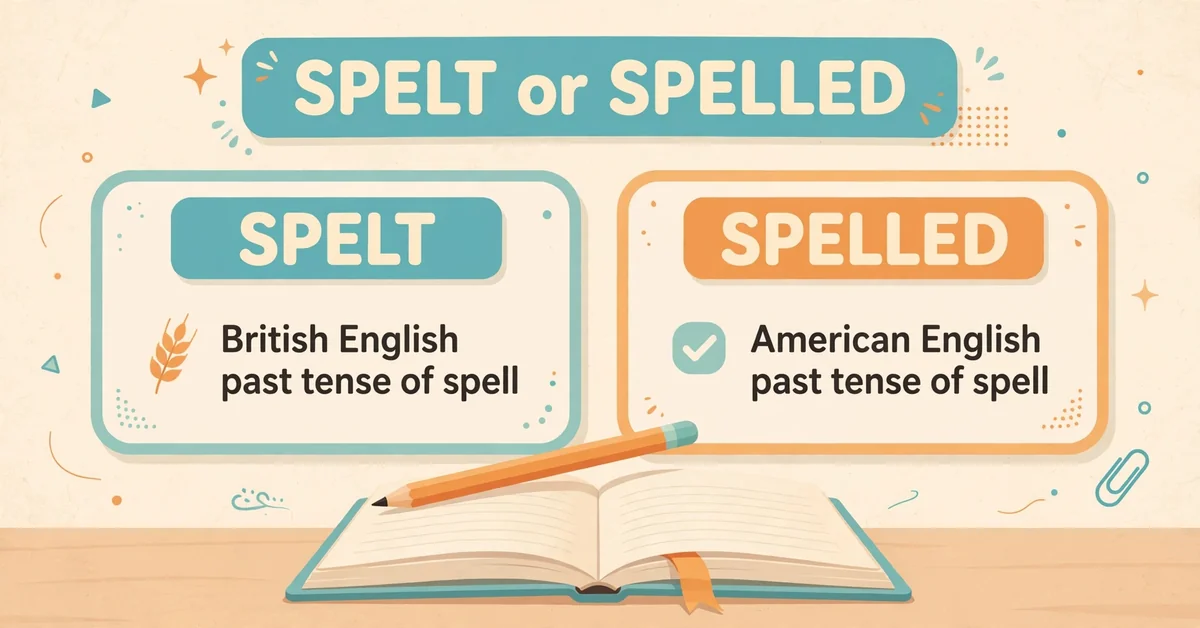

Few word pairs cause as much quiet embarrassment as spelt or spelled. You write an email, type one of them, and suddenly the red squiggle appears — or worse, no squiggle appears, and you still are not sure you picked the right one. Is “spelt” even a real word? Does it matter which one you use in an essay, a job application, or a friendly text? If you have ever paused over this pair, you are in good company: learners, native speakers, and professional editors weigh in on this question every day.
The short answer is reassuring. Both “spelt” and “spelled” are legitimate past forms of the verb “to spell,” but they are not always interchangeable. Which one is correct depends mostly on whether you are writing American English or British English — and, in one quirky case, whether you are talking about letters or bread.
By the end of this article, you will know exactly what each word means, where each one is preferred, how to use them in everyday conversation, workplace writing, and formal academic prose, and how to sidestep the common mistakes that trip people up. Plenty of real, original examples are included, so you can see both forms working in sentences that sound like actual English — not textbook filler.
What Does “Spelled” Mean?
The word spelled is the past tense and past participle of the verb “to spell.” The verb “to spell” most commonly means to name, write, or arrange the letters of a word in their correct order. When you say “She spelled her name for the receptionist,” you mean she said or wrote out the individual letters — S, then U, then S, and so on — so the receptionist could record the name correctly.
Spelled as the Past Tense of “Spell”
Whenever the action of spelling happened in the past, “spelled” is the standard form. It works the same way as other regular verbs: just as “walked” is the past of “walk,” “spelled” is the past of “spell.”
- Yesterday in class, the teacher asked me how “necessary” was spelled.
- He spelled his surname slowly so the clerk would not mishear it.
- My grandmother always spelled “okay” as “OK” in her letters.
In each of these sentences, “spelled” describes a completed action: somebody arranged letters in the past. This is the single most frequent use of the word, and it is accepted everywhere English is written.
Spelled as a Past Participle
“Spelled” also serves as the past participle, which means it appears after forms of “have” and in passive constructions. This is where learners sometimes stumble, because the past participle of an irregular verb can look different from its simple past — but here they are identical.
- She has spelled the address correctly on every form this year.
- The instructions had been spelled out clearly on the first page.
- The company name is spelled with a silent “h” at the end.
Notice the last example: “is spelled” is a passive construction, and it is one of the most common patterns in business and academic writing. When you need to state how a word is written, “is spelled” is the safe, universally accepted choice.
Spelled Beyond Letters: “To Signify” and “Spell Out”
The verb “spell” has two more meanings worth knowing, and “spelled” carries both into the past tense. First, “spell” can mean “to signify or result in,” as in “This delay could spell disaster for the project.” In the past: “The missed deadline spelled the end of the partnership.” Second, “spell out” means to explain something in full, simple detail: “Please spell out exactly what you need.” In the past: “The lawyer spelled out the terms before we signed.”
What Does “Spelt” Mean?
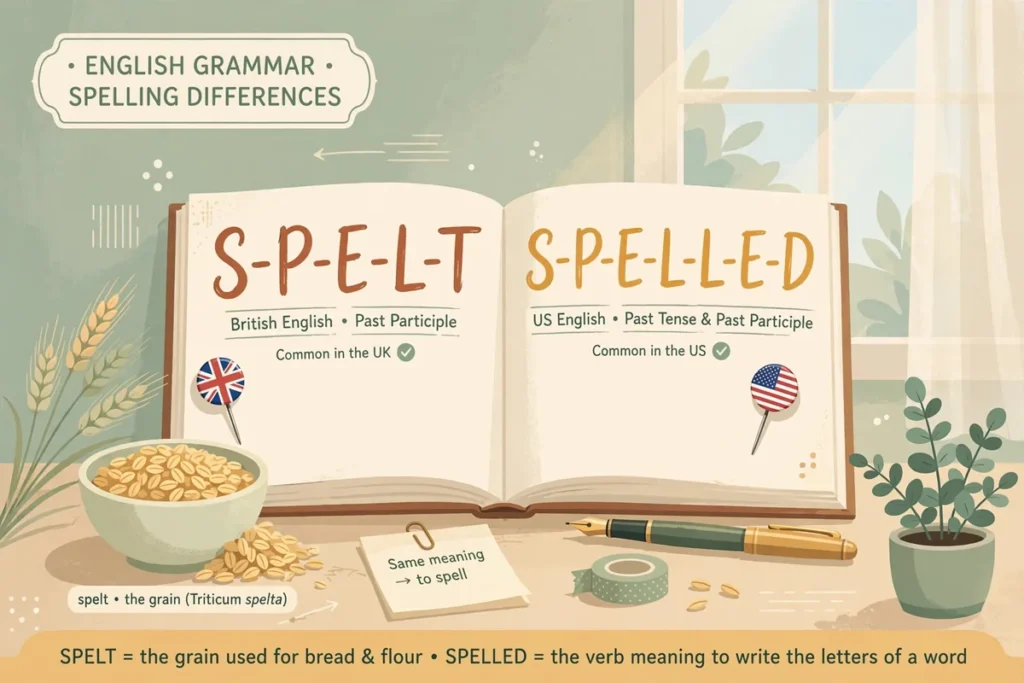
The word spelt is the alternative past tense and past participle of “to spell.” It means exactly the same thing as “spelled” — to have named or written letters in order — but it is used in different regions. In British, Canadian, and Australian English, “spelt” is a perfectly ordinary, correct form. In American English, it is generally not accepted as a verb form and will usually be flagged as an error.
Spelt as a British English Past Form
British English has a whole family of verbs that can take either the regular “-ed” ending or an irregular “-t” ending: learnt/learned, dreamt/dreamed, burnt/burned, knelt/kneeled — and spelt/spelled belongs to this group. For these verbs, the “-t” forms have traditionally been the more characteristically British choice.
- The child spelt the word aloud for the teacher.
- She spelt her name three times before the official got it right.
- “Rhythm” is spelt without any vowels, he reminded the class.
If you are writing for a British audience — a UK university essay, a London-based company, an email to colleagues in Manchester — “spelt” will look completely natural.
Spelt the Grain: The Tricky Homograph
Here is the twist that makes this pair genuinely confusing. Spelt is also a noun: an ancient species of wheat (Triticum spelta) that has been cultivated for thousands of years and is popular today in wholegrain breads, pastas, and health-food products. This noun exists in all varieties of English, including American English.
- This loaf is made with organic spelt flour.
- Spelt has a slightly nutty flavour that works well in rustic bread.
- The bakery switched from modern wheat to ancient spelt last year.
So in the United States, “spelt” is a real word — but only as the grain. Write “He spelt his name wrong” in an American document and most readers (and every spellchecker) will treat it as a mistake. Write “spelt flour” and nobody will object. Context is everything.
The Key Difference Between “Spelt” and “Spelled”
Now that both forms are defined, the difference comes down to one question: which English are you writing? This is not a matter of one being “right” and the other “wrong” in any absolute sense. It is a matter of regional convention, audience expectation, and consistency.
American English: Only “Spelled”
In American English, “spell” is treated as a fully regular verb. The only correct past form is “spelled.” If you submit an American college paper, a résumé, or a business proposal with “spelt” used as a verb, it will almost certainly be marked as an error, even though a British reader would find it flawless.
- Correct in the US: “She spelled her name for the agent.”
- Incorrect in the US: “She spelt her name for the agent.”
American spellcheckers are configured this way too. Microsoft Word, Google Docs, and Grammarly set to US English will underline “spelt” (as a verb) with a red squiggle. That is not the software being clever — it is simply enforcing the American convention.
British English: Both Are Correct
In British English, both “spelled” and “spelt” are accepted, and major British dictionaries list both forms. Traditionally, “spelt” was the more characteristically British choice — the one that signalled British spelling the way “colour” signals it against American “color.” In recent decades, however, “spelled” has gained ground in the UK through media, software, and the internet, though “spelt” remains common and entirely respectable.
What matters most in British writing is consistency. If you open an essay with “spelt,” do not switch to “spelled” halfway through. Pick one and stick with it. Examiners and editors notice inconsistency far more than they care which of the two correct forms you chose.
Other English Varieties
Canadian and Australian English generally follow the British pattern: both forms are understood, and “spelt” is widely used, though “spelled” is also common. International English — the kind used in multinational companies, academic journals with global readership, and standardized tests — tends to default to “spelled,” simply because it is the one form accepted in every variety. When in doubt and writing for a mixed audience, “spelled” is the safest single choice you can make.
Spelt vs Spelled: Comparison Table
| Feature | Spelled | Spelt |
|---|---|---|
| Part of speech | Verb (past tense / past participle) | Verb (past tense / past participle); also a noun (a grain) |
| Meaning as a verb | Named or wrote letters in order; signified; explained in detail | Exactly the same as “spelled” |
| American English | Standard and correct — the only accepted verb form | Not accepted as a verb; correct only as the noun (the grain) |
| British English | Correct and increasingly common | Correct and traditionally preferred |
| Canadian / Australian English | Correct and widely used | Correct and widely used |
| Safest choice for a global audience | Yes — accepted in every variety | No — flagged as an error in the US |
| Example (verb) | She spelled her name slowly. | She spelt her name slowly. (UK) |
| Example (noun) | — (no noun sense) | The bread is made with spelt flour. (all varieties) |
| Negative forms | misspelled | misspelt (UK) / misspelled (US) |
| Memory tip | “Spelled” contains “spell” + “ed” — the regular pattern | “Spelt” ends in “t” like learnt, dreamt, burnt — the British irregular family |
Usage Examples Across Contexts
Knowing the rule is one thing; hearing both words in realistic sentences is what makes the choice automatic. The sections below show “spelt” and “spelled” across everyday conversation, workplace writing, and formal academic prose.
Everyday Conversation
In casual speech and informal writing — texts, chats, social media — the distinction rarely causes trouble because both forms are pronounced almost identically and listeners do not see the spelling. Still, when you write the words down, the regional rule applies.
- “How is your new colleague’s name spelled? I want to add him correctly.” (universal)
- “Mum, I spelled ‘beautiful’ right on the test!” (American child)
- “Mum, I spelt ‘beautiful’ right on the test!” (British child)
- “Sorry, I think I spelled your street name wrong on the invitation.”
- “He spelled it out for me letter by letter, and I still got it wrong.”
In conversation, nobody will judge you for either form. The choice only becomes visible — and therefore only matters — in writing.
Work and Business Writing
Professional writing is where the American/British split bites hardest, because the wrong choice can look like carelessness to a reader from the other side of the Atlantic. Match your form to your company’s house style or your client’s location.
- “Please confirm that the client’s name is spelled correctly on the contract before we send it.” (safe everywhere)
- “The previous agency had spelled the product name three different ways across the website.”
- “Our London office confirmed the venue name is spelt with an ‘e’ at the end, not an ‘a’.” (British internal email — fine)
- “The typo spelled disaster for the launch; the headline went out with the brand name wrong.” (the “signify” sense)
- “Has the invoice reference been spelled correctly in the system?”
Notice how the business examples lean on “spelled”: most international business writing defaults to the globally accepted form, even in British companies that otherwise use British spelling. When your readers span continents, “spelled” is the professional default.### Formal and Academic Writing
Academic writing demands consistency above all. APA, MLA, and Chicago (American styles) require “spelled”; Oxford and most UK university guides accept either but expect you to choose one and stay with it.
- “The manuscript spelled the author’s name inconsistently across chapters.” (academic critique)
- “Participants were asked to write how the stimulus words were spelt from memory.” (British psychology paper — acceptable)
- “The inscription is spelled exactly as it appears on the monument.”
- “This inconsistency spelled the end of the theory’s credibility among reviewers.” (the “signify” sense, formal register)
- “All proper nouns were spelled according to the Oxford English Dictionary.”
A useful academic habit: decide your form before you start writing, set your spellchecker to the matching regional dictionary, and run a final search for the other form to catch slips. On the other hand, if your institution has no stated preference and you are writing in British English, either choice will pass — just do not mix them. For a related look at how small connective phrases shape academic tone, see On the Other Hand.
Common Mistakes to Avoid
Even once you know the rule, a few traps keep catching writers out. Here are the mistakes worth watching for.
Mistake 1: Using “Spelt” as a Verb in American Writing
This is the big one. An American student writes “The teacher asked how the word was spelt,” and the professor circles it. The fix is simple: if your audience is American — or international and unspecified — use “spelled.”
- Wrong (US context): “He spelt his address on the form.”
- Right: “He spelled his address on the form.”
Mistake 2: Assuming “Spelt” Is Always a Typo
The mirror-image error: an American reader sees “spelt” in a British article and assumes the writer cannot spell. “Spelt” is a legitimate word with a centuries-long history in British English, and it is also the name of a real grain. Before “correcting” someone, check which English they are writing.
Mistake 3: Mixing Both Forms in One Document
A report that says “spelled” on page one and “spelt” on page four looks sloppy even to readers who accept both. Pick one form during drafting and enforce it during editing — a quick find-and-replace at the end takes seconds.
Mistake 4: Confusing the Verb With the Grain
“She spelt the flour into the bowl” is nonsense — the verb you want is “spelled” (or an ordinary verb like “poured”). Conversely, “spelled flour” in a recipe would puzzle readers; the grain is always “spelt,” in every variety of English. Keep the two meanings in separate mental boxes: verb form versus ancient wheat.
Mistake 5: Forgetting “Misspelled” vs “Misspelt”
The negative forms follow the same regional pattern. American English uses “misspelled”; British English accepts both “misspelled” and “misspelt.” Apply the same rule to the whole word family: learnt/learned, burnt/burned, dreamt/dreamed — the pattern is consistent.
- “The contract was returned because the client’s name was misspelled.” (universal)
- “The essay lost marks for several misspelt technical terms.” (British — acceptable)
Tricky Cases and Edge Cases
A few situations do not fit neatly into the US/UK rule. Here is how to handle them.
“Spelt” the Grain in American Writing
Remember: even the strictest American style guide has no objection to “spelt flour,” “spelt bread,” or “spelt pasta.” The noun is standard worldwide. The only thing American English rejects is “spelt” as a past-tense verb. If your sentence is about baking, you are safe everywhere.
Quoting or Editing Someone Else’s Text
If you are quoting a British source in an American paper, keep the original “spelt” inside the quotation marks — altering a quotation’s spelling is a bigger error than any regional mismatch. Outside quotations, follow your own document’s convention.
Brand Names, Titles, and Proper Nouns
Never regularize a proper noun. If a bakery is called “The Spelt Loaf,” it stays “Spelt” in every variety of English. If a book title contains “spelled,” quote it exactly. Regional spelling rules apply to your own prose, not to other people’s names.
Tests, Exams, and Automated Checkers
Standardized English tests usually accept the form matching the test’s declared variety — and many international tests accept both. Automated grammar checkers simply follow their language setting: if yours flags “spelt,” check whether it is set to American English before assuming you made an error.
Which Should a Learner Memorize?
If you are learning English and want exactly one form to memorize, memorize spelled. It is correct in American English, correct in British English, and correct everywhere else. You can add “spelt” to your passive vocabulary later — you need to recognize it when reading British texts, but you will never go wrong producing “spelled.” This shows the practical value of learning the global default first and the regional variant second: This Shows how a single safe choice can simplify an entire category of decisions.
Frequently Asked Questions
Is “spelt” a correct word or a misspelling of “spelled”?
“Spelt” is a fully correct word. As a verb, it is the standard British English past tense and past participle of “to spell.” As a noun, it names an ancient variety of wheat and is correct in all varieties of English, including American English. It is only considered an error when used as a verb in American English writing.
Should I use “spelt” or “spelled” in American English?
Use “spelled” — always, when you mean the verb. American English treats “spell” as a regular verb, so “spelled” is the only accepted past form. “Spelt” as a verb will be marked wrong by teachers, editors, and US spellcheckers. The one exception is the noun: “spelt flour” and “spelt bread” are perfectly correct in American English because they refer to the grain.
Is “spelt” more common than “spelled” in British English?
Traditionally, yes — “spelt” was the distinctively British form, the way “colour” signals British spelling. Both remain correct in the UK, but “spelled” has gained ground in British writing over recent decades. Either choice is acceptable in British English today; the important thing is to use one consistently throughout a document.
What is the difference between “misspelled” and “misspelt”?
They are the negative forms of “spelled” and “spelt,” and they follow the same regional pattern. “Misspelled” is standard in American English and also correct in British English. “Misspelt” is correct in British English but not in American English. Both can function as verbs (“She misspelled my name”) or as adjectives describing a wrongly written word (“a misspelt address”).
Can I use “spelt” and “spelled” interchangeably in the same document?
Grammatically, in British English, both are correct — but stylistically you should not mix them. Switching between the two within a single essay, report, or article looks inconsistent and unproofread. Choose the form that matches your audience (or your house style guide), then use find-and-replace during editing to make sure the other form does not appear.
Final Thoughts
The spelt or spelled question looks tricky from a distance, but it resolves into a simple, practical rule: “spelled” works everywhere, while “spelt” as a verb belongs to British and other non-American varieties of English — plus one permanent exception, the ancient grain that keeps the word alive in American bakeries and health-food aisles. Once you know which English your readers expect, the choice takes about two seconds.
If you take one habit from this guide, make it consistency. Readers forgive a regional variant they do not personally use; what they notice — in a job application, an essay, or a client report — is a document that cannot decide. Pick your form, set your spellchecker to match, and do a final search before you send. Clean, consistent spelling is one of the fastest signals of careful writing a reader ever gets — and I Was Wondering is never the impression you want to leave when the answer was this simple.
Explore more on Synonynmsof.