
Few English mix-ups are as stubborn as “lose or loose.” The two words look almost identical, they sound nearly the same in fast speech, and both show up in everyday sentences — yet they mean completely different things. It is one of those errors that slips into text messages, work emails, and even published articles, and once you notice it, you start seeing it everywhere.
The confusion is understandable. “Lose” and “loose” differ by a single letter, and their pronunciations are close enough that many people never learn the distinction by ear alone. But readers notice the difference on the page, and in professional or academic writing, mixing them up can quietly undermine your credibility.
This guide clears it up once and for all. You will learn exactly what each word means, how to pronounce them, when to use each one across casual, business, and formal contexts, and the tricky edge cases that catch even confident writers off guard.
What Does “Lose” Mean?
“Lose” is a verb — it describes an action, something you do. Its forms are lose (base), loses (third person singular), lost (past tense and past participle), and losing (present participle). Every meaning of “lose” involves something going away, slipping out of your possession, or failing to keep it.
The Core Meanings of “Lose”
The word covers several closely related ideas. The most common is misplacing something: “I always lose my keys.” A second major meaning is failing to win or keep a competition: “Our team lost the match.” A third is suffering the removal or death of someone: “She lost her grandfather last year.” A fourth is shedding something unwanted, as in “He is trying to lose weight.” And a fifth is failing to maintain a quality or state: “Don’t lose your temper,” “Try not to lose focus,” or “We are losing daylight.”
Notice the thread running through all of these: something you had is now gone, diminished, or out of your control. That “going away” idea is the heart of “lose,” and it is the feeling you should reach for whenever the sentence describes loss in any form.
“Lose” in Real Sentences
Here is how the verb behaves in everyday English:
- “I don’t want to lose this opportunity.”
- “Did you lose your wallet again?”
- “They lost the contract to a competitor.”
- “She lost interest halfway through the movie.”
- “We are losing money on every order.”
- “He lost his way in the old part of town.”
- “Don’t lose hope — things will improve.”
In every one of these, you could substitute a phrase like “no longer have” or “fail to keep,” and the sentence would still make sense. If that substitution works, “lose” is your word.
Idioms built on “lose” are worth learning as fixed phrases, because they rarely translate word for word. To “lose your mind” means to go crazy with worry or excitement. To “lose sleep over something” means to worry about it at night. To “lose touch” means to stop communicating with someone. To “lose your cool” means to stop staying calm. In each case the underlying idea is the same — something you possessed (sanity, sleep, contact, composure) has slipped away. English speakers use these so often that they barely notice the verb anymore, but every one of them needs the single-o spelling.
What Does “Loose” Mean?
“Loose” is most often an adjective — it describes the state of something. The core idea is the opposite of tight, fixed, or controlled. A knot that is not tight is loose. Pants that do not fit snugly are loose. A tooth that wiggles is loose. A dog running free is loose. In each case, “loose” describes how something is, not what someone is doing.
The Many Shades of “Loose”
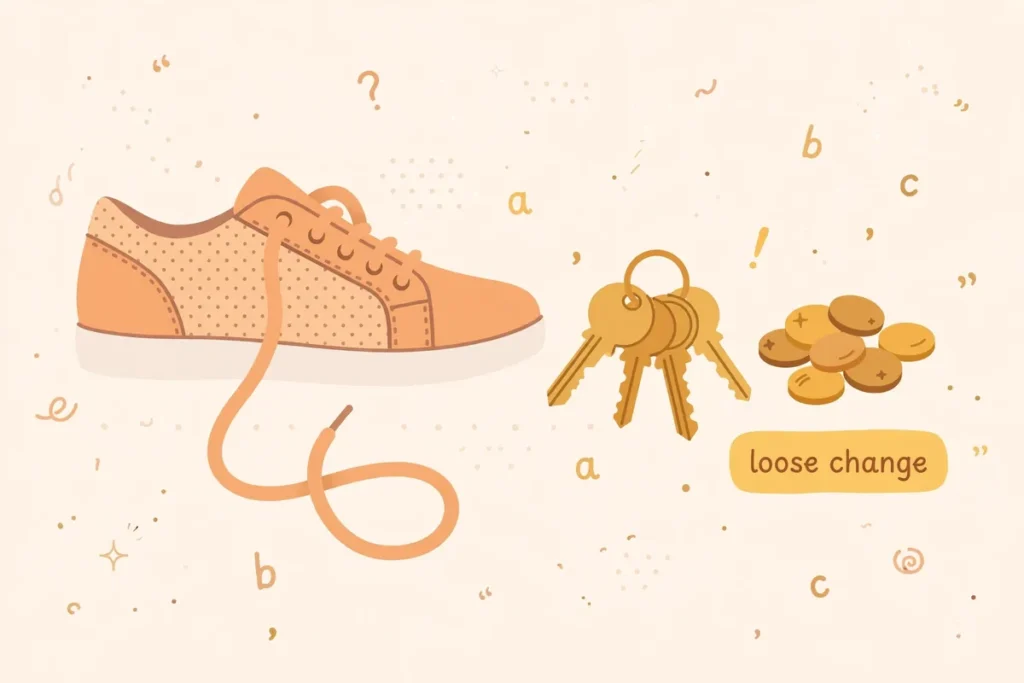
Because it is a descriptive word, “loose” shows up in a wide range of phrases. “Loose change” is the coins jingling in your pocket. A “loose end” is an unfinished detail. A “loose cannon” is an unpredictable person. “Loose soil” crumbles easily. A “loose translation” is approximate rather than exact. In fashion, “loose-fitting” clothes hang away from the body. In each use, the underlying sense is the same: not firmly held, not tight, not exact.
There are also well-known idioms built on “loose.” If a criminal is “on the loose,” they have escaped and are at large. To “let loose” means to release energy or behave freely, as in “The kids let loose on the playground.” To “hang loose” is casual slang for relaxing. “Footloose” describes someone free from commitments. All of these keep the adjective’s core meaning of freedom from restraint.
“Loose” as a Verb (Yes, Really)
Here is the twist that surprises most learners: “loose” can also be a verb, meaning to release or set free. It is formal and somewhat old-fashioned, which is why many people never encounter it. Examples: “The archers loosed their arrows,” or “He loosed the dogs into the yard.” The past tense is “loosed.” You will mostly see this in literature, historical writing, or dramatic narration — not in everyday conversation. On the other hand, this rare verb form is exactly why careful writers double-check which word they need.
“Loose” in Real Sentences
- “These screws are loose — hand me a screwdriver.”
- “She wore a loose dress to stay cool.”
- “The horse broke loose from the stable.”
- “There’s a nail loose in this floorboard.”
- “His tie hung loose around his neck.”
- “The translation was a bit loose, but the meaning came through.”
- “Don’t leave loose papers on the desk.”
Every one of these describes a state or quality. If you can swap in “not tight,” “baggy,” “free,” or “unfastened” and the sentence still works, “loose” is correct.
A few classic sayings keep the adjective alive in everyday speech. “Loose lips sink ships” is an old wartime warning that careless talk causes damage — “loose” here means uncontrolled. Someone with a “loose tongue” talks too freely and says things they should not. A “loose cannon,” as noted above, is unpredictable and potentially dangerous. These expressions all lean on the same core image: something that should be held fast has come undone.
Lose or Loose: The Key Difference
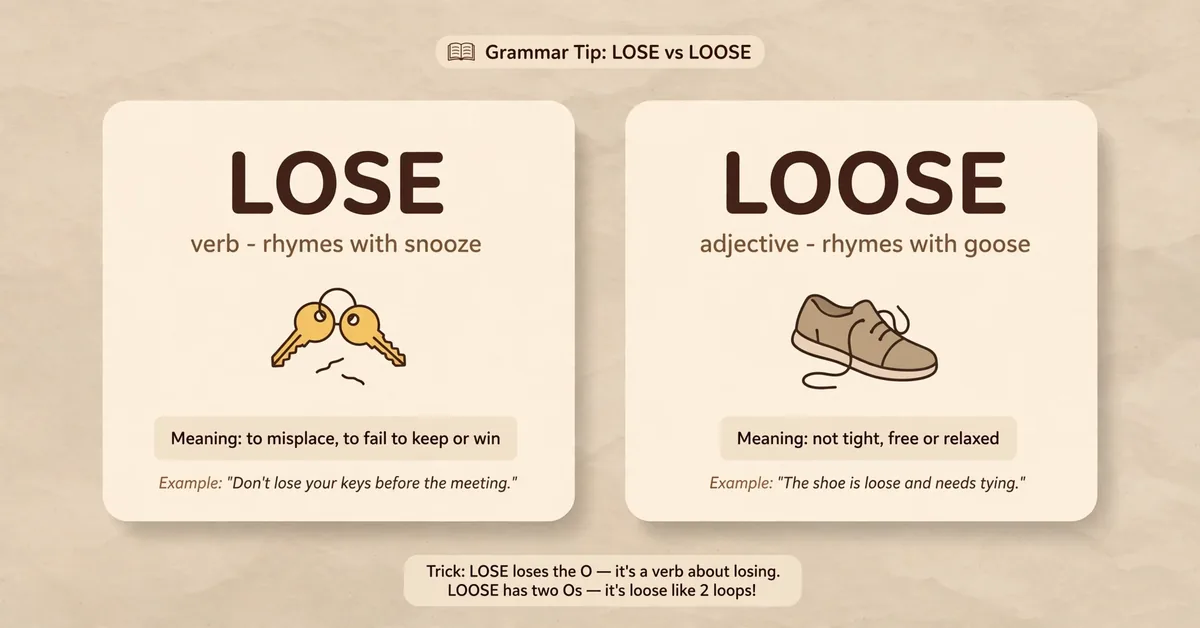
The difference comes down to two things: grammar and sound. Grammatically, “lose” is a verb (an action) and “loose” is an adjective (a description). Phonetically, they do not rhyme with each other. “Lose” is pronounced with a “z” sound — it rhymes with “snooze,” “choose,” and “booze.” “Loose” is pronounced with a crisp “s” sound — it rhymes with “goose,” “moose,” and “caboose.”
This pronunciation split is the single most useful thing to remember. Native speakers who mix the words up in writing almost never mix them up in speech, because their mouths already know the difference. When you are unsure on the page, say the sentence out loud. If you hear the “z” buzz, you want “lose.” If you hear the hissing “s,” you want “loose.”
A handy spelling memory aid: “lose” lost an “o.” The word about loss literally lost one of its letters. If your sentence is about losing something, use the shorter spelling. If your sentence is about something being loose — not tight — keep both o’s, because nothing was lost.
Lose or Loose at a Glance: Comparison Table
| Feature | Lose | Loose |
|---|---|---|
| Part of speech | Verb (action word) | Adjective (describing word); rarely a verb |
| Pronunciation | /luːz/ — rhymes with “snooze” | /luːs/ — rhymes with “goose” |
| Core meaning | To no longer have; to fail to win or keep | Not tight, not fixed, not exact; free |
| Opposite idea | Win, keep, find, gain | Tight, firm, snug, exact |
| Example | “Don’t lose your keys.” | “Your shoelace is loose.” |
| Quick test | Can you say “no longer have”? → lose | Can you say “not tight”? → loose |
| Common mix-up | “loose weight” ✗ | “don’t loose hope” ✗ |
Lose or Loose in Everyday Conversation
In casual speech, the difference rarely causes trouble, because pronunciation keeps the words apart. You say “I might lose my phone” with a “z,” and “my jeans are loose” with an “s.” The trouble starts when conversation moves to text — messages, comments, captions, and posts. Thumbs move faster than grammar, and “loose” often appears where “lose” belongs.
Common texting slip-ups include “don’t loose your mind,” “we cant loose this game,” and “I loose my charger every week.” Every one of these should use “lose.” A useful habit is to read your message back before sending: if you said it with a “z” sound, make sure you typed one “o.”
Slang and casual idioms also favor “loose.” You might hear “cut loose” (relax and have fun), “all hell broke loose” (chaos erupted), or “turn someone loose” (let them act freely). These are fixed expressions — learn them as chunks rather than reasoning them out each time. In relaxed conversation, nobody will fault you for idioms, but the basic lose/loose split still applies.
Sports talk is another everyday arena for both words, and a good place to practice telling them apart. Fans say “we can’t lose this game” with the verb, and commentators describe “loose ball” situations — a ball no player firmly controls — with the adjective. Hearing the two side by side in one broadcast is a perfect live demonstration: the “z” word does the action, the “s” word paints the picture.
Lose or Loose in Work and Business Writing
At work, the stakes are higher. A misused “loose” in a client email or a company report signals carelessness, even if the reader understands your meaning. Business writing is full of “lose” situations: losing clients, losing revenue, losing momentum, losing a bid. Each one takes the single-o verb.
Watch for these workplace sentences:
- “We cannot afford to lose this client.” (not “loose”)
- “The company lost market share last quarter.” (not “loosed”)
- “We need to avoid losing key staff during the transition.”
- “If we miss the deadline, we lose the contract.”
- “She lost her train of thought during the presentation.”
“Loose” appears at work too, but in its adjective role: “a loose interpretation of the policy,” “loose ends to tie up before launch,” or “the guidelines are fairly loose on this point.” Notice how different these feel from the “lose” sentences — they describe states, not actions. If time permits, have a colleague proofread important documents; a fresh pair of eyes catches lose/loose slips that spellcheckers routinely miss, because both words are correctly spelled.
One more professional tip: in performance reviews or formal feedback, “lose” carries emotional weight (“the team lost confidence in the timeline”), so use it deliberately and sparingly. Precision with small words builds trust in your larger message.
Lose or Loose in Formal and Academic Writing
Academic writing demands the same distinction with even less tolerance for error. Essays, theses, and research papers frequently need “lose”: “the study lost participants over time,” “the signal loses strength with distance,” or “societies that lose their languages lose part of their identity.” Each describes a process of loss — the verb’s home territory.
“Loose” in academic prose usually appears in its “not exact” sense: “a loose definition of the term,” “the author uses the word in a loose sense,” or “these categories remain loose and overlapping.” It can also describe physical states in scientific writing: “loose soil,” “loose connections,” or “the bandage was left loose.”
Examiners and editors treat lose/loose confusion as a basic literacy signal, similar to mixing up “their” and “there.” In timed exams, where you cannot consult a dictionary, fall back on the sound test: say the word in your head. The “z” buzz means one “o”; the “s” hiss means two. It is a small trick, but it works under pressure.
Common Mistakes to Avoid
The number-one error is writing “loose” when you mean “lose.” It appears in phrases like “don’t loose hope,” “we can’t loose,” “loose weight,” and “I loose track of time.” In every case, the intended meaning is loss — misplacing hope, failing to win, shedding pounds, failing to keep track — so “lose” is correct. This single substitution accounts for the vast majority of real-world mix-ups.
The reverse error — “lose” where “loose” belongs — is rarer but does happen: “the lid is lose,” “my tooth feels lose,” or “these pants are too lose.” Here the sentence describes a state of not-tightness, so “loose” with two o’s is right. Reading the sentence aloud usually exposes this one immediately.
A third trap is the spellchecker. Because both “lose” and “loose” are valid dictionary words, no red underline will save you. Autocorrect can even make things worse by “fixing” an unusual word into the wrong familiar one. The only reliable defense is knowing the difference yourself — which, after this guide, you do.
Finally, watch out for the phrase “loose cannon.” Writers sometimes type “lose cannon,” which is meaningless. The idiom describes an unpredictable person — like a cannon rolling loose on a ship’s deck — so it needs the double-o adjective. Fixed expressions reward memorization: learn “on the loose,” “let loose,” “loose end,” and “loose cannon” as set phrases.
There is also a cousin confusion worth a brief mention: “choose” versus “chose.” Like “lose” and “loose,” these two differ in sound and spelling in ways that trip up fast typists. The parallel is instructive — English has several verb pairs where a single-letter difference changes everything, and the fix is always the same: slow down, say the word, and match the spelling to the sound.
Tricky Cases and Edge Cases
“Loosed” vs. “lost.” The past tense of “lose” is “lost,” never “loosed.” “Loosed” is the past tense of the rare verb “loose” (to release): “The archers loosed their arrows.” If you write “we loosed the game,” every reader will stumble — the correct form is “we lost the game.”
“Loosen.” This is a separate verb meaning to make something less tight: “Loosen your tie,” “The regulations were loosened.” It is related to the adjective “loose” and never interchangeable with “lose.” “Loosen up” before exercise; never “lose up.”
“On the loose” vs. “on the lose.” Only “on the loose” exists — it means escaped or at large: “The suspect is still on the loose.” There is no such phrase as “on the lose.” If you catch yourself typing it, the double o is your signal.
“Lose face.” This idiom means to suffer embarrassment or damage to one’s reputation: “He didn’t want to lose face in front of the team.” It uses “lose” because reputation is something you can no longer keep — a form of loss. Do not write “loose face.”
“Loose change” vs. “lose change.” Coins in your pocket are “loose change” (not tightly held). “Lose change” would mean misplacing coins — grammatically possible (“I always lose change in the sofa”) but a completely different meaning. Context decides.
“Hang loose” and “stay loose.” Both use the adjective in its relaxed sense. Athletes are told to “stay loose” before competing — keep muscles relaxed, not tight. The spelling with two o’s preserves the “not tight” meaning.
American vs. British English. Good news: there is no transatlantic split here. “Lose” and “loose” work identically in American, British, Canadian, and Australian English, with the same spellings and pronunciations. One less thing to worry about.
Frequently Asked Questions
Is it “lose weight” or “loose weight”?
It is “lose weight.” You are shedding pounds — something is going away — so the verb “lose” is correct. “Loose weight” is one of the most common misspellings in fitness writing, but it makes no sense: weight cannot be “not tight.” Remember the rule: loss takes “lose.”
How can I remember the difference between lose and loose?
Use two memory aids together. First, the sound test: “lose” rhymes with “snooze” (z sound, one o), while “loose” rhymes with “goose” (s sound, two o’s). Second, the spelling trick: “lose” lost an “o” — the word about loss is literally missing a letter. Between the two, you will rarely hesitate again.
Can “loose” ever be used as a verb?
Yes, though it is rare and formal. As a verb, “loose” means to release or set free: “The archers loosed their arrows at dawn.” Its past tense is “loosed,” not “lost.” You will encounter it in literature, historical fiction, and dramatic writing — in everyday prose, you will almost always want the adjective form instead.
Is it “on the loose” or “on the lose”?
It is “on the loose.” The idiom means escaped and at large, as in “The suspect is still on the loose.” It uses the adjective “loose” in its sense of “free, not restrained.” The phrase “on the lose” does not exist in standard English.
What is the past tense of “lose”?
The past tense of “lose” is “lost”: “I lost my keys,” “They lost the final.” “Loosed” is not a form of “lose” at all — it is the past tense of the separate verb “loose” (to release). Mixing these up (“we loosed the match”) is a clear error, so keep “lost” for every past-tense use of “lose.”
Conclusion
The “lose or loose” question looks tricky only until you see the pattern underneath it. One is a verb about loss, spelled with a single “o” and buzzed with a “z” — it rhymes with “snooze.” The other is an adjective about not being tight, spelled with a double “o” and hissed with an “s” — it rhymes with “goose.” Say the sentence out loud, and your ears will usually tell you which one you need before your eyes finish reading it.
Getting this right matters more than it seems. In casual writing it keeps your meaning crisp; in professional and academic writing, this shows the reader that you handle the details with care. Master the sound test, remember that “lose” lost an “o,” and this particular mix-up will never trouble you again.
Explore more on Synonynmsof.