
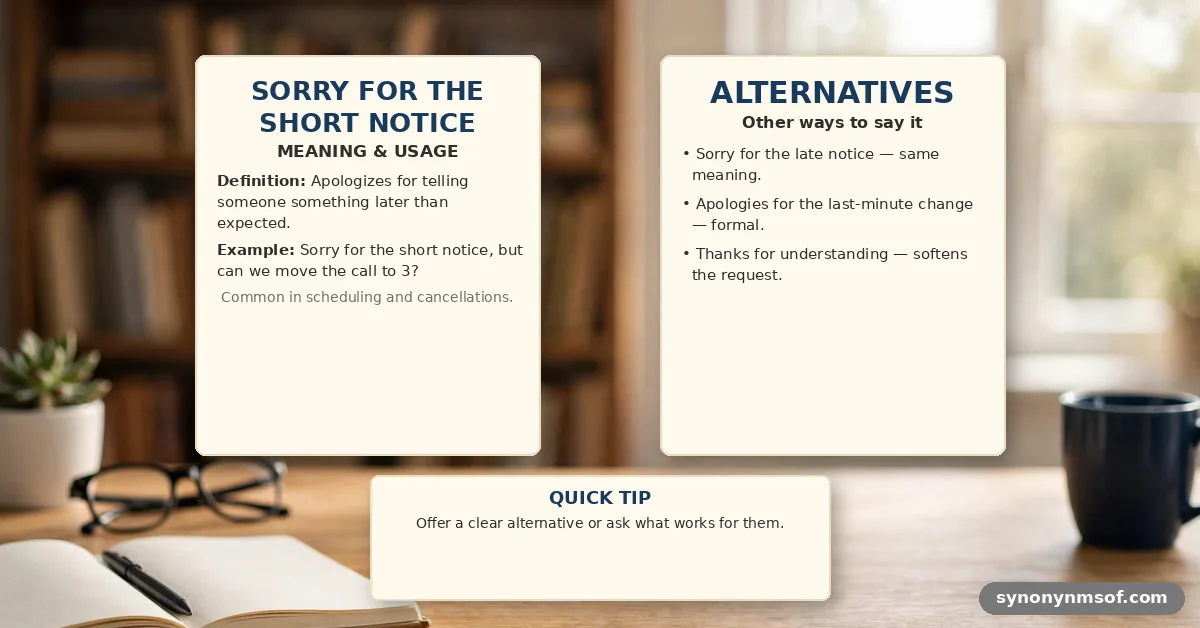

When you send a message beginning with an apology for the short notice, you are acknowledging that your request or update arrives later than ideal. This phrase serves as a social lubricant, signaling respect for the recipient’s time while addressing the lack of preparation window. Whether you are rescheduling a meeting, requesting a last-minute project review, or informing a colleague of a sudden absence, the way you frame this delay defines your professional reputation.
Mastering these expressions allows you to maintain credibility even when your planning falls short. Understanding the nuance behind when and how to offer these apologies ensures your communication remains effective and polite rather than perceived as disorganized.
The phrase is a standard way to acknowledge that a request, change, or piece of information is being delivered with very little lead time. It functions as a courtesy, effectively saying that you recognize the burden your timing places on the other person. By using it, you aren’t just apologizing; you are validating the recipient’s need for time and structure.
Professional environments thrive on consistency and planning. When you deviate from that, you create a ripple effect that impacts others’ workflows. Using a clear, direct acknowledgment of this impact shows that you are self-aware and considerate of the team’s collective bandwidth.
When to Use This Apology
You should employ this expression whenever your request forces someone else to pivot quickly. It is not a catch-all for bad planning, but rather a tool for unexpected scenarios that genuinely require a rapid response. Use it when project requirements shift due to external factors or when a personal emergency necessitates an immediate change in your schedule.
Key Scenarios for Usage

- Requesting a last-minute meeting to address a critical client issue.
- Asking for an expedited document review due to an unforeseen deadline change.
- Informing a manager that you need to take leave due to a sudden illness.
- Inviting a colleague to an event or call that was finalized only hours prior.
- Notifying a vendor that a previously agreed-upon order needs a volume adjustment.
Professional Alternatives to the Standard Phrase
Sometimes, the standard apology can feel repetitive or too informal. Depending on the recipient and the gravity of the situation, you might want to vary your language to sound more precise or professional. Choosing the right words helps you manage expectations while keeping the relationship positive.
Polite and Soft Expressions
These are best for clients or senior management where you want to emphasize your regret for the inconvenience caused. They soften the blow of the disruption. * “I apologize for the limited lead time regarding this update.” * “I realize this is a last-minute request and appreciate your flexibility.” * “Thank you for accommodating this change on such short notice.”
Direct and Action-Oriented Alternatives
Use these when you are in a fast-paced environment where efficiency is prioritized over flowery language. They get straight to the point while still acknowledging the timing. * “Please excuse the late notice; this matter has become urgent.” * “Given the sudden change in project scope, I need your input today.” * “I know this is a quick turnaround, but your expertise is required immediately.”
Analyzing the Impact of Your Timing
The effectiveness of your communication often hinges on the gap between your request and the expected deadline. If you have only thirty minutes to spare, a simple apology might not be enough to secure the cooperation you need. You must often pair the apology with a justification or a clear explanation of why the situation evolved this way.
Transparency is your best friend when you have to send a message at the last minute. If you can explain that the urgency stems from a client demand or a system failure, the recipient is far more likely to forgive the interruption. Avoid over-explaining, however, as too much detail can sound like you are making excuses for poor management.
Comparison of Timing and Formality
Choosing the correct phrase requires a quick assessment of your relationship with the recipient. You would speak differently to a direct report than you would to a board member. This table illustrates how to scale your language based on the professional context.
| Situation | Formality Level | Recommended Expression |
|---|---|---|
| Client Request | High | “I apologize for the short notice and appreciate your patience.” |
| Managerial Update | Medium | “Sorry for the late notice; here is the updated plan.” |
| Peer Collaboration | Low | “Apologies for the quick turnaround on this.” |
| Emergency Absence | High | “Please excuse the sudden notice regarding my availability.” |
Common Mistakes to Avoid
Many people accidentally undermine their own professionalism by using the wrong tone or being overly apologetic. A common error is over-explaining the reasons for your delay, which can make you appear incompetent or scattered. Keep your focus on the solution rather than the mistake.
Another mistake is failing to provide a clear call to action after the apology. If you say you are sorry, but do not explain what you need from the person, you leave them in a state of confusion. Always pair your apology with a specific request so the recipient knows exactly how to help.
FAQ
Is saying sorry for the short notice considered professional?
Yes, it is standard professional practice. It demonstrates that you value the other person’s time and are aware that your request deviates from standard scheduling.
What is the best way to express urgency politely?
The best approach is to state the deadline clearly while expressing gratitude for the recipient’s flexibility. Instead of demanding action, frame it as a request for assistance given the unusual circumstances.
What is the difference between at your earliest convenience and as soon as possible?
The phrase at your earliest convenience is a polite way to ask for something without setting a hard, aggressive deadline. In contrast, as soon as possible implies that the task is urgent and should be prioritized immediately.
Should I always apologize for late notice?
You should apologize if your late notice causes the other person to rearrange their day or miss a previous commitment. If the late notice is expected or part of your normal workflow, a simple heads-up is usually sufficient.
Mastering Your Professional Tone
Refining your communication style is a continuous process that pays dividends in your career. When you find yourself in a scenario where you must send a message on short notice, take a moment to consider the impact of your words.
A well-placed apology goes a long way in preserving the goodwill of your colleagues and clients. By balancing your need for speed with a genuine respect for others’ time, you ensure that your professional reputation remains intact, regardless of the deadline pressure.
Always aim for clarity and brevity when sending these messages. Your goal is to move the project forward while maintaining a positive rapport with everyone involved.
If you consistently show that you respect others’ time, they will be much more willing to assist you when the unexpected happens. Practicing these nuances will help you stay composed and effective in any high-pressure situation.
SEO Title: Sorry for the Short Notice: Meaning & Examples
Meta Description: Learn professional ways to say sorry for the short notice. Get tips on timing, formal alternatives, and how to maintain professional relationships.
Suggested URL Slug: sorry-for-the-short-notice-meaning-examples
Primary Keyword: Sorry for the Short Notice
Secondary Keywords: professional ways to say as soon as possible, polite ways to say as soon as possible, short notice, apologies, professional communication