
When you tell someone to please take your time, you are signaling that the quality of their work matters more than the speed of delivery. This phrase is a powerful tool for managing expectations and reducing the pressure that often builds up in high-stakes professional environments. By removing the ticking clock from a request, you create space for better results and build stronger trust with your colleagues or clients.
Mastering the nuance of this expression helps you balance empathy with productivity. You will learn how to use it effectively in various settings, ensuring your message lands with the right tone and intent every time.
Understanding the True Meaning of Take Your Time
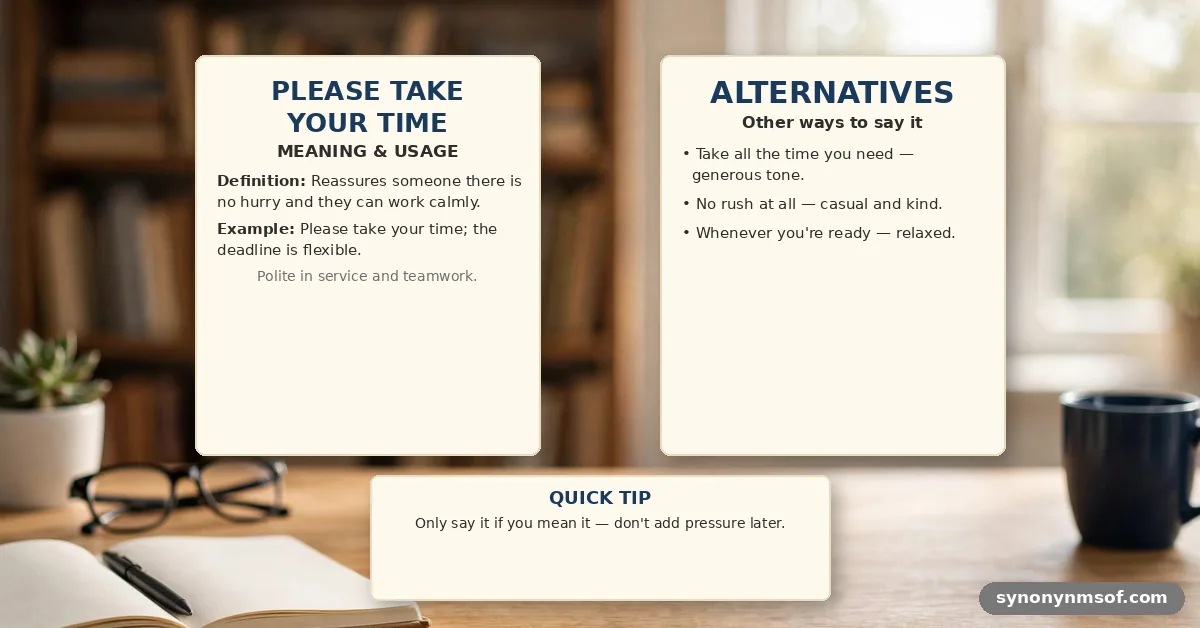
The phrase is essentially an invitation to prioritize accuracy over haste. When you use it, you effectively grant the recipient permission to pause, reflect, and produce their best possible effort without the anxiety of a looming deadline. It transforms a standard request into a collaborative process where the output is valued above the timing.
In many cases, this approach is the best use of your communication resources. If you push a team member to finish a complex project too quickly, you often invite errors that require more time to fix later. By encouraging them to pace themselves, you are investing in the long-term success of the project.
The Emotional Weight of the Phrase

There is a distinct emotional component to this language that separates it from standard transactional emails. It signals that you recognize the complexity of the task at hand. When a colleague feels understood, they are far more likely to engage deeply with the work rather than rushing to check a box.
It also functions as a release valve for stress. Many professionals carry the weight of constant urgency; receiving a message that grants them the free space to breathe can significantly improve their morale. This is a subtle but effective tip for leaders who want to maintain high performance without burning out their teams.
When to Use This Expression Professionally
Deciding when to offer someone more time depends heavily on the nature of the task and your relationship with the recipient. If the work is highly creative or requires deep focus, such as writing a long report or coding a complex function, this phrase is almost always appropriate. It acknowledges that the brain needs time to process information correctly.
However, you should avoid it when a hard deadline is non-negotiable. If a client is waiting on a deliverable for a meeting happening in one hour, telling them to take their time will sound patronizing or disconnected from reality. Always assess the level of urgency before you hit send.
- Use it when the task requires creative problem-solving.
- Use it during the initial stages of a long-term project.
- Use it when you notice a team member is overwhelmed.
- Avoid it when a specific, immovable deadline exists.
- Avoid it when the recipient has already delayed the task significantly.
Professional Alternatives for Different Contexts
Depending on the situation, you might need a variation that sounds more formal or more direct. While the core meaning remains the same, the word choice can alter how the recipient perceives your authority and your expectations. Here are several ways to express this sentiment effectively.
Soft and Collaborative Options
These alternatives are perfect for peers or subordinates who are already working hard. They emphasize your partnership and your desire for quality. For instance, you might say, “I would appreciate your thorough review whenever you have a moment to focus on it,” which implies that you do not want them to rush through the document.
Another example is, “Please do not feel the need to rush this; I would rather have a complete version than a quick one.” This clearly articulates your preference for excellence. It removes the pressure while keeping the end goal in sight.
Neutral and Formal Alternatives
If you are communicating with a client or a senior executive, you might choose phrasing that maintains a polite, professional distance. “Please feel free to provide your feedback at your earliest convenience” is a standard, safe choice. It provides the recipient with control over their own schedule while acknowledging that you are waiting for their input.
Alternatively, “We are in no immediate hurry for this, so please prioritize it as your schedule allows” works well. This is a professional phrase that respects the other person’s existing workload. It shows that you are considerate of their time management.
Comparison of Urgency and Formality
Choosing the right words requires balancing the intensity of the deadline with the formality of the relationship. The following table provides a quick reference for when to use specific approaches.
| Phrase | Formality Level | Best Used With |
|---|---|---|
| Take your time | Casual/Friendly | Close teammates |
| No rush on this | Neutral | Colleagues |
| At your convenience | Formal | Clients/Executives |
| Please prioritize as able | Professional | Management |
Common Mistakes to Avoid
One of the biggest mistakes people make is using these phrases to hide a lack of planning. If you constantly tell people to take their time, they may eventually conclude that the task itself is not important. You must balance the offer of time with clear communication about the final deadline.
Another error is using these expressions in a way that sounds condescending. If you are a manager, saying “take your time” to a direct report who is clearly struggling can feel like you are ignoring their need for support. Always ensure your offer of time is backed by an offer of assistance, such as asking, “Do you have everything you need to complete this?”
The Impact on Workplace Relationships
Using the right language to discuss time frames builds a culture of mutual respect. When you show that you value the quality of work over the speed of completion, you foster an environment where people feel safe to do their best. This leads to higher retention and better overall project outcomes.
Furthermore, it helps you manage your own reputation as a leader. People want to work for those who are reasonable, empathetic, and clear about their expectations. By mastering these small communication habits, you signal that you are a thoughtful professional who understands the human element of business.
Frequently Asked Questions
Is it professional to say take your time in an email?
Yes, it is perfectly professional, provided the context supports it. It is especially useful when you are delegating a task that requires careful attention to detail. Just ensure you are not using it to mask a lack of clear expectations regarding the final delivery date.
What is the best way to express urgency politely?
If you genuinely need something done quickly, avoid the phrase entirely. Instead, use clear, objective language like, “I would appreciate your feedback by Wednesday at noon so we can proceed with the next phase.” This is much more effective than trying to soften a demand for speed.
What is the difference between at your earliest convenience and as soon as possible?
At your earliest convenience is a polite, formal way to ask for something without setting a hard, aggressive deadline. As soon as possible is often interpreted as an urgent, high-pressure command. In a professional setting, the former is usually preferred to maintain a positive tone.
How do I know if the person needs more time?
Look for cues like delayed responses, frequent questions about the scope of the project, or signs of stress in their communication. If you notice these, it is a good time to step in and offer flexibility. A simple, “I realize this is a heavy lift; please take your time to ensure it is accurate,” can go a long way.
Conclusion
Choosing the right words when managing deadlines is about finding a balance between your needs and the capacity of your team. By learning when to offer flexibility, you demonstrate a high level of professional maturity and emotional intelligence. Always consider the recipient, the nature of the task, and the overall impact of your request on their workload.
When you use a phrase like please take your time with genuine intent, you encourage a culture of excellence rather than one of frantic, error-prone activity. Start implementing these variations in your daily correspondence to see how they influence the responsiveness and quality of your colleagues’ work. Cultivating these small, thoughtful habits will make your communication more effective and help you build lasting, high-quality professional relationships.
SEO Title: Please Take Your Time: Meaning, Usage, and Examples
Meta Description: Learn the professional meaning of please take your time, how to use it in emails, and discover formal alternatives for every workplace situation.
Suggested URL Slug: please-take-your-time-meaning-usage-examples
Primary Keyword: please take your time
Primary Keyword: please take your time
Secondary Keywords: professional ways to say as soon as possible, polite ways to say as soon as possible, take time, meaning, usage, example, tone, english