
It is one of the most misspelled words in the English language, and the mistake is so common that spellcheckers flag it millions of times a day. You write a quick email, a school essay, or a business report, and somewhere in the middle sits the word seperate — or is it separate? The two spellings look almost identical, they sound exactly the same, and yet only one of them is correct. If you have ever paused mid-sentence wondering which version to use, you are far from alone.
The confusion between seperate or separate is not a sign of poor English. It is a natural trap built into the language itself. The word is pronounced with a soft, unstressed middle syllable that sounds like uh, which makes the ear hear an e where the spelling demands an a. Add in the fact that many English words really do follow an e-heavy pattern, and it is easy to see why fingers type seperate before the brain catches up.
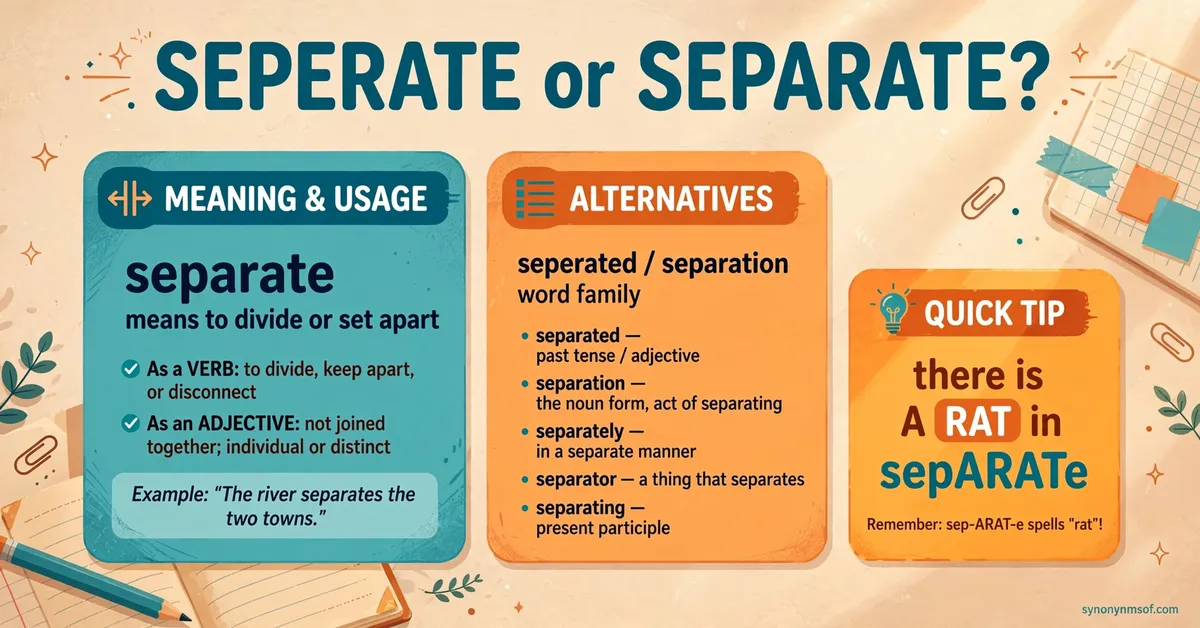
Here is the short answer you came for: separate is the only correct spelling — as a verb, an adjective, and even as a rare noun. Seperate is always a misspelling, in every variety of English, in every context. In this guide, we will dig into exactly why the correct spelling looks the way it does, trace the word back to its Latin roots, show you how to use it confidently in real sentences, and give you memory tricks that will make the mistake impossible to repeat.
What Does “Separate” Mean?
Before we fix the spelling, let us make sure the meaning is crystal clear. Separate is a versatile word that works as a verb, an adjective, and occasionally as a noun. In every role, it circles the same core idea: division, distance, or distinction.
Separate as a Verb
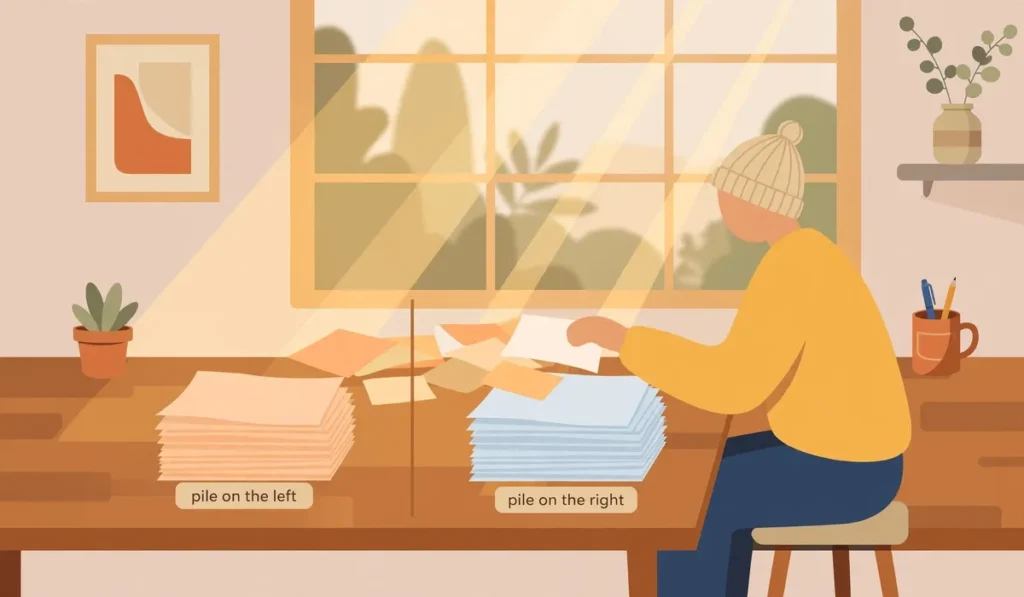
As a verb, separate means to divide something into parts, to cause things to move apart, or to keep things distinct from one another. It describes an action — something is being split, sorted, or set apart. When a teacher asks students to form smaller discussion groups, she is asking them to separate. When you sort your laundry into lights and darks, you separate the clothes. When a scientist divides a mixture into its chemical components, the process is called separation.
The verb separate is regular, which means its past tense and past participle are formed by simply adding -d: separated. The present participle is separating. These forms follow the same spelling rule as the base word, so the a in the middle stays put in every form. If you remember that the base word has two a‘s, the rest of the family tree takes care of itself.
Consider how naturally the verb fits into everyday speech. A parent might say, “Please separate the bills from the junk mail.” A manager might write, “We need to separate the project into three phases.” A friend giving cooking advice could say, “Separate the egg whites from the yolks before you start whisking.” In each case, the meaning is active and physical: take what is together and make it apart.
Separate as an Adjective
As an adjective, separate describes things that are distinct, individual, or not connected. Two brothers might live in separate apartments. A couple might keep separate bank accounts. An office building might have separate entrances for staff and visitors. Here the word is not describing an action but a state of being: the things in question exist apart from each other.
The adjective form is extremely common in both spoken and written English. You will hear it in real estate listings (“separate dining room”), in legal documents (“separate legal entities”), in school policies (“separate classes for beginners and advanced students”), and in casual conversation (“We took separate cars so nobody had to wait”). The spelling never changes — adjective or verb, it is always separate with an a.
One subtle point worth noting: when separate is used as an adjective, it is typically placed before the noun it describes, but it can also appear after linking verbs. “They are a separate couple” and “The couple is separate from the group” are both correct. The position shifts, the spelling does not.
Separate as a Noun
Less commonly, separate can function as a noun, almost always in the plural form separates. In the fashion world, separates are individual clothing items — skirts, blouses, jackets, trousers — designed to be mixed and matched rather than worn as a fixed suit or set. A store might advertise “a new collection of summer separates.” This usage is rare outside retail and fashion writing, but it follows the exact same spelling.
Why “Seperate” Is Always Wrong
Let us be direct: seperate is not a word. It does not appear as a valid entry in any major dictionary — not Merriam-Webster, not Oxford, not Cambridge. It is not a British variant, not an American variant, not an archaic form, and not an acceptable alternative in informal writing. Every style guide and every spellchecker treats it as an error, plain and simple.
So why do so many people write it? The answer lies in pronunciation. In natural speech, the middle syllable of separate is unstressed and reduced to a neutral vowel sound called a schwa — the uh sound you hear in the first syllable of about or the last syllable of sofa. Because the schwa can be spelled with almost any vowel letter in English, the ear gives no reliable clue about whether that syllable should be par or per. Writers guess, and e is a very common guess.
The true spelling becomes obvious once you look at the word’s history. Separate comes from the Latin separatus, the past participle of separare, meaning “to divide” or “to set apart.” That Latin root contains the letter a — sep-a-ratus — and English preserved it when the word entered Middle English in the 1400s. The a is not random; it is a direct inheritance from Latin. Once you know the word literally carries its history in its middle syllable, the e version starts to look like the imposter it is.
There is also a psychological factor at play. English is full of words where an unstressed middle syllable really is spelled with e: different, reference, preference, conference. The brain pattern-matches seperate to this familiar family and accepts it without question. The only cure is to learn the word’s actual family — separate, separated, separation — and to recognize that it belongs to the Latin a camp, not the e camp.
Memory Tricks That Actually Work
The most famous mnemonic for this word is also one of the most effective in all of English spelling: there is A RAT in sepARATe. Look at the capital letters — the word separate contains the sequence arat, which holds both the letter a and the word rat. Picture a rat sitting in the middle of the word, guarding that a so no e can sneak in. It is silly, and that is exactly why it sticks.
Another useful trick focuses on the word’s structure rather than a joke. Notice that separate has two a‘s separated by an r: sep-a–r–a-te. The two a‘s are themselves separate from each other, with the r standing between them like a fence. The spelling demonstrates its own meaning. When you hesitate, just ask yourself: are the two a‘s still separated by that r? If yes, you have spelled it correctly.
A third approach connects the spelling to the meaning through the Latin root. Se- means “apart” and parare means “to prepare” — so separate literally means “to prepare apart” or “to set apart.” The par in the middle is the same par you see in part, partition, and apartment. All of these words are about dividing things into parts, and all of them keep their a. If you can spell part, you can spell the middle of separate.
Finally, there is the brute-force method that many strong spellers quietly use: write the word correctly ten times in a row, slowly, saying each letter aloud. S-e-p-a-r-a-t-e. The physical act of writing the a repeatedly builds muscle memory that survives even when you are typing fast and thinking about something else. Combine this drill with one of the mnemonics above, and the error should disappear within days.
The Whole Family: Separated, Separating, Separation
The misspelling does not stop at the base word — it infects the entire word family. If someone writes seperate, they will usually also write seperated and seperation. All three are wrong, and all three are fixed by the same rule: the a stays.
Separated is the correct past tense and past participle: “They separated the class into two groups.” Separating is the present participle: “She is separating the recyclables from the trash.” Separation is the noun form, meaning the act or state of being moved apart: “The separation of the two departments took six months.” Notice how separation keeps both a‘s from the base word — sep-a-r-a-tion. If you learn the base spelling, every derived form follows automatically.
This consistency is actually good news. Many English words change their spelling unpredictably when suffixes are added, but separate is perfectly well-behaved. There are no dropped letters, no doubled consonants, no surprises. Master one spelling and you have mastered four words.
Example Sentences: “Separate” in Real Contexts
Seeing a word used correctly in varied, realistic sentences is one of the fastest ways to lock in both its spelling and its meaning. Study the examples below, paying attention to whether separate is acting as a verb or an adjective in each one.
Separate as a Verb in Sentences
The chef asked his assistant to separate the egg whites from the yolks before starting the meringue. Airport security requires passengers to separate liquids from the rest of their carry-on luggage. The committee decided to separate the budget proposal into capital expenses and operating costs. Please separate your personal emails from your work messages so nothing important gets lost. The teacher had to separate two students who would not stop talking during the exam. Scientists separate the mixture by heating it until the components evaporate at different rates. We should separate fact from opinion before we draw any conclusions about the report. The movers will separate the fragile items and wrap each one individually.
In every one of these sentences, separate describes the action of dividing or sorting. Try substituting divide or split — if the sentence still makes sense, you are looking at the verb form, and the spelling is s-e-p-a-r-a-t-e.
Separate as an Adjective in Sentences
The twins insisted on having separate bedrooms even though they shared everything else. We took separate cars to the wedding so that nobody would be stranded if one of us had to leave early. The restaurant has a separate menu for children with smaller portions and simpler dishes. Each department operates as a separate unit with its own budget and leadership. They maintain separate social lives but come together for every family holiday. The application requires two separate letters of recommendation from people who know your work. The hotel offered us separate checks, which made splitting the bill much easier. Her work life and her personal life are completely separate, and she prefers it that way.
Here separate describes a state of distinctness. Try substituting different or individual — if the sentence still works, you have the adjective, spelled exactly the same way.
Common Phrases and Collocations
Certain phrases pair with separate so often that they are worth learning as fixed units. The most common is separate from, which marks the thing being left behind or divided away: “Keep the cleaning supplies separate from the food.” Next is separate into, which describes the parts that result from dividing: “The class was separated into four teams.” You will also encounter separate out, a phrasal verb meaning to isolate one thing from a group: “She separated out the damaged boxes before the inspection.”
In formal and legal writing, watch for separate and distinct, a paired phrase that emphasizes total independence: “The two companies are separate and distinct legal entities.” In everyday speech, people often say go their separate ways to describe parting: “After graduation, the friends went their separate ways.” And in discussions of fairness, you may hear a separate but equal used historically — a phrase tied to segregation-era law that modern writers reference only in historical context.
Learning these collocations does more than improve your vocabulary; it gives your brain ready-made correct examples to imitate. When you have typed “separate from” correctly fifty times, your fingers will produce the right spelling on autopilot.
Why Spellcheck Is Not Enough
You might wonder why this matters in an age of autocorrect. After all, will your phone not just fix seperate automatically? Sometimes it will — but not always, and not everywhere. Many professional writing environments, exam settings, handwritten notes, and online forms have no spellchecker running. More importantly, some spellcheckers learn your mistakes: if you type seperate often enough and dismiss the correction, the software may add it to your personal dictionary and stop flagging it entirely.
There is also the credibility factor. Readers judge writing quickly, and a misspelled common word can undermine an otherwise strong message. A job application, a client proposal, or an academic paper containing seperate signals carelessness, even if the ideas are excellent. Hiring managers and professors notice. In one widely cited survey of business professionals, spelling errors ranked among the top factors that damaged a writer’s credibility. The stakes are real, and the fix is simple.
Finally, relying on software keeps you dependent. The goal of learning the correct spelling is not to pass a test — it is to write with confidence, speed, and independence. When you truly know that separate has two a‘s, you never have to pause, second-guess, or wait for a red squiggly line again.
Quick Self-Test
Before we move to the FAQs, test yourself with these five sentences. Each one contains either the correct or the incorrect spelling — can you spot which?
1. The landlord installed a seperate meter for each apartment. 2. Please separate the dark clothes from the light ones. 3. The seperation of powers is a key democratic principle. 4. They ordered separate desserts to share. 5. She carefully separated the pages that were stuck together.
Sentences 2, 4, and 5 are correct. Sentences 1 and 3 contain the misspellings seperate and seperation, which should be separate and separation. If you caught both errors, the a rule is already working for you.
Frequently Asked Questions
Is “seperate” ever correct?
No. Seperate is never correct in any variety of English — not American, not British, not Australian, not Canadian. It is not an accepted alternative spelling, an archaic form, or a regional variant. Every major dictionary lists only separate as the valid spelling, whether the word is used as a verb, an adjective, or a noun. If you see seperate in print, it is a typo or an error, even if it appears on a professional-looking website. Always write separate.
Why do so many people spell it “seperate”?
The mistake comes from pronunciation. The middle syllable of separate is unstressed and pronounced as a schwa — a neutral uh sound that gives no clue about which vowel letter belongs there. Because many English words with a similar rhythm really do use e in that position, such as different and reference, the brain guesses e by analogy. The correct a comes from the word’s Latin ancestor separatus, which is invisible in everyday speech but preserved in the spelling.
What is the correct spelling: “separated” or “seperated”?
Separated is correct; seperated is a misspelling. The past tense is formed by adding -d to the base word separate, and the middle a carries over unchanged. The same rule fixes the rest of the word family: separating is correct, not seperating, and separation is correct, not seperation. Learn the base spelling once, and every derived form follows the same pattern with no exceptions.
Does “separate” change meaning as a verb versus an adjective?
The core idea stays the same, but the grammatical role shifts. As a verb, separate describes the action of dividing or setting things apart: “Please separate the files by date.” As an adjective, it describes the resulting state of being distinct or apart: “They keep separate files for each client.” One practical test: if you can replace the word with divide, it is the verb; if you can replace it with distinct or individual, it is the adjective. The spelling is identical in both cases.
How can I remember to spell “separate” correctly?
The most popular memory trick is the sentence “there is A RAT in sepARATe” — the word contains the letters a-r-a-t right in the middle, which guarantees both a‘s are in place. A second trick is to notice that the two a‘s are separated by an r, so the spelling illustrates its own meaning. A third is to link the middle syllable to the word part, since separate comes from Latin separare and shares the par root with part, partition, and apartment. Pick the trick that clicks for you and use it until the correct spelling becomes automatic.
Conclusion
The debate over seperate or separate has a clear winner: separate is correct in every context, and seperate is always a mistake. The confusion is understandable — an unstressed middle syllable, a misleading pronunciation, and a brain that loves patterns all conspire to produce the wrong vowel. But the fix is straightforward once you know the word’s Latin roots and have a memory trick you trust. Whether you picture a rat guarding the middle of the word or simply remember that two a‘s stand separated by an r, you now have everything you need to spell it right for life.
Good spelling is not about memorizing endless rules; it is about understanding the handful of words that trip you up and giving each one a permanent home in your memory. Separate — verb, adjective, or noun — belongs to the a family, alongside separated, separating, and separation. Write it with confidence in your emails, essays, and reports, and let the red squiggly lines find someone else to bother. Your writing will look sharper, your meaning will come through clearly, and you will never again have to pause and wonder which vowel goes in the middle.
Explore more on Synonynmsof.