
Open a health magazine in New York and you will read about aging gracefully. Open a newspaper in London and you will read about ageing gracefully. Same word, same pronunciation, same meaning — one extra letter. The ageing or aging question is one of the most searched spelling dilemmas in English, and unlike many confusing pairs, the answer here is refreshingly simple: both spellings are correct. The only thing that decides between them is geography.
But that simple answer hides an interesting story. Why does the same word have two accepted spellings at all? The trail leads back to a 19th-century American dictionary maker who believed English spelling should be simpler and more logical, and to a British tradition that preferred to keep the language’s historical shape. Understanding this split does more than settle a spelling argument — it gives you a reliable rule for dozens of similar word pairs and helps you write with confidence for any audience in the world.
In this guide, we will define exactly what ageing and aging mean, map out where each spelling is used, explain the history behind the difference, and show you how the word works as an adjective, a verb, and a noun. By the end, you will know precisely which spelling to use in your own writing — and you will never mix them up again.

What Do “Ageing” and “Aging” Mean?
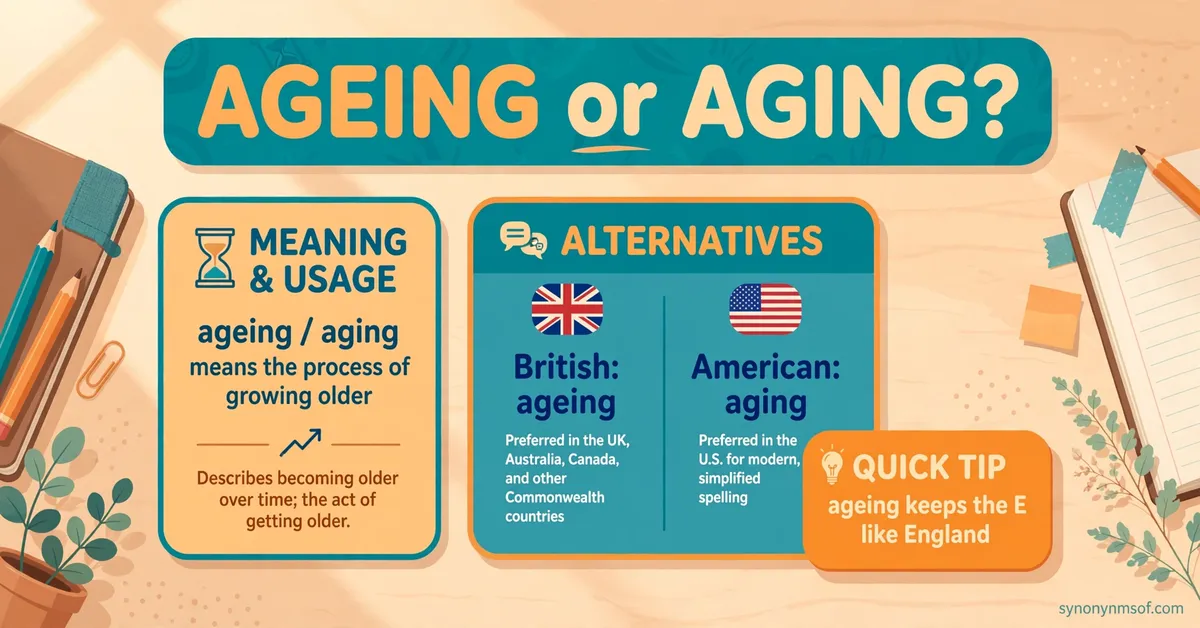
Ageing and aging are two spellings of the exact same word, and they share an identical meaning: the process of growing older or becoming old. The word can describe people, animals, objects, and even abstract systems. A person experiences ageing as the years pass. A building shows ageing in its cracked paint and worn steps. A population undergoes ageing when the average age of its citizens rises. In every case, the meaning is the slow, continuous change that time brings.
Both spellings are pronounced identically: AY-jing. There is no difference in sound, no difference in definition, and no difference in grammar. If you read a sentence aloud, no listener could tell you which spelling the writer chose. The distinction exists purely on the page, which is why it causes trouble only for writers, never for speakers.
It is worth stressing this point because many learners assume that two different spellings must signal two different meanings — like discreet and discrete, or capital and capitol. That logic does not apply here. Ageing and aging are what linguists call spelling variants: different written forms of one word, separated by regional convention rather than by meaning.
The Only Real Difference: Where You Are
The rule for choosing between ageing and aging fits in a single sentence: use aging for American audiences and ageing for British and Commonwealth audiences. That is the entire decision.
Aging — without the e — is the standard spelling in the United States. It is the form listed first in Merriam-Webster, the form used by American newspapers like The New York Times, and the form expected in American academic writing, business documents, and government publications. If you are writing for an American reader, an American employer, or an American exam such as the TOEFL, aging is the safe and correct choice.
Ageing — with the e — is the standard spelling in the United Kingdom, Ireland, Australia, New Zealand, South Africa, and India. It is the form listed first in the Oxford English Dictionary, the form used by the BBC, and the form expected in British academic and official writing. Writers in Canada are an interesting middle case: aging is generally preferred, but ageing is widely recognized and accepted, reflecting Canada’s position between American and British conventions.
The golden rule, regardless of region, is consistency. Never mix the two spellings in a single document. A report that discusses an ageing population in paragraph one and an aging workforce in paragraph three looks careless, even though each spelling is correct on its own. Pick the spelling that matches your audience and stick with it from the first sentence to the last.
Why the Split Happened: The Noah Webster Story
To understand why one word has two spellings, we need to travel back to the early 1800s and meet Noah Webster, the American lexicographer whose dictionary shaped American English. Webster believed that English spelling was cluttered with unnecessary letters inherited from French and Latin, and he set out to simplify it. He wanted a distinctly American version of the language — practical, logical, and free of silent letters that served no purpose.
Webster’s reforms gave us many of the spelling differences we now take for granted. Colour became color. Honour became honor. Centre became center. And ageing became aging. His logic for this particular word was straightforward: the base verb is age, and the standard English rule for adding -ing to a verb ending in a silent e is to drop the e first. We write making from make, taking from take, and hoping from hope. By that rule, age plus -ing should naturally produce aging, and Webster saw no reason to make an exception.
British English, however, kept the exception. British spelling tradition held that ageing preserved the pronunciation more clearly and honored the word’s historical form. Interestingly, older British texts sometimes used aging too — the e-ful form only became the firm British standard over time. Meanwhile, Webster’s 1828 dictionary locked aging into American usage, and the split has persisted for two centuries.
There is a practical reason the British form survived alongside the American one. English has other verbs where dropping the e before -ing would create confusion or awkwardness — singe becomes singeing (not singing, which belongs to sing) to avoid colliding with an existing word. Ageing does not strictly need the e for clarity, but the British tradition of preserving it reflects a broader preference for keeping historical spellings intact rather than streamlining them.
How the Word Works: Adjective, Verb, and Noun
Whichever spelling you choose, the word behaves identically in sentences. It can serve as an adjective, as the present participle of the verb to age, and as a noun (gerund). Let us look at each role.
As an Adjective
As an adjective, aging or ageing describes a noun that is growing older or showing the effects of time. An aging actor is one whose career spans many decades. An ageing bridge is one that needs inspection and repair. The adjective often carries a gentle, neutral tone — it observes the passage of time without harsh judgment. In phrases like the aging population, it has become a standard demographic term used by economists, policymakers, and journalists worldwide, with the spelling adjusted to the publication’s regional style.
As a Verb (Present Participle)
As the present participle of to age, the word describes the ongoing process of becoming older. “He is aging gracefully” means the process is happening now and continuing. “The cheese is ageing in the cellar” describes a deliberate, desirable transformation over time — proof that ageing is not always negative. Wine, cheese, and whiskey are all aged on purpose, and their ageing is a selling point, not a flaw.
As a Noun (Gerund)
As a noun, aging or ageing names the process itself. “Aging is inevitable” is a philosophical statement about life. “Scientists study the biology of ageing” describes an entire field of research. The noun form appears in compound terms like anti-aging (American) and anti-ageing (British), a multi-billion-dollar industry spanning skincare, nutrition, and medicine.
Example Sentences: Both Spellings in Action
The sentences below demonstrate the word in realistic contexts. Read each pair and notice that the meaning never changes — only the spelling shifts with the region.
American Spelling: Aging
The country’s aging population is putting new pressure on the healthcare system. She has built a successful career writing about aging gracefully and staying active after sixty. The city’s aging water pipes burst during the cold snap, flooding two downtown streets. Researchers are studying the aging process at the cellular level to understand why some people live longer. The aging Hollywood star received a lifetime achievement award at the ceremony. Anti-aging creams promise younger-looking skin, though dermatologists urge realistic expectations. He spent the weekend repairing his aging car instead of buying a new one. The report warns that an aging workforce will create labor shortages within a decade.
British Spelling: Ageing
The country’s ageing population is putting new pressure on the National Health Service. She has built a successful career writing about ageing gracefully and staying active after sixty. The city’s ageing water pipes burst during the cold snap, flooding two downtown streets. Researchers are studying the ageing process at the cellular level to understand why some people live longer. The ageing Hollywood star received a lifetime achievement award at the ceremony. Anti-ageing creams promise younger-looking skin, though dermatologists urge realistic expectations. He spent the weekend repairing his ageing car instead of buying a new one. The report warns that an ageing workforce will create labour shortages within a decade.
Notice that in the British versions, related words also shift — labour instead of labor — which is exactly how regional consistency works. When you choose a regional spelling, apply it across the whole document.
Anti-Aging or Anti-Ageing?
This compound term deserves special attention because it appears constantly in advertising, journalism, and product labels. The rule is the same as for the base word: anti-aging is the American standard, anti-ageing the British standard. American magazines, dermatology journals, and skincare brands use anti-aging. British publications and European brands use anti-ageing.
One practical note: because the global beauty industry is dominated by American marketing language, you will sometimes see anti-aging on products sold in Britain. This is a branding choice, not a grammar rule — companies often keep one global label rather than printing regional variants. In your own writing, however, match the compound to your audience’s spelling, just as you would with the base word.
Common Mistakes to Avoid
Even though both spellings are correct, writers still make errors around this word. The most common is inconsistency: starting a document with ageing and drifting into aging halfway through. This usually happens when writers copy sentences from American and British sources without standardizing them. Always do a final search of your document for both spellings before you publish.
The second mistake is choosing the wrong regional form for the audience. Using ageing in a document written for an American employer will not be marked as a spelling error by most readers, but it can look slightly off — like wearing the wrong uniform. Similarly, aging in a British university essay might draw a tutor’s red pen. Neither is wrong in absolute terms, but matching your audience shows professionalism.
The third mistake is inventing new variants. Forms like ageging, agging, or ageeing are never correct. There are exactly two accepted spellings, and anything else is a typo. If your spellchecker flags the word, check which regional dictionary it is set to before assuming you are wrong — an American spellchecker will flag ageing, and a British one will flag aging, even though both are legitimate.
Finally, watch out for autocorrect overreach. If you write for both American and British audiences, your software may silently “correct” one spelling to the other based on its default dictionary. Set your proofing language deliberately for each document, or you may find your careful regional choices undone by a helpful but misguided algorithm.
Memory Tricks
Remembering which spelling belongs where is easy with a simple association: ageing keeps the e, like England. The extra e in the British spelling matches the E at the start of England. If you are writing for a British audience, keep the e; if you are writing for an American audience, drop it, just as Webster dropped so many other silent letters.
Another approach is to learn this word as part of a family. The same American-British split applies to color/colour, honor/honour, center/centre, and traveling/travelling. Once you know which side of the Atlantic your reader sits on, the whole family of words follows the same pattern. And if you ever truly cannot remember, aging is the statistically more common spelling worldwide thanks to the size of the American publishing market — but for British readers, ageing remains the respectful choice.
Ageing and Aging in Everyday Language and Culture
Beyond grammar, the word carries rich cultural baggage. English is full of idioms and fixed expressions built around ageing, and they reveal how differently societies view growing older. To age gracefully is a compliment — it suggests accepting the years with dignity and good humor. To show your age is gentler criticism, implying that someone’s behavior has revealed how old they really are. Something that ages well, whether a wine or a film, improves with time, while a joke that has not aged well now feels dated or offensive.
The wellness and technology industries have given the word new life in the 21st century. Healthy aging is now a public-health priority in countries with rising life expectancy, covering everything from exercise programs for seniors to age-friendly city design. In tech, aging infrastructure describes bridges, power grids, and software systems that need renewal — a metaphorical extension of the word far from its biological roots. Demographers warn of population aging, economists debate the aging workforce, and marketers segment the aging consumer. The word has become essential vocabulary for describing modern society itself.
Literature has long treated ageing as one of its great themes. Shakespeare called it the “seventh age of man,” a time of second childishness. Modern writers are kinder: memoirs with titles about the art of growing older fill bookstore shelves, and the pro-aging movement pushes back against anti-aging marketing by celebrating wrinkles as evidence of a life fully lived. Whatever your view of getting older, the language gives you two spellings to express it — and now you know exactly which one your readers expect to see.
Frequently Asked Questions
Is “ageing” or “aging” correct?
Both are correct. Aging is the standard spelling in American English, while ageing is the standard spelling in British English and most Commonwealth countries, including Australia, New Zealand, South Africa, and India. The difference is purely regional — it is not a grammar error to use either one, as long as the spelling matches your audience and you stay consistent throughout your document.
Do “ageing” and “aging” mean different things?
No. The meaning is identical. Both spellings refer to the process of growing older, whether describing people, animals, objects, or systems. They are pronounced exactly the same way, they function the same way as adjectives, verbs, and nouns, and they appear in the same kinds of sentences. Unlike some confusing word pairs where different spellings signal different meanings, here the two forms are simply regional variants of a single word.
Which spelling should I use in formal writing?
Use the spelling that matches your audience’s variety of English. For American institutions, employers, publishers, and exams, use aging. For British, Australian, and other Commonwealth institutions and publications, use ageing. In Canada, aging is generally preferred but ageing is also accepted. The most important rule in formal writing is consistency: never mix the two spellings in one document.
Is it “anti-aging” or “anti-ageing”?
Follow the same regional rule as the base word: anti-aging is standard in American English and anti-ageing in British English. You will sometimes see anti-aging on products sold internationally because global brands often use one label worldwide, but in your own writing, match the compound spelling to your audience. Both forms describe products, treatments, or habits intended to slow or mask the effects of growing older.
Why does British English keep the “e” in “ageing”?
British spelling tradition preserved the historical form of the word, keeping the e from the base verb age before adding -ing. American spelling follows Noah Webster’s 19th-century reform, which applied the standard rule of dropping a silent e before -ing — the same rule that gives us making from make and hoping from hope. So ageing reflects historical preservation, while aging reflects systematic simplification. Neither approach is wrong; they are just different philosophies of spelling.
Conclusion
The ageing or aging question turns out to be one of the friendliest dilemmas in English spelling: there is no wrong answer, only a right answer for your audience. Use aging for American readers and ageing for British and Commonwealth readers, keep your choice consistent from start to finish, and you will never go wrong. Behind the single-letter difference lies a two-hundred-year-old story about Noah Webster’s mission to simplify American spelling — a story that also explains color, center, and honor.
More broadly, this word pair teaches a valuable lesson about English itself. Not every spelling difference signals a difference in meaning. Sometimes language is simply shaped by history and geography, and the skilled writer’s job is not to declare one form the winner but to choose the form that serves the reader best. Whether you write about an aging population or an ageing one, what matters most is that your meaning comes through clearly — and now you know exactly how to make that happen.
Explore more on Synonynmsof.