

Picture a food factory where every jar rolling off the line needs a sticker with its ingredients, or a warehouse where thousands of boxes need barcodes before shipping. The word for that ongoing activity is spelled two ways: “labelling” and “labeling.” Type either one into a document and some spell-checker, somewhere, will probably underline it. The confusion is understandable, because unlike many spelling questions, there is no single right answer here. Both forms are correct, and the one you should use depends on which variety of English you are writing in.
The rule is straightforward: “labelling” with a double “l” is the standard spelling in British English, while “labeling” with a single “l” is the standard spelling in American English. Both are the present participle and gerund of the verb “to label,” meaning the act of attaching labels or categorizing things, and “labelling” also works as a noun in its own right, as in “food labelling regulations.” In this article, we will define each form, explain the spelling rule behind the difference, compare them side by side, show real example sentences, and walk through the mistakes writers make most often.
This distinction earns its place in your writing toolkit because the word appears so often in working documents. Manufacturing instructions, laboratory protocols, retail operations, software interfaces, nutrition policy, and marketing briefs all talk about labelling or labeling something. Choosing the spelling that matches your audience, and using it consistently, keeps the focus on your message instead of your mechanics. As with all regional spelling pairs, the real error is not picking the “wrong” one but mixing the two.

What Does “Labelling” Mean?
“Labelling” is the British English spelling of the present participle and gerund of the verb “to label.” As a present participle, it describes the ongoing action of attaching labels: “She is labelling the jars in the kitchen.” As a gerund, it names the activity itself: “Labelling the samples took all morning.” In both roles, the meaning is the same: marking items with identifying information, or categorizing people or things with a descriptive tag.
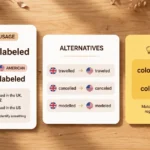
The spelling “labelling” doubles the final “l” before adding “-ing,” following the British convention for verbs that end in a vowel plus “l.” The same convention gives British English “travelling” from “travel,” “cancelling” from “cancel,” “modelling” from “model,” and “signalling” from “signal.” If your writing already uses “colour,” “favourite,” and “organised,” then “labelling” is the natural member of that family, and British readers will expect to see it.
“Labelling” also functions as a standalone noun, especially in regulatory and commercial contexts. “Food labelling” is the standard term in the United Kingdom, the European Union, Australia, and New Zealand for the information printed on food packaging: ingredients, nutrition facts, allergen warnings, and use-by dates. Phrases like “labelling requirements,” “labelling laws,” and “clear labelling” appear constantly in policy documents and industry guidance across the British-English world. Major British dictionaries list “labelling” as the primary spelling, with the single-“l” form noted as the American variant.
What Does “Labeling” Mean?
“Labeling” is the American English spelling of the present participle and gerund of the verb “to label.” It means exactly what “labelling” means: the act of attaching labels to things, or the act of categorizing people or things. A technician in Texas who is “labeling the equipment” is doing precisely the same work as a technician in Leeds who is “labelling the equipment.” The extra “l” changes nothing about the meaning, the grammar, or the pronunciation.
In American English, the final “l” is not doubled before “-ing” when the stress falls on an earlier syllable. Because “label” is stressed on its first syllable, American spelling adds “-ing” directly to give “labeling.” The same principle produces “traveling,” “canceling,” “modeling,” and “signaling.” This streamlined approach comes from the spelling reforms promoted in the early nineteenth century by Noah Webster, who wanted American English to shed what he saw as unnecessary letters and stand apart from British usage.
American dictionaries list “labeling” as the standard form, and it is the spelling you will find in United States government documents, American textbooks, and the style guides of US publishers and news organizations. In American regulatory language, the noun form appears as “labeling” too: the US Food and Drug Administration writes about “food labeling” requirements, where a British regulator would write “food labelling.” If your document uses “color,” “center,” and “organize,” then “labeling” is the spelling that fits.
Key Differences Between “Labelling” and “Labeling”
The two spellings are twins separated by an ocean. They share a meaning, a pronunciation, and a grammatical role, and they differ in exactly one letter. The table below captures the whole distinction at a glance.
- Variety of English: “labelling” is British English; “labeling” is American English.
- Spelling pattern: “labelling” doubles the final “l” before “-ing”; “labeling” does not.
- Meaning: identical. Both describe the act of attaching labels or categorizing things.
- Grammatical roles: identical. Both work as a present participle (“she is labelling the boxes”) and as a gerund or noun (“labelling takes time,” “food labelling rules”).
- Pronunciation: identical. The extra “l” is silent.
- Dictionary status: both appear in major dictionaries, each standard within its own variety.
- Where used: “labelling” dominates in the UK, Ireland, Australia, New Zealand, South Africa, and India, and is common in Canadian formal writing; “labeling” dominates in the United States.
As with “labelled” and “labeled,” the meaningful choice here is between consistency and inconsistency, not between the two spellings themselves. A British safety manual that uses “labelling” throughout is correct; an American operations guide that uses “labeling” throughout is equally correct. A document that drifts between the two looks unfinished, and readers may wrongly conclude that the writer does not know the rule. Picking one form at the outset and sticking with it is the entire skill.
One practical wrinkle is worth noting. Because so much software defaults to American English, British writers frequently see “labelling” underlined as a suspected error. The underline is a settings problem, not a spelling problem. Before accepting a suggested change from “labelling” to “labeling,” check the language setting of the application. If the document is meant for a British audience, the correct response is to change the setting, add “labelling” to the custom dictionary, or simply ignore the suggestion.
Usage Rules: When to Use Each Form
Choose “labelling” when you write in British English and “labeling” when you write in American English. The quickest way to tell which variety a document belongs to is to look at its other spellings. A text that uses “colour,” “favourite,” “organise,” and “travelling” is British, and “labelling” belongs in it. A text that uses “color,” “favorite,” “organize,” and “traveling” is American, and “labeling” is the matching choice.
The doubling rule behind “labelling” covers the whole British “-ing” family. In British English, a verb ending in a vowel plus “l” doubles the “l” before “-ing,” even though the stress sits on an earlier syllable. That is why British writers produce “travelling,” “cancelling,” “modelling,” “signalling,” “quarrelling,” and “marvelling.” In American English, the “l” doubles only when the final syllable carries the stress, as in “compelling” from “compel” or “rebelling” from “rebel.” Because “label” is stressed on the first syllable, American English writes “labeling” with a single “l.”
Canada again sits between the systems. Canadian government, academic, and legal writing traditionally follows British conventions, so “labelling” is the expected form there. Canadian business and media writing often follows American conventions, so “labeling” is common too. When writing for a Canadian audience, consult the organization’s style guide first; without one, choose a form and apply it consistently across the document.
Australia, New Zealand, South Africa, and India follow British conventions, so “labelling” is standard in their schools, newspapers, and official publications. Note the regulatory vocabulary: in the UK and EU, “food labelling” is the fixed legal term for information on food packaging, while in the United States the fixed term is “food labeling.” These are not interchangeable within a single regulatory context. A compliance document written for the British market should say “labelling,” and one written for the American market should say “labeling,” because each regulator expects its own term.
The regional pattern extends across the word family, so keep the relatives matched. British English uses “labelling” alongside “labelled” and “labeller”; American English uses “labeling” alongside “labeled” and “labeler.” Mixing a British past tense with an American participle, such as “labelled” in one paragraph and “labeling” in the next, creates exactly the inconsistency this article warns against. When you proofread, search for every form of the word and confirm the whole family belongs to the same variety.
One more rule concerns the noun use. When “labelling” or “labeling” names a process or a field of regulation, it behaves like any other noun: it can take adjectives and appear in compounds, as in “clear labelling,” “nutrition labeling,” or “labelling requirements.” The regional spelling still applies. There is no version of English in which “food labelling” and “food labeling” are both standard in the same document; pick the one your market or regulator uses.
The word also leads a second life in academic and technical fields. In sociology, “labelling theory” describes how the labels applied to people,
Example Sentences
The sentences below show each spelling doing the same jobs in the same kinds of contexts. Compare the two sets to see how the single-letter difference is the only thing that changes.
British English, using “labelling”:
- She is labelling all the files in the office this afternoon.
- Labelling the samples correctly is essential for the experiment.
- The new food labelling rules come into force next month.
- He spent the morning labelling boxes for the house move.
- Clear labelling helps customers find allergen information quickly.
- The students started labelling the parts of the diagram.
- Labelling people based on a single encounter is unfair.
- The company is labelling its products in three languages.
American English, using “labeling”:
- She is labeling all the files in the office this afternoon.
- Labeling the samples correctly is essential for the experiment.
- The new food labeling rules come into force next month.
- He spent the morning labeling boxes for the house move.
- Clear labeling helps customers find allergen information quickly.
- The students started labeling the parts of the diagram.
- Labeling people based on a single encounter is unfair.
- The company is labeling its products in three languages.
Notice how the participle, the gerund, and the noun uses all appear in both sets. Whether the word describes an action in progress, names an activity, or forms part of a regulatory term, the spelling choice follows the same regional rule every time.
Common Mistakes and How to Avoid Them
The most damaging mistake is mixing “labelling” and “labeling” in the same piece of writing. Because each spelling is correct in its own variety, writers sometimes assume that alternating between them is harmless, or they inherit a mixed draft from multiple contributors and never standardize it. The result reads as sloppy even though every individual instance is defensible. The remedy is a single decision made before writing begins: name the variety of English, set every tool to it, and run a final search for both spellings to confirm that only one survived.
A second common error is the genuine typo “lableing” or “labeliing.” These come from fingers moving faster than the intended letter order, and they are not words in any variety of English. Spell-checkers usually catch them, but they can survive in image text, printed labels, and PDF documents where the text is not checked. Because “labelling” and “labeling” already look similar, a scrambled version can slip past a tired proofreader, so slow down on this word and verify the letter order: l-a-b-e-l-l-i-n-g or l-a-b-e-l-i-n-g.
A third mistake is treating one correct spelling as an error. An American editor may “fix” a British author’s “labelling” to “labeling,” or a British teacher may mark an American student’s “labeling” wrong. Both corrections miss the point. Before changing the spelling, ask which variety of English the document follows. A correction that converts a consistent British document into a mixed one, or vice versa, does more harm than the original “error” ever did.
A fourth mistake is mismatching the word family. A writer who chooses “labeling” may still type “labelled” out of habit, or a writer committed to “labelling” may write “labeled” without noticing. The forms are a package deal: “labelling,” “labelled,” and “labeller” belong together on the British side, while “labeling,” “labeled,” and “labeler” belong together on the American side. During proofreading, search for all three forms at once rather than checking only the one you remember using.
A fifth mistake is letting software defaults make the decision silently. Word processors, email clients, and content management systems each carry a language setting, and American English is the default in many of them. A British writer who never changes the setting will be nudged toward “labeling” on every page, and accepting those nudges without thought produces a document that contradicts its own audience. Make the language setting part of your document setup, alongside the font and the margins.
Finally, watch the figurative use. “Labelling” people, as in “labelling colleagues as difficult,” means categorizing them, often unfairly, and the verb carries a mildly negative tone in that sense. The spelling does not change the tone, but the choice of verb does. In sensitive writing about people, consider whether a more neutral word, such as “describing” or “identifying,” would serve better than either spelling of “labelling.”
Frequently Asked Questions
Which is correct: “labelling” or “labeling”?
Both are correct. “Labelling” with a double “l” is the standard spelling in British English, and “labeling” with a single “l” is the standard spelling in American English. Both are the present participle and gerund of the verb “to label,” and both can also function as a noun, as in “food labelling” or “food labeling” regulations. The meaning, grammar, and pronunciation are identical. Choose the spelling that matches the variety of English your audience uses, and use it consistently throughout your document.
Is “labelling” used in the United States?
Generally, no. In the United States, the standard spelling is “labeling” with a single “l.” American dictionaries list “labeling” as the primary form, and US publishers, government agencies, and style guides expect it. You may occasionally see “labelling” in American writing, usually because the author follows British conventions or because a British source was quoted, but in strictly American documents it would be edited to “labeling.” If your audience is American, write “labeling.”
How do you spell it in Canada, Australia, and New Zealand?
In Australia and New Zealand, use “labelling.” Both countries follow British spelling conventions, so the double-“l” form is standard in schools, media, and official documents. In Canada, the answer depends on context: formal, academic, and government writing traditionally uses the British “labelling,” while business writing and some journalism use the American “labeling.” When writing for a Canadian organization, follow its house style guide. Without a guide, choose one spelling and keep it consistent.
Is “labelling” a noun as well as a verb form?
Yes. “Labelling” works as a present participle (“She is labelling the jars”), as a gerund (“Labelling the jars took an hour”), and as a full noun naming a process or field (“food labelling regulations,” “clear labelling”). The same is true of “labeling” in American English. The noun use is especially common in regulatory language: the UK and EU speak of “food labelling” law, while the United States speaks of “food labeling” law. In every role, the regional spelling rule stays the same.
What is the difference between “labelling” and “labelled”?
The difference is grammatical, not regional. “Labelling” is the present participle and gerund, describing an ongoing action or naming the activity: “She is labelling the boxes.” “Labelled” is the past tense and past participle, describing a completed action: “She labelled the boxes yesterday.” Both follow the same British doubling pattern, and both have American counterparts with a single “l”: “labeling” and “labeled.” Keep the tense and the regional spelling aligned, and the whole word family stays consistent.
Conclusion
“Labelling” and “labeling” are two correct spellings of the same word, divided by the Atlantic rather than by meaning. “Labelling” with its double “l” is the British standard, at home in the UK, Australia, New Zealand, and the regulatory language of food packaging across much of the world. “Labeling” with its single “l” is the American standard, streamlined by Webster’s reforms and expected by US readers, publishers, and regulators. Pronunciation, grammar, and meaning are identical; only the convention differs.
The lesson is the same one that runs through every regional spelling pair: choose deliberately, then stay consistent. Set your language tools to match your audience, keep the whole word family aligned from “labelling” through “labelled,” and give the final draft a quick search for the rival spelling. Handled that way, this small double letter stops being a source of doubt and becomes one more quiet sign of careful writing.
such as “criminal” or “troublemaker,” can shape their behavior and identity; the theory is usually spelled “labelling theory” in British textbooks and “labeling theory” in American ones. In computing and artificial intelligence, “data labelling” or “data labeling” is the process of tagging training examples so that machine learning models can learn from them. Whether the context is a warehouse, a courtroom, or a dataset, the regional spelling rule does not change: British contexts double the “l,” American contexts do not.Explore more on Synonynmsof.