
Choosing the right closing for a professional letter or email often comes down to the word sincerely. It remains a standard in business correspondence because it conveys respect without overstepping personal boundaries. Understanding when to use this classic term helps you strike the correct balance between professional distance and genuine warmth in your writing.
You’ll find that using this sign-off effectively can improve how your messages are received by colleagues and clients alike. This article provides the context you need to master your professional sign-offs and ensure your correspondence always hits the right note.
The True Meaning of Sincerely
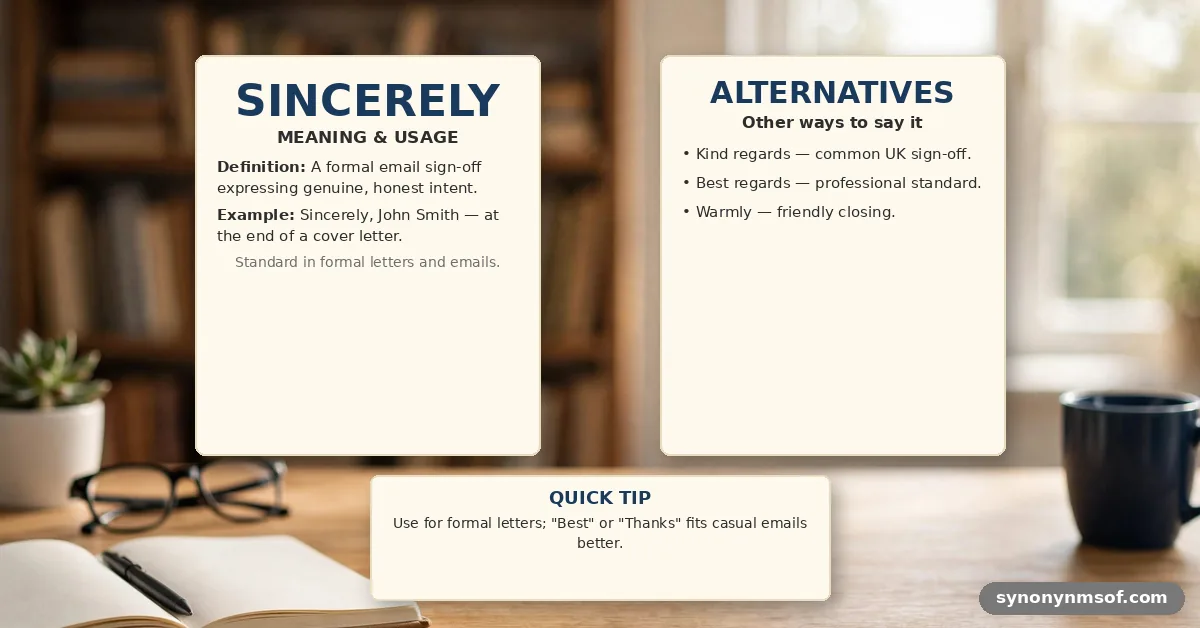
At its core, the term sincerely is an adverb derived from the Latin word sincerus, which means clean, pure, or unadulterated. In modern English, it functions as a declaration of honesty and truthfulness. When you place it at the end of a letter, you are essentially promising that the content of your message reflects your genuine thoughts and intentions.
Many people view it as a neutral, safe choice. It lacks the potential intimacy of words like warmly or the rigid formality of respectfully. Because it is so widely recognized, it rarely confuses the recipient, making it a reliable staple in your professional vocabulary.
History and Evolution in Correspondence
The use of this sign-off dates back centuries, evolving alongside the standards of letter writing. In earlier eras, closing a letter required elaborate phrasing to demonstrate social standing and deference. As communication styles shifted toward efficiency, these long-winded endings were dropped in favor of shorter, more direct expressions.
By the 19th and 20th centuries, it became the gold standard for formal business documents. It signaled that the sender was a person of integrity, someone whose word could be trusted. Today, while digital communication has made many rules more flexible, the weight of the word remains largely intact.
When to Use Sincerely
You should reach for this closing when the situation calls for a professional, polite, and standard tone. It is particularly effective when you are writing to someone you do not know well, such as a potential employer, a new client, or a government official. It keeps the interaction focused on the business at hand rather than the personal relationship between the parties.
Consider the following scenarios where this choice is ideal:
- Cover letters for job applications where you must maintain a formal tone.
- Formal complaints to a company where you want to remain objective and firm.
- Initial outreach emails sent to people in your industry you haven’t met yet.
- Legal or administrative correspondence requiring a neutral, professional finish.
Common Variations of the Phrase
While the single word is standard, you will often see it paired with other words. These variations change the nuance of the closing. Using yours sincerely is common in British English, whereas sincerely alone or sincerely yours is more frequent in American English.
| Phrase | Tone | Best Usage Context |
|---|---|---|
| Sincerely | Professional/Neutral | Standard business emails. |
| Sincerely yours | Slightly more formal | Traditional printed letters. |
| Very sincerely | Intense/Serious | Letters of apology or deep concern. |
| Yours sincerely | Formal/Classic | Formal British correspondence. |
Examples of Usage in Sentences
Seeing how the word fits into a real-world list of professional documents makes it easier to apply in your own writing. Below are examples of how to integrate it into your correspondence.
Professional Job Applications

After outlining your experience and interest in a role, you might conclude with: “I look forward to discussing how my skills can contribute to your team’s success. Sincerely, [Your Name].”
Formal Client Inquiries
When requesting specific information from a vendor, you might write: “Thank you for your assistance in clarifying these terms. Sincerely, [Your Name].”
Important Official Correspondence
If you are writing to a landlord or a local representative, keep it concise: “Please let me know if you require any further documentation regarding this request. Sincerely, [Your Name].”
Common Mistakes to Avoid
One major error is using it in a context that is too casual. If you are emailing a close coworker or a friend, the word can sound cold or robotic. In those cases, best or thanks is usually a better fit.
Another mistake is misusing the capitalization or punctuation. It should always be capitalized as the first word of the sign-off, followed by a comma. Putting a period after it or failing to include the comma can make your writing look rushed or unpolished.
FAQ
Is sincerely considered too formal for email?
It depends on the industry and the recipient. In legal, academic, or high-level corporate environments, it is perfectly appropriate for email. If your workplace culture is very relaxed, it might feel slightly stiff, but it is rarely considered offensive.
What is the difference between sincerely and truly?
Truly is often used in the phrase yours truly, which is more informal and sometimes perceived as slightly dated or overly familiar. Sincerely carries a more professional weight and is generally preferred in business settings where you want to maintain a respectful distance.
Can I use sincerely if I do not know the recipient?
Yes, it is actually the best choice when you do not know the recipient well. Because it doesn’t imply a personal friendship, it is the safest way to ensure you are being polite without overstepping.
How do I pronounce sincerely?
In standard English, it is pronounced sin-SEER-lee. The emphasis falls on the second syllable, and it should be spoken clearly to avoid sounding like you are mumbling your sign-off.
Conclusion
Mastering the use of sincerely allows you to navigate professional situations with confidence. By understanding that it represents both honesty and professional respect, you can choose the right moment to use it in your daily communication. It serves as a reliable anchor, ensuring your messages conclude with a tone that is both clear and appropriate.
If you aren’t sure which sign-off to use, sticking to this classic word is rarely the wrong move. It signals to the reader that you take the exchange seriously and value their time.
As you continue to refine your professional writing, keep this tool in your kit for those moments when clarity and decorum are your highest priorities. Start applying it in your next set of emails and notice how it shapes the perception of your messages.
SEO Title: Sincerely: Meaning, Usage, and Examples
Meta Description: Learn the meaning, proper usage, and professional context for using sincerely in your business emails and letters to improve your correspondence.
Suggested URL Slug: sincerely-meaning-usage-examples
Primary Keyword: Sincerely
Primary Keyword: Sincerely
Secondary Keywords: sincerely meaning, usage, examples, professional, writing, vocabulary