
Have you ever finished writing an email and ended it with “Please let me know” without giving it a second thought?
You’re not alone. It’s one of the most commonly used phrases in professional emails, customer service messages, workplace conversations, and even everyday chats. Whether you’re asking for feedback, requesting an update, or inviting someone to ask questions, this simple expression has become a go-to choice because it sounds polite, respectful, and professional.
However, using the same phrase repeatedly can make your writing feel predictable or overly formal. In today’s workplace, people appreciate communication that is not only clear but also warm, natural, and engaging. Small changes in wording can make your emails feel more personal and help you build stronger relationships with colleagues, clients, and customers.
In this guide, you’ll discover what “please let me know” really means, when it’s appropriate to use it, and 28 professional alternatives that can make your communication sound more polished and conversational. Each alternative includes its tone, the best situations to use it, and an example sentence to help you choose the right expression with confidence.
What Does “Please Let Me Know” Mean?
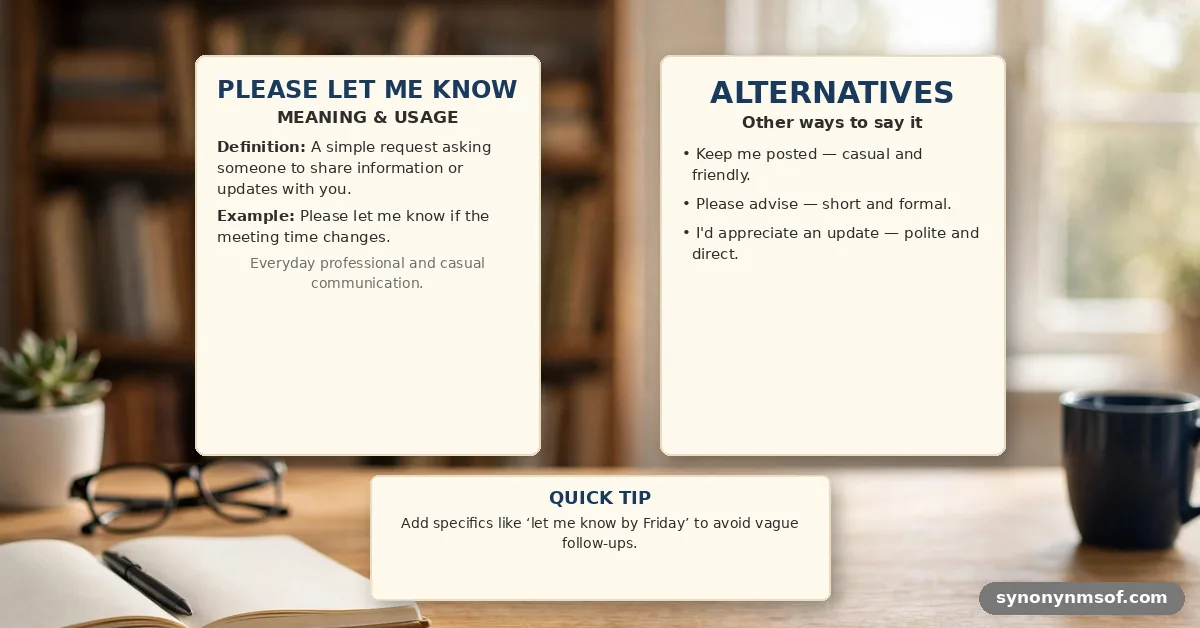
Simply put, “please let me know” is a polite way of asking someone to provide information, share an update, confirm something, or respond to your request.
It’s a courteous invitation for the other person to continue the conversation whenever they have the answer or information you’re looking for.
In simple words, it means:
- Please tell me.
- Please inform me.
- Please update me.
- I’d appreciate hearing from you.
- Kindly share your response.
For example:
Please let me know if Friday works for you.
Here, you’re politely asking someone to confirm whether Friday is convenient.
Another example:
Please let me know if you have any questions.
This tells the reader you’re open to helping them and encourages further communication.
Because it’s respectful and flexible, this phrase works well in business emails, academic settings, customer support, networking messages, and casual professional conversations.
See Also: Communication Skills on a Resume: 28 Best Examples That Impress Employers
28 Other Ways to Say “Please Let Me Know”
1. Feel Free to Reach Out
Tone: Warm and approachable
Usage: Best when you want people to feel comfortable contacting you.
Example:
Feel free to reach out if you need any additional information.
2. Let Me Know What You Think
Tone: Friendly and collaborative
Usage: Perfect for requesting opinions or feedback.
Example:
I’ve attached the proposal. Let me know what you think.
3. Keep Me Posted
Tone: Casual professional
Usage: Great for ongoing projects or regular updates.
Example:
Keep me posted on the client’s decision.
4. Don’t Hesitate to Contact Me
Tone: Formal and reassuring
Usage: Ideal for professional emails and customer communication.
Example:
Don’t hesitate to contact me if you have any questions.
5. I’d Love to Hear Your Thoughts
Tone: Friendly and conversational
Usage: Suitable for creative discussions and teamwork.
Example:
I’d love to hear your thoughts on the new design.
6. Please Share Your Feedback
Tone: Professional
Usage: Asking for reviews or suggestions.
Example:
Please share your feedback after reviewing the presentation.
7. Keep Me Informed
Tone: Professional
Usage: Best for workplace updates.
Example:
Please keep me informed about any changes to the schedule.
8. Let Me Know If Anything Changes
Tone: Flexible
Usage: Useful when plans might change.
Example:
Let me know if anything changes before Friday.
9. I’m Happy to Help
Tone: Supportive
Usage: Ending customer service or support emails.
Example:
I’m happy to help if you need further assistance.
10. Reach Out Anytime
Tone: Warm
Usage: Encourages future communication.
Example:
Reach out anytime if new questions come up.
Must read: Thank You for Your Cooperation: Meaning, 28 Professional Alternatives, and Better Ways to Say It
11. I’d Appreciate Your Feedback
Tone: Respectful
Usage: Requesting constructive opinions.
Example:
I’d appreciate your feedback on the final draft.
12. Please Keep Me Updated
Tone: Professional
Usage: Following project progress.
Example:
Please keep me updated throughout the hiring process.
13. I’d Appreciate an Update
Tone: Polite
Usage: Following up without sounding demanding.
Example:
I’d appreciate an update when you have more information.
14. Please Share Any Updates
Tone: Neutral
Usage: Asking for ongoing communication.
Example:
Please share any updates regarding the shipment.
15. Let Me Know Your Availability
Tone: Professional
Usage: Scheduling meetings.
Example:
Let me know your availability next week.
16. I’d Be Glad to Answer Any Questions
Tone: Helpful
Usage: Client communication.
Example:
I’d be glad to answer any questions you may have.
17. I’d Appreciate Hearing From You
Tone: Polite and personal
Usage: Professional follow-ups.
Example:
I’d appreciate hearing from you by Friday.
18. Please Get Back to Me
Tone: Direct but polite
Usage: Waiting for a response.
Example:
Please get back to me when you’ve reviewed the proposal.
19. Looking Forward to Your Response
Tone: Professional
Usage: Formal email closing.
Example:
Looking forward to your response.
20. Let Me Know If You Need Anything
Tone: Helpful
Usage: Offering assistance.
Example:
Let me know if you need anything before the meeting.
21. I’d Welcome Your Input
Tone: Collaborative
Usage: Team discussions.
Example:
I’d welcome your input on this strategy.
22. Please Advise
Tone: Formal
Usage: Business correspondence.
Example:
Please advise whether the proposal meets your expectations.
23. Let Me Know Your Decision
Tone: Direct
Usage: Waiting for approval.
Example:
Let me know your decision by Thursday.
24. I’d Like to Hear From You
Tone: Friendly
Usage: Networking and follow-ups.
Example:
I’d like to hear from you once you’ve had time to consider the offer.
25. Keep Me in the Loop
Tone: Informal professional
Usage: Team collaboration.
Example:
Please keep me in the loop regarding future meetings.
26. Please Confirm
Tone: Clear and concise
Usage: Requesting confirmation.
Example:
Please confirm your attendance by Monday.
27. I’d Appreciate Your Response
Tone: Respectful
Usage: Formal requests.
Example:
I’d appreciate your response at your earliest convenience.
28. Let Me Know If You Have Any Concerns
Tone: Supportive and reassuring
Usage: Client communication and workplace discussions.
Example:
Let me know if you have any concerns about the proposed timeline.
Quick Comparison Table: Alternatives to “Please Let Me Know”
| Alternative | Tone | Best Used For |
|---|---|---|
| Feel free to reach out | Warm | Customer support, business emails |
| Let me know what you think | Friendly | Feedback and collaboration |
| Keep me posted | Casual professional | Project updates |
| Don’t hesitate to contact me | Formal | Client communication |
| I’d love to hear your thoughts | Conversational | Creative discussions |
| Please share your feedback | Professional | Reviews and evaluations |
| Keep me informed | Professional | Workplace updates |
| Let me know if anything changes | Flexible | Scheduling and planning |
| I’m happy to help | Supportive | Customer service |
| Reach out anytime | Warm | Ongoing communication |
| I’d appreciate your feedback | Respectful | Professional reviews |
| Please keep me updated | Professional | Progress reports |
| I’d appreciate an update | Polite | Follow-up emails |
| Please share any updates | Neutral | General communication |
| Let me know your availability | Professional | Meeting scheduling |
| I’d be glad to answer any questions | Helpful | Sales and client support |
| I’d appreciate hearing from you | Polite | Email follow-ups |
| Please get back to me | Direct | Awaiting responses |
| Looking forward to your response | Formal | Email closings |
| Let me know if you need anything | Friendly | Offering assistance |
| I’d welcome your input | Collaborative | Team projects |
| Please advise | Formal | Business correspondence |
| Let me know your decision | Direct | Approvals and confirmations |
| I’d like to hear from you | Friendly | Networking |
| Keep me in the loop | Informal professional | Team collaboration |
| Please confirm | Concise | Confirmations |
| I’d appreciate your response | Professional | Formal requests |
| Let me know if you have any concerns | Supportive | Client and workplace communication |
When Should You Use “Please Let Me Know”?
Although there are many alternatives, “please let me know” remains a professional and widely accepted phrase. The key is knowing when it fits naturally.
It’s especially useful when you want to:
- Ask for an update.
- Request feedback.
- Confirm a meeting or appointment.
- Invite questions.
- Encourage someone to respond.
- Offer assistance.
- Keep communication open.
For example:
Please let me know if Tuesday works for your team.
or
Please let me know if you require any additional documents.
These sentences sound courteous without being overly complicated.
When Should You Avoid It?
Even good phrases can lose their impact when they’re overused.
If every email ends with “please let me know,” your writing may begin to feel repetitive or automated.
Instead of writing:
Please let me know if you have questions.
Please let me know your availability.
Please let me know your thoughts.
Try varying your wording:
Feel free to reach out if you have any questions.
Let me know your availability for next week.
I’d love to hear your thoughts on the proposal.
The message stays the same, but the writing feels more engaging and natural.
Why Tone Matters in Professional Communication
Words don’t just communicate information—they also communicate attitude.
The way you ask for a response can influence how approachable, confident, and respectful you appear.
Compare these two examples:
Example 1
Send me the report tomorrow.
Example 2
Please let me know if you’ll be able to send the report tomorrow.
The second version feels more collaborative because it respects the other person’s schedule and invites a conversation rather than issuing a command.
A thoughtful tone can help you:
- Build trust.
- Improve teamwork.
- Strengthen client relationships.
- Reduce misunderstandings.
- Create a positive impression.
Common Mistakes to Avoid
1. Repeating the Same Phrase
Using “please let me know” several times in one email makes your writing feel repetitive.
Instead, mix in alternatives like “keep me posted” or “I’d appreciate your feedback.”
2. Being Too Formal
Some situations don’t require highly formal language.
Instead of:
Please advise.
You could write:
Let me know what you think.
This sounds friendlier while remaining professional.
3. Being Too Vague
Avoid ending emails without explaining what you’re expecting.
Less clear:
Please let me know.
Better:
Please let me know whether you’re available for a meeting on Thursday afternoon.
Specific requests make it easier for the recipient to respond.
4. Sounding Passive
Adding unnecessary words can weaken your message.
Instead of:
Please let me know if perhaps this might work.
Say:
Let me know if this works for you.
The second version is shorter and more confident.
5. Forgetting the Audience
Different audiences expect different tones.
For example:
- A client may appreciate “Don’t hesitate to contact me.”
- A teammate may prefer “Keep me posted.”
- A close colleague might respond better to “Reach out anytime.”
Choosing the right tone shows emotional intelligence and professionalism.
Tips to Sound More Natural in Emails
Professional doesn’t have to mean robotic.
Here are a few simple ways to make your emails sound more human:
- Write as if you’re speaking respectfully to the reader.
- Keep your sentences concise.
- Choose alternatives instead of repeating the same expression.
- Match your tone to your audience.
- Be clear about the response you’re requesting.
- Offer help when appropriate.
- End your email with a friendly, positive closing.
These small adjustments make your communication more engaging and approachable.
Frequently Asked Questions
1. What does “please let me know” mean?
It means you’re politely asking someone to inform you, provide an update, answer a question, or respond to your request.
2. Is “please let me know” professional?
Yes. It’s a standard expression in business emails, workplace communication, customer service, and professional correspondence.
3. Is “please let me know” polite?
Absolutely. The word “please” makes the request courteous and respectful without sounding demanding.
4. Can I use “please let me know” in an email?
Yes. It’s commonly used when asking for feedback, confirming meetings, requesting updates, or inviting questions.
5. What is a more professional way to say “please let me know”?
Some excellent alternatives include:
- Please keep me updated.
- I’d appreciate your feedback.
- Don’t hesitate to contact me.
- Please confirm.
- Looking forward to your response.
6. Is “please let me know” too formal?
Not necessarily. It’s neutral enough for both formal and semi-formal communication. However, if you want a warmer tone, consider alternatives like “Feel free to reach out” or “I’d love to hear your thoughts.”
7. Can I use it in casual conversations?
Yes. While it’s more common in professional settings, it’s also perfectly acceptable in everyday conversations when asking someone to keep you informed.
8. What are the best alternatives for workplace emails?
Good workplace alternatives include:
- Keep me posted.
- Please keep me updated.
- Let me know your availability.
- I’d appreciate an update.
- Keep me informed.
9. Why does “please let me know” sometimes sound repetitive?
Because it’s one of the most frequently used email phrases. Repeating it multiple times in the same message can make your writing sound templated or less engaging.
10. How can I make my emails sound more natural?
Use a conversational tone, be specific about what you need, vary your wording, and choose alternatives that fit the situation instead of relying on the same expression every time.
11. Should I always use “please” in professional emails?
In most situations, yes. Including “please” helps maintain a polite and respectful tone, especially when making requests.
12. Which alternative sounds the friendliest?
Expressions like “Feel free to reach out,” “I’m happy to help,” and “Reach out anytime” create a warm and approachable tone while remaining professional.
Conclusion
The phrase “please let me know” has earned its place as one of the most reliable expressions in professional communication. It’s simple, polite, and versatile enough to use in emails, workplace conversations, customer support, and everyday interactions.
However, relying on it too often can make your writing feel repetitive. By expanding your vocabulary with alternatives like “keep me posted,” “I’d appreciate your feedback,” or “feel free to reach out,” you can communicate more naturally while maintaining professionalism.
The best communication isn’t about using complicated language—it’s about choosing words that match your audience, express genuine respect, and make your message easy to understand. The next time you’re about to type “please let me know,” consider whether one of these 28 alternatives might better fit the situation. A small change in wording can leave a stronger, more memorable impression.