
Whether you’re writing a business email, responding to a customer, or sending an office announcement, “thank you for your cooperation” is one of the most common professional phrases you’ll come across.
It’s polite, respectful, and widely accepted—but because it’s used so often, it can sometimes sound overly formal or even a little robotic.
The good news is that you don’t always have to rely on the same expression. Depending on the situation, there are plenty of warmer, friendlier, and more natural alternatives that still sound professional.
In this guide, you’ll learn what “thank you for your cooperation” means in simple words, when to use it, and 28 better ways to say it, complete with tone descriptions and example sentences.
What Does “Thank You for Your Cooperation” Mean?
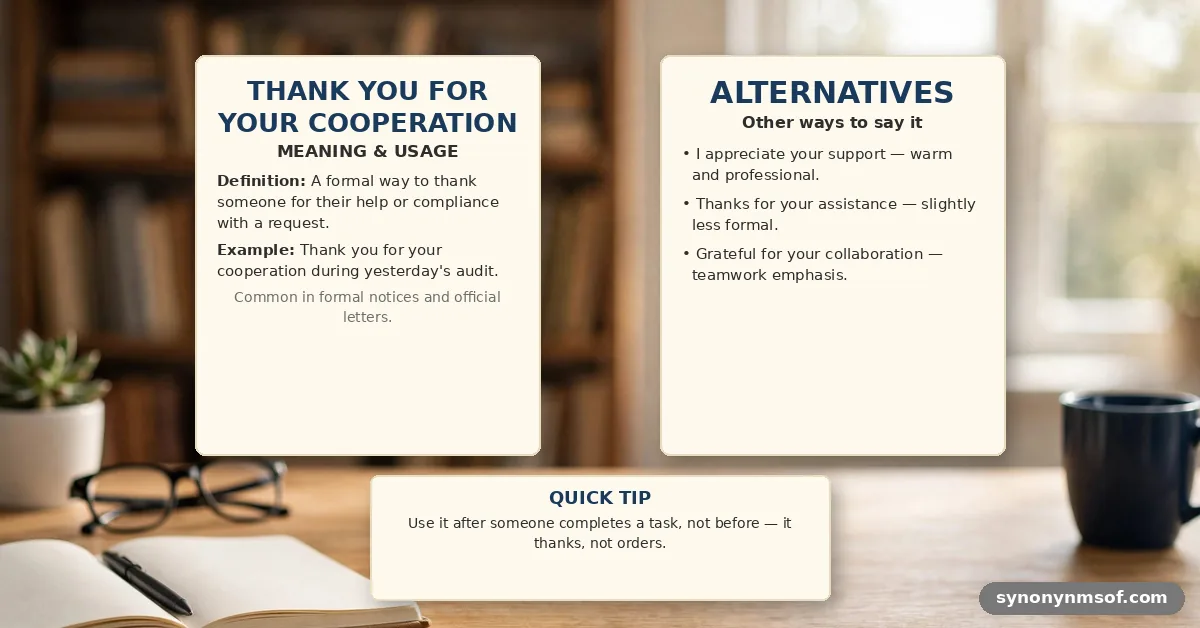
“Thank you for your cooperation” is a polite way of expressing appreciation to someone for helping, following instructions, being patient, or working together toward a shared goal.
In simple words, it means:
“Thank you for helping and working with us.”
People commonly use this phrase when:
- Asking someone to follow instructions
- Requesting patience during delays
- Thanking employees or customers
- Explaining policy changes
- Managing workplace communication
- Sending official announcements
- Coordinating projects
Although the phrase is professional, using the same wording repeatedly can make your communication feel generic. Choosing an alternative that better matches the situation often sounds more sincere.
See Also: I Hope Everything Is Going Well: Meaning, 28 Better Alternatives, and How to Sound More Genuine
28 Other Ways to Say “Thank You for Your Cooperation”
1. Thank You for Your Understanding
Tone: Warm, professional
Example:
“We apologize for the delay and thank you for your understanding while we resolve the issue.”
2. Thank You for Your Patience
Tone: Empathetic
Example:
“Thank you for your patience as our team works on your request.”
3. We Appreciate Your Support
Tone: Friendly and appreciative
Example:
“We appreciate your support during this transition.”
4. Thanks for Working With Us
Tone: Conversational
Example:
“Thanks for working with us while we improve our services.”
5. We Appreciate Your Flexibility
Tone: Collaborative
Example:
“We appreciate your flexibility regarding the revised meeting schedule.”
6. Thank You for Your Help
Tone: Personal
Example:
“Thank you for your help in completing the project ahead of schedule.”
7. Thanks for Your Collaboration
Tone: Professional
Example:
“Thanks for your collaboration throughout this project.”
8. Your Support Is Greatly Appreciated
Tone: Grateful
Example:
“Your support is greatly appreciated during this busy season.”
See Also: Great Asset to the Team: 28 Professional Alternatives
9. Thank You for Your Assistance
Tone: Formal
Example:
“Thank you for your assistance with today’s event.”
10. Thanks for Your Continued Support
Tone: Warm
Example:
“Thanks for your continued support as we grow our business.”
11. We Value Your Cooperation
Tone: Respectful
Example:
“We value your cooperation and commitment to this process.”
12. Thank You for Working Together
Tone: Friendly
Example:
“Thank you for working together to achieve our goals.”
13. We Appreciate Your Partnership
Tone: Professional
Example:
“We appreciate your partnership throughout this project.”
14. Thank You for Being So Understanding
Tone: Warm
Example:
“Thank you for being so understanding during the unexpected delay.”
15. Thanks for Your Understanding and Patience
Tone: Appreciative
Example:
“Thanks for your understanding and patience while we complete the upgrade.”
16. We Truly Appreciate Your Cooperation
Tone: Genuine
Example:
“We truly appreciate your cooperation throughout the process.”
17. Thank You for Your Continued Cooperation
Tone: Formal
Example:
“Thank you for your continued cooperation with our policies.”
18. We Appreciate Your Time
Tone: Respectful
Example:
“We appreciate your time and attention to this matter.”
19. Thank You for Your Commitment
Tone: Professional
Example:
“Thank you for your commitment to maintaining high standards.”
20. We Appreciate Your Efforts
Tone: Encouraging
Example:
“We appreciate your efforts in making this project successful.”
21. Thank You for Your Prompt Response
Tone: Professional
Example:
“Thank you for your prompt response to our request.”
22. Thanks for Your Cooperation and Support
Tone: Friendly
Example:
“Thanks for your cooperation and support throughout this initiative.”
23. We Appreciate Your Willingness to Help
Tone: Genuine
Example:
“We appreciate your willingness to help whenever needed.”
24. Thank You for Helping Us Improve
Tone: Customer-focused
Example:
“Thank you for helping us improve through your valuable feedback.”
25. We Appreciate Your Understanding During This Time
Tone: Empathetic
Example:
“We appreciate your understanding during this temporary disruption.”
26. Thank You for Staying Patient
Tone: Friendly
Example:
“Thank you for staying patient while we resolved the issue.”
27. Thank You for Your Kind Cooperation
Tone: Formal
Example:
“Thank you for your kind cooperation regarding this matter.”
28. We Couldn’t Have Done It Without You
Tone: Warm and appreciative
Example:
“We couldn’t have done it without your support and cooperation.”
Frequently Asked Questions
1. What does “thank you for your cooperation” mean?
It means you’re expressing appreciation for someone’s willingness to help, follow instructions, or work together.
2. Is “thank you for your cooperation” professional?
Yes. It’s widely used in business emails, customer service, schools, government offices, and workplace communication.
3. Is the phrase too formal?
Not necessarily. It’s professional, but in casual conversations it may sound a little stiff. Friendlier alternatives often feel more natural.
4. When should I use “thank you for your cooperation”?
Use it when someone has followed instructions, shown patience, or helped complete a task or process.
5. What is the best alternative?
“Thank you for your understanding” and “Thank you for your patience” are among the most natural alternatives because they sound warm and sincere.
6. Can I use it in customer service emails?
Absolutely. It’s commonly used when thanking customers for their patience, understanding, or support.
7. Why does it sometimes sound passive-aggressive?
It can feel passive-aggressive if it’s paired with strict warnings or impersonal language. Adding empathy makes it sound much friendlier.
8. How can I sound more genuine?
Use specific appreciation, acknowledge any inconvenience, and choose alternatives that fit the situation instead of repeating the same phrase.
9. Is it appropriate for workplace communication?
Yes. It’s suitable for emails, announcements, project updates, policy reminders, and team communications.
10. Should I always use the same phrase?
No. Rotating your wording helps your communication feel more personal, authentic, and engaging.
11. Which alternative works best for delays?
“Thank you for your patience” is generally the best choice because it directly acknowledges the inconvenience.
12. Which alternative is best for teamwork?
“We appreciate your support,” “Thanks for your collaboration,” and “Thank you for working together” are excellent choices for team projects.
Watch out for doubled consonants in business writing — verify transferred or transfered before you hit send. Small spelling details signal care, so check tumeric or turmeric whenever the spice comes up. And confirm vender or vendor in contracts and invoices to keep your documents professional. Conditional phrases trip people up too, so double-check weather or not when you mean “whether or not.”
Conclusion
“Thank you for your cooperation” remains one of the most reliable and professional ways to express appreciation in workplace and customer communication. It’s respectful, clear, and suitable for many formal situations.
However, using the same phrase repeatedly can make your writing feel repetitive or impersonal. By choosing alternatives like “Thank you for your understanding,” “We appreciate your support,” or “Thank you for your patience,” you can match your tone to the situation and create a more genuine connection with your audience.
The best professional communication isn’t just about being polite—it’s about making people feel respected, valued, and appreciated. A small change in wording can make your emails, announcements, and conversations sound more natural, thoughtful, and memorable.