
Writing “excellent communication skills” on your resume might seem like the right thing to do—but today, it rarely helps you stand out.
Recruiters review hundreds of resumes every week, and many of them include the exact same phrase. After seeing it over and over again, hiring managers often skip past it because it doesn’t tell them how you communicate or why you’re good at it.
The truth is, employers don’t just want someone who can talk to people. They want someone who can explain ideas clearly, collaborate with teammates, write professionally, resolve conflicts, and build strong relationships with clients and coworkers.
That’s why simply listing communication skills isn’t enough anymore. The strongest resumes show those skills through specific examples and achievements that demonstrate real value.
In this guide, you’ll learn what communication skills on a resume really mean, why they matter to employers, and discover 28 professional communication skills you can include with practical examples for each one.
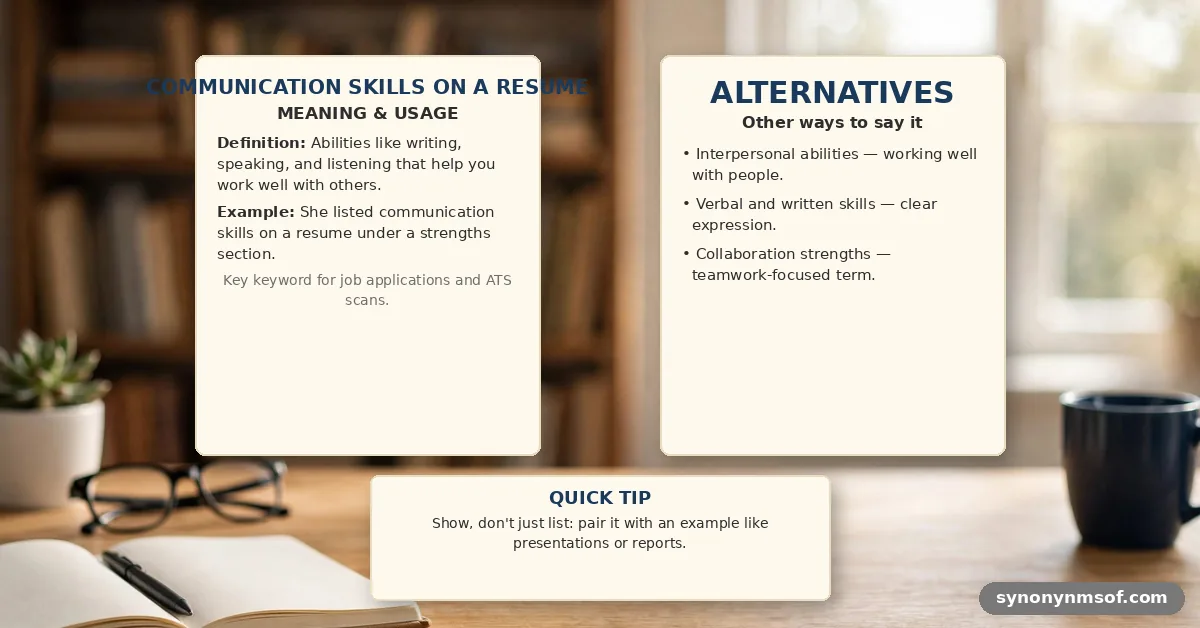
Communication skills are the abilities that help you share information clearly, understand others, and work effectively with people in a professional environment.
These skills go beyond speaking confidently. They also include listening carefully, writing clearly, presenting ideas, collaborating with teams, solving conflicts, and adapting your communication style to different situations.
On a resume, communication skills should demonstrate that you can:
- Express ideas clearly
- Listen actively
- Write professional emails and reports
- Work well with colleagues
- Present information confidently
- Build positive client relationships
- Handle workplace conversations professionally
- Adapt your communication to different audiences
Instead of simply writing “excellent communication skills,” employers prefer seeing real examples that prove you have these abilities.
See Also: Thank You for Your Cooperation: Meaning, 28 Professional Alternatives, and Better Ways to Say It
28 Best Communication Skills to Put on a Resume
Each skill includes its tone, when to use it, and a resume example.
1. Verbal Communication
Tone: Professional
Usage: Ideal for jobs involving meetings, customer interactions, presentations, or teamwork.
Resume Example:
Delivered project updates to senior management and cross-functional teams with clarity and confidence.
2. Written Communication
Tone: Professional
Usage: Best for administrative, marketing, remote, legal, and office roles.
Resume Example:
Prepared reports, proposals, and business documentation with accuracy and attention to detail.
3. Active Listening
Tone: Collaborative
Usage: Useful for customer service, healthcare, HR, and management positions.
Resume Example:
Listened carefully to customer concerns and resolved issues while maintaining high satisfaction ratings.
4. Public Speaking
Tone: Confident
Usage: Great for leadership, education, consulting, and sales roles.
Resume Example:
Presented quarterly business reports to executive leadership and stakeholders.
5. Team Collaboration
Tone: Cooperative
Usage: Suitable for almost every profession.
Resume Example:
Collaborated with designers, developers, and marketing teams to complete projects ahead of schedule.
6. Client Communication
Tone: Professional
Usage: Customer-facing positions.
Resume Example:
Maintained strong client relationships through proactive communication and regular follow-ups.
7. Conflict Resolution
Tone: Diplomatic
Usage: HR, management, customer support.
Resume Example:
Resolved workplace disagreements while maintaining productive team relationships.
8. Presentation Skills
Tone: Confident
Usage: Business, consulting, education.
Resume Example:
Delivered engaging presentations that improved stakeholder understanding of project goals.
9. Interpersonal Communication
Tone: Friendly
Usage: Team-oriented workplaces.
Resume Example:
Built positive working relationships across multiple departments.
10. Stakeholder Communication
Tone: Executive
Usage: Project management.
Resume Example:
Coordinated communication between executives, vendors, and project teams.
Must Read: I Hope Everything Is Going Well: Meaning, 28 Better Alternatives, and How to Sound More Genuine
11. Cross-Functional Communication
Tone: Professional
Usage: Large organizations.
Resume Example:
Facilitated communication between engineering, marketing, and customer success teams.
12. Customer Service Communication
Tone: Helpful
Usage: Retail and support roles.
Resume Example:
Assisted customers by providing clear solutions and timely responses.
13. Negotiation Skills
Tone: Persuasive
Usage: Sales and procurement.
Resume Example:
Negotiated vendor contracts that reduced annual operating costs.
14. Leadership Communication
Tone: Authoritative
Usage: Supervisory positions.
Resume Example:
Communicated team objectives and delegated responsibilities effectively.
15. Email Communication
Tone: Professional
Usage: Office and remote jobs.
Resume Example:
Managed professional email correspondence with clients and stakeholders.
16. Technical Communication
Tone: Clear
Usage: IT and engineering.
Resume Example:
Simplified technical concepts for non-technical audiences.
17. Digital Communication
Tone: Modern
Usage: Hybrid and remote workplaces.
Resume Example:
Collaborated efficiently using Slack, Microsoft Teams, and Zoom.
18. Relationship Building
Tone: Warm
Usage: Sales, HR, customer success.
Resume Example:
Developed long-term client relationships through consistent communication.
19. Persuasive Communication
Tone: Convincing
Usage: Marketing and sales.
Resume Example:
Persuaded prospective clients through consultative product presentations.
20. Feedback Delivery
Tone: Constructive
Usage: Management and HR.
Resume Example:
Provided constructive feedback that improved employee performance.
21. Coaching and Mentoring
Tone: Supportive
Usage: Leadership roles.
Resume Example:
Trained and mentored new employees during onboarding.
22. Meeting Facilitation
Tone: Organized
Usage: Project coordination.
Resume Example:
Led weekly meetings to track project milestones.
23. Crisis Communication
Tone: Calm
Usage: Operations and management.
Resume Example:
Coordinated communication during operational disruptions to minimize delays.
24. Empathetic Communication
Tone: Compassionate
Usage: Healthcare and customer support.
Resume Example:
Responded empathetically to customer concerns while providing effective solutions.
25. Report Writing
Tone: Formal
Usage: Administrative and analytical roles.
Resume Example:
Produced detailed performance reports for senior management.
26. Training Communication
Tone: Educational
Usage: Learning and development.
Resume Example:
Conducted employee training sessions on company policies.
27. Networking Skills
Tone: Professional
Usage: Business development.
Resume Example:
Built professional partnerships that generated new business opportunities.
28. Adaptable Communication
Tone: Flexible
Usage: Every industry.
Resume Example:
Adjusted communication style to suit executives, colleagues, and clients from diverse backgrounds.
Tips for Listing Communication Skills on Your Resume
To make your resume stronger:
- Show communication skills through accomplishments instead of generic claims.
- Include relevant communication keywords naturally throughout your resume.
- Match your examples to the job description.
- Quantify your achievements whenever possible.
- Keep your wording clear, concise, and professional.
Frequently Asked Questions
1. What are communication skills on a resume?
Communication skills describe your ability to share information clearly, listen effectively, collaborate with others, and build professional relationships.
2. Should I write “excellent communication skills” on my resume?
It’s better to prove your communication abilities through specific accomplishments rather than using generic phrases.
3. Which communication skills do employers value most?
Employers commonly look for verbal communication, written communication, active listening, teamwork, presentation skills, conflict resolution, and relationship building.
4. Where should communication skills appear on a resume?
You can include them in your skills section, professional summary, and work experience bullet points.
5. Are communication skills considered soft skills?
Yes. Communication is one of the most important soft skills employers evaluate during the hiring process.
6. How can I prove communication skills on a resume?
Use measurable achievements such as leading meetings, presenting reports, training employees, or improving customer satisfaction.
7. What communication skills are important for remote jobs?
Written communication, virtual collaboration, email etiquette, video conferencing, and time management are especially valuable for remote roles.
8. Can communication skills help me get hired?
Absolutely. Strong communication skills improve teamwork, leadership potential, customer service, and overall workplace performance, making candidates more attractive to employers.
9. Should communication skills be customized for each job?
Yes. Tailor your examples to match the responsibilities and keywords mentioned in the job posting.
10. What are common mistakes when listing communication skills?
Avoid vague buzzwords, repeating the same skill multiple times, or listing communication abilities without providing supporting examples.
11. Do ATS systems recognize communication skills?
Yes. Applicant Tracking Systems often scan for keywords like verbal communication, written communication, stakeholder communication, collaboration, presentation skills, and conflict resolution.
12. How many communication skills should I include on my resume?
Most resumes benefit from listing five to eight relevant communication skills while demonstrating them through your work experience.
Conclusion
Communication skills remain one of the most valuable qualities employers look for, but simply writing “excellent communication skills” is no longer enough. Recruiters want evidence that you can communicate effectively in real workplace situations.
By including specific examples—such as leading meetings, writing reports, collaborating across departments, resolving conflicts, or building strong client relationships—you can demonstrate your value far more convincingly than with generic buzzwords.
Choose the communication skills that best match the role you’re applying for, support them with measurable accomplishments, and keep your resume clear, organized, and easy to read. When your resume itself communicates professionally, it becomes the strongest proof of your communication abilities.