
Understanding the nuances of No Need to Apologize: Meaning and Polite Responses helps you maintain healthy boundaries while keeping your social interactions gracious. Many people struggle with over-apologizing for things outside their control, leading to a loss of personal authority in professional and private settings.
By learning how to deflect unnecessary apologies, you gain the ability to offer reassurance instead of merely accepting guilt. This guide provides the tools to recognize when an apology isn’t required and how to communicate that with warmth and clarity.
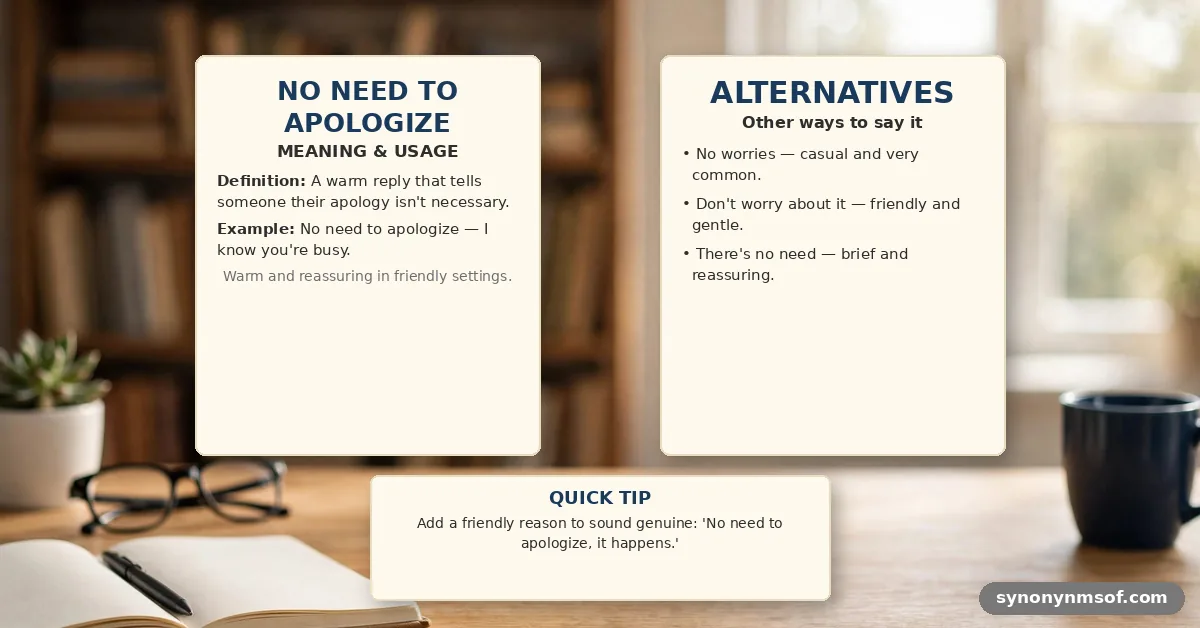
When someone says “no need to apologize,” they are signaling that the perceived offense is either nonexistent, trivial, or not your responsibility. This phrase is a bridge between two people, intended to dissolve tension and prevent the other person from feeling burdensome. It is a way of saying, “Your mistake does not change our dynamic or my opinion of you.”
The core of this phrase is the removal of guilt. When you tell someone there is no need to apologize, you are effectively wiping the slate clean for them. It acknowledges that social friction is inevitable and that you don’t hold a grudge.
In many cases, the speaker is also trying to lower their own status to match yours. By saying it, they are telling you that you are not in the wrong. It is a gesture of equality meant to restore balance to the conversation.
The Psychology of Reassurance
People often apologize to manage their own anxiety rather than to address a genuine harm. When you respond with kindness, you help them regulate that emotional state. It shifts the focus from the mistake to the relationship itself.
According to research highlighted by Psychology Today, chronic over-apologizing can signal low self-esteem or a fear of conflict. By using phrases that mitigate the need for an apology, you are actually helping the other person build more confidence. You are setting a standard that says “I value you more than I value perfection.”
Categorizing Your Responses

Selecting the right response depends heavily on the context of the interaction. You wouldn’t use the same language with a supervisor as you would with a close friend. The following table illustrates how to adjust your tone based on the setting.
| Context | Tone | Recommended Response |
|---|---|---|
| Professional | Formal | “I appreciate the update; we can resolve this quickly.” |
| Casual/Friend | Warm | “Don’t worry about it at all, it happens!” |
| Service Industry | Polite | “Thank you for letting me know, no problem.” |
| Personal Conflict | Empathic | “I hear you, and I appreciate your honesty.” |
Professional Settings and Boundaries
In the workplace, constant apologizing can make you appear less competent than you actually are. If you make a minor error, such as a slight delay in a report, you don’t need to grovel. Acknowledging the situation and providing a solution is far more effective.
Instead of saying “I’m so sorry for being late,” try “Thank you for waiting, I have the data ready now.” This shifts the narrative from your failure to your productivity. It shows you respect the other person’s time without devaluing your own work.
When an Apology Truly Is Necessary
There is a distinct difference between a minor social slip and a genuine grievance. If you have caused real harm or broken a significant boundary, you should never brush it off. Dismissing a serious issue can make the other person feel unheard or undervalued.
Look for these signs that an apology is actually required:
- Physical or emotional harm was inflicted.
- A commitment or promise was broken without notice.
- Someone’s personal property or time was disrespected.
- A pattern of behavior is causing ongoing frustration.
The Biblical Perspective on Grace
The concept of grace often mirrors the social practice of letting go of minor offenses. In Colossians 3:13, the text encourages individuals to forgive one another if any have a complaint against another, just as one has been forgiven. This suggests that holding onto small, unintentional slights is counterproductive to community.
Paraphrased, this verse reminds us that when someone trips up, we should extend the same grace we hope to receive. It is not about ignoring reality; it is about choosing to prioritize the relationship over the error. This is a foundational principle for maintaining peace in any social circle.
How to Respond to Someone Else
If someone tells you there is no need to apologize, acknowledge their grace immediately. Don’t keep pushing the apology, as this can make the other person feel uncomfortable. Simply say, “Thank you for understanding,” and move on to the next topic.
Continuing to apologize after someone has told you not to can come across as self-centered. It forces the other person to keep reassuring you. Accept their kindness as a gift and allow the conversation to progress naturally.
Cultural Differences in Apologies

Different cultures treat apologies with varying levels of intensity. In some regions, an apology is a formal social lubricant used frequently, while in others, it is reserved for serious infractions. Understanding this helps you interpret why someone might be apologizing to you in the first place.
If you are interacting with someone from a culture that values high-frequency apologizing, be patient. They aren’t necessarily feeling guilty; they are just following a social script. Your role is to be the steadying force that reminds them that everything is fine.
The Impact on Your Self-Perception
When you stop apologizing for existing, your self-perception begins to shift. You start to see yourself as someone who makes reasonable mistakes rather than someone who is constantly failing. This change in internal monologue is crucial for long-term mental wellness.
Practice replacing “I’m sorry” with “Thank you” whenever possible. Instead of “Sorry I’m so talkative,” use “Thank you for listening to my thoughts.” The shift is subtle but powerful in how it frames your personality to others.
Managing Social Anxiety
Social anxiety often drives the urge to apologize as a safety behavior. By saying sorry, you are trying to minimize the risk of being judged or rejected. Recognizing this impulse is the first step toward correcting it.
When you feel the urge to say sorry, pause for two seconds. Ask yourself, “Did I actually do something wrong, or am I just feeling awkward?” If it’s just awkwardness, take a deep breath and stay silent instead of apologizing.
Maintaining Long-Term Relationships
Healthy, long-term relationships rely on the ability to move past minor annoyances. If you and your partner or friend spend all your time apologizing, you lose time for genuine connection. Acknowledging that “no need to apologize” is a valid stance allows you to focus on the bigger picture.
Establish a mutual understanding that minor mistakes are okay. When both parties agree that they don’t need to keep score, the relationship becomes much more resilient. It creates a “safe” environment where people feel free to be human.
The Art of the Pivot
The best way to handle a situation where an apology is offered but not needed is to pivot the conversation. Acknowledge the sentiment, offer a brief word of reassurance, and then move forward. This keeps the momentum of the conversation going without getting stuck in the mud of regret.
Example: “Don’t worry about being late, I completely understand the traffic. Shall we look at the agenda for today?” This is efficient and kind.
FAQ
Is it rude to tell someone there is no need to apologize?
It is rarely rude, provided your tone is warm and sincere. If you say it dismissively, it can come across as cold, but if you say it with a smile, it is a gesture of kindness.
What if I really feel I should apologize?
If you feel a genuine need to apologize, do it once, sincerely, and then stop. Do not repeat the apology, as that shifts the burden of comfort onto the other person.
How do I stop over-apologizing at work?
Focus on replacing your apologies with expressions of gratitude. Instead of “Sorry for the delay,” say “Thank you for your patience while I finished this.”
Is there a professional way to accept an apology?
Yes, keep it brief and professional. “I appreciate you saying that, let’s move forward with the next steps” is a perfect response for a corporate environment.
How does this topic relate to personal growth?
Learning when to apologize and when to accept that no apology is needed is a sign of high emotional intelligence. It shows you have a clear sense of self and respect for others.
Conclusion
Mastering the nuances of No Need to Apologize: Meaning and Polite Responses is a journey toward more authentic and balanced communication. By recognizing when to release the need for perfection and when to offer grace to others, you build stronger, more honest connections. Remember that your worth is not tied to your ability to avoid every minor error, and your relationships aren’t held together by constant penance.
Instead, they thrive on mutual respect and the freedom to be human. Start observing your own habits today, and look for those moments where a simple “don’t worry about it” can replace an unnecessary apology. You will likely find that people appreciate the shift just as much as you do.