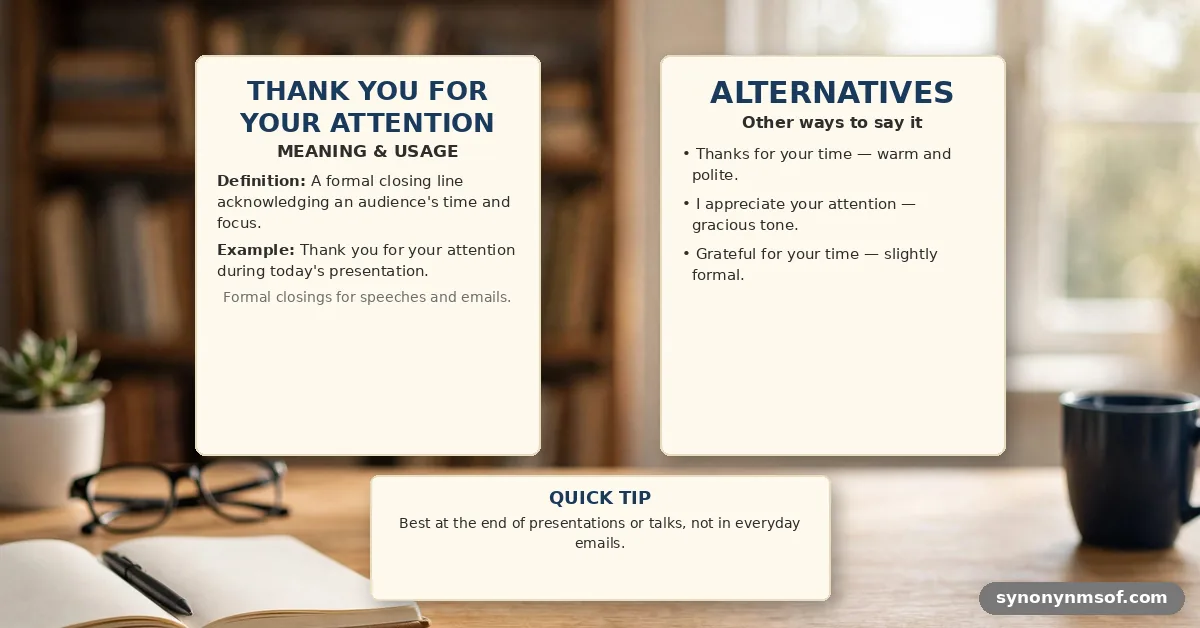

Refining how you close a presentation or email is essential for leaving a lasting impact, which is why exploring thank you for your attention: better ways to say it can transform your professional communication. The standard phrase often sounds robotic or overly formal, failing to capture the genuine appreciation you feel for your audience’s time.
By selecting more specific, action-oriented, or warm alternatives, you ensure your message resonates long after the final slide appears. This guide provides concrete replacements to help you sound more authentic, confident, and engaging in any setting.
The most effective way to replace the standard “thank you for your attention” is to focus on what you want the audience to do next. Instead of thanking them for merely listening, thank them for their engagement or their future collaboration. This shifts the focus from your performance to the value you provide them.
Try these specific alternatives for your next closing:
- “I appreciate your thoughtful questions during this session.”
- “I look forward to hearing your feedback on these proposals.”
- “Let’s continue this conversation via email if you have further ideas.”
- “Thank you for the opportunity to share these findings with you today.”
- “I value your time and the energy you brought to this discussion.”
These phrases work because they imply a two-way relationship rather than a one-way lecture. By acknowledging the specific contribution of the audience, you build rapport and encourage deeper connection.
The Problem with Standard Closings
Using generic phrases like “thank you for your attention” can inadvertently signal that the speaker is relieved the presentation is over. It creates distance between the speaker and the listeners by framing the interaction as a chore that has finally been completed. Audiences often tune out the moment they hear these words because they sound like a signal to stop listening.
When you use a generic phrase, you lose a prime opportunity to reinforce your main point. Your closing is the last thing people remember, so it should be as impactful as your opening. Stale language creates a stale impression, whereas fresh language keeps the audience engaged until the very last second.
| Generic Phrase | Better Alternative | Best Context |
|---|---|---|
| Thank you for your attention. | I value your time and input. | General meetings |
| Any questions? | What aspects of this project interest you most? | Brainstorming sessions |
| That concludes my talk. | Let’s discuss how we can implement these steps. | Action-oriented briefs |
| Thanks for listening. | I appreciate your partnership on this. | Client relationships |
Tailoring Your Message to the Audience
The best way to express gratitude depends entirely on who is in the room. A board of directors requires a different tone than a group of peers or potential customers. You should always align your closing language with the existing relationship you have with your audience.
For a formal setting, focus on the professional value exchanged. You might say, “I appreciate the board’s time in reviewing these quarterly figures.” This acknowledges the gravity of the meeting while remaining polite and professional.
In a casual or creative setting, you have more room for warmth. “Thanks for hanging in there with me while we walked through these complex designs” shows humility and acknowledgment of the effort the audience put into understanding your work. This creates a humanizing effect that makes you more likable and approachable.
Reframing for Action and Impact
Closing your presentation with an invitation to act is far more effective than a passive thank you. When you direct the audience toward a specific outcome, you transform the end of your talk into the beginning of a process. This keeps the momentum alive even after you stop speaking.
Consider using a call to action that mirrors your objective. If you are seeking approval for a budget, say, “I look forward to your thoughts on this budget plan by Friday.” If you are presenting a new concept, say, “I invite you to test these prototypes and share your feedback.”
This approach removes the ambiguity of the ending. People appreciate knowing exactly what is expected of them once the formal presentation concludes. It turns your closing into a tool for productivity rather than just a polite formality.
Handling Questions Effectively
Many speakers use “thank you for your attention” as a barrier against questions. They say it, then immediately pack up their laptop to signal that no further interaction is desired. If you actually want to engage, you must bridge the gap between your final slide and the Q&A session.
Use phrases that invite inquiry rather than shutting it down. Saying “I am eager to hear your perspectives on these points” sets a welcoming tone. It invites the audience to participate in the intellectual process you just presented.
This is also a great time to reference the American Psychological Association’s guidance on effective communication regarding active listening. When you signal that you are ready to listen, you validate the audience’s role in the dialogue. This makes them feel like partners in the outcome rather than passive recipients of information.
Professionalism in Written Correspondence
Email communication requires a different touch than speaking. While “thank you for your attention” is common in corporate emails, it can sound demanding or slightly condescending. It implies that the recipient was obligated to pay attention to your message, which can put them on the defensive.
Instead, try being more collaborative in your sign-offs. “I appreciate you looking into this matter” sounds much more respectful. It acknowledges that the person has other priorities and that their time spent on your request is a favor, not a requirement.
When you are asking for something specific, clearly state the value of their time. Say, “Thank you for your assistance with this request; it helps our team stay on track.” This connects their effort to a larger, positive outcome for the organization.
Avoiding Common Pitfalls
One of the biggest mistakes speakers make is apologizing for their time. You might be tempted to say, “Sorry for taking so long, thank you for your attention.” This immediately undermines your authority and the value of your presentation.
Never apologize for the length of your talk if you have been respectful of the allotted time. If you went over, apologize for the timing, but do not frame your content as a burden. Keep your closing confident and focused on the message you delivered.
Another pitfall is using overly flowery language. You don’t need to be poetic to be polite. Simple, clear, and direct language is almost always more effective than attempting to be overly charming or clever in your closing remarks.
Even small spelling choices matter in professional writing, so check whisky or whiskey if the topic ever comes up. Casual interjections have their own conventions too — look up whoa or woah before dropping one into a relaxed message. Tricky verbs can undermine polished writing, so confirm worshiped or worshipped and stay consistent. The same goes for worshipping or worshiping, where your style guide decides the correct form.
Cultural Nuances and Global Communication

When presenting to international audiences, the standard “thank you for your attention” might be interpreted differently. In some cultures, high-context communication is preferred, and a direct, overly formal thank you might feel abrupt. You may need to add a sentence about the pleasure of visiting or the honor of sharing the stage.
Research the cultural norms of your audience before finalizing your closing. In some regions, acknowledging the hierarchy or the seniority of the people in the room is expected. A simple “It is an honor to present these ideas to such an experienced group” can go a long way.
Always prioritize clarity and respect over flair. If you are unsure of the local etiquette, sticking to a professional, humble, and clear statement of appreciation is the safest and most effective strategy. You cannot go wrong with a genuine expression of gratitude for the time invested.
The Role of Body Language
Your physical presence while saying these words matters as much as the words themselves. If you are looking at your notes or packing your bag while speaking, your gratitude will feel insincere. Maintain eye contact and keep your posture open until the very last word.
Wait a beat after you finish your final sentence before you start moving. This silence allows your final point to sink in for the audience. It shows that you respect the content of your own presentation enough to let it stand alone for a moment.
Use your hands to gesture toward the audience or the screen as you offer your final thanks. This helps direct the energy outward rather than inward. A slight nod of the head can also reinforce the sincerity of your appreciation.
Personalizing Your Closing Style
You should develop a signature closing style that feels natural to your personality. If you are naturally energetic, your closing should reflect that. If you are more analytical, your closing should be precise and focused on the data.
Practice different closings until you find a few that feel right for different situations. Have one for high-stakes meetings, one for team updates, and one for public presentations. Having a repertoire of options prevents you from falling back on the same tired, generic phrases.
Don’t be afraid to experiment with your language. Try a new closing in a low-stakes environment, like a weekly team check-in, to see how it lands. You will quickly learn which phrases generate the best reactions and which ones feel forced.
Balancing Humility and Authority
Finding the right balance between humility and authority is the hallmark of a great communicator. You want to show that you value the audience’s time, but you also want to maintain the authority you established during the presentation. Avoid being overly deferential, as this can make you seem unsure of your own expertise.
State your thanks clearly and then pause. Do not rush to fill the silence with excuses or soft language. A confident, appreciative closing leaves the audience with a sense of clarity and respect for your position as the speaker.
Remember that the audience wants you to succeed. They are there to learn or to reach a decision, and they are usually grateful for a clear, concise presentation. Your thanks should reflect that mutual respect rather than a perceived imbalance of power.
Scripting for Success
If you struggle with nervousness, scripting your final sentences can be a massive help. When you know exactly what you are going to say, you can deliver it with more confidence. Write out your closing and practice saying it aloud until it sounds like natural speech, not a memorized script.
Consider the “if-then” structure for your scripts. “If you are interested in the data, then let’s connect after the meeting.” This provides a clear path for the audience to follow, making your closing functional and helpful.
Keep your scripts short and focused on the most important takeaway. If the audience remembers nothing else, what should they remember? Craft your closing to reinforce that one specific point, ensuring your message leaves a lasting impression.
FAQ Section
Is it ever okay to use “thank you for your attention”?
It is perfectly acceptable in very formal or traditional settings where a standard, polite closing is expected. However, even in those cases, adding a specific detail about what you appreciated—such as their patience with a long presentation—makes it better.
How do I transition to Q&A without a generic closing?
Use a bridge statement that invites interaction. Phrases like “I’ve covered a lot of ground today, and I’d like to hear which parts are most relevant to your work” turn the transition into a natural part of the conversation rather than a hard stop.
What should I say if I am short on time?
Be brief and direct. Say, “Thank you for your time today, and I look forward to our follow-up discussion.” This is professional, polite, and respects the fact that everyone is in a hurry, without sounding dismissive.
How can I be unique in my closing?
Focus on the emotional or intellectual impact of your talk. Share a brief, final thought that ties everything together or pose a question that leaves the audience thinking. Uniqueness comes from connecting your specific content to the audience’s specific needs.
Conclusion
Mastering how you conclude your interactions is a subtle but powerful way to improve your professional presence. By moving beyond the default, you demonstrate that you value your audience’s time and are committed to clear, meaningful communication. Whether you are in a boardroom or writing an email, choosing your words with intention makes a significant difference in how your message is received.
Implementing these strategies for thank you for your attention: better ways to say it will help you leave a more professional and lasting impression in every interaction. Start by swapping out your standard closing in your next email or meeting, and notice how much more engaged your audience becomes when you show them the respect of a thoughtful, tailored conclusion.