
Understanding the common phrase “just so you know” is essential for effective communication, as it shapes the tone and clarity of your daily interactions. By exploring the meaning, examples, and alternatives of this expression, you can refine how you share information without sounding overly aggressive or dismissive. Whether you are sending a quick email or having a face-to-face conversation, choosing the right words helps maintain positive rapport.
This article breaks down the nuances of the phrase and provides actionable substitutes to help you communicate more precisely. Mastering these subtle linguistic shifts ensures your message is heard exactly as you intended.
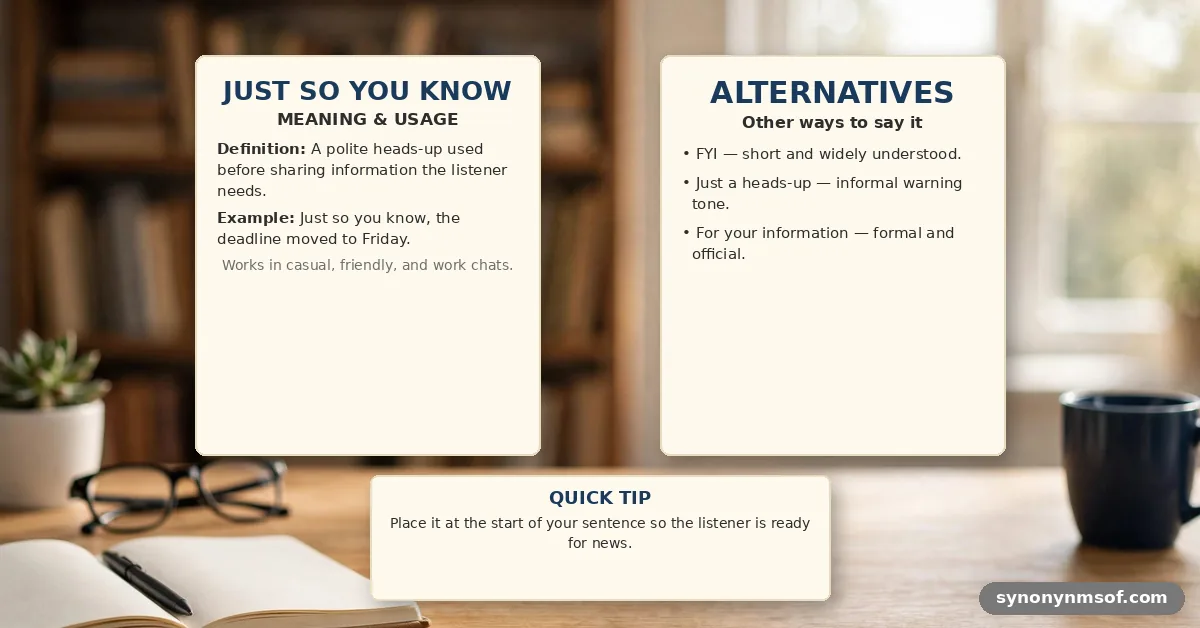
The phrase “just so you know” is a conversational marker used to introduce information that the speaker believes the listener should have but might not already possess. It functions as a preemptive alert, often softening the delivery of potentially surprising or corrective news. Think of it as a verbal “heads-up” designed to keep everyone on the same page.
While the intent is usually helpful, the interpretation depends heavily on the context and the medium. In a text message, it can sometimes be misread as passive-aggressive, especially if the recipient feels the information is being used to point out a mistake. When spoken aloud, the tone of your voice typically clarifies that you are offering a courtesy rather than issuing a critique.
When to Use This Expression

You should reach for this phrase when you want to provide context without making a formal announcement. It works best in situations where the stakes are low but the information is relevant to the immediate task. For instance, if you are working on a shared spreadsheet and notice a minor formatting error, you might say, “Just so you know, the total column is using a different formula.”
Avoid using it when delivering high-stakes feedback or serious news. If you are firing someone or addressing a major performance issue, using a casual “just so you know” can undermine the gravity of the situation. It minimizes the weight of the communication, which can lead to confusion about the importance of what you are saying.
Common Examples in Daily Life
We use this phrase to bridge gaps in knowledge during collaborative projects. It acts as a low-pressure way to share updates that might not warrant a dedicated meeting. Below are common scenarios where this phrasing is frequently employed:
- Informing a coworker that you have completed your portion of a shared task.
- Alerting a friend that a restaurant they recommended is currently closed for renovations.
- Providing a quick update on your arrival time when you are running five minutes late.
- Sharing a piece of industry news that might impact a team member’s upcoming deadline.
Comparing Communication Styles
Different phrases carry different levels of formality and perceived intent. Choosing the right one depends on your relationship with the person and the urgency of the matter. The following table compares common ways to convey similar information.
| Phrase | Best Usage | Tone |
|---|---|---|
| Just so you know | Casual, quick updates | Informal |
| For your information | Formal reports, emails | Professional |
| I wanted to mention | Collaborative feedback | Thoughtful |
| As a reminder | Recurring tasks | Direct |
Alternatives for Professional Settings
In a workplace, you may want to sound more intentional than the casual “just so you know” allows. Using more precise language helps colleagues understand exactly why you are sharing the information. If you are reporting a status change, try starting with “I am writing to update you on…” instead.
If you want to provide a gentle nudge, consider saying, “I thought you might find this helpful.” This shifts the focus from the act of telling to the value of the information itself. It frames the interaction as an act of service rather than a statement of authority.
Alternatives for Personal Relationships
When speaking to friends or family, “just so you know” can sometimes feel like a lecture. Instead, try framing your input as a personal observation or a shared experience. You might say, “I noticed that…” or “I was thinking about…” to make the conversation feel more like a dialogue.
Using these alternatives helps avoid the defensive reaction that can sometimes arise from unsolicited advice. It keeps the conversation grounded in your perspective rather than imposing a “correction” on the other person. By staying humble in your delivery, you foster deeper trust and better communication.
The Impact of Tone and Punctuation

In written communication, punctuation changes everything. A period after “Just so you know” can feel final and cold. Using an ellipsis or an exclamation point can soften the impact, though these should be used sparingly to avoid appearing unprofessional.
Voice inflection is equally critical in person. If your pitch drops at the end of the phrase, it can sound like you are annoyed or impatient. Keeping your voice light and rising suggests you are simply sharing a quick, helpful detail.
Avoiding Passive-Aggressive Traps
The phrase is often criticized for being a vehicle for passive-aggression. If you find yourself using “just so you know” to point out someone else’s failure, stop and rephrase. State the problem directly and focus on the solution instead of the person’s oversight.
Direct communication is almost always more effective than hinting at a problem. If a colleague missed a deadline, saying “I am concerned about the timeline for the project” is more honest than saying “Just so you know, the report was due yesterday.” Clarity builds respect, whereas hints often create unnecessary friction.
Biblical Perspectives on Speech
The importance of choosing the right words is a recurring theme in ancient wisdom literature. Proverbs 15:1 (KJV) reminds us that a soft answer turns away wrath, while grievous words stir up anger. This principle applies directly to modern communication; how we frame our information matters as much as the information itself.
Another relevant passage is found in Colossians 4:6 (WEB), which encourages us to let our speech always be with grace, seasoned with salt. This suggests that our words should be both pleasant and beneficial to those who hear them. When we offer information, we should aim to add value rather than cause frustration.
Digital Communication Etiquette
In instant messaging apps like Slack or Microsoft Teams, speed is often prioritized over nuance. However, even in fast-paced environments, being mindful of your phrasing prevents misunderstandings. If you are sending a message to a superior, consider if “just so you know” is too casual for the context.
You can learn more about effective business communication by consulting established style guides. These resources offer deep insights into how professional language has evolved. They help you strike the right balance between being approachable and maintaining authority in your writing. Getting tricky word pairs right matters just as much: when you are coloring fabric, the choice between dyeing or dying changes everything. Distance comparisons trip up many writers, so it is worth mastering the distinction between farthest or furthest. A quick refresher on fazed or phased can likewise keep your feedback sounding sharp instead of careless. And a small spelling slip like firey or fiery should never distract from an otherwise polished message.
The Psychology of Information Sharing
Why do we feel the need to qualify our statements with “just so you know”? Often, it is a psychological buffer. We want to ensure the recipient doesn’t feel blindsided or pressured by the incoming information.
This serves a social function of smoothing over potential conflict. By framing the information as “extra” or “optional,” we give the other person an “out.” They don’t feel obligated to react immediately, which can reduce social anxiety for both parties.
FAQ on Communication Phrasing
Is it rude to use “just so you know”?
It is not inherently rude, but it depends on the context and tone. If it is used to deliver constructive information, it is generally seen as helpful. If it is used to point out a mistake in a condescending way, it will likely be perceived as rude.
What is the most professional alternative?
The most professional alternative is to be direct and state your purpose. “I am sharing this update for your records” or “Please be aware of the following change” are much clearer and avoid the ambiguity of the casual phrase.
Why do people say “just so you know” before bad news?
People often use it as a psychological cushion to soften the blow. They hope that by labeling the news as something the person “should know,” they can distance themselves from the negative impact of the information. It is rarely an effective way to deliver serious news, however.
Can I use this phrase in a formal speech?
You should avoid this phrase in formal speeches. It is too informal and can make you sound unprepared or overly conversational. Use precise language that emphasizes the gravity of your points instead.
What should I say if someone uses it against me?
If you feel someone is being passive-aggressive, remain calm and focus on the facts. You can say, “I appreciate the update, how would you like me to handle this?” This shifts the focus back to the task and keeps the conversation productive.
Final Thoughts on Modern Language
Navigating the nuances of phrases like “just so you know” requires a blend of social awareness and intentionality. By understanding the meaning, examples, and alternatives provided here, you can choose your words to build stronger connections rather than creating barriers. Language is a tool that evolves with our needs, and being mindful of how you communicate is a sign of true professional maturity.
Start by replacing one instance of the phrase in your next email with a more direct, purposeful alternative. You will likely find that your colleagues respond with greater clarity and appreciation for your transparency. Engagement is a two-way street, and your careful choice of words is the best way to keep that path open and clear for everyone involved.