
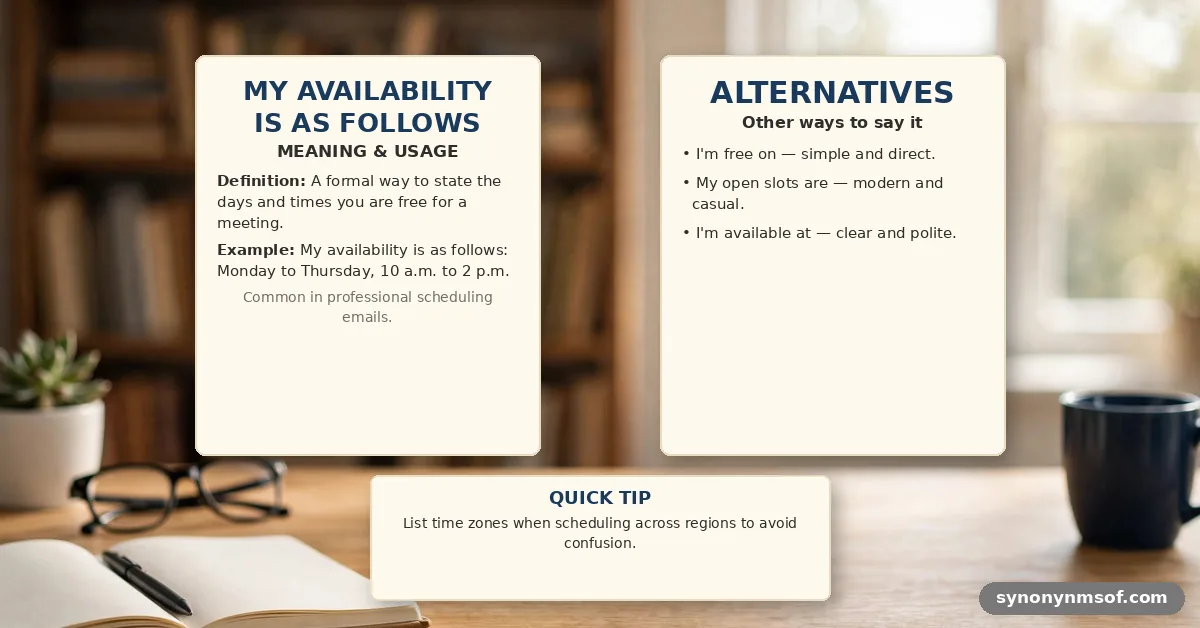

When you write that your availability is as follows, you are establishing a clear boundary for when you can be reached or when you can perform a specific task. This phrase serves as a professional anchor in emails, helping you manage expectations while avoiding the back-and-forth friction that often plagues appointment setting.
Using this language effectively ensures your recipient respects your time and understands exactly when you are ready to engage. By providing these specific details upfront, you demonstrate organizational skills and respect for the other person’s schedule. You will gain a firm grasp on how to use this phrasing to streamline your communication and maintain a polished, efficient image in both formal and informal business settings.
Understanding the Core Meaning

The phrase is a formal way to introduce a list of time slots or dates when you are free. It functions as a signpost, telling the reader that the information they need to schedule a meeting is coming immediately after the colon. Because it is inherently structured, it removes ambiguity from the coordination process.
When you use this phrasing, you are taking control of your calendar. Instead of asking someone when they are free and waiting for a response, you provide your own constraints first. This is a common tactic in high-stakes environments where time is a limited resource and efficiency is prioritized over open-ended negotiation.
Grammatically, the phrase is straightforward. You are declaring that the information provided in the following lines constitutes your total current availability. It acts as a bridge between your greeting and the logistical details, keeping the body of your message focused and purposeful.
Why Tone Matters in Scheduling
Choosing the right tone is essential because this phrase can sound overly stiff if used in the wrong context. In a very casual team environment, it might feel robotic or unnecessarily distant. However, in client-facing roles or when reaching out to someone for the first time, it conveys a sense of respect for their time.
The best use of this language occurs when you want to signal that you are busy but willing to accommodate a meeting. It strikes a balance between being helpful and being protective of your work hours. If you are communicating with a supervisor, it shows that you are proactive and organized.
Balancing Formality and Approachability
To keep the tone from becoming too detached, you can soften the surrounding text. Instead of jumping straight into the list, add a polite lead-in that acknowledges the importance of the meeting. This maintains a human connection while still utilizing the efficiency of the formal phrasing.
Consider the difference between these two approaches:
- Formal: My availability is as follows: Monday from 9 AM to 11 AM, and Wednesday from 2 PM to 4 PM.
- Softened: I would love to connect on this project. My availability is as follows, though I am happy to adjust if these times don’t work for you.
Common Scenarios for Usage
You will find the most success using this language during the initial stages of scheduling. It is particularly helpful when you are coordinating with people outside your immediate organization. Since they do not have access to your shared calendar, they rely on your email to understand your windows of opportunity.
Another common scenario is during the recruitment process. When a hiring manager asks for your interview availability, providing a structured list ensures they can match your schedule against their interviewers without confusion. It simplifies their administrative workload, which is always a positive impression to make.
| Scenario | Best Practice | Tone |
|---|---|---|
| Client Meeting | Provide 3 specific blocks | Professional |
| Internal Sync | Link to calendar | Casual |
| Job Interview | List clear dates/times | Formal |
| Vendor Inquiry | State morning or afternoon | Direct |
Grammar and Syntax Essentials
A frequent point of confusion is whether to use “is” or “are” when drafting this sentence. The correct choice depends entirely on whether you view your availability as a singular concept or a collection of items. In most professional writing, “My availability is as follows” is the standard, as it treats “availability” as a collective noun representing your schedule.
If you prefer to focus on the individual slots, you might write, “My available times are as follows.” Both are technically correct, but the first option remains the most common in corporate settings. Consistency is more important than strict prescriptive grammar here, so choose one style and stick with it throughout your correspondence.
Always ensure that you follow the introductory phrase with a colon. A colon serves as a visual indicator that a list is imminent, which helps the reader scan your email quickly. If you end the sentence with a period, you break the flow and make the information harder to extract at a glance.
Structuring Your Available Times
Efficiency relies on how you format the information after the colon. Avoid burying your time slots in a long paragraph, as this forces the reader to hunt for the relevant details. Instead, use bullet points or clear line breaks to make your schedule pop off the screen.
When providing your times, always include the time zone. This is a crucial detail that is often overlooked, leading to missed meetings and unnecessary frustration. If you are working in a global team, you might even consider listing the time in UTC as well, though local time is generally sufficient for most domestic interactions.
Be specific about the duration of the slots you are offering. If you have a one-hour window, state it clearly. This prevents the other person from assuming you are free for an entire afternoon when you actually have a hard stop at 2 PM.
Handling Scheduling Conflicts
Even with clear communication, conflicts will arise. When you state that your availability is as follows, you are setting a starting point for negotiation, not a rigid demand. If the recipient cannot make those times work, be prepared to offer alternatives gracefully.
If your schedule is particularly tight, consider using an automated scheduling tool. You can find more information on how to manage these digital workflows through resources like the Nielsen Norman Group’s insights on interface design for productivity. These tools often integrate directly with your calendar, removing the need for manual email correspondence entirely.
If you do not have access to such tools, keep a running list of your “open” times in a draft folder. This allows you to copy and paste your availability quickly without having to re-calculate your free slots every time you send an email. It saves time and ensures you don’t accidentally offer a slot that is already booked.
Avoiding Common Pitfalls
One major mistake is providing too many options. If you list every single hour you are free over the next two weeks, you overwhelm the reader and make them do the work of filtering your schedule. Aim for three to four distinct, high-quality slots that give the other person enough flexibility without creating choice paralysis.
Another pitfall is using vague language like “I’m free whenever” or “Just let me know what works.” While this sounds accommodating, it is actually a burden on the recipient. It forces them to guess your preferences and likely leads to a longer email thread than necessary.
Finally, avoid being overly rigid. If you state your availability is as follows and then refuse to budge when the other person has a genuine conflict, you appear difficult to work with. Use your stated times as a guide, but keep your ultimate goal of securing the meeting in mind.
FAQ
Is it better to say my availability is as follows or are as follows?
In most professional contexts, “my availability is as follows” is preferred because “availability” is treated as a collective noun. While “are” is technically acceptable if you are thinking of multiple specific times, “is” sounds more natural and is the industry standard for formal business emails.
How do I list my availability without sounding robotic?
To avoid sounding like a machine, pair the phrase with a polite, human-centric opening. For example, “I’m looking forward to our chat; my availability is as follows for the coming week.” This small addition maintains the efficiency of the list while establishing a warm tone.
What should I do if none of my listed times work for the recipient?
If they cannot meet during your suggested slots, simply ask them to provide three times that work for their schedule. This shifts the burden of coordination fairly and shows that you are willing to accommodate their needs once your primary options have been exhausted.
Should I include my time zone when sharing my availability?
Yes, always include your time zone. Even if you believe you are in the same region, remote work and travel mean that time zone assumptions are a frequent cause of missed meetings. It is a small detail that demonstrates high professional awareness.
Conclusion
Mastering the use of this phrase is a simple yet effective way to improve your professional communication. By being precise with your schedule, you respect the time of others and ensure that your meetings are set with minimal effort. Remember that when your availability is as follows, you are not just listing times, but also setting the standard for how you handle your professional commitments.
The next time you need to coordinate a meeting, avoid the temptation to leave your schedule open-ended. Select a few clear blocks, present them confidently, and watch how much faster your calendar fills with productive, well-planned sessions. If you continue to refine how you share your availability, you will find that your daily workflow becomes much more manageable and efficient for everyone involved.