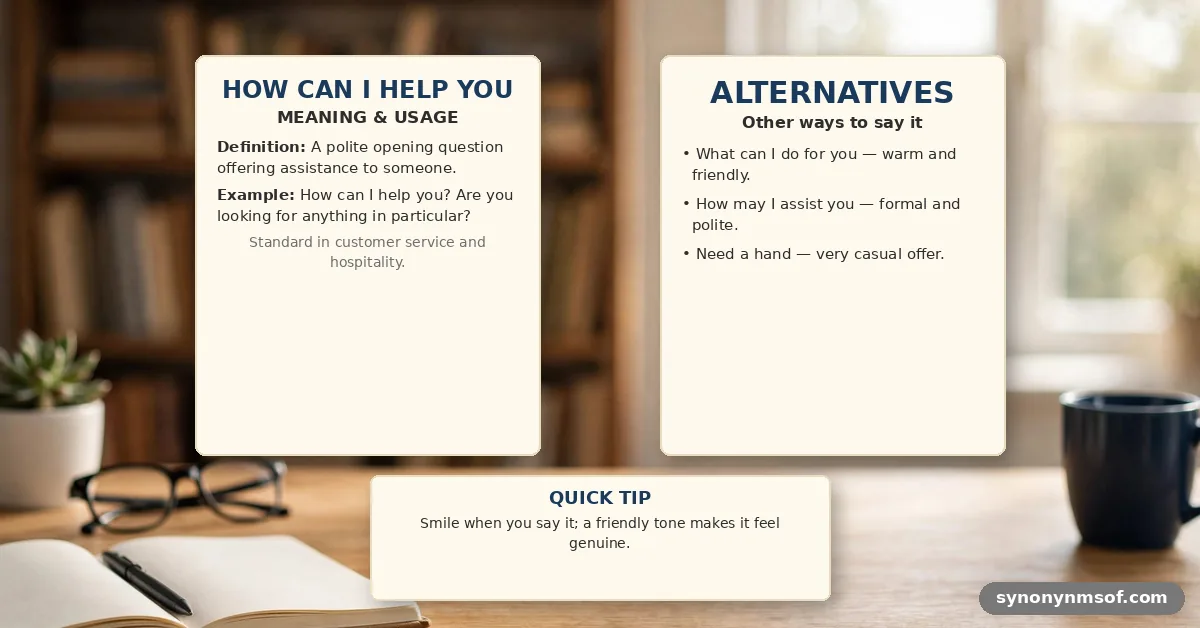

When someone asks, “How can I help you,” they are offering their assistance in a direct, professional, or personal capacity. This phrase serves as a polite gateway to communication, signaling that the speaker is ready to listen to your needs or solve a problem.
Mastering the timing and tone of this inquiry is essential for building rapport, whether you are working in customer service, managing a team, or simply checking in on a friend. By understanding the nuance behind these words, you will find that you are better equipped to foster positive interactions in any environment, ensuring that your offer of support lands with sincerity and purpose.
The Core Meaning and Intent
At its heart, asking how you can assist someone is an act of service. It shifts the focus from your own agenda to the priorities of the person standing in front of you. When you use this phrase, you communicate that you are present, attentive, and willing to invest your time in their objective.
The phrase functions as a social lubricant that removes uncertainty. Without a clear opening, a person might hesitate to state their needs, fearing they are interrupting or becoming a burden. By explicitly inviting them to speak, you lower the barrier to entry for their request.
Why Tone Matters

The words themselves are neutral, but the delivery changes everything. A monotone, rapid-fire delivery in a retail setting often sounds robotic, signaling that the speaker wants the interaction to end quickly. Conversely, a measured, warm delivery suggests genuine interest in the outcome.
If you are in a professional role, your body language should match your verbal offer. Maintain soft eye contact, keep your posture open, and avoid multitasking while you speak. These non-verbal cues reinforce the message that you are actually ready to help.
Usage in Professional Settings
In the workplace, this inquiry is a cornerstone of effective client management and internal collaboration. It is the standard starting point for support tickets, front-desk interactions, and initial project meetings. Using it correctly can drastically improve the trajectory of a professional relationship.
When you are in a high-pressure environment, the phrase acts as a filter. It forces the other person to articulate their specific requirement, which helps you move from vague frustration to actionable steps. You are essentially asking for a defined scope of work.
- Customer Support: Use it to transition immediately from a greeting to problem resolution.
- Team Leadership: Use it during one-on-one meetings to identify blockers for your direct reports.
- Sales: Use it as a discovery tool to uncover a lead’s primary pain point.
- Networking: Use it when meeting someone new to establish a reciprocal relationship.
Variations for Different Contexts
While the standard phrase is effective, it isn’t always the best fit for every scenario. Sometimes, you need to adjust the level of formality or the specificity of your offer to match the environment. A casual “What can I do for you?” might feel jarring in a formal legal consultation, just as a rigid “How may I be of service?” might feel stifling at a family gathering.
You can adjust the phrasing to reflect your specific role or the depth of your relationship. The following table highlights how to adapt your language based on the setting you find yourself in.
| Context | Recommended Phrasing | Nuance |
|---|---|---|
| Formal Business | “How may I be of service?” | High respect, professional distance. |
| Casual Peer-to-Peer | “What do you need a hand with?” | Collaborative, friendly, informal. |
| Retail/Service | “How can I help you today?” | Efficient, welcoming, standard. |
| Crisis/Urgent | “What is the priority right now?” | Direct, action-oriented, focused. |
Examples of Effective Responses
Knowing how to ask the question is only half the battle; understanding how to respond to it is equally important. If you are the one being asked, you should aim for clarity. Vague responses like “I’m just looking” or “I don’t know” can stall progress, even if they are technically honest.
For better results, try to pair your request with context. If you are in a shop, instead of “I’m just looking,” say, “I’m looking for a gift for a friend who likes gardening; do you have a specific section for that?” This gives the person helping you a clear path to provide value.
Refining Your Request

When you need help with a complex task, be specific about the outcome you want. Instead of saying “I need help with this report,” try “I’m having trouble with the data formatting on page three of the report; could you show me how to fix that?” This precision saves time for both parties.
Remember that the person asking is human. If you are frustrated, take a moment to breathe before you respond. A clear, calm explanation of your needs will almost always yield a faster and more accurate solution than an emotional outburst.
Avoiding Common Pitfalls
The most common mistake people make is using the phrase as a filler. If you say it while checking your phone or looking at your watch, you are being dishonest. This creates a sense of distrust, as the listener realizes your offer of assistance is performative.
Another pitfall is over-promising. If you ask how you can help, you must be prepared to follow through on whatever is requested.
If you cannot fulfill the request, be honest immediately. You might say, “I can’t help with that specific software, but I can point you toward someone on the team who is an expert in it.”
The Role of Empathy
Helping others is not just a transactional process; it is an emotional one. When someone approaches you for help, they are often experiencing stress, confusion, or exhaustion. Your response should acknowledge that reality, even if you are in a busy office.
Consider the biblical perspective on service, which emphasizes the spirit in which we give. The scripture in Galatians 6:10 reminds us to do good to everyone whenever we have the opportunity. This principle applies to our daily language as well; when we offer to help, we are choosing to prioritize the needs of others over our own immediate convenience.
Advanced Communication Strategies
Once you are comfortable with the basic phrase, you can start layering in more advanced techniques. One strategy is the “offer-and-guide” method. Instead of just asking, you provide a starting point for them to consider.
For example, you might say, “I have some time to help with the project; would you prefer I handle the research or start on the draft?” This limits the cognitive load on the other person. You aren’t just asking them to think of a task; you are offering them a choice between two helpful paths.
Active Listening
The most important part of helping is listening to the answer. Many people start formulating their solution while the other person is still speaking.
This is a mistake. Wait until they finish, confirm you understand, and then offer your support.
You can use reflective listening to ensure you are on the same page. If they explain a complicated problem, repeat the main points back to them briefly. This signals that you have heard their concerns and are genuinely engaged with their situation.
FAQ
Is it better to say “How can I help” or “How may I help”?
The version with “can” is standard and works in almost every situation. Using “may” adds a layer of formality that works well in luxury service or high-stakes corporate environments. Use “may” if you want to sound more traditional or deferential.
What should I do if I genuinely cannot help the person?
Be honest and direct. You do not need to apologize profusely, as that can make the interaction awkward. Simply state the limitation and offer an alternative, such as a referral or a suggestion for where they can find the information they need.
How do I ask this if I am in a bad mood?
If you are struggling to be pleasant, keep your interaction brief and focused on the task. You don’t need to be overly cheerful to be helpful. Professionalism relies more on consistency and competence than on constant high energy.
Why do people say “How can I help you” when I am just browsing?
In retail, this is a standard protocol designed to ensure no customer feels ignored. If you are just browsing, a simple “No thanks, just looking, but I’ll let you know if I need anything” is perfectly acceptable. It acknowledges their effort without requiring you to engage further.
Conclusion
Mastering the art of asking how you can assist others is about more than just vocabulary. It is about cultivating a mindset of service and clarity. When you use this phrase with intention, you create a space for others to feel heard and supported.
Whether you are in a professional meeting or a casual conversation, remember that your goal is to bridge the gap between a problem and a solution. By keeping your language clear and your attitude attentive, you will build stronger connections and solve problems more effectively.
Take the next step by practicing this in your daily life. Observe how different people respond to your offer of help, and adjust your tone and timing accordingly.
You will soon find that you are more adept at navigating complex social and professional situations. Keep your focus on the person you are helping, and you will find that your interactions become much more meaningful and productive.