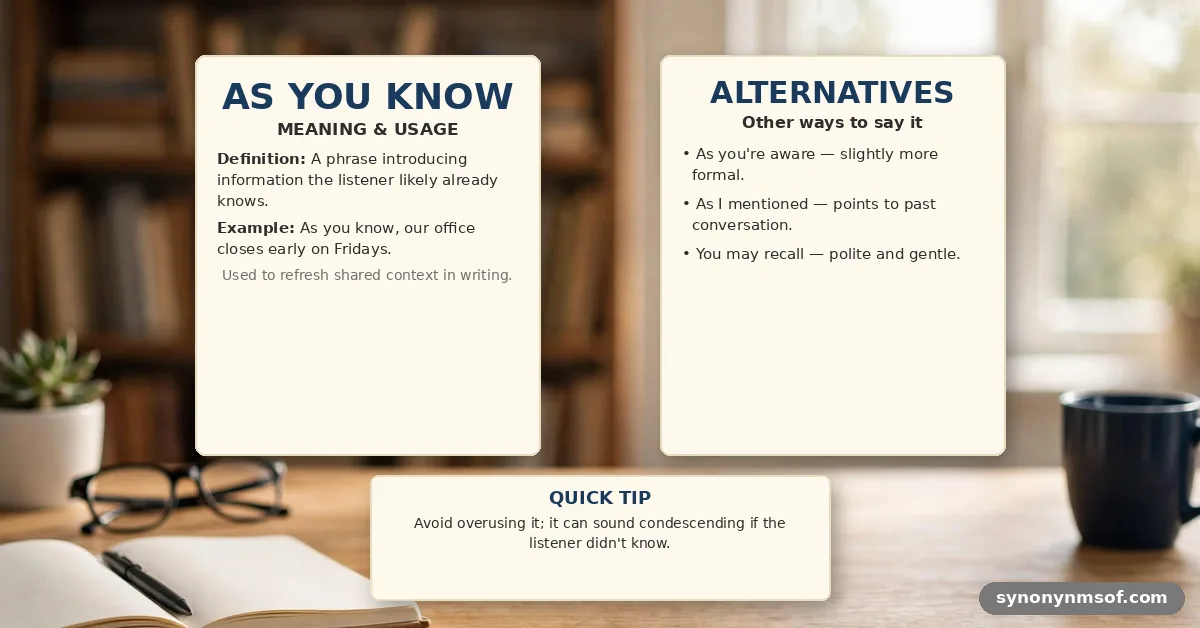

Using the phrase “as you know” is a common way to introduce information that the speaker assumes the listener already possesses. It functions as a conversational bridge, signaling that the upcoming statement is a reminder or a shared point of reference rather than brand-new news.
Whether you are drafting a professional email or chatting with a friend, understanding how to deploy this phrase effectively prevents you from sounding condescending or redundant. By mastering the nuances of this expression, you ensure your communication remains respectful of your audience’s existing knowledge while keeping the conversation flowing smoothly.
The core purpose of this phrase is to establish common ground between speakers. When you say, “As you know,” you are essentially validating a shared reality. This can be used to set the stage for a new argument, remind someone of a deadline, or build a sense of rapport.
It acts as a polite preface that acknowledges the listener’s intelligence. However, if overused, it can quickly turn patronizing, making the recipient feel as though you are explaining something they have already mastered. Using it sparingly is the key to maintaining a professional and balanced tone in your interactions.
Defining the Functional Purpose
At its heart, the phrase serves as a discourse marker. It signals to the listener that the information following the phrase is not a revelation, but a reinforcement of established facts. This is particularly useful in complex discussions where you need to anchor your point in a previously agreed-upon premise.
Establishing Shared Context

When you use this expression, you are essentially creating a baseline. By acknowledging that the listener is already informed, you show respect for their time and their history with the topic. It helps avoid the awkwardness of explaining basic concepts that everyone in the room already understands.
Managing Tone and Perception
There is a fine line between helpful context and arrogance. If you rely on the phrase too heavily, it can sound like you are lecturing.
People often perceive it as a passive-aggressive way to highlight that someone should have known something, even if that wasn’t your intent. Always weigh whether the information truly requires a reminder before invoking this specific phrasing.
Common Scenarios for Proper Usage
The most effective use of this phrase occurs in professional settings, such as business meetings or formal correspondence. It allows you to transition between topics without starting from scratch. Here are a few ways to categorize how the phrase appears in daily communication.
- Project Status Updates: Reminding stakeholders of a previously discussed timeline or budget constraint.
- Academic or Formal Writing: Referencing a foundational theory or a well-documented fact in an essay.
- Negotiations: Recapping agreed-upon terms before introducing a new request or modification.
- Mentorship: Gently nudging a student toward a fact they have already encountered in their studies.
Grammar and Structural Nuances
While the phrase is simple, its placement within a sentence changes the flow of your message. It is almost always set off by commas because it acts as an introductory or parenthetical element. Failing to use proper punctuation can make the sentence feel rushed or grammatically cluttered.
Placement Options
You can place the phrase at the beginning, middle, or end of a sentence. Each position carries a slightly different emphasis. Putting it at the start is the most common approach for setting a formal tone.
| Position | Example | Effect |
|---|---|---|
| Beginning | As you know, the report is due on Friday. | Clear, direct, and authoritative. |
| Middle | The deadline, as you know, is rapidly approaching. | Adds a reflective or emphatic pause. |
| End | The budget is tight, as you know. | Casual, conversational, and collaborative. |
Avoiding the Pitfalls of Condescension
One of the biggest risks with this phrase is the “mansplaining” effect. If you assume someone knows something they actually don’t, you put them in an uncomfortable position. They may feel pressured to nod along to avoid admitting their ignorance.
The Risk of False Assumption
Before you say, “As you know,” pause to consider your audience. Are you certain they have the context you are referencing?
If there is any doubt, it is far better to skip the phrase and simply state the facts. Clarity is always superior to the assumption of shared knowledge.
Alternatives for Better Clarity
If you want to avoid the potential for sounding arrogant, there are several ways to phrase your thoughts without relying on this specific expression. You can use phrases like “As we previously discussed,” or “To recap,” which are more neutral.
These alternatives focus on the history of the conversation rather than the listener’s personal knowledge base. You can learn more about effective communication through discourse markers to refine your style further.
Cultural and Social Contexts
Language is rarely static, and the way we use these phrases changes based on the social environment. In high-context cultures, people often assume a significant amount of shared knowledge. In such cases, “as you know” might be used more frequently as a way to maintain social cohesion and confirm that everyone is on the same page.
Professional vs. Casual Dynamics

In a casual setting, like a conversation with friends, the phrase can sometimes sound sarcastic. Using it to state something obvious—like “As you know, the sun is hot”—is a common trope used to mock someone’s obvious observation. Be mindful of your delivery, as tone of voice often dictates whether the phrase is received as polite or facetious.
Regional Variations
While the phrase is standard English, its frequency varies by region and industry. In fast-paced corporate environments, it is often used as a tool for efficiency.
Conversely, in more relaxed or creative settings, it might be seen as overly formal or stiff. Adapt your usage to the culture of the group you are addressing.
Examples in Professional Writing
To see how this works in practice, consider how it functions in emails. A well-placed “as you know” can prevent a long, rambling explanation. It signals that you are building upon a foundation, which is a great way to save time in busy workplaces.
Drafting Effective Emails
Instead of re-explaining the entire project scope, you can write: “As you know, the primary goal of this project is to increase user engagement by 15%.” This keeps the reader focused on the current task. It reminds them of the objective without wasting space on history they already understand.
Structuring Reports
In longer documents, the phrase acts as a signpost. It tells the reader that they have encountered this information before and that it is critical to the current section. This helps maintain the logical flow of your argument across multiple pages.
Common Misunderstandings
Many people treat this phrase as a universal filler, but it has a specific job to do. If you use it to introduce brand-new information, you create confusion. The listener will be left wondering if they missed an earlier conversation, which can lead to unnecessary anxiety.
When to Avoid the Phrase
Do not use this phrase if you are introducing a new concept. If the information is fresh, own it.
Say, “I want to share an update,” or “Here is some new information.” Using “as you know” to introduce a new idea is a form of gaslighting, even if it is unintentional.
Identifying Redundancy
If you find yourself using the phrase in every other sentence, stop. It becomes a verbal tic that detracts from your message.
Good writing and speaking rely on variety. Use other transitional phrases to keep your audience engaged and your communication fresh.
Frequently Asked Questions
Is it ever rude to use the phrase?
It can be perceived as rude if the listener does not actually know the information you are referencing. It can make them feel unintelligent for not knowing, or it can feel like you are being condescending. Always ensure you are on solid ground before using it.
Can I use this phrase in a text message?
Yes, but be careful with the tone. Texting is informal, and “as you know” can sometimes sound overly formal or even sarcastic depending on the context. If you are keeping things light, you might prefer a simpler way to phrase your reminder.
What is a good synonym for as you know?
Depending on the context, you can use “As we discussed,” “As mentioned previously,” “To recap,” or “As is well established.” These alternatives often feel more objective and less personal than “as you know.”
How do I stop overusing the phrase?
If you realize it is a habit, try to replace it with a direct statement of fact. Instead of “As you know, the meeting is at five,” just say, “The meeting is at five.” You will find that your communication becomes more direct and efficient without the filler.
Mastering Professional Communication
Refining how you use common phrases like “as you know” is a simple but powerful way to improve your clarity and authority. When you use the phrase with intention, it serves as a bridge that keeps your audience informed without wasting their time.
Remember that the best communicators are those who value their listener’s perspective. By avoiding unnecessary assumptions and keeping your tone balanced, you ensure that your message is always received in the spirit it was intended.
Practical communication is about precision and empathy. Whether you are speaking in a boardroom or writing a quick note, choose your words to build rapport rather than distance.
If you keep these principles in mind, you will find that your interactions become more productive and your message resonates more deeply with those you are trying to reach. Take the time to evaluate how you structure your sentences and watch how your professional influence grows.