
Every letter you send, every email you write, and every form you fill in asks you to make a small choice that carries real social weight: what title to put before a woman’s name. Ms. and Mrs. look almost identical on the page — two letters, a period, and a world of assumptions. Pick the right one and nobody notices; pick the wrong one and you can sound careless, old-fashioned, or even rude.
The confusion is understandable. For men, English offers a single title that works for everyone: Mr. covers the married, the unmarried, the divorced, and the private about it, with no questions asked. For women, the language historically split titles along one fault line — marital status — and left writers guessing at information they may have no business knowing. That is exactly the problem the title Ms. was created to solve, and it is why this tiny word-pair trips up native speakers and learners alike.
In this guide, we break down the ms or mrs question from every angle: what each title means, where Ms. came from, when Mrs. is the right call, how they are pronounced, and what to do in every tricky situation — from wedding invitations to work emails to addressing a stranger. By the end, you will never hesitate over these two letters again.
What Does “Ms.” Mean?
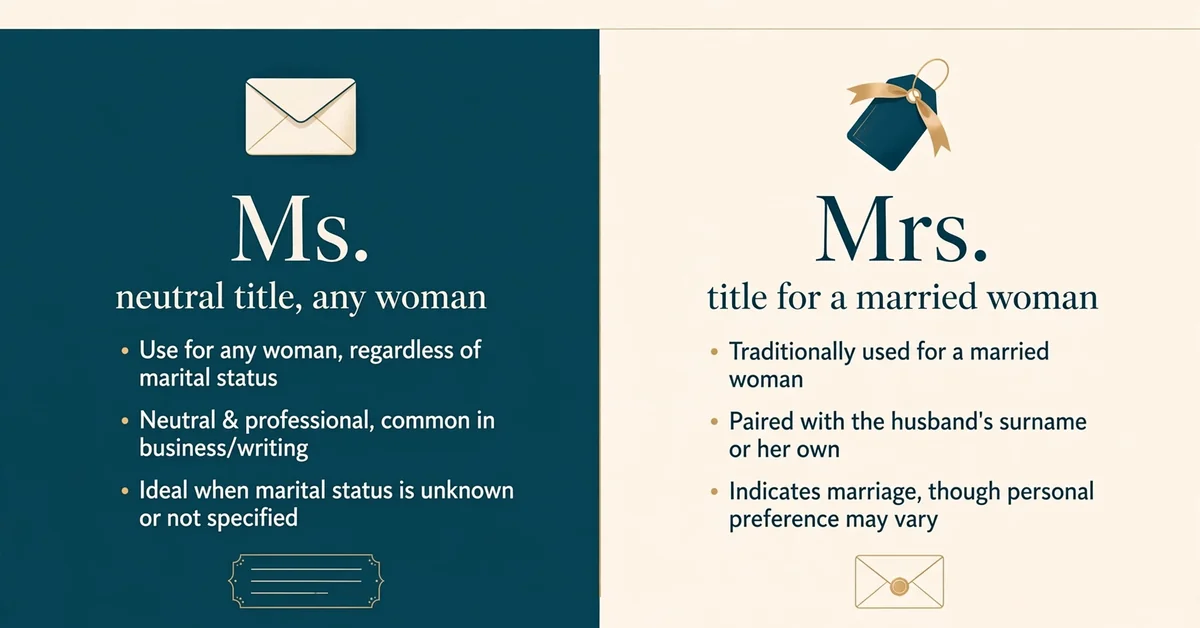
Ms. (pronounced “miz”) is a courtesy title for a woman that says nothing about her marital status. A woman can be married, single, divorced, widowed, or simply private about her personal life — Ms. fits all of them. In that way, it is the exact female counterpart of Mr., which likewise reveals nothing about a man’s marriage.
The defining feature of Ms. is not what it declares but what it leaves alone. When you write “Ms. Carter” or say “Excuse me, Ms.,” you extend the same neutral respect that “Mr.” gives men. The woman’s relationship status never enters the picture, which is why Ms. has become the default title in business correspondence, journalism, and any situation where marital status is either unknown or irrelevant.
The History of “Ms.”
The idea behind Ms. is older than most people think. In the 1600s and 1700s, printers occasionally combined “Miss” and “Mistress” into “Ms.” as a general title, but it never caught on. The modern revival began in the 1950s, when business writers needed a title that did not announce whether a woman was married. But it was the feminist movement of the late 1960s and 1970s that pushed it into the mainstream: women argued that no man had to reveal his marital status in his title, so no woman should have to either.
The turning point came in 1971, when Gloria Steinem launched Ms. magazine, deliberately putting the title on the cover of a national publication. By the 1980s, style guides like the Associated Press and major newspapers had adopted Ms. as the default title for women in news stories — a rule that holds to this day. What began as a protest became standard English.
How to Use “Ms.”
Use Ms. before a woman’s surname or full name whenever:
- You do not know her marital status.
- Her marital status is irrelevant to the situation.
- She has indicated that she prefers Ms.
- You are writing in a professional or business context.
Examples: “Please welcome our speaker, Ms. Okafor.” / “Dear Ms. Lindqvist, thank you for your application.” Note that Ms. is almost always followed by the surname, not the first name — “Ms. Rivera,” not “Ms. Elena.” (One regional exception: in parts of the American South, “Ms.” plus a first name is a traditional term of respect, but that usage belongs to spoken custom, not formal writing.)
What Does “Mrs.” Mean?
Mrs. (pronounced “missiz” or “mis-uhz”) is the traditional title for a married woman. It comes from “mistress” — once simply the female form of “master,” used for a woman in authority — and over centuries it narrowed to its modern meaning: a woman who is or has been married.
Unlike Ms., Mrs. tells the world something specific: that the woman belongs, or belonged, to a marriage. Traditionally it was paired with the husband’s surname — “Mrs. John Harrison” was once the standard formal address, literally folding the wife’s identity into her husband’s. Today, most women who use Mrs. pair it with their own surname, married or otherwise: “Mrs. Patel,” “Mrs. Nguyen.”
Who Uses “Mrs.” Today?
Plenty of women actively prefer Mrs. It can feel dignified, traditional, and personally meaningful — many married women choose it as a badge of the life they have built. Some women keep it after divorce or widowhood, sometimes because they kept the family surname along with it. The key point: for these women, Mrs. is not outdated — it is a preference, and using it correctly is a sign of respect.
Use Mrs. when:
- You know the woman is married and you know she uses Mrs.
- She introduces herself or signs her name as Mrs.
- You are following a stated style, such as a wedding invitation list.
Never guess it. Assigning “Mrs.” to a woman whose marital status you do not know is one of the most common etiquette errors in English — and the main reason business writers default to Ms.
Pronunciation and Spelling Notes
Mrs. is always spelled with a capital M and a final period in American English: Mrs. In British English, the period is traditionally dropped — Mrs — because the abbreviation ends with the last letter of the full word (“mistress”). The same British/American split applies to Ms./Ms and Mr./Mr. Both conventions are correct; just stay consistent within a single document.
Ms. or Mrs.: The Key Difference
The difference is simple to state and important to honor: Mrs. announces a marriage; Ms. announces nothing. Ms. is neutral about marital status, Mrs. is specific about it. Everything else — etiquette, safety, and modern usage — flows from that single contrast.
Think of it this way: a man’s title never forces him to disclose his marriage, so the fair, modern default for a woman is the title that offers the same privacy. On the other hand, when a woman has made her preference clear — she signs her letters “Mrs. Alvarez,” she introduces herself as “Mrs. Whitfield” — then Mrs. is not only acceptable but the most respectful choice you can make.
Where Does “Miss” Fit In?
No discussion of Ms. vs Mrs. is complete without Miss, the third title in the set. Miss (pronounced “miss,” no period) is the traditional title for an unmarried woman or girl, and it is still used for children and teenagers: “Miss Carter, please take your seat.” Some unmarried adult women prefer it too, though that preference is becoming rarer. The trap: calling an adult woman “Miss” can sound patronizing once she is past her teens, especially in professional settings. When in doubt, Ms. is the safe default, not Miss.
Ms. and Mrs. Side by Side
| Ms. | Mrs. | |
|---|---|---|
| Meaning | Neutral title for any woman | Title for a married woman |
| Marital status revealed? | No | Yes — married |
| Pronunciation | “miz” (rhymes with fizz) | “missiz” (rhymes with Mrs. = “missus”) |
| Period (AmE) | Ms. | Mrs. |
| Period (BrE) | Ms | Mrs |
| Used with | Surname (“Ms. Chen”) | Surname (“Mrs. O’Brien”) |
| Safe default when unsure? | Yes — always | No — never guess |
| Professional settings | Preferred standard | Only if she requests it |
| Feminist-era origin | Revived 1960s–70s | Centuries old |
| Plural form | Mss. or Mses. | Mmes. (mesdames) |
How to Use “Ms.” and “Mrs.” in Real Life
In Everyday Conversation
In speech, you rarely go wrong starting with Ms. A hotel receptionist asking “How can I help you, Ms.?” or a new neighbor saying “Nice to meet you, Ms. Thompson” sounds polite and modern. If a woman corrects you — “It’s Mrs. actually” — simply switch and move on; no apology speech is needed.
Teachers deserve a special mention: in schools, “Mrs.” has long been the default for female teachers, and many still prefer it. Students should follow the teacher’s own introduction. Adults meeting a teacher for the first time can default to Ms. and adjust.
One spoken habit to drop: calling an unknown adult woman “Miss” as a generic attention-getter (“Excuse me, miss!”). It is regional and often fine with teenagers, but “Excuse me” alone is cleaner with adults whose age and status you cannot guess.
At Work and in Business
Business writing is where Ms. truly rules. HR forms, job applications, client emails, contracts, and press releases should default to Ms. unless the woman has stated otherwise. There are three solid reasons: it avoids assumptions about a colleague’s private life, it matches the neutral “Mr.” used for men, and it keeps the focus on the professional role rather than the personal one.
A few business-specific guidelines:
- Email greetings: “Dear Ms. Osei,” is the professional standard opening when you do not know the recipient personally. Once she replies signing her first name, drop the title.
- Introductions: “This is Ms. Farouk, our new analyst” treats her exactly as you would treat “Mr. Farouk.”
- Directories and name badges: list women as “Ms.” by default and let individuals change it if they wish.
- Never use a title to guess seniority: “Ms.” fits the intern and the CEO equally.
In Formal and Academic Writing
Formal writing — letters, invitations, certificates, academic papers — follows the same principle with a few extra conventions.
Letters and emails. The salutation sets the tone. “Dear Ms. Whitaker:” (note the colon in American business letters) is safe. If the recipient has told you she is “Mrs.,” use “Dear Mrs. Whitaker:”. When writing to a couple, tradition says “Mr. and Mrs. Whitaker,” though many modern couples prefer “Mr. Whitaker and Ms. Whitaker” or simply both full names. When in doubt, ask — or use both names with no titles at all.
Addressing envelopes. Wedding and formal invitations are the one place where Mrs. still appears most often, because the host usually knows the guests’ marriages. “Mrs. Daniel Reyes” is the ultra-traditional form (wife addressed through her husband’s name); the modern standard is “Mrs. Sofia Reyes.” For an unmarried woman, “Ms. Sofia Reyes” is correct — never “Miss” on a formal invitation to an adult unless she prefers it.
Forms and applications. Government and institutional forms increasingly offer “Ms.” as the first or only feminine option, and many now include “Mx.” as a gender-neutral choice. Tick “Ms.” unless you genuinely prefer Mrs. — nobody will question it.
Academic and professional titles. A doctor is “Dr.,” a professor is “Prof.” — professional titles outrank courtesy titles, so “Dr. Amara Silva” needs no Ms. or Mrs. at all.
Common Mistakes to Avoid
Even careful writers stumble over these titles. Watch out for the classic errors:
- Guessing “Mrs.” from a wedding ring. A ring suggests marriage, not a title preference. Plenty of married women use Ms. — and plenty of unmarried women wear rings. The ring tells you nothing; ask or default to Ms.
- Using “Mrs.” with a first name only. “Mrs. Elena” is wrong in standard English (outside the regional Southern custom). Titles pair with surnames: “Mrs. Vargas.”
- Calling every adult woman “Miss.” It reads as young or dismissive past the teenage years. In a shop, an office, or an email, it is the riskiest of the three titles.
- Writing “Miss.” with a period. Miss is a complete word, not an abbreviation — no period, ever. (Its period-less look is the easiest way to tell it apart from Ms. and Mrs. on the page.)
- Mixing British and American punctuation. Pick “Ms.” or “Ms” and “Mrs.” or “Mrs” and stay consistent through the whole document.
- Assuming a divorced woman becomes “Miss.” Divorce does not rewind a title. Many divorced women keep Mrs. with the married surname; many switch to Ms. Either is correct — it is her call, not a rule.
- Using “Mrs.” for a woman who kept her maiden name to make a point. Some married women keep their birth surname precisely to be addressed as Ms. Calling them “Mrs. [Maiden Name]” overrides a deliberate choice.
- Overcorrecting to “Ms.” after being told “Mrs.” If she says “It’s Mrs.,” believe her. Insisting on Ms. in the name of modernity is its own kind of rudeness.
Tricky Cases and Edge Cases
When the Marital Status Is Unknown
This is the easiest case of all, because the answer never changes: use Ms. That is literally what the title was invented for. A new client, a name on a conference list, a byline you are citing — “Ms.” covers every one of them without a single assumption. Journalists, recruiters, and customer-service teams live by this rule because it removes an entire category of error.
Divorced Women
Divorce scrambles the old rules, which is exactly why the rules changed. A divorced woman may keep Mrs. (especially if she kept her married surname and likes the title), switch to Ms. (the most common modern choice), or in rare cases return to Miss. There is no default you can apply from the outside. If you knew her as “Mrs. Dalton” before the divorce, keep using it until she signals otherwise — continuity beats guesswork.
Widowed Women
Widows traditionally kept Mrs. — “Mrs. Eleanor Vance” remained Mrs. Vance after her husband’s death, and many widows still prefer it as a link to their married life. Others adopt Ms. Some widows keep the ultra-traditional “Mrs. Robert Vance” on formal stationery while using “Ms. Vance” at work. As always, follow her lead; if you cannot know her lead, Ms. is the respectful fallback.
Professional Settings
In offices, universities, hospitals, and courtrooms, Ms. is the institutional standard. Style guides from newsrooms to corporations say the same thing: use Ms. unless the woman specifies otherwise. A workplace has no business sorting women by marriage, and the default protects everyone from the awkward correction.
The Ms. vs. Miss Pronunciation Puzzle
Say them out loud: Ms. is “miz” (rhymes with “fizz”), Miss is “miss” (rhymes with “hiss”), and Mrs. is “missiz.” The Ms./Miss pair is the troublemaker — in fast speech, “miz” and “miss” can blur, especially across accents. If you are introducing someone aloud and want zero ambiguity, use her full name with the title clearly enunciated: “Please welcome Ms. Zara Ahmed.” In writing, the spelling does the work for you, so the confusion is mainly a spoken-word issue.
Same-Sex Marriages and Title Choice
Marriage equality added a straightforward rule: a married woman is a married woman. A woman married to another woman may use Mrs. — many do, including “Mrs. and Mrs.” couples on invitations — or Ms., exactly as any married woman might. Do not assume that a woman in a same-sex marriage automatically prefers Ms.; the choice is personal, not political. And never address a married couple as “Mr. and Mrs.” unless you are sure that is how they style themselves.
Cultural and Regional Variations
English is global, and titles travel with local customs. In British English, the periods disappear (Ms, Mrs). In parts of the American South, “Miss” plus a first name (“Miss Carol”) remains a warm, respectful address for women of any age — outsiders should not “correct” it. In South Asia, “Mrs.” is still the strong default for married women in formal contexts, and switching a traditional woman to “Ms.” uninvited can genuinely offend. The universal principle survives every variation: default to Ms. with strangers, honor stated preferences, and when preferences are unknown and the stakes are high — a wedding invitation, a condolence letter — I was wondering which title you prefer? — is never the wrong question.
What If You Get It Wrong?
You will, eventually — everyone does. The recovery is simple: correct yourself once, briefly, and move on. “Sorry — Ms. Osei. As I was saying…” A short correction shows respect; a long apology makes it about you. Then remember her preference — write it down if you must — then use it consistently from that moment forward. That follow-through is what turns a slip into proof that you listen.
Frequently Asked Questions
What is the main difference between Ms. and Mrs.?
Mrs. is a title for a married woman — it tells the reader she is married. Ms. is a neutral title that reveals nothing about marital status and can be used for any woman: married, unmarried, divorced, or widowed. When you are unsure which to use, Ms. is always the safe choice.
Is it rude to call a married woman Ms. instead of Mrs.?
Generally no — Ms. is a respectful, standard title. However, some women feel strongly about Mrs. and may correct you, and honoring that correction matters. Think of Ms. as the polite default and Mrs. as the personalized option you switch to once you know her preference.
Should I use Ms. or Mrs. in a business email?
Use Ms. Business and professional writing defaults to Ms. because a colleague’s marital status is irrelevant at work, and Ms. is the female equivalent of the neutral Mr. Switch to Mrs. only if the woman herself uses it in her signature or has told you she prefers it.
How do you pronounce Ms. vs Mrs.?
Ms. is pronounced “miz,” rhyming with “fizz.” Mrs. is pronounced “missiz” (like “missus”), with the stress on the first syllable. Miss — the third title — is pronounced exactly as it looks: “miss,” rhyming with “hiss.” In writing, remember that Miss takes no period because it is not an abbreviation.
Do British and American English use Ms. and Mrs. differently?
The meanings are identical; only the punctuation differs. American English writes Ms. and Mrs. with periods, while traditional British English drops them: Ms and Mrs. Modern British usage is mixed, so either style is acceptable as long as you are consistent within a single document.
Conclusion
The ms or mrs question looks like a grammar quiz, but it is really an etiquette skill. Mrs. honors a marriage a woman has chosen to name; Ms. honors her right not to name anything at all. One title declares, the other declines to — and knowing which moment calls for which is the whole art of it.
So make it simple for yourself: default to Ms. with every woman whose preference you do not know, switch to Mrs. the moment she tells you, and never guess from a ring, a surname, or a hunch. Two small letters, handled with care, signal something large — that you see the person before the category. And that is never the wrong message to send.