
“He was laying on the beach.” If that sentence looks fine to you, you are in very good company, because it is one of the most common grammar mistakes in English. The correct version is “He was lying on the beach.” The difference between lying and laying comes down to a single question, whether something is being placed, but the two words are so tangled in everyday speech that even confident writers mix them up.
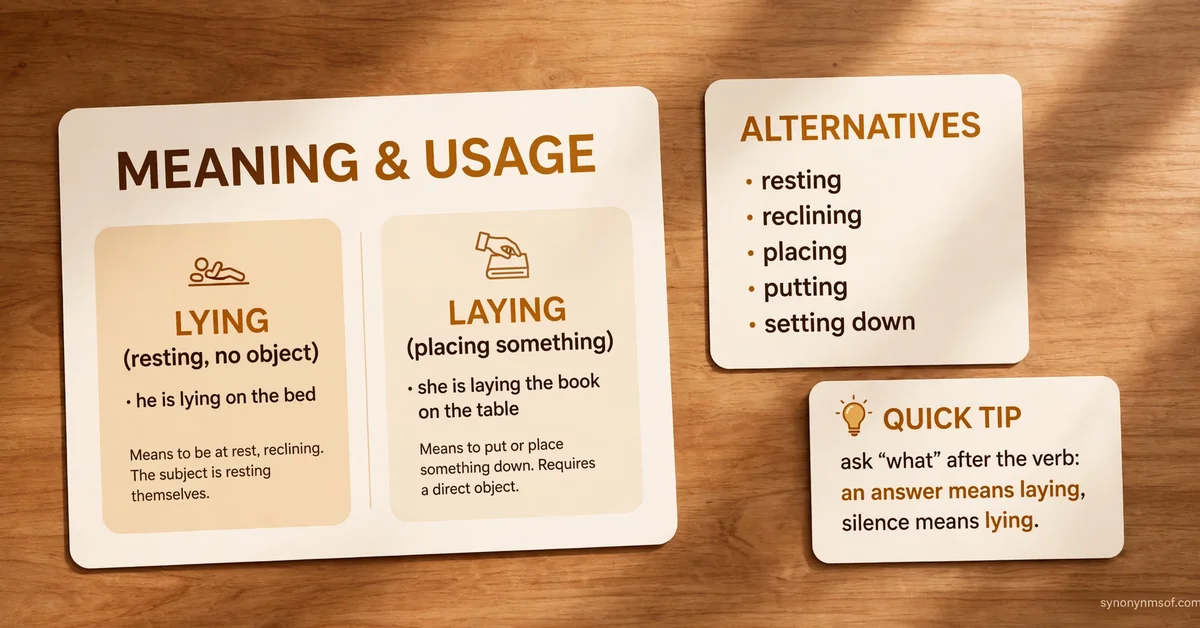
“Lying” is the present participle of “lie,” the verb that means to recline or rest. It describes someone or something in a horizontal position, and it never takes a direct object. “Laying” is the present participle of “lay,” the verb that means to put or place something down. It always takes a direct object, because there is always something being placed. Keep those two definitions side by side, and the pair starts to make sense at last.
This guide covers lying or laying in full detail. You will learn exactly what each word means, the grammar behind each one, a simple test that picks the right word every time, and the reasons this pair confuses so many people. You will also get plenty of example sentences, a tour of the most common mistakes, memory tricks that actually work, and answers to the questions people ask most often.

What Does “Lying” Mean?
“Lying” is the present participle of the verb “lie,” and it carries two meanings. The one that matters for this comparison is the reclining sense: to rest in a horizontal position. “She is lying on the sofa” means she is stretched out resting. “The papers are lying on the desk” means the papers are sitting there undisturbed. The other meaning of “lying” is telling a falsehood, as in “he is lying about his age.” Both meanings share the same spelling and the same grammar.
The grammar of “lying” is straightforward: it is intransitive. The subject is simply in a state or position, and no object receives the action. “The dog is lying under the table” is complete. There is nothing being placed, nothing being moved, nothing being acted upon. This absence of an object is the defining feature of “lying,” and it is what separates it from “laying.”
The Forms Behind “Lying”
“Lying” comes from the irregular verb “lie,” whose principal parts are lie, lying, lay, lain. The simple past “lay” is the troublemaker of the whole family, because it is spelled exactly like the present tense of the other verb. “Yesterday, I lay on the grass” uses the past of “lie”: I reclined, and nothing was placed. The past participle “lain” pairs with helping verbs: “She has lain awake for hours.” Knowing these forms keeps you from drifting into “laid” or “laying” territory when you mean rest.
What Does “Laying” Mean?
“Laying” is the present participle of the verb “lay,” which means to put or place something somewhere. “She is laying the baby in the crib” describes placing a child down gently. “They are laying new carpet” describes installing flooring. “The hen is laying an egg” uses an older sense of producing something. In every case, there is a direct object receiving the action: the baby, the carpet, the egg.
The grammar of “laying” is the mirror image of “lying”: it is transitive. A sentence built on “laying” is incomplete without its object. “He is laying” begs the question “laying what?” The answer completes the thought: “He is laying the bricks.” If your sentence cannot answer that question, “laying” is the wrong word, and “lying” is almost certainly what you want.
The Forms Behind “Laying”
“Laying” comes from the verb “lay,” whose principal parts are lay, laying, laid, laid. The past and past participle are identical, which makes this verb simpler than it looks: “Yesterday, she laid the table” and “She has laid the table many times.” Every form of “lay” keeps the direct object. The object is not optional decoration; it is the reason the verb exists. “Lay” without an object is like “give” without a gift.
Lying or Laying: The Key Difference
Here is the whole distinction in one rule: if there is a direct object, something is being placed, and you want “laying.” If there is no direct object, someone or something is simply resting, and you want “lying.” “The cat is lying on the rug” has no object, so “lying” is correct. “She is laying a blanket on the rug” has an object, the blanket, so “laying” is correct.
The comparison table below puts the two words side by side so you can see how every feature lines up.
| Feature | Lying | Laying |
|---|---|---|
| Comes from | “Lie” (to recline) | “Lay” (to place) |
| Meaning | Resting horizontally | Putting something down |
| Transitive or intransitive | Intransitive (no object) | Transitive (needs an object) |
| Simple past | lay | laid |
| Past participle | lain | laid |
| Correct example | He is lying on the bed. | She is laying the book on the bed. |
| Common error | “He is laying on the bed.” | “She is lying the book on the bed.” |
The most dangerous row in that table is the simple past. The past of “lie” is “lay,” and the present of “lay” is also “lay.” So “he lay on the bed” can be correct, the past of resting, while “he lay the book on the bed” is also correct, the present of placing. Context and the presence of an object tell you which one you are looking at. The rule never breaks; only the spelling overlaps.
Why This Pair Confuses Everyone
Three forces team up to make lying or laying one of the hardest distinctions in English. The first is sound: the two words rhyme, and in fast speech they are nearly identical. The second is meaning: both relate to horizontal positions, so the concepts bleed together in the mind. The third is the past tense overlap, where “lay” does double duty. Any one of these would be manageable; together, they form a perfect storm.
Everyday speech makes it worse. In casual conversation, “laying” has been spreading into “lying” territory for generations. “I was laying on the couch” is something millions of native speakers say without a second thought. Dictionaries note the informal use, but editors, teachers, and style guides still mark it wrong. The result is a split: what sounds natural at the dinner table looks wrong on the page. Writers who trust their ear get burned.
There is also the falsehood sense of “lie” lurking in the background. When someone hears “he is lying,” the first interpretation is often deception, not rest. That momentary ambiguity makes writers reach for “laying” as a way to dodge the double meaning. It does not work, because “laying” has its own fixed meaning, but the impulse explains why the error keeps appearing in otherwise careful writing.
The Object Test: Your Fastest Tool
The object test resolves nearly every lying or laying sentence in seconds. After the verb, ask “what?” If you get an answer, use “laying.” “She is laying what? The tiles.” Correct. If you get no answer, use “lying.” “He is lying what?” makes no sense, so “He is lying on the floor” is correct. The test works because it mirrors the grammar: transitive verbs take objects, intransitive verbs do not.
Try it on the classic problem sentences. “The dog was laying on the porch.” Ask “laying what?” Nothing is being placed, so the sentence wants “lying”: “The dog was lying on the porch.” “The workers were lying bricks.” Ask “lying what?” Bricks are being placed, so the sentence wants “laying”: “The workers were laying bricks.” Two questions, two fixes, no memorization required.
The test also handles the tricky past tense. “Yesterday, she lay on the hammock.” Ask “lay what?” There is no object, so this “lay” is the past of “lie,” and the sentence is correct. “Yesterday, she laid the picnic blanket on the grass.” Ask “laid what?” The blanket, so this is the past of “lay,” and the sentence is correct. Same spelling family, different grammar, and the object question sorts them out every time.
Example Sentences: Lying
- He is lying on the couch, fast asleep.
- She was lying in the sun all afternoon.
- The baby is lying in her crib.
- They were lying side by side on the blanket.
- I have been lying awake since four in the morning.
- The letter had been lying on the mat for days.
- She lay down and was lying there when I arrived.
- The town is lying in a wide, green valley.
- Do not wake him; he is lying down with a migraine.
- The keys were lying right where she left them.
- He spent the whole flight lying back with his eyes closed.
- After the race, she lay on the grass, catching her breath.
Example Sentences: Laying
- She is laying the table for six guests.
- He is laying tiles in the bathroom.
- The workers were laying fresh asphalt on the road.
- She laid the baby gently in the crib.
- They have been laying the groundwork for months.
- He is laying his cards on the table.
- The farmer watched the hen laying eggs.
- She laid her coat across the back of the chair.
- We are laying plans for a weekend trip.
- He laid the foundation stone in the spring.
- They were laying wreaths at the memorial.
- She is laying out the fabric before cutting it.
Common Mistakes to Avoid
Mistake one is the big one: “laying” for resting. “He was laying on the bed,” “the cat is laying in the sun,” and “we were laying by the pool” all need “lying.” This is the error that informal speech normalizes, so it feels right even when it is wrong. In writing, run the object test on every “laying” you type. If nothing is being placed, change it to “lying.”
Mistake two is the mirror image: “lying” for placing. “She is lying the plates on the shelf” and “he was lying the bricks” both need “laying,” because plates and bricks are objects being placed. This error is less common, but it shows up when writers overcorrect after learning the first rule. Both directions matter; the test works both ways.
Mistake three is mixing up the past forms. “I laid on the bed” is wrong when nothing was placed; the sentence needs “lay,” the past of “lie.” “I lay the tiles yesterday” is correct, because tiles were placed and this “lay” is the present of “lay,” though many writers second-guess it into “laid” when they mean the present moment. Keep the principal parts straight: lie, lying, lay, lain for rest; lay, laying, laid, laid for place.
Mistake four is forgetting that “lie” also means to deceive. “He is lying” can mean he is resting or he is fibbing, and only context decides. Writers sometimes avoid “lying” entirely to dodge the ambiguity, reaching for “laying” or rephrasing awkwardly. The better fix is to trust context: “He is lying on the sofa” is never read as deception, and “He is lying to his boss” is never read as rest.
Memory Tricks That Work
The best memory aid for this pair is the “place” test. “Lay” and “place” both start with sounds that pair naturally, and “lay” always involves placing something. If you can replace the verb with “place” and the sentence still works, use a form of “lay”: “She is placing the book on the shelf” works, so “She is laying the book on the shelf” is correct. If the replacement fails, use “lie”: “He is placing on the bed” is nonsense, so “He is lying on the bed” is correct.
Another aid is the sentence frame: “I lay myself down, so I am lying down.” Saying it out loud reminds you that the resting verb needs no object, you are not placing anything, and the present participle is “lying.” For the other side: “I lay the book down, so I am laying it down.” The object, the book, stays visible in every form, reminding you that “laying” never travels alone.
A third trick targets the past tense overlap. Write the two sentences side by side: “Yesterday I lay on the beach” and “Yesterday I laid my towel on the beach.” The first has no object, so “lay” is the past of “lie.” The second has an object, so “laid” is the past of “lay.” Seeing them together makes the pattern visible in a way that rules alone sometimes do not.
A fourth trick uses the helping verbs. Whenever you see “has,” “have,” or “had,” you know a past participle follows, and the choice narrows to “lain” or “laid.” If the meaning is rest, pick “lain”: “She has lain in bed all day.” If the meaning is place, pick “laid”: “She has laid the table.” Because “lain” looks unusual, it acts as a flag: its very strangeness reminds you that you are in resting-verb territory, where “lying” is the present participle and “lay” is the simple past.
Practice: Test Yourself
The fastest way to lock in this distinction is to practice it. Read each sentence below, choose “lying” or “laying,” and check your answer against the short explanation that follows.
1. The baby is ___ in the crib. Answer: lying. Nothing is being placed; the baby is resting, so the intransitive verb is correct.
2. She is ___ the baby in the crib. Answer: laying. The baby is the direct object being placed, so the transitive verb is correct.
3. Yesterday, he ___ on the beach all afternoon. Answer: lay. This is the simple past of “lie,” the resting verb, and there is no object.
4. Yesterday, she ___ her towel on the beach. Answer: laid. The towel is the object being placed, and “laid” is the past of “lay.”
5. The workers have been ___ bricks since morning. Answer: laying. Bricks are the object being placed, so the transitive participle is correct.
6. I have been ___ awake since dawn. Answer: lying. No object is involved; the subject is simply in a state of rest.
7. They were ___ the foundation for the new wing. Answer: laying. The foundation is the object being placed, so “laying” is correct.
8. She ___ down for a nap an hour ago. Answer: lay. This is the past tense of the resting verb “lie,” with no object.
9. He is ___ his jacket across the chair. Answer: laying. The jacket is the object being placed.
10. The documents had been ___ on the desk for a week. Answer: lying. The documents are at rest; nothing is being placed in this sentence.
If you scored eight or better, the distinction is sticking. If you missed several, run the object test on each miss and say the corrected sentence aloud. The pattern becomes automatic faster than you might expect.
Frequently Asked Questions
Is it “lying on the bed” or “laying on the bed”?
“Lying on the bed” is correct. The sentence describes someone resting, and nothing is being placed, so you need “lying,” the present participle of “lie.” “Laying on the bed” would require an object being put down, as in “She is laying the blanket on the bed.”
What is the difference between lying and laying?
“Lying” means resting in a horizontal position, or telling a falsehood, and it never takes a direct object: “He is lying on the couch.” “Laying” means putting or placing something down, and it always takes a direct object: “She is laying the tiles.” Ask “what?” after the verb: if you get an answer, use “laying.”
Why do people say “laying” when they mean “lying”?
Informal speech has blurred the two for generations, so “I was laying on the couch” sounds natural to many native speakers even though it is nonstandard. The words also rhyme, share meanings around horizontal positions, and overlap in the past tense spelling “lay.” In careful writing, the distinction still holds: no object means “lying.”
What are the past tenses of lie and lay?
The past tense of “lie” (recline) is “lay”: “Yesterday, he lay on the grass.” Its past participle is “lain”: “He has lain there for an hour.” The past tense of “lay” (place) is “laid,” and its past participle is also “laid”: “She laid the book down” and “She has laid the book down.” Only the resting verb uses “lay” and “lain.”
Can “lying” also mean telling a falsehood?
Yes. “Lying” is also the present participle of the other verb “lie,” which means to tell an untruth: “He is lying about his age.” This is a fully regular verb with the forms lie, lying, lied, lied. Context tells you whether “lying” means resting or deceiving in any given sentence.
Conclusion
Lying or laying is the trickiest corner of an already tricky verb family, but the way out is simple: ask whether something is being placed. An object being put down means “laying,” with its steady forms lay, laying, laid, laid. No object, just rest, means “lying,” from the irregular lie, lying, lay, lain. That single question cuts through the rhymes, the overlapping spellings, and the stubborn habits of casual speech.
Do not trust your ear alone on this pair, because informal speech has spent generations blurring it. Trust the object test instead, and run it on every “laying” you write. With that habit in place, you will choose correctly every time, and one of the most common errors in English will stop appearing in your writing for good. Your readers will notice the difference, even if they cannot name the rule.
Explore more on Synonynmsof.