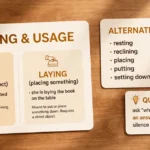


English has few traps as persistent as the choice between “lays” and “lies.” The two words look nearly identical, sound nearly identical, and both are common third-person singular verbs — yet they belong to two completely different verbs, lay and lie, and mixing them up is one of the most noticed mistakes in the language. Even confident native speakers hesitate before sentences like “the cat lays on the rug.” If you have ever typed one, deleted it, and typed the other while feeling no more certain, you are in very good company.
The confusion has one root cause: the past tense of lie (to recline) is lay, which is spelled exactly like the base form of lay (to place something down). Two different verbs share a form, and your brain has to do real grammatical work to keep them apart. Add the third-person forms “lays” and “lies” — which both appear constantly in everyday sentences — and it is no wonder people get tangled. The underlying rule is short and logical, and once learned, it settles the question in a second.
In this guide, you will learn exactly what “lays” means, exactly what “lies” means, and the one rule that separates them: whether the verb needs an object. You will see full conjugation charts for lay, lie (to recline), and the unrelated lie (to tell falsehoods), a comparison table, dozens of example sentences across conversation and writing, the most common mistakes and how to fix them, and answers to the questions learners ask most. By the end, choosing between lays and lies will feel as automatic as it should.

What “Lays” Means
“Lays” is the third-person singular present form of the verb lay, which means to place or put something down — to cause an object to rest in a position. “Lays” is always transitive, which means it requires a direct object: something or someone that is being placed. The hen lays an egg each morning. The delivery driver lays the package by the door. In each of these sentences, there is a thing being put somewhere — the egg, the package — and without that object the sentence would be broken. If you can ask “lays what?” and get an answer, “lays” is doing its job correctly.
Think of “lays” as the doing-to-something form. The subject performs the action of placing, and a separate object receives it: a mason lays bricks, a bird lays eggs, a strategist lays plans. This pattern holds across every tense and every use of the verb. Its principal parts are lay, laid, have laid, laying — “yesterday she laid the blanket on the bed,” “they have laid the foundation,” “he is laying the tiles now.” Because “lays” carries that object with it, it is the word you reach for whenever something is being put, set, or placed by someone.
What “Lies” Means
“Lies” is the third-person singular present form of the verb lie in its reclining sense: to be in, or to get into, a horizontal or resting position. Unlike “lays,” “lie” is intransitive — the subject is not acting on any object, it is simply resting or stretching out on its own. The cat lies on the rug. The village lies in the valley. In each case, the subject is doing the resting itself, and there is no object to point to. “Lies what?” is not a question you can ask here, because nothing is being placed by anyone.
The reclining verb lie has some of the most irregular principal parts in English: lie, lay, have lain, lying. So “the dog lies by the fire” becomes “the dog lay by the fire yesterday” and “the dog has lain there all afternoon.” Notice what happens: the past tense of lie is lay, the exact spelling of the other verb’s base form. This single overlap is responsible for most lay/lie confusion in English. When you see “lay” describing a past rest — “he lay down for a nap” — it is the past of lie, not the present of lay, and it takes no object.
“Lies” has one more meaning to keep on a separate shelf: the verb lie meaning to tell an untruth. “He lies about his age” uses an entirely different verb with its own regular conjugation: lie, lied, have lied, lying — “she lied to the committee,” “they have lied before.” Because it is regular, it never collides with lay/lie forms, and context almost always makes the meaning obvious.
The Key Difference Between “Lays” and “Lies”
The whole difference between “lays” and “lies” is transitivity — whether the verb takes a direct object. “Lays” needs one: the subject is placing something, so there must be something being placed. “Lies” takes none: the subject is resting on its own, so there is nothing to receive the action. Reduce every decision to the object test. If the sentence has something being put down — the book, the egg, the foundation, the groundwork — you want “lays” (or lay/laid/laying). If the subject is simply stretched out, resting, or situated somewhere on its own — the cat, the papers, the town — you want “lies” (or lie/lay/lain).
Try it on real sentences. “She lays the baby in the crib” — what is being placed? The baby. Transitive, so “lays” is correct. “She lies on the couch after work” — what is being placed? Nothing; she is the one resting. Intransitive, so “lies” is correct. “He lays the map flat on the table” — he is placing the map; now there is an object, and “lays” wins. Same scene, two different wordings, and the object test decides between them every time without fail.
One more way to think about it: “lays” always implies an outside force moving something else, while “lies” describes a state of rest belonging to the subject itself. A hen lays eggs because eggs are produced and placed; a cat lies on the sofa because it reclines there itself. If you remember that “lays” is about doing to something and “lies” is about being somewhere, you will resolve almost every case correctly on the first try.
“Lays” vs “Lies” at a Glance: Comparison Table
| Feature | “Lays” | “Lies” (to recline) |
|---|---|---|
| Base verb | Lay (to place down) | Lie (to recline or rest) |
| Transitivity | Transitive — needs a direct object | Intransitive — never takes an object |
| Object test | “Lays what?” has an answer | “Lies what?” is unanswerable |
| Past tense | Laid (“she laid the tray down”) | Lay (“she lay down for a rest”) |
| Past participle | Laid (“they have laid the carpet”) | Lain (“the dust has lain there for years”) |
| Present participle | Laying (“he is laying bricks”) | Lying (“the cat is lying in the sun”) |
| Typical examples | The hen lays eggs; he lays the book down | The cat lies asleep; the valley lies to the north |
| Memory hook | Lay → place (both have “la”) | Lie → recline (both have “li”) |
The Full Conjugation Chart: Lay, Lie (Recline), and Lie (Deceive)
The reason lay and lie stay confusing is that their principal parts overlap. Lay out all three verbs side by side and the pattern becomes visible. The placing verb lay goes: lay, lays, laid, have laid, laying — “I lay the towel on the chair,” “she laid the towel yesterday,” “they have laid the towel out,” “we are laying the towels now.” It is regular in the -ed tenses, and it always carries an object. Learn this row and it never changes.
The reclining verb lie goes: lie, lies, lay, have lain, lying — “I lie awake at night,” “the patient lies still,” “the patient lay still for an hour,” “the patient has lain there since morning,” “the patient is lying down now.” The trap is in the middle: the past tense of lie is lay, identical in spelling to the base form of the placing verb. When you encounter “lay” describing a completed rest — “the book lay on the shelf all winter,” “yesterday we lay on the grass” — read it as the past of lie and expect no object.
For completeness, the falsehood verb lie goes: lie, lies, lied, have lied, lying — “he lies constantly,” “she lied to the committee,” “they have lied before.” It is perfectly regular, which makes it the least confusing of the three despite sharing the present forms. In practice, context does the sorting: “the witness lies” in a courtroom report is about untruths, while “the folder lies on the desk” is about resting position. Keep the three rows separate in your head and the system is fully predictable.
Using “Lays” and “Lies” in Everyday Conversation
Daily speech is where lays and lies collide most often, especially with pets and household objects. “The dog lies by the door all evening” is correct because the dog is resting on its own. “She lays the remote on the armrest” is correct because she is placing an object. People often say “the cat lays in the sun” — and most listeners will not stop them — but “the cat lies in the sun” is the grammatical form, since the cat is reclining rather than placing anything. In casual conversation the slip barely registers, but knowing the right form gives you the option of being precise.
Morning routines are a rich source of examples. “He lies in bed for ten more minutes” — no object, just resting, so “lies” is right. “She lays out her clothes the night before” — she is placing the clothes, so “lays” is right. “The newspaper lies on the porch” — resting on its own, “lies.” Saying these pairs out loud a few times builds the instinct faster than any chart, because your ear starts expecting the object whenever “lays” appears and expects rest whenever “lies” appears.
Informal speech also tolerates a gray zone: many native speakers say “lay down” when they mean “lie down,” especially in the imperative — “go lay down” instead of “go lie down.” Strictly, the correct form is “go lie down,” since the person is reclining themselves with no object. The “lay down” version is widespread in casual American speech, but in writing, tests, or professional contexts, “lie down” is the expected form.
Using “Lays” and “Lies” at Work and in Writing
Professional writing exposes lay/lie mistakes because reports and emails get read carefully and kept on file. “The responsibility lies with the finance team” is correct — responsibility rests somewhere, no object, so “lies.” “She lays out the quarterly figures in the appendix” — she is placing the figures, an object, so “lays.” “The contract lies unsigned on his desk” describes a state of rest; “he lays the contract on the desk for signature” describes an act of placing. This distinction appears constantly with abstract subjects — blame lies, blame is laid; foundations are laid, the truth lies somewhere.
Resumes, cover letters, and client communication deserve extra care because errors in small words undermine confidence in the big ones. “I lay the groundwork for the new onboarding program” (past tense of lay, transitive) is a strong sentence; “the groundwork lay unfinished for months” (past of lie, intransitive) is also correct. Mixing them — “the groundwork laid unfinished for months” — is a classic error: “laid” always needs an object, so it cannot stand alone here. In any sentence without an object, “lay” or “lain” (past) and “lies” (present) are your only options.
Common Mistakes to Avoid
Mistake 1: Writing “lays” for a person or animal that is resting. The most frequent error of all is sentences like “the baby lays on the blanket” or “he lays in bed until noon.” A person resting on a bed is not placing anything, so “lays” cannot work: the correct forms are “the baby lies on the blanket” and “he lies in bed until noon.” The fix is the object test. Ask “lays what?” — if there is no answer, the sentence needs “lie” or “lies.” Only if something is genuinely being placed — “she lays the baby on the blanket” — does “lays” belong.
Mistake 2: Using “laid” without an object. Because “laid” sounds finished and authoritative, writers insert it where “lay” or “lain” belongs: “the papers laid scattered on the floor all week.” But “laid” is the past of the transitive lay, so it must have an object — “she laid the papers on the floor.” When nothing is being placed, the intransitive forms do the work: “the papers lay scattered on the floor all week” (past) or “the papers have lain there all week” (past participle). If your “laid” has no object, swap it for “lay” or “lain” depending on tense.
Mistake 3: Confusing “lying” with “laying.” The -ing forms trip people up because they sound similar. “Laying” belongs to the placing verb: “she is laying the tiles,” “the hen is laying eggs,” “workers are laying cables.” “Lying” belongs to the reclining verb: “the cat is lying in the sun,” “he is lying awake,” “the tools are lying on the bench.” The spelling gives you a hint: “lying” drops the e from “lie” and doubles nothing, while “laying” keeps the y of “lay.” Match the -ing form to the base verb — placing is laying, resting is lying — and they sort themselves out.
Mistake 4: Treating “lie” (to deceive) as irregular. Because the reclining lie is irregular (lie, lay, lain), some writers carry that irregularity over to the falsehood lie and write things like “he has lain about his past.” The deceiving verb is regular: “he lied about his past,” “she has lied before,” “they were lying to the auditors.” The past and past participle are both “lied,” never “lay” or “lain.” Keeping the two lie-verbs on separate shelves — recline is irregular, deceive is regular — prevents one of the rarer but more embarrassing mix-ups.
Tricky Cases and Edge Cases
Why the Past Tense Is the Real Trap
Present-tense “lays” and “lies” are actually the easy part; the pain lives in the past. “Yesterday the keys lay on the counter” uses “lay” as the past of lie (the keys were resting there), while “yesterday she laid the keys on the counter” uses “laid” as the past of lay (she placed them). Same keys, same counter, different verbs — and the only thing that decides is whether someone placed them or they were simply resting. When you write about the past, run the object test before choosing: object present means “laid,” no object means “lay” or “lain.”
Idioms and Fixed Phrases
Fixed expressions freeze one verb or the other, and they are worth learning as chunks. “Lay the groundwork,” “lay the blame,” “lay down the law,” “lay off workers,” “lay out a plan” — all use lay because they describe placing or imposing something. “Let sleeping dogs lie,” “lie low,” “lie in wait” — all use lie because they describe rest or position. Notice that “lie low” means stay quiet and hidden, not “lay low.” Learning the common idioms as whole phrases spares you from re-deriving the rule every time.
Frequently Asked Questions
Is it “he lays down” or “he lies down”?
It is “he lies down.” The person is reclining himself, and no object is being placed, so the intransitive verb lie is required — third-person singular present “lies,” past “lay,” past participle “lain.” “He lies down for a nap” is correct in the present; “he lay down for a nap” is correct for the past. “He lays down” is only correct with an object, as in “he lays down his tools at the end of the day.”
Is “she lays the book on the table” correct?
Yes, it is perfectly correct. “Lays” is the transitive placing verb, and here it has a clear direct object — the book — which is being placed on the table. The object test passes: “lays what?” Answer: the book. Any time the structure is “subject + lays + object + place,” the sentence is sound: “the mason lays bricks,” “the designer lays out the page,” “the committee lays down the rules.”
What is the past tense of “lie” (to recline)?
The past tense of lie (to recline) is lay, and its past participle is lain. So: “I lie awake” becomes “I lay awake last night” and “I have lain awake all week.” This is the single most confusing fact in the lay/lie system, because the past tense of lie is spelled exactly like the base form of the placing verb lay. The way to keep them apart is the object test: “he lay on the sofa” has no object, so it is the past of lie; “he laid the remote on the sofa” has an object, so it is the past of lay. With practice, the absence or presence of an object reads instantly.
What is the past tense of “lay” (to place)?
The past tense and past participle of lay (to place) are both laid: “she laid the baby in the crib,” “they have laid the tiles.” This verb is regular in its -ed forms and — crucially — always takes a direct object. You cannot “laid” without placing something: “the tools laid on the bench” is wrong and should be “the tools lay on the bench” (past of lie) or “the tools have lain on the bench.” Whenever you reach for “laid,” check that an object is present; if one is, “laid” is exactly right.
Does “lies” also mean telling falsehoods?
Yes — but that is a separate, unrelated verb. The falsehood verb lie means to say something untrue, and it conjugates regularly: lie, lies, lied, have lied, lying. “He lies about his qualifications” is correct, and its past is “he lied,” never “he lay” or “he lain.” In most contexts the meaning is obvious — “the suspect lies to the police” is about untruths, while “the documents lie on the desk” is about resting. Keep this verb on its own shelf so its regular past tense “lied” does not get tangled with the irregular “lay/lain” of the reclining verb.
Conclusion
The lays-or-lies decision is really one decision repeated: is something being placed, or is something simply resting? If there is an object being put down — the book, the eggs, the foundation, the plans — the verb is lay, and its third-person form is “lays.” If the subject is resting on its own with nothing to receive the action — the cat, the letter, the town — the verb is lie, and its third-person form is “lies.” The object test, “lays what?”, settles it every time.
Run that test for a week and the habit becomes reflex. You will catch yourself mid-sentence, ask whether an object is present, and land on the right form without a charge. Few grammatical habits pay off as visibly as this one: getting lay and lie right signals a careful command of English, and it removes one of the most common corrections editors make. Lays places, lies rests — hold onto that, and the rest follows.
Explore more on Synonynmsof.