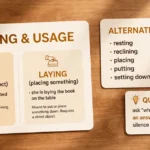


Few pairs of English words cause as much trouble as lie and lay. They sound alike, their meanings overlap around the idea of a horizontal position, and to make matters worse, the past tense of “lie” is “lay,” which is identical to the present tense of “lay.” It is one of the most tested and most missed distinctions in the language, and even careful writers stumble over it.
The core difference is grammatical. “Lie” means to recline or rest in a horizontal position, and it is intransitive, which means it never takes a direct object. You lie down; you do not lie anything down. “Lay” means to put or place something somewhere, and it is transitive, which means it always takes a direct object. You lay the book on the table; you do not simply lay. Once you grasp that single distinction, most of the confusion falls away.
This guide explains lie or lay from the ground up. You will learn the exact meaning of each verb, how they conjugate in every tense, the simple test that tells you which one to use, and the traps that catch even experienced writers. Dozens of example sentences, common mistakes, a quick decision trick you can use mid-sentence, and answers to the most frequent questions round out the guide, so you can finally use these two verbs with complete confidence.

What Does “Lie” Mean?
“Lie” is an intransitive verb with two separate meanings. The one at the center of the lie or lay confusion is the reclining sense: to rest in a horizontal position or to move into one. “I lie on the couch every afternoon” describes a habit of resting. “She lay down for a nap” describes moving into a resting position in the past. The second meaning of “lie” is to tell a falsehood, as in “he lied about his age.” That meaning is fully regular and causes no confusion with “lay,” so this article focuses on the reclining sense.
Because “lie” is intransitive, it never takes a direct object. The subject performs the action on itself, so to speak: the person rests, the animal sleeps, the object sits at rest. “The dog lies by the fire” is complete; nothing receives the action. This is the test you will return to again and again. If your sentence has something being placed or put down, “lie” is the wrong verb.
How “Lie” Conjugates
The reclining “lie” is irregular, and its forms are worth memorizing because they overlap with “lay” in exactly the wrong places. The principal parts are: lie (present), lying (present participle), lay (simple past), lain (past participle). In sentences: “Today I lie down,” “Yesterday I lay down,” “In the past I have lain down.” The past participle “lain” always appears with a helping verb such as “has,” “have,” or “had”: “She has lain in bed all morning.”
Notice that “lain” is rare in everyday speech, which is part of why people avoid it and reach for the wrong form instead. Many speakers say “I have laid down” when they mean “I have lain down,” usually because “lain” sounds formal or unfamiliar. In writing, though, “lain” is correct, and using it marks you as someone who has the pair under control. A little practice makes it feel natural.
What Does “Lay” Mean?
“Lay” is a transitive verb meaning to put or place something somewhere, usually in a careful or deliberate way. “Lay the newspaper on the table” is a direct instruction to place an object. “The hen lays an egg every morning” describes producing something, another transitive use. “They laid the foundation for the new building” uses the verb figuratively, but the structure is the same: an object receives the action.
Because “lay” is transitive, it must have a direct object to complete its meaning. “She lays” is not a complete thought; “she lays the baby in the crib” is. The object answers the question “what?” after the verb: she lays what? The baby. He laid what? His tools. They are laying what? The carpet. If you cannot answer that question, “lay” is the wrong verb for the sentence.
How “Lay” Conjugates
The verb “lay” is regular in sound but irregular in spelling, with the principal parts: lay (present), laying (present participle), laid (simple past), laid (past participle). In sentences: “Today I lay the book on the desk,” “Yesterday I laid the book on the desk,” “In the past I have laid the book on the desk.” The past and the past participle are identical, which actually makes “lay” easier than “lie” once you know which verb you are dealing with.
The danger zone is the present tense “lay” sitting next to the past tense “lay” of the other verb. “I lay the book down” is present tense of “lay,” meaning I place the book. “I lay down” is past tense of “lie,” meaning I reclined. The words look the same, but the grammar behind them is different. Keeping the transitive test in mind, that “lay” needs an object, tells you which one you are reading: if an object follows, it is the verb “lay”; if not, it is the past tense of “lie.”
Lie or Lay: The Key Difference
Everything about this pair reduces to one question: is there a direct object? If the answer is yes, something is being placed, and you want “lay.” If the answer is no, someone or something is simply resting, and you want “lie.” “He lies on the bed” has no object, so “lie” is correct. “He lays the blanket on the bed” has an object, the blanket, so “lay” is correct.
The table below lays out the full comparison, including every principal part, so you can see the overlap clearly.
| Feature | Lie (recline) | Lay (place) |
|---|---|---|
| Meaning | To rest horizontally | To put or place something |
| Transitive or intransitive | Intransitive (no object) | Transitive (needs an object) |
| Present | lie, lies | lay, lays |
| Present participle | lying | laying |
| Simple past | lay | laid |
| Past participle | lain | laid |
| Example | I lie on the sofa. | I lay the book on the desk. |
Look at the row for the simple past of “lie”: it is “lay,” the exact spelling of the present tense of “lay.” This is the single biggest trap in the pair, and it is why the distinction has a reputation for difficulty. But the test still works. “Yesterday, he lay on the beach” has no object, so that “lay” is the past tense of “lie.” “Yesterday, he laid his towel on the beach” has an object, the towel, so that is the past tense of “lay.”
Usage Rules for Lie and Lay
Rule one: use “lie” when the subject is resting and nothing is being placed. “I need to lie down” is the correct plea of an exhausted person. “The papers lie scattered on the floor” describes papers at rest. “She lies awake at night” describes someone unable to sleep. In each case, no object receives the action, and “lie” in one of its forms is the right choice.
Rule two: use “lay” when the subject is placing an object. “Please lay your coat on the chair” asks someone to put something down. “He laid the baby in the crib” describes the past action of placing. “They were laying new tiles in the kitchen” describes an ongoing placing action. In each case, there is a direct object, and removing it would leave the sentence broken.
Rule three: form the present participle from the present tense, never from the past tense. “Lying” comes from “lie,” and “laying” comes from “lay.” A surprising number of errors come from mixing these up, as in “he was laying on the bed,” which pairs the placing verb with a sentence that has no object. The writer means “lying,” the participle of the resting verb. Keeping the object test in front of you prevents this one automatically.
Rule four: with helping verbs like “has,” “have,” and “had,” use the past participle. “She has lain in bed all day” is correct for resting. “She has laid the table for dinner” is correct for placing. “Lain” follows the helpers for “lie”; “laid” follows them for “lay.” If “lain” feels stiff in conversation, you can rephrase: “She has been lying in bed all day” says the same thing with a form people use more often.
Example Sentences: Lie
- I lie down for twenty minutes every afternoon.
- She lies on the hammock reading novels all summer.
- The cat is lying in the warmest spot by the window.
- Yesterday, he lay on the couch until dinner.
- They have lain on the beach since morning.
- Do not lie down right after eating a heavy meal.
- The valley lies between two mountain ranges.
- She was lying awake, thinking about the interview.
- He lay still while the doctor examined him.
- The responsibility lies with the manager.
- We lay in the grass and watched the stars.
- She has been lying low since the argument.
Example Sentences: Lay
- Please lay your bag on the bench.
- She lays the table with fresh flowers every Sunday.
- He is laying bricks for the new patio.
- Yesterday, they laid the carpet in the living room.
- She has laid out her clothes for tomorrow.
- The workers were laying cables under the street.
- Lay the baby gently in the crib.
- He laid his hand on her shoulder.
- They have laid the groundwork for the project.
- She lays the newspaper flat before reading it.
- The chef laid the dish on the counter.
- We are laying plans for the summer trip.
Common Mistakes to Avoid
The classic mistake is “I am going to lay down” or “he was laying on the bed.” Both sentences describe resting with no object, so both need “lie” forms: “I am going to lie down” and “he was lying on the bed.” This error is so widespread that some dictionaries now note the informal use, but in careful writing and on any test, it is wrong. The object test catches it every time: what is being placed? Nothing. So it is “lie.”
The reverse mistake is rarer but still common: using “lie” where an object is being placed. “She lied the book on the table” mixes the falsehood verb into a placing sentence; the writer wants “laid.” “He was lying the tiles” wants “laying.” Whenever something is being put somewhere, “lay” or “laid” or “laying” is the answer, never a form of “lie.”
Past tense mix-ups complete the picture. “I laid on the bed yesterday” is wrong; “laid” is the past of the placing verb, and nothing was placed, so the sentence needs “lay,” the past of “lie”: “I lay on the bed yesterday.” Conversely, “I lay the book down” as a present-tense statement is correct, because it is the present of “lay,” but writers second-guess it into “I laid the book down” when they mean right now. Keeping the principal parts chart nearby until the forms feel automatic is the fastest fix.
A subtler issue is the phrase “lie low” versus “lay low.” The standard idiom is “lie low,” meaning to keep a low profile, and it follows the resting verb: “After the scandal, he lay low for a year.” “Lay low” appears in informal speech, but careful writers keep the “lie” form. It is a small detail, but getting it right signals that you truly understand the pair.
A Quick Decision Trick
If you need a shortcut in the middle of writing, use the substitution trick. Replace the verb with “place” or “put.” If the sentence still makes sense, you want “lay”: “Please place your bag on the bench” works, so “Please lay your bag on the bench” is correct. If the sentence stops making sense, you want “lie”: “I need to place down” is nonsense, so “I need to lie down” is correct.
Another shortcut is the object question. After the verb, ask “what?” or “whom?” If you get an answer, use a form of “lay”: “She laid what? Her keys.” If you get silence, use a form of “lie”: “He lay what?” makes no sense, so “He lay on the bed” uses the past of “lie.” Between these two tricks, you can resolve nearly every lie or lay sentence in a few seconds, even under exam pressure.
For the past tense trap specifically, try adding “yesterday” to the sentence. “Yesterday, I lie on the couch” is wrong, and the correction that sounds right is “Yesterday, I lay on the couch.” That “lay” with no object is the past of “lie.” Now try “Yesterday, I lay the book on the desk.” That sounds right too, but this time an object follows, so it is the present of “lay.” Same spelling, different grammar, and the object tells you which is which.
Lie and Lay in Idioms and Everyday Phrases
Idioms are where the lie or lay distinction quietly tests you, because the phrases are old and their grammar is frozen. “Lie low” means to keep a low profile, and it follows the resting verb: “After the controversy, the actor lay low for a year.” The past tense “lay” here is correct, even though it looks like the placing verb. Swapping in “laid” would break the idiom and the grammar at once.
“Lay down the law” goes the other way. It means to state rules firmly, and it uses the placing verb because an object, the law, is being set down: “The coach laid down the law about practice attendance.” Every form follows “lay”: “She lays down the law,” “He is laying down the law,” “They have laid down the law.” Because the object is always present, this idiom is a safe place to practice the transitive side of the pair.
“Let sleeping dogs lie” uses “lie” in the resting sense, and it is a good reminder that the verb needs no object. “Let the matter lie” works the same way: the matter is at rest, and nothing is being placed. Contrast that with “lay it on thick,” meaning to exaggerate, where “it” is the object being laid. “He laid it on thick during the interview” is correct because something, the flattery, is being applied.
These phrases are worth learning as whole units, but they also reward analysis. Each one confirms the core rule: no object means “lie,” an object means “lay.” When you can see the rule working inside an idiom, you have moved past memorization into genuine understanding, and the pair stops feeling like a trap.
Frequently Asked Questions
What is the difference between lie and lay?
“Lie” means to recline or rest, and it is intransitive, so it never takes a direct object: “I lie on the sofa.” “Lay” means to put or place something, and it is transitive, so it always takes a direct object: “I lay the book on the desk.” The object test is the fastest way to choose: if something is being placed, use “lay”; if not, use “lie.”
What is the past tense of lie?
The past tense of “lie” in the reclining sense is “lay”: “Yesterday, I lay on the couch.” The past participle is “lain”: “I have lain here too long.” Be careful not to confuse this “lay” with the present tense of the other verb “lay,” which means to place something: “Today, I lay the book on the desk.”
Is it correct to say “lay down” when you mean rest?
In the present tense, no. “I am going to lay down” is a common error; the correct form is “I am going to lie down,” because nothing is being placed. In the past tense, however, “I lay down” is correct, because “lay” is the simple past of “lie.” The same spelling serves two different grammatical roles.
What is the past tense of lay?
The past tense of “lay” is “laid,” and the past participle is also “laid”: “Yesterday, she laid the baby in the crib” and “She has laid the table for dinner.” Remember that “laid” always belongs to the placing verb and always implies an object that was put somewhere.
How can I remember lie vs lay easily?
Use the object test: ask “what?” after the verb. If you can answer, you want “lay,” as in “She laid what? The blanket.” If you cannot answer, you want “lie,” as in “He is lying on the bed.” The substitution trick also works: if “place” or “put” fits the sentence, use “lay”; if it does not, use “lie.”
Conclusion
Lie or lay comes down to a single question: is something being placed? If the answer is yes, reach for “lay” and its forms lay, laying, laid, laid. If the answer is no, reach for “lie” and its forms lie, lying, lay, lain. That one test resolves the present tense, the participles, and even the notorious overlap where the past of “lie” spells itself “lay.” Master it once, and the confusion never returns.
The pair is genuinely tricky, and mistakes with it are among the most common in English, which means mastering it pays off more than most grammar points. Editors, teachers, and hiring managers all notice lie and lay errors, so every sentence you get right quietly strengthens your credibility. Learn the principal parts, keep the object test handy, and give “lain” a little practice until it stops feeling strange. Do that, and you will write lie and lay correctly for the rest of your writing life.
Explore more on Synonynmsof.