
You have just finished writing a report, and your spell-checker underlines the word “labelled” in red. You delete an “l,” the underline disappears, and you move on. The next day, a British colleague reads the same document and quietly puts the “l” back. Who is right? This small tug-of-war over a single letter is one of the most common spelling questions
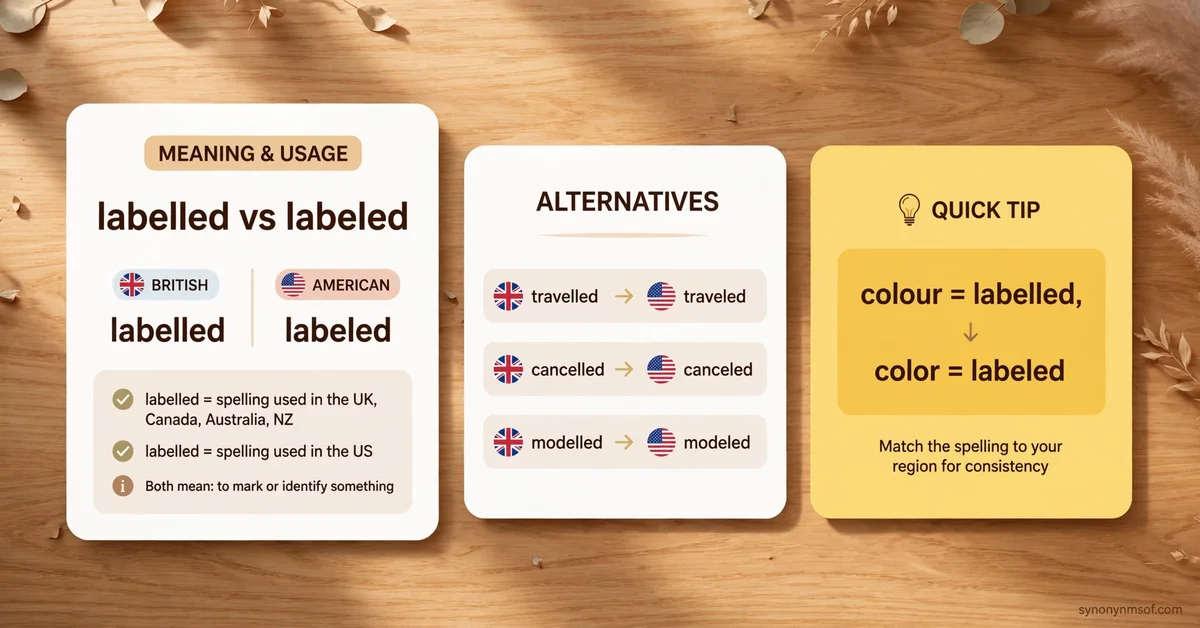
Specifically, “labelled” with a double “l” is the standard spelling in British English, while “labeled” with a single “l” is the standard spelling in American English. The meaning is identical: to attach a label to something, or to describe or categorize someone or something in a particular way. In this article, we will define each spelling, explain the rule behind the difference, compare them side by side, show how each is used in real sentences, and clear up the mistakes writers make most often.
Understanding this difference matters because it shows up constantly in professional writing. Product packaging, laboratory procedures, warehouse instructions, marketing copy, and academic papers all use the verb “label” in its past forms. Choosing the spelling that matches your audience, and using it consistently, signals care and professionalism. Mixing the two forms in one document, on the other hand, looks careless even though each form is correct on its own.
in English, and it has a refreshingly simple answer: both “labelled” and “labeled” are correct. They are the same word, the past tense of “label,” spelled differently in different parts of the world.
What Does “Labelled” Mean?
“Labelled” is the British English spelling of the past tense and past participle of the verb “to label.” To label something means to attach a small piece of paper, plastic, or other material to it that gives information about it, such as its name, contents, price, or instructions. In a figurative sense, to label someone means to describe or categorize them, often in a way that is limiting or unfair, as in “She was labelled a troublemaker after one incident.”
The spelling “labelled” doubles the final “l” before adding “-ed.” This follows the British convention for verbs ending in a vowel plus “l”: the consonant is doubled even though the stress falls on the first syllable. The same convention gives British English “travelled” from “travel,” “cancelled” from “cancel,” “modelled” from “model,” and “signalled” from “signal.” If you write “colour,” “favourite,” and “organise,” then “labelled” is the spelling that belongs in your documents.
“Labelled” is the standard form across the United Kingdom, Ireland, Australia, New Zealand, South Africa, and India, and it is widely used in Canada as well, particularly in formal, academic, and government writing. Major British dictionaries, including the Oxford English Dictionary, list “labelled” as the primary spelling. In these regions, the single-“l” form “labeled” looks American, and using it in a British school essay or a formal report would likely be marked as a spelling error by a teacher or editor.
What Does “Labeled” Mean?
“Labeled” is the American English spelling of the past tense and past participle of the verb “to label.” It carries exactly the same meaning as “labelled”: to attach a label to something, or to describe or categorize someone or something. A warehouse worker in Ohio who “labeled the boxes” did precisely the same thing as a warehouse worker in Manchester who “labelled the boxes.” The only difference is the spelling convention of the variety of English each one writes in.
In American English, the final “l” is not doubled when the stress falls on an earlier syllable. Because “label” is stressed on its first syllable, American spelling adds “-ed” directly to give “labeled.” The same principle produces “traveled,” “canceled,” “modeled,” and “signaled.” This simplification was championed in the early nineteenth century by the American lexicographer Noah Webster, who believed English spelling in the United States should be simpler and more consistent than the British system it had inherited.
American dictionaries, including Merriam-Webster, list “labeled” as the standard form, though they generally note “labelled” as an accepted variant. If you write “color,” “favorite,” and “organize,” then “labeled” is the spelling that matches your style. In the United States, the double-“l” form looks British, and in strictly American style guides, such as those used by many US publishers and news organizations, “labelled” would be changed to “labeled” during editing.
Key Differences Between “Labelled” and “Labeled”
Unlike the “potatoes” versus “potatos” question, where one form is simply wrong, “labelled” and “labeled” represent a genuine fork in the road. Both are correct, and the right choice depends entirely on your audience. The comparison below summarizes the distinction.
- Variety of English: “labelled” is British English; “labeled” is American English.
- Spelling pattern: “labelled” doubles the final “l” before “-ed”; “labeled” does not.
- Meaning: identical. Both mean that a label was attached or that a description was assigned.
- Pronunciation: identical. The extra “l” is silent, so the two forms sound exactly the same.
- Dictionary status: both appear in major dictionaries, each listed as standard within its own variety.
- Where used: “labelled” dominates in the UK, Ireland, Australia, New Zealand, South Africa, and India, and is common in Canadian formal writing; “labeled” dominates in the United States and in much international business writing.
The most important difference is not between the two spellings but between consistent and inconsistent use. A document that uses “labelled” throughout is perfectly correct for a British audience, and a document that uses “labeled” throughout is perfectly correct for an American audience. A document that mixes the two, however, looks unpolished no matter who reads it. Editors and teachers notice inconsistency quickly, and many readers interpret it as carelessness rather than as knowledge of both varieties.
There is also a practical point about digital tools. Most spell-checkers and grammar tools are set to one variety of English by default, and many default to American English. That means a British writer may see “labelled” flagged as an error even though it is correct, while an American writer may never see “labelled” suggested at all. Checking your software’s language setting, and setting it to match your intended audience, prevents the tool from “correcting” a spelling that was right in the first place.
Usage Rules: When to Use Each Form
The rule for choosing between “labelled” and “labeled” is geographic and stylistic, not grammatical. Use “labelled” when you are writing in British English, and use “labeled” when you are writing in American English. The simplest test is to look at the other words in your document. If you write “colour,” “centre,” “favourite,” and “organise,” your document is in British English, and “labelled” belongs there. If you write “color,” “center,” “favorite,” and “organize,” your document is in American English, and “labeled” is the matching choice.
The doubling pattern behind “labelled” applies to a whole family of British spellings. In British English, verbs ending in a vowel plus “l” double the “l” before “-ed” and “-ing,” even when the stress is not on the final syllable. This gives “travelled,” “cancelled,” “modelled,” “signalled,” “quarrelled,” and “counselled.” In American English, the “l” is doubled only when the final syllable is stressed, as in “compelled” from “compel” and “rebelled” from “rebel.” Since “label” is stressed on its first syllable, American English keeps a single “l”: “labeled.”
Canada deserves a special note because it sits between the two systems. Canadian formal, academic, and government writing traditionally follows British conventions, so “labelled” is common and expected in those contexts. Canadian business writing and journalism, however, often lean American, so “labeled” appears frequently too. If you write for a Canadian audience, check the style guide of your publication or organization; when no guide exists, pick one form and stay with it.
Australia, New Zealand, South Africa, and India follow British conventions, so “labelled” is the expected form in schools, newspapers, and official documents. International organizations sometimes adopt one system for all their publications: the United Nations, for example, uses British-influenced spelling, while many multinational companies headquartered in the United States use American spelling. When writing for a specific organization, its house style outranks general regional rules.
The same regional pattern extends to related forms of the word. The present participle is “labelling” in British English and “labeling” in American English. The agent noun, meaning a person or machine that applies labels, is “labeller” in British English and “labeler” in American English. Once you commit to one variety, apply it across the whole word family so that “labelled,” “labelling,” and “labeller” appear together, or “labeled,” “labeling,” and “labeler” appear together.
The story behind the split is worth knowing, because it explains why neither side is “wrong.” The verb “label” comes from the Old French word for a ribbon or narrow band, which itself traces back to a Germanic root meaning a rag or flap of cloth. For centuries, English spelled its inflected forms with the doubled consonant. In the early nineteenth centu
Example Sentences
The examples below show each spelling in natural sentences. Read the British set and the American set separately to get a feel for how each form sits inside ordinary prose.
British English, using “labelled”:
- She carefully labelled each folder with the client’s name.
- The parcels were labelled with the correct postage before dispatch.
- The museum labelled every exhibit with a detailed description.
- All the specimens in the laboratory had been labelled for identification.
- He was labelled a genius after publishing his first paper.
- The teacher labelled the jars with the names of different spices.
- Each box in the storage room was labelled to make finding things easier.
- The products were labelled with their manufacturing dates.
American English, using “labeled”:
- She carefully labeled each folder with the client’s name.
- The parcels were labeled with the correct postage before shipping.
- The museum labeled every exhibit with a detailed description.
- All the specimens in the laboratory had been labeled for identification.
- He was labeled a genius after publishing his first paper.
- The teacher labeled the jars with the names of different spices.
- Each box in the storage room was labeled to make finding things easier.
- The products were labeled with their manufacturing dates.
Notice that the sentences are otherwise identical. The spelling of this one word is the only thing that changes, which is exactly why consistency matters so much. A reader may not consciously register whether you wrote “labelled” or “labeled,” but they will register it if you write both.
Common Mistakes and How to Avoid Them
The single most common mistake with this word pair is not choosing the wrong spelling but mixing both spellings in the same document. A report that says “labelled” on page one and “labeled” on page three forces the reader to wonder which variety of English the writer is using, and the uncertainty distracts from the content. The fix is a deliberate choice at the start of every writing project: decide whether the document is British or American English, set your spell-checker to match, and keep a short style list of the words you tend to wobble on.
A second mistake is dropping a letter and writing “labled” or “labeld.” Neither is a word in any variety of English. “Labled” usually comes from typing too fast and skipping the second “e” of “-ed,” while “labeld” comes from the same habit applied to the final “e.” Both look like careless typos because they are. Reading the sentence aloud does not always catch them, because the misspelled forms sound the same as the correct ones, so a visual check of the ending is the reliable safeguard.
A third mistake is assuming that one of the two correct spellings must be a typo. British readers sometimes “correct” an American writer’s “labeled” to “labelled,” and American spell-checkers sometimes flag a British writer’s “labelled” as an error. Both corrections are wrong. Before changing someone else’s spelling, check which variety of English the document uses. Editing “labeled” to “labelled” in an American document, or the reverse in a British one, introduces the very inconsistency you were trying to remove.
A fourth mistake is forgetting that the choice extends to the whole word family. Writers who settle on “labeled” sometimes still write “labelling” with two “l”s, or writers who choose “labelled” still write “labeling” with one. The forms belong together: “labelled,” “labelling,” and “labeller” travel as a British set, while “labeled,” “labeling,” and “labeler” travel as an American set. When you proofread, search for all three forms and make sure the whole family matches.
A fifth mistake is letting software decide for you without checking. Autocorrect, predictive text, and grammar tools each have a default language, and that default is often American English. A British student who accepts every suggestion without looking may end up submitting an essay full of “labeled,” “traveling,” and “canceled” that a teacher marks down. Glance at your application’s language setting before you start writing, and treat any red underline on a word like “labelled” as a question about your settings, not proof of an error.
Finally, be careful with the figurative sense of the verb. To “label” a person means to categorize them, often unfairly, and the past forms carry that meaning in both spellings: “He was labelled a troublemaker” and “He was labeled a troublemaker” say the same thing. The mistake here is not spelling but tone: labelling people in writing can sound dismissive, so use the figurative sense deliberately and sparingly, whichever spelling you choose.
Frequently Asked Questions
Which is correct: “labelled” or “labeled”?
Both are correct. “Labelled” with a double “l” is the standard spelling in British English, and “labeled” with a single “l” is the standard spelling in American English. They are the past tense and past participle of the verb “to label,” and they mean exactly the same thing: that a label was attached to something, or that someone or something was described or categorized in a particular way. Choose the spelling that matches the variety of English your audience uses, and use it consistently throughout your document.
Is “labelled” a spelling mistake?
No. “Labelled” is not a mistake; it is the standard British English spelling. It follows the British convention of doubling the final “l” in verbs ending in a vowel plus “l” before adding “-ed,” the same convention that gives “travelled,” “cancelled,” and “modelled.” It is listed as the primary spelling in British dictionaries, including the Oxford English Dictionary. If your spell-checker flags “labelled,” the checker is probably set to American English. Change the language setting rather than the spelling.
Which spelling should I use in Canada and Australia?
In Australia, use “labelled.” Australian English follows British spelling conventions, so the double-“l” form is expected in schools, newspapers, and official documents. In Canada, the picture is mixed: formal, academic, and government writing traditionally uses the British “labelled,” while business writing and some journalism lean toward the American “labeled.” If you are writing for a Canadian organization, follow its house style guide. If no guide exists, pick one spelling and use it consistently from start to finish.
Does the same British and American difference apply to “labelling”?
Yes. The present participle and gerund follow the same regional pattern: “labelling” with a double “l” is British English, and “labeling” with a single “l” is American English. The meaning is identical, referring to the act of attaching labels or the process of categorizing. Whichever past-tense spelling you choose, match it with the corresponding “-ing” form: pair “labelled” with “labelling,” and pair “labeled” with “labeling.” The agent noun follows suit as well: “labeller” in British English, “labeler” in American English.
Can I use “labelled” and “labeled” in the same document?
You should not. While each spelling is correct on its own, mixing them in one document is considered an error of consistency. Readers and editors expect a document to follow one variety of English throughout, and switching between “labelled” and “labeled” looks careless even though neither form is wrong by itself. Decide at the start whether your document is British or American English, set your writing tools to that variety, and proofread at the end with a quick search for both spellings to confirm only one appears.
Conclusion
The “labelled” versus “labeled” question has no single winner, and that is the point. “Labelled” with its double “l” is the correct, standard spelling in British English, used across the UK, Australia, New Zealand, and many other countries. “Labeled” with its single “l” is the correct, standard spelling in American English, simplified in the tradition of Noah Webster’s reforms. They share a meaning, a pronunciation, and a grammatical role; they differ only in the spelling convention of the audience you are writing for. Neither tradition is going anywhere, so the distinction is worth learning once and keeping.
What matters most is the discipline around the choice. Pick the variety of English your readers expect, set your tools to match it, and keep the whole word family consistent, from “labelled” and “labelling” to “labeled” and “labeling.” Do that, and a word that once caused hesitation becomes one more small proof that your writing is careful, professional, and worth trusting.
ry, the American lexicographer Noah Webster deliberately simplified many such spellings in his dictionaries, arguing that American English should be easier to learn and distinct from British usage. His reforms gave American writers “labeled,” “traveled,” and “canceled.” British English kept the older doubled forms, preserving “labelled,” “travelled,” and “cancelled.” Knowing this history turns the choice from a guess into an informed decision: you are not picking the “right” spelling, you are picking a tradition.Explore more on Synonynmsof.