
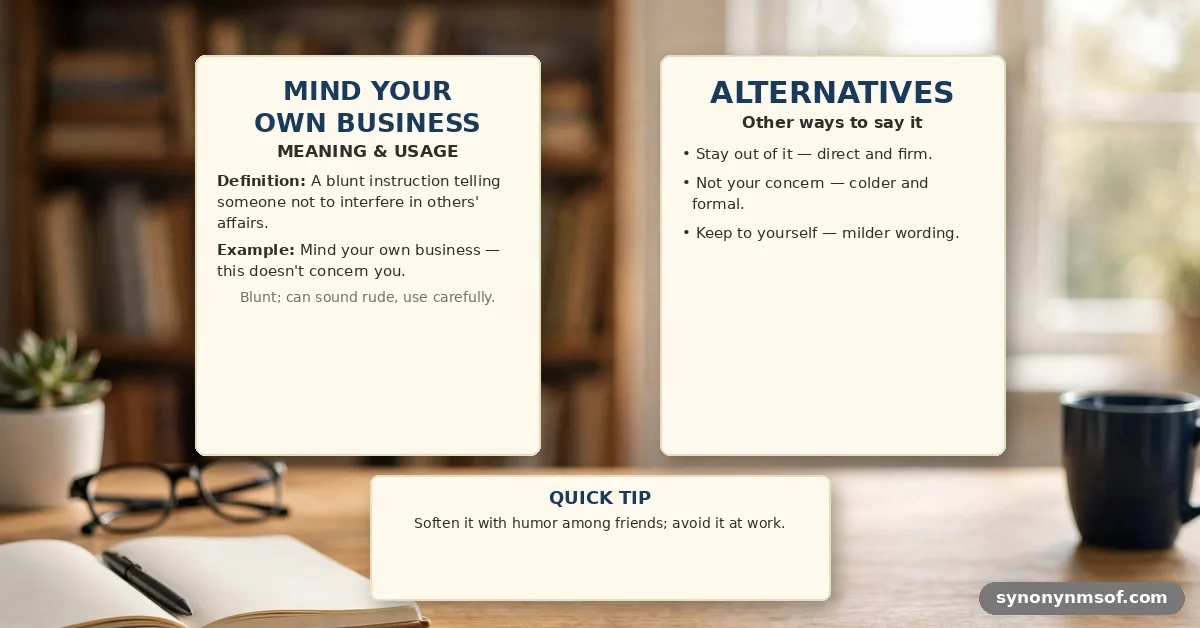

To mind your own business is to focus your energy on your own affairs rather than interfering in the lives of others. While the phrase often carries a sharp, defensive tone, it serves as a fundamental principle for maintaining personal boundaries and social harmony. Learning when to step back allows you to preserve your mental clarity and respect the autonomy of those around you.
This article examines the nuance behind this common expression, providing clear examples of how to apply the concept in professional and personal settings. You will gain a better understanding of why keeping your focus internal is a sign of emotional maturity rather than indifference.
Defining the Phrase

At its core, the directive to mind your own business is a request for privacy and non-interference. It functions as a boundary-setting tool that signals when a conversation or observation has crossed the line from helpful interest into intrusive curiosity. When someone tells you to focus on your own affairs, they are typically asserting that their personal choices are not open for public debate or critique.
In the English language, this expression acts as a verbal stop sign. It is a way to reclaim autonomy in environments where unsolicited advice or gossip has become overwhelming. While it can sound blunt, it is often the most efficient way to end a cycle of unproductive commentary.
Historical Context
The sentiment is not new; it has roots in ancient philosophy and societal norms that value self-regulation. The Merriam-Webster dictionary notes that phrases prioritizing personal responsibility over external meddling have existed for centuries. Stoic philosophers frequently argued that an individual’s only true business is their own character and actions.
By centering your attention on your own conduct, you avoid the pitfalls of judging others. This shift in perspective is a hallmark of a person who values integrity over social validation. You stop worrying about what your neighbor earns or how your colleague spends their weekends, which frees up significant mental space.
Examples in Professional Settings
Workplaces are often hotbeds for office politics and unwanted scrutiny. Applying the principle of minding your own business in a professional context does not mean ignoring your teammates; it means respecting their professional boundaries. It involves focusing on your specific objectives rather than tracking the productivity or personal lives of your peers.
Consider the following table to differentiate between constructive collaboration and intrusive behavior:
| Behavior | Category | Impact |
|---|---|---|
| Asking for help on a shared project | Constructive | Increases efficiency |
| Critiquing a peer’s vacation time | Intrusive | Creates resentment |
| Focusing on your own KPIs | Constructive | Boosts performance |
| Gossiping about a colleague’s salary | Intrusive | Damages office morale |
Managing Personal Boundaries
Setting boundaries is the practical application of this concept in your private life. You likely have friends or family members who feel entitled to comment on your diet, your career path, or your relationship status. Minding your own business—and encouraging them to do the same—protects your peace of mind.
You can enforce these boundaries without being aggressive. Often, a neutral, firm response is enough to signal that a topic is closed for discussion. By consistently modeling this behavior, you teach others how to interact with you on your own terms.
Strategies for Polite Disengagement
If you find yourself in a situation where others are prying, you can use specific techniques to pivot. The goal is to remain composed while clearly stating that you prefer to keep certain matters private. Consider these approaches:
- Changing the subject to a neutral, shared interest.
- Stating clearly that you are not comfortable discussing personal details.
- Asking a question about the other person to redirect their focus.
- Removing yourself from the conversation entirely if it becomes toxic.
The Psychology of Meddling
Why do some people find it so difficult to mind their own business? Often, it stems from a desire for connection, albeit an unhealthy one. When people feel unfulfilled in their own lives, they may project their anxieties onto others to find a sense of temporary relief or superiority.
Understanding this can help you react with empathy rather than anger. Recognizing that a person’s intrusive questions are usually about their own lack of fulfillment, not your failings, allows you to remain detached. You don’t need to take their comments personally or feel pressured to justify your existence.
Cultural Perspectives on Privacy

The expectation of privacy varies significantly across different cultures. In some societies, communal living and shared responsibility mean that people are expected to be deeply involved in one another’s lives. In these settings, the directive to mind your own business might be viewed as cold or selfish.
Conversely, in more individualistic cultures, the phrase is seen as a necessary safeguard for liberty. Balancing these perspectives requires situational awareness. You must recognize when someone is genuinely seeking help versus when they are merely being nosy.
When Interference is Necessary
There is a critical distinction between being intrusive and being a responsible member of a community. Minding your own business does not mean turning a blind eye to harm or injustice. If someone is in immediate danger or is acting in a way that directly threatens others, stepping in is a moral imperative.
The challenge is determining where the line falls. Ask yourself if your involvement is requested or if it is required for the safety of others. If the answer to both is no, it is usually best to maintain your distance.
Spiritual and Ethical Dimensions
Many belief systems emphasize the importance of focusing on one’s own path. In the Bible, there are verses that caution against being a busybody in the affairs of others. For instance, the sentiment found in 1 Thessalonians 4:11 encourages believers to study to be quiet and to do their own business with their own hands.
This ancient wisdom highlights that true growth comes from self-examination. When you spend your time observing others, you lose the opportunity to refine your own character. Focusing on your personal development is the ultimate form of minding your own business.
Long-term Benefits of Self-Focus
Cultivating a habit of focusing on your own life leads to profound personal growth. You become more productive, less stressed, and more secure in your identity. Because you are not constantly comparing your progress to that of others, you can pursue your goals at your own pace.
This practice fosters genuine relationships built on mutual respect rather than shared gossip. When you stop talking about others, you create space for deeper, more meaningful conversations. Ultimately, you become a person who is defined by their own actions rather than their opinions on the actions of others.
FAQ
Is it rude to tell someone to mind their own business?
It can be perceived as rude depending on your tone and the context. However, it is a valid way to assert boundaries when someone is being intrusive. Using a calm and firm delivery helps ensure the message is received as a boundary rather than an insult.
How do I stop being a busybody?
Start by redirecting your attention whenever you feel the urge to comment on someone else’s life. Focus on your own hobbies, work, or self-improvement goals. Over time, you will find that you have less interest in the affairs of others and more satisfaction in your own achievements.
What should I do if someone keeps prying after I ask them to stop?
If someone continues to ignore your boundaries, you have the right to limit your contact with them. You are not obligated to entertain persistent intrusions into your private life. Distance yourself from the interaction to preserve your peace.
Is this phrase always defensive?
While often used defensively, it can also be a neutral reminder to prioritize personal tasks. In a work environment, it might simply mean focusing on your assigned duties instead of getting distracted by office drama. It is a tool for productivity as much as it is for privacy.
Conclusion
Learning to mind your own business is one of the most effective ways to improve your quality of life. By shifting your focus from the lives of others to your own personal development, you reduce unnecessary stress and foster healthier boundaries. It is a practice that requires patience and consistency, but the rewards are well worth the effort.
Start by identifying areas where you frequently become distracted by external events. Choose to redirect that energy toward your own goals, whether in your career or your personal growth.
By valuing your own time and autonomy, you gain the freedom to live authentically. Embracing this mindset will not only help you navigate complex social dynamics but also ensure that your energy is spent exactly where it matters most.