
Few spelling questions spark as much second-guessing as truely or truly. You know the word you want — that warm, sincere adverb that means “in truth” or “genuinely” — but when your fingers hit the keyboard, a small doubt appears. Is it T-R-U-L-Y, or do you keep the silent “e” from “true” and write T-R-U-E-L-Y?
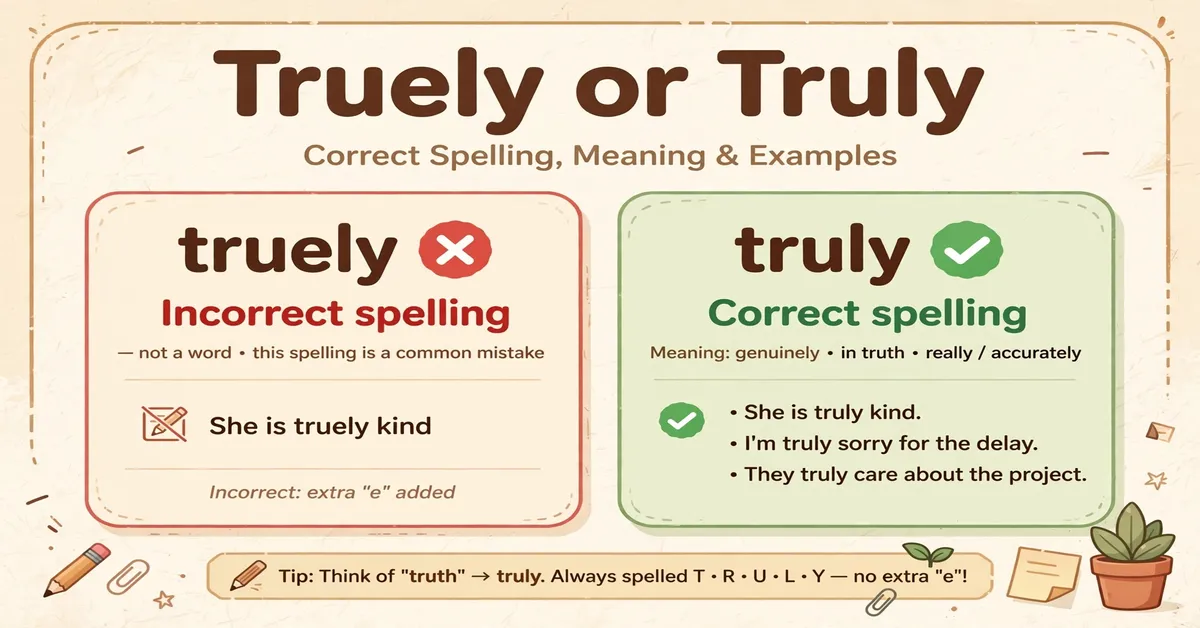
The short answer is that “truly” is the only correct spelling. “Truely” is a common misspelling, not a standard English word, and no major dictionary lists it as an accepted variant. If you have ever typed it the other way, you are far from alone — it is one of the most frequently flagged spelling errors in English.
In this guide, we will settle the truely or truly question once and for all. You will learn the simple rule that makes the correct spelling obvious, why so many people get it wrong, and how “truly” is actually used — plus a few tricky edge cases that catch even confident writers off guard.
“Truely”: A Common Misspelling, Not a Word
Let us start with the blunt fact: “truely” is not a word in standard English. You will not find it in Merriam-Webster, Oxford, or Cambridge as a recognized spelling. Spell-checkers flag it, teachers correct it, and editors remove it.
The confusion is understandable because the logic behind it feels sound. The adjective is “true,” which ends in a silent “e.” To make an adverb, you add “-ly” to the adjective. So “true” + “ly” should equal “truely,” right? English learners and native speakers alike follow this pattern, and with some words it works perfectly — “nice” becomes “nicely” and “false” becomes “falsely.”
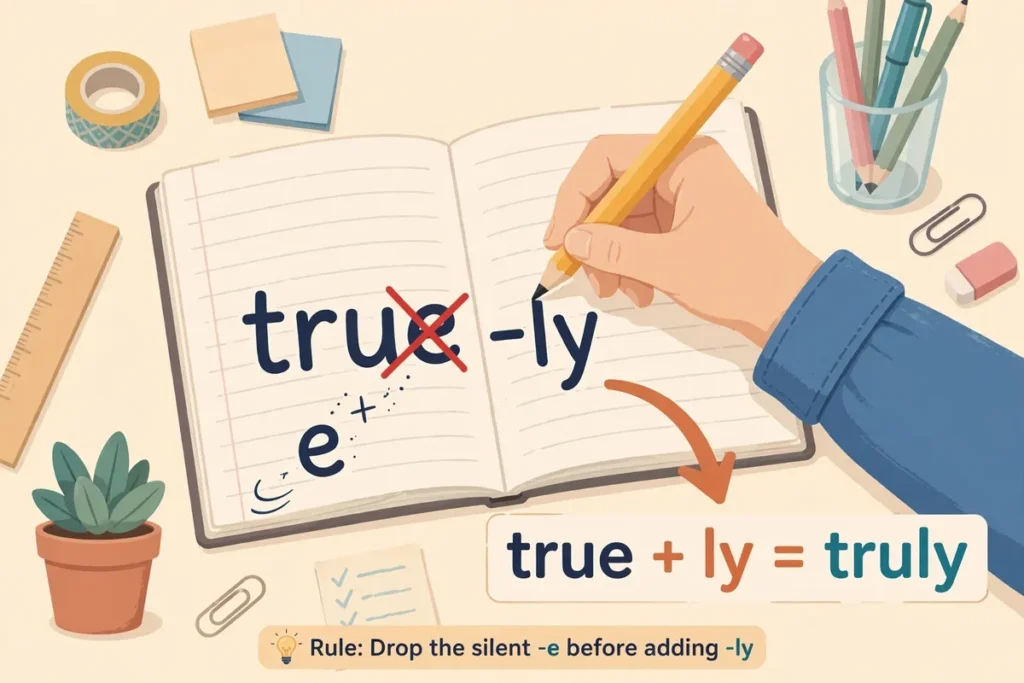
But “true” belongs to a different group of words. English has a specific spelling rule for adjectives that end in “-ue”: when you add the “-ly” suffix, the silent “e” is dropped first. That is why “true” becomes “truly,” “due” becomes “duly,” and “argue” becomes “arguably.” Keeping the “e” in place, as “truely” does, breaks the pattern that English has followed for centuries.
Why So Many People Write “Truely”
If “truely” is simply wrong, why does it show up everywhere — in emails, text messages, social media posts, and even published writing? A few forces work together to keep this misspelling alive.
The silent “e” intuition. The biggest culprit is the way we learn to form adverbs. The basic formula — take the adjective, stick “-ly” on the end — is one of the first grammar patterns English learners internalize. Since “true” visibly ends in “e,” the brain completes the pattern automatically: “truely.” The brain is doing something reasonable; it just does not know about the silent-e exception.
Inconsistent English spelling. English does not drop the silent “e” before “-ly” for every word. “Nice” keeps it (“nicely”), “wise” keeps it (“wisely”), and “polite” keeps it (“politely”). Because the rule is not applied uniformly, writers cannot rely on pure instinct — and when they guess with “true,” they often guess wrong.
Autocorrect blind spots. Many people type “truely” because their fingers have typed it before. Predictive keyboards learn from your habits, so once you type the misspelling a few times, your phone may start suggesting it. It then feels “official” simply because it appears on screen.
Speed and informality. In quick messages and casual posts, people rarely pause to check spelling. “Truely” looks close enough to “truly” that it slips past the writer’s own proofreading eye, and once it appears publicly, other readers absorb it as a plausible spelling and repeat it.
“Truly”: Meaning and Correct Usage
“Truly” is an adverb formed from the adjective “true,” and it carries several closely related meanings. At its core, it means “in a truthful manner” — when you say something truly, you mean it sincerely, without deception. From there, its meaning broadens: it also means “genuinely” or “really,” and it works as an intensifier meaning “absolutely,” “completely,” or “properly.”
Understanding these shades helps you use the word naturally instead of repeating it mechanically. Let us look at the main ways “truly” functions.
Truly as “In a Truthful or Sincere Manner”
This is the oldest and most literal use of the word. When “truly” modifies a verb of saying, feeling, or believing, it emphasizes honesty and sincerity:
- “He truly meant every word of his apology.”
- “I truly believe the team can win this.”
- “She spoke truly about her experience, holding nothing back.”
In these sentences, “truly” answers the question “how?” — how did he mean it, how do I believe it, how did she speak? The answer: sincerely, from the heart, without pretense.
Truly as “Genuinely” or “Really”
In everyday use, “truly” often means “genuinely” or “really,” describing something as authentic:
- “It was a truly remarkable achievement.”
- “That restaurant serves truly exceptional food.”
- “The storm caused truly devastating damage.”
Here “truly” modifies an adjective (“remarkable,” “exceptional,” “devastating”) and raises the level of the description. Saying the achievement was “truly remarkable” carries more weight than calling it merely “remarkable.”
Truly as an Intensifier
“Truly” can also intensify a statement about extent or degree, much like “absolutely” or “completely”:
- “The project is truly finished — no more changes.”
- “She is truly the best singer in the choir.”
- “That was truly the worst flight I have ever taken.”
Notice how in each case, “truly” could be replaced by “really” or “absolutely” without changing the meaning. This flexible, emphatic use is what makes “truly” such a common word in reviews, speeches, and social media.
Truly at the Start of a Sentence
“Truly” can open a sentence to set the tone for everything that follows, functioning as a sentence adverb:
- “Truly, this was the highlight of my year.”
- “Truly, I have never seen anything like it.”
- “Truly, words cannot describe how grateful I am.”
This placement gives the word extra emphasis. It signals to the reader that what comes next is honest and deeply felt, which is why it appears so often in thank-you notes, speeches, and heartfelt messages.
The Difference Between Truely and Truly
At this point the difference is simple but worth stating outright. “Truly” is the correct adverbial form of “true,” recognized by every dictionary. “Truely” is a misspelling that follows a plausible but incorrect logic, and it has no accepted meaning or use.
The difference is not about style, region, or preference. Unlike pairs where British and American spellings differ, “truely” has never been standard on either side of the Atlantic. Using it does not signal a dialect; it signals an error — the kind that can quietly undermine an otherwise polished email or application.
The good news is that the fix is mechanical, not creative. Once you know the rule — drop the silent “e” before adding “-ly” — you can spell “truly” correctly every time without memorizing anything else. And the rule pays dividends beyond this one word, because the same pattern governs “duly” (from “due”), “arguably” (from “argue”), and “wholly” (from “whole,” which also drops its silent “e” and doubles the “l”).
| Aspect | Truly | Truely |
|---|---|---|
| Status | Correct spelling | Misspelling |
| Dictionary recognition | Listed in all major dictionaries | Not recognized as standard |
| Grammar rule followed | Drops the silent “e” before “-ly” (true → truly) | Keeps the silent “e” (incorrect pattern) |
| Meaning | “In truth,” “genuinely,” “really,” “absolutely” | Has no meaning of its own |
| Usage in formal writing | Accepted everywhere | Never acceptable |
| Usage in casual writing | Accepted everywhere | Considered an error even in informal contexts |
| Example | “I truly appreciate your help.” | “I truely appreciate your help.” (wrong) |
| Related correct forms | Duly, arguably, wholly | — |
How to Remember the Correct Spelling
Because “truely” looks so plausible, it helps to have a memory trick that stops the mistake before it happens. Here are three that writers actually use:
Think of “truth,” not “true.” The word “truth” — the noun at the heart of this family of words — contains no “e” at all: T-R-U-T-H. If you associate “truly” with “truth,” the extra “e” simply has no place to come from. Some writers even remember it as “tru-ly,” hearing the two clean parts.
Remember the drop rule with a rhyme. “Before you add the L-Y, let the silent E say goodbye.” It is a little silly, but silly rhymes are exactly the kind that stick in memory when you are typing quickly.
Use the “due/duly” parallel. “Due” becomes “duly” by the exact same pattern: the “-ue” ending loses its “e” when “-ly” arrives. If you can spell “duly,” you already know the rule — “truly” is just its more famous sibling.
If you want to double-check related confusing pairs where a small spelling or word-choice difference changes the meaning, it is worth reading our guide to on the other hand, which covers another phrase writers often mix up. And for softening requests in the same kinds of messages where “truly” tends to appear, our article on I was wondering walks through polite phrasing in English.
Usage Examples Across Contexts
“Truly” is a flexible word, but its tone shifts depending on where it appears. The examples below show how it behaves in different settings — and how the same word can sound casual in one place and formal in another.
Everyday Conversation
In daily speech and informal writing, “truly” appears most often as an intensifier. People reach for it when “really” feels too flat and they want extra warmth or emphasis:
- “That was truly the best pizza I have ever had.”
- “I am truly sorry I missed your call.”
- “It is truly hard to describe how beautiful it was.”
- “She is truly one of the funniest people I know.”
In conversation, “truly” also shows up in short, standalone reactions: “Truly?” as a surprised question, or “Truly incredible!” as an exclamation. These uses lean on the word’s emphatic power rather than its literal meaning of truthfulness.
Work and Business Writing
In professional settings, “truly” does heavier lifting. It appears in apologies, thanks, and commitments — the places where sincerity actually matters:
- “We truly value your partnership and look forward to next year.”
- “I am truly grateful for the opportunity to lead this project.”
- “Management truly understands the concerns raised by the team.”
- “This was a truly outstanding quarter for the department.”
In business writing, “truly” has one important limitation: it is overused. Phrases like “truly sorry” and “truly appreciate” appear in so many corporate emails that they can start to sound automatic. If you find yourself writing “truly” in every message, consider a more specific word — “deeply,” “sincerely,” “genuinely” — to carry more meaning.
Formal and Academic Writing
In formal writing, “truly” is less common but still legitimate. It appears in scholarly prose when the writer wants to stress that something is the case in the fullest sense:
- “The results are truly significant, not merely statistically notable.”
- “This discovery represents a truly novel approach to the problem.”
- “The novel is truly representative of its era.”
Academic writers tend to use “truly” sparingly, preferring precise alternatives. Where a casual writer might say “truly amazing,” an academic might write “remarkable” or “unprecedented.” If you are writing a paper or thesis, use “truly” only when you genuinely need its emphasis — and never let it replace a specific, informative adjective.
Common Mistakes to Avoid
The truely/truly confusion is the headline error, but a few related mistakes orbit around it. Watch for these:
Using “truely” in any context. This bears repeating: there is no informal, creative, or poetic license that makes “truely” acceptable in standard English. It is wrong in texts, wrong in tweets, and wrong in novels. Every time you type it, your credibility takes a small hit.
Confusing “truly” with “truthfully.” These two overlap but are not identical. “Truthfully” means “in accordance with the truth” — it is about factual accuracy. “Truly” is broader: it can mean “genuinely” or “really.” You can say “She is truly kind” (genuinely kind), but “She is truthfully kind” sounds odd, because kindness is not a factual claim.
Stacking “truly” with “really.” Because “truly” and “really” overlap in meaning, combining them creates redundancy: “That was truly really impressive” is one intensifier too many. Pick one. Similarly, avoid piling “truly” onto already-absolute adjectives — “truly unique” is a classic example, since “unique” already means one of a kind.
Misplacing “truly” in a sentence. Adverb placement affects emphasis. “She truly loves him” (she loves him sincerely) differs subtly from “Truly, she loves him” (it is true that she loves him). Neither is wrong, but the first modifies the verb while the second modifies the whole claim. Be aware of which effect you want, especially in formal writing.
Tricky Cases and Edge Cases
Most of the time, “truly” is straightforward. But a handful of situations trip writers up, and they are worth knowing about.
Other “-ly” Adverbs and the Silent “e” Rule
The rule that governs “truly” — drop the silent “e” before “-ly” — applies to adjectives ending in “-ue,” but English being English, the general silent-e rule has exceptions elsewhere. “Wise” keeps its “e” (“wisely”), “nice” keeps its “e” (“nicely”), and “polite” keeps its “e” (“politely”). So why does “true” lose it?
The difference is the vowel before the “e.” In “true,” “due,” and “argue,” the “e” follows the letter “u,” forming the “-ue” ending. For this specific group, standard English drops the “e” — hence “truly,” “duly,” and “arguably.” In “nice,” “wise,” and “polite,” the “e” follows a consonant, and it stays. The rule depends on the letter pattern, not on the silence of the “e” alone.
This is also why “wholly” (from “whole”) drops its “e”: the pattern “-ole” behaves like “-ue” in this respect. Once you see the pattern, “truly” stops feeling like an exception and starts looking like the rule working as intended.
“Yours Truly” in Letters and Sign-Offs
“Truly” appears in one of the most famous email and letter sign-offs in English: “Yours truly.” This closing is a shortened form of “I am yours truly” — meaning “I am sincerely yours” — and it has been standard in business correspondence for well over a century.
Because the sign-off is so common, it is also one of the most common places the “truely” mistake appears. Typing “Yours truely” at the end of a job application is a particularly unfortunate error, because the sign-off is the last thing the reader sees. If you use this closing, double-check it: Yours truly, never “yours truely.”
Note that “Yours truly” is somewhat formal and traditional. In modern business emails, “Best regards,” “Kind regards,” or simply “Best” are more common. “Yours truly” still works for formal letters and for situations where you want a touch of old-fashioned courtesy.
“Truly” in Fixed Expressions
A few fixed phrases use “truly” in ways that are easy to mistype or misremember:
- “Well and truly” — a British English idiom meaning “completely”: “The project is well and truly behind schedule.” Note that it is “well and truly,” not “well and truely.”
- “True to form” — uses the adjective “true,” not the adverb: “True to form, he arrived late.”
- “True story” — again the adjective, used as an intensifier in informal speech: “That actually happened — true story.” Do not write “truly story.”
“Truly” vs. “Real” and “Genuine”
Writers sometimes hesitate between “truly,” “real,” and “genuine.” The distinction is grammatical: “real” and “genuine” are adjectives, while “truly” is an adverb. You need “truly” when modifying a verb, adjective, or another adverb (“truly remarkable”), and “real” or “genuine” when modifying a noun (“a real achievement,” “a genuine smile”).
In informal American speech, people sometimes use “real” as an adverb (“That was real good”), but this is nonstandard. In writing, stick with “truly” or “really” for the adverb job. Choosing the right form is a small detail that marks the difference between polished and sloppy prose — and if you ever need to buy yourself time while phrasing a careful message, our guide on if time permits covers polite ways to do exactly that.
Frequently Asked Questions
Is “truely” a word?
No. “Truely” is not recognized as a word in standard English. No major dictionary — Merriam-Webster, Oxford, Cambridge — lists it as an accepted spelling. It is simply a common misspelling of “truly,” caused by keeping the silent “e” from “true” when adding “-ly.” Always write “truly.”
What is the correct spelling: truely or truly?
“Truly” is the only correct spelling. The adverb form of “true” drops the silent “e” before adding “-ly,” following the same pattern as “due” to “duly” and “argue” to “arguably.” The spelling “truely” is incorrect in all contexts, formal and informal alike.
What does “truly” mean?
“Truly” is an adverb meaning “in a truthful or sincere manner” (“he truly meant it”), “genuinely” or “really” (“a truly remarkable achievement”), or “absolutely” and “completely” as an intensifier (“the project is truly finished”). Which shade applies depends on what it modifies in the sentence.
Why do people spell it “truely”?
Three reasons. First, the standard adverb rule — add “-ly” to the adjective — seems to demand “true” + “ly” = “truely.” Second, many adjectives keep their silent “e” (“nice” to “nicely,” “wise” to “wisely”), so writers assume “true” behaves the same way. Third, the misspelling gets reinforced by predictive keyboards and repeated exposure online.
How do you use “truly” in a sentence?
Use “truly” to modify verbs, adjectives, adverbs, or whole sentences: “I truly appreciate your help,” “It was a truly beautiful ceremony,” “She speaks truly eloquently,” and “Truly, I could not have done it without you.” In letters, the traditional sign-off “Yours truly” uses it as well.
Final Thoughts
The truely or truly debate has a clear winner: truly, spelled T-R-U-L-Y, with the silent “e” from “true” dropped before “-ly” is added. “Truely” is a misspelling — understandable, extremely common, but never correct. The logic that produces it is sound for many words and simply does not apply here.
Remember the rule, not just the word. When an adjective ends in “-ue,” drop the “e” before “-ly”: true becomes truly, due becomes duly, argue becomes arguably. With that single pattern in your toolkit, you will never hesitate over this spelling again — and you will catch the error instantly when you see it in someone else’s writing.