
You have probably seen both “travelling” and “traveling” appear in articles, novels, and travel blogs, and paused for a moment to wonder which one is actually right. The reassuring answer is that both are correct. They are simply two spellings of the same word — the present participle and gerund of the verb “travel,” meaning to go from one place to another.
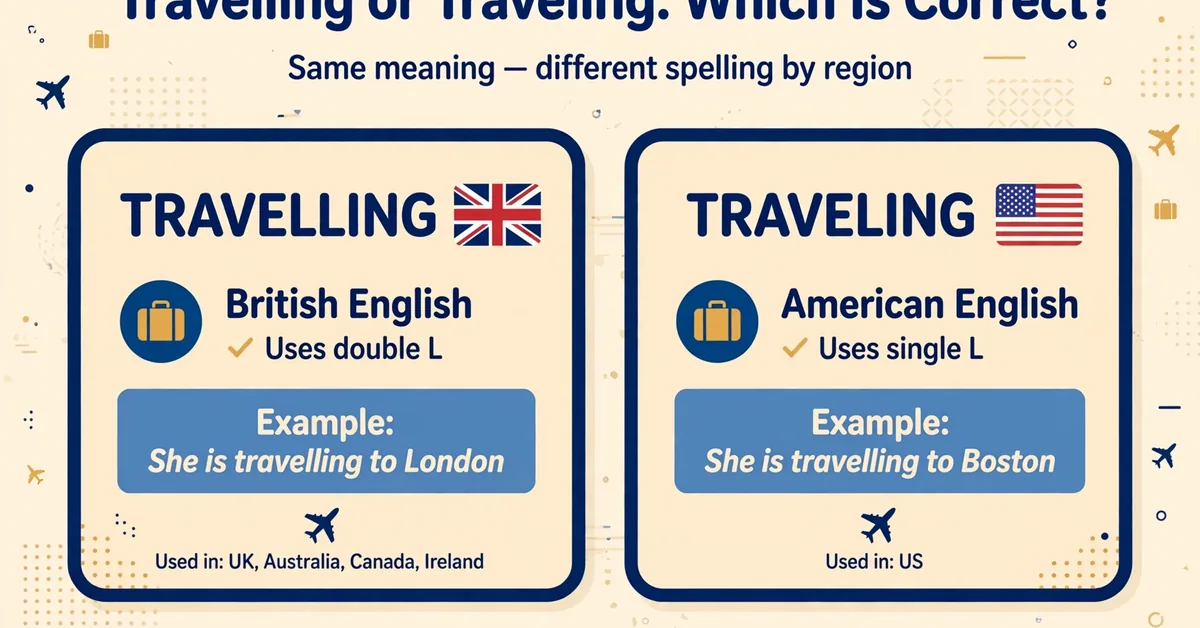
The split between them is regional, not semantic. “Traveling,” with a single L, is the standard spelling in American English. “Travelling,” with a double L, is the norm in British English and in most Commonwealth countries, including Canada, Australia, and New Zealand. The difference goes back to early 19th-century spelling reforms and two slightly different rules about when to double a final consonant.
In this guide, you will learn exactly what each spelling means, where each one belongs, the spelling rule behind the extra L, and how dictionaries and style guides treat the pair. You will also find usage examples for everyday, business, and academic contexts, the mistakes writers most often make with these spellings, and a few tricky edge cases that catch even confident writers off guard. You might be wondering whether one spelling is somehow more “proper” than the other — by the end of this article, you will know exactly which form to pick and why.

What Does “Travelling” Mean?
“Travelling” is the present participle and gerund of the verb “travel,” spelled with a double L. It describes the act of moving from one place to another, usually over some distance. As a gerund, it functions as a noun: the activity of going on trips or journeys. As a present participle, it teams up with helper verbs to form continuous tenses, describing journeys in progress.
The double L changes nothing about the meaning. “Travelling” sounds exactly like “traveling” when spoken aloud; the distinction exists purely on the page. Writers choose this form when they are following British or Commonwealth spelling conventions.
Where “Travelling” Is Standard
“Travelling” is the default spelling throughout the United Kingdom, Ireland, Canada, Australia, New Zealand, South Africa, and most other countries that follow British English conventions. School textbooks, national newspapers, government documents, and publishing houses in these regions all use the double-L form as a matter of course. The Oxford English Dictionary lists “travelling” as the primary spelling, and British style guides such as The Economist’s style guide and The Guardian’s style guide expect it.
The double-L pattern extends to the whole word family in these regions: “travelled” (past tense), “traveller” (noun for a person who travels), and “travelling” (participle/gerund). Consistency across the family is the point — once a writer commits to British spelling, every related form doubles its L.
Example Sentences Using “Travelling”
- She has spent the last six months travelling through Southeast Asia.
- Travelling by overnight train is one of the most relaxing ways to cross the country.
- They are travelling to Edinburgh next weekend for a wedding.
- My grandfather made his living as a travelling salesman in the 1970s.
- The travelling exhibition will visit twelve cities before the end of the year.
- Travelling light means packing only what fits in a single carry-on bag.
- We met a group of travelling musicians at the festival in Galway.
- He finds travelling for work exhausting, but the frequent-flyer miles help.
What Does “Traveling” Mean?
“Traveling” is the exact same word — the present participle and gerund of “travel” — spelled with a single L. It carries precisely the same meaning: journeying, moving from place to place, or spending time on trips. Whether you write “traveling” or “travelling,” your reader understands the identical idea.
The single-L spelling is simply the American convention. American English generally avoids doubling the final consonant of a two-syllable verb when the stress falls on the first syllable, and “travel” is stressed on its first syllable (TRAV-el). So American writers drop the second L, producing “traveling,” “traveled,” and “traveler.”
Where “Traveling” Is Standard
“Traveling” is the standard spelling across the United States in every register: news reporting, business writing, academic publishing, government documents, and everyday correspondence. Merriam-Webster lists “traveling” as the primary American spelling, and the two most influential American style authorities — the AP Stylebook and the Chicago Manual of Style — both prescribe the single-L form. American spell-checkers flag “travelling” as an error by default, which is why students and professionals writing for US audiences need to get this right.
As with the British family, the American forms stay consistent: “traveled” (past tense), “traveler” (noun), and “traveling” (participle/gerund) all keep a single L.
Example Sentences Using “Traveling”
- She has spent the last six months traveling through Southeast Asia.
- Traveling by overnight train is one of the most relaxing ways to cross the country.
- They are traveling to Chicago next weekend for a wedding.
- My grandfather made his living as a traveling salesman in the 1970s.
- The traveling exhibition will visit twelve cities before the end of the year.
- Traveling light means packing only what fits in a single carry-on bag.
- We met a group of traveling musicians at the festival in Austin.
- He finds traveling for work exhausting, but the frequent-flyer miles help.
The Difference Between Travelling and Traveling
The difference between “travelling” and “traveling” is entirely a matter of regional spelling convention. There is no difference in meaning, pronunciation, part of speech, or grammatical function. A London newspaper and a New York newspaper describing the very same journey would simply spell the word differently, each following its own house standard.
A Regional Spelling, Not a Meaning Difference
It helps to think of this pair the way you think of “colour” and “color” or “favour” and “favor.” No native speaker would claim that “colour” describes a different thing than “color” — and the same logic applies here. “Travelling” does not mean a fancier, longer, or more adventurous kind of travel than “traveling.” Both refer to the same activity, and swapping one for the other never changes what a sentence says. It only changes how the sentence looks to readers who expect a particular regional standard.
Because the difference is only visual, context decides which form is “correct” for you. Writing for an American company, university, or publication? Use “traveling.” Writing for a British, Canadian, or Australian audience, or sitting an exam graded against British English? Use “travelling.” Writing for a global online audience? Pick one and stay with it from the first paragraph to the last.
The Consonant-Doubling Rule Behind the Extra L
The extra L is not random; it comes from a well-known spelling pattern. In English, when a verb ends in a single consonant preceded by a single vowel, you normally double that consonant before adding a suffix that starts with a vowel (like -ing, -ed, or -er). That is why “run” becomes “running,” “stop” becomes “stopped,” and “begin” becomes “beginner.”
For two-syllable verbs, however, there is an extra condition: the doubling usually happens only when the stress falls on the final syllable. Compare “compel” (com-PEL, stressed at the end) → “compelling,” with “travel” (TRAV-el, stressed at the start) → “traveling.” By this logic, “travel” should never double its L — and in American English, it doesn’t.
British English simply applies a broader convention: verbs ending in L double that letter before vowel suffixes regardless of where the stress falls. That is why British spelling gives us “travelling,” “cancelled,” “labelled,” and “modelled,” while American spelling gives us “traveling,” “canceled,” “labeled,” and “modeled.” Both systems are internally consistent; they just draw the line in different places.
Why the Spellings Diverged
The split traces back to the American lexicographer Noah Webster, whose 1828 American Dictionary of the English Language deliberately simplified many spellings to make English more regular and easier to teach. Webster championed forms like “color” for “colour,” “honor” for “honour,” “center” for “centre” — and “traveling” for “travelling.” His reforms caught on in the United States and became the national standard.
Meanwhile, Britain and its colonies kept the older, traditional spellings. The double-L form of “travelling” had been the norm in English for centuries before Webster, so from the British perspective nothing changed; it was American English that broke away. On the other hand, from the American perspective, the single-L form is simply the modern, streamlined standard — and the double L looks old-fashioned.
What Dictionaries and Style Guides Say
Every major dictionary acknowledges both spellings but flags them by region. Oxford (British) lists “travelling” first and marks “traveling” as the US variant; Merriam-Webster (American) does the reverse. Cambridge lists both with regional labels. No reputable dictionary calls either spelling wrong.
Style guides follow the same regional split. The AP Stylebook and the Chicago Manual of Style — the authorities behind most American journalism and book publishing — prescribe “traveling,” “traveled,” and “traveler.” British house styles, including those of the BBC, The Guardian, and Oxford University Press, prescribe “travelling,” “travelled,” and “traveller.” The practical takeaway is not that one authority wins, but that you should follow the authority your audience expects.
Travelling vs Traveling: Comparison Table
| Feature | Traveling | Travelling |
|---|---|---|
| Spelling | Single L | Double L |
| Meaning | To go from one place to another | To go from one place to another (identical) |
| Pronunciation | /ˈtræv.əl.ɪŋ/ | /ˈtræv.əl.ɪŋ/ (identical) |
| Standard in | United States | United Kingdom, Canada, Australia, New Zealand |
| Past tense form | Traveled | Travelled |
| Noun form (person) | Traveler | Traveller |
| Key dictionaries | Merriam-Webster (primary) | Oxford English Dictionary (primary) |
| Example | She is traveling to Boston. | She is travelling to London. |
Usage Examples Across Contexts
The word appears in every kind of writing, so it is worth seeing how each spelling behaves in different registers. Note that the surrounding vocabulary and tone shift with the context, but the travel word itself only changes its L-count according to the regional standard you have chosen.
Everyday Conversation
In casual speech and writing — texts, social media posts, personal blogs, and friendly emails — either spelling works as long as it matches your own regional habit. Readers in everyday contexts rarely notice or care, but consistency still looks tidier.
- I’ve been traveling nonstop this month and I’m exhausted. (US casual)
- I’ve been travelling nonstop this month and I’m exhausted. (UK casual)
- We did a lot of traveling around the national parks last summer.
- We did a lot of travelling around the national parks last summer.
- She’s traveling with two kids under five — brave woman.
- He’s travelling with two kids under five — brave man.
Work and Business
In professional writing, the stakes are slightly higher because documents represent a company. Most organizations follow the spelling standard of the country where they are based, and many maintain an internal style guide. A Chicago-based consultancy writes “traveling expenses” in its reports; a London-based one writes “travelling expenses.” When you write for an international team, check the company’s house style before you start — mixing the two in a single proposal looks careless.
- Our sales team will be traveling to the Denver office in Q3. (US business)
- Our sales team will be travelling to the Manchester office in Q3. (UK business)
- Please submit all traveling receipts by Friday for reimbursement.
- Please submit all travelling receipts by Friday for reimbursement.
- Frequent business traveling can take a toll on family life.
- Frequent business travelling can take a toll on family life.
Formal and Academic Writing
Academic and formal writing demands the strictest consistency, because examiners, editors, and peer reviewers do notice spelling conventions. American universities and journals expect “traveling”; British, Canadian, and Australian institutions expect “travelling.” If you are submitting a thesis, a journal article, or a standardized test essay, find out which English variety the institution uses and apply it to every doubled-consonant word in your document, not just this one. This shows examiners that you understand register and convention, not just vocabulary.
- The study examines patterns of seasonal traveling among retirees. (US academic)
- The study examines patterns of seasonal travelling among retirees. (UK academic)
- Traveling musicians played a key role in spreading folk traditions.
- Travelling musicians played a key role in spreading folk traditions.
- The paper analyzes how wartime restrictions limited civilian traveling.
- The paper analyzes how wartime restrictions limited civilian travelling.
Common Mistakes to Avoid
Mixing Both Spellings in One Document
The single most common error is inconsistency: writing “traveling” in the introduction and “travelling” three paragraphs later. Readers may not consciously register the switch, but editors and spell-checkers will, and the document looks unproofread. Decide on your standard before you start writing — based on your audience, your institution, or your publication’s house style — and apply it to every form of the word family. A quick find-and-replace pass at the end of drafting catches most of these slips.
Using “Traveling” in UK Exams and Assignments
Students sitting British-curriculum exams (GCSEs, A-levels, IELTS) or submitting work to UK, Canadian, or Australian universities should use “travelling.” Examiners in these systems mark against British spelling conventions, and the American form can cost marks in language-accuracy criteria. The reverse applies equally: American students writing SAT essays or submitting to US journals should use “traveling.” Know your audience’s standard before you write a single word.
Assuming the Single L Is Always American
The “one L equals American, two Ls equal British” rule is a reliable starting point, but it has limits. Proper nouns keep their original spelling regardless of where you live — you never “correct” a quoted book title, song name, or brand. Direct quotations also keep the author’s spelling: if you quote an American source in a British essay, “traveling” stays as the author wrote it, and you would not add a “[sic]” because it is not an error. Finally, some regions are genuinely mixed: Canadian English officially follows British doubling, but heavy American media influence means you will see plenty of “traveling” in Canadian writing too.
Forgetting the Rest of the Word Family
Writers who remember “travelling” sometimes forget “travelled” and “traveller,” producing hybrid sentences like “the travelling salesman travelled widely” — fine — versus the inconsistent “the travelling salesman traveled widely.” The rule applies to the whole family: British “travelling / travelled / traveller,” American “traveling / traveled / traveler.” Learn them as a set, not as isolated words.
Confusing “Traveling” With Unrelated Words
Less often, learners confuse “travelling/traveling” with “traversing” (crossing through an area, often difficult terrain) or with the noun “travels” (journeys, as in “his travels took him to Peru”). “Travels” as a noun is plural-only in this sense — you cannot say “a travel” to mean a journey in standard English. Keep the verb family and the noun forms distinct in your mind.
Tricky Cases and Edge Cases
The “Traveling Salesman” Idiom
The classic compound “traveling salesman” — a salesperson who goes door to door or town to town — is an American idiom, so it traditionally appears with one L. In British writing you will often see “travelling salesman” with two, following the regional rule. The same applies to the famous computer-science puzzle, the “travelling salesman problem” (usually double L in British and international academic literature) versus the “traveling salesman problem” (single L in American textbooks). The meaning is identical; only the house style differs.
Proper Nouns Keep Their Original Spelling
Never alter the spelling inside a proper noun to match your regional standard. The American band is “The Traveling Wilburys” with one L, and a British writer referring to them keeps that spelling. A book titled Travelling Light keeps its double L when cited in an American bibliography. Titles, brand names, and organization names are frozen — “correcting” them introduces an error rather than fixing one.
Parallel Words: Cancel, Label, Model, and More
“Travel” is not alone; a whole group of two-syllable verbs ending in L follows the identical pattern. Learning the group makes every member easier to remember:
| Verb | American | British |
|---|---|---|
| travel | traveling / traveled / traveler | travelling / travelled / traveller |
| cancel | canceling / canceled | cancelling / cancelled |
| label | labeling / labeled | labelling / labelled |
| model | modeling / modeled | modelling / modelled |
| fuel | fueling / fueled | fuelling / fuelled |
| marvel | marveling / marveled | marvelling / marvelled |
| dial | dialing / dialed | dialling / dialled |
| rival | rivaling / rivaled | rivalling / rivalled |
Notice that “unravel” belongs to this group too: American “unraveling,” British “unravelling.” If you can spell one of these families correctly in your chosen standard, you can spell them all.
Verbs That Always Double (Both Standards)
Contrast the group above with verbs stressed on the final syllable, where both American and British English double the consonant: “compel” → “compelling,” “refer” → “referred,” “occur” → “occurring,” “prefer” → “preferred.” Here there is no regional split at all, because the stress rule and the British L-doubling convention agree. This contrast is exactly why “travel” is special: its first-syllable stress is what opens the door to the American single-L spelling.
“Travelling” as an Adjective or Noun Modifier
Both spellings also work as adjectives describing people or things that move around: “a travelling circus,” “the traveling exhibition,” “travelling folk.” In these uses the same regional rule applies — pick your L-count by audience. Occasionally “travellers” appears as a noun for nomadic communities (as in “Irish Travellers,” always capitalized and always double L in that proper name). Context tells you whether you are looking at the ordinary verb form or a fixed proper noun.
Frequently Asked Questions
Is “travelling” or “traveling” correct?
Both are correct. “Traveling” with one L is the standard spelling in American English, while “travelling” with two Ls is standard in British, Canadian, Australian, and New Zealand English. They mean exactly the same thing — the difference is purely regional spelling convention.
Which spelling should I use in Canada or Australia?
Use “travelling” with a double L. Both Canada and Australia officially follow British spelling conventions, so “travelling,” “travelled,” and “traveller” are the expected forms in schools, government documents, and publishing. Be aware that American media influence means you will sometimes see the single-L form in Canadian writing, but the double L remains the formal standard.
Do “travelled/traveled” and “traveller/traveler” follow the same rule?
Yes. The whole word family follows the same regional pattern: American English uses “traveling,” “traveled,” and “traveler” (single L throughout), while British and Commonwealth English uses “travelling,” “travelled,” and “traveller” (double L throughout). Whichever standard you choose, apply it consistently to every form.
Why does British English double the L in “travelling”?
British spelling convention doubles a final L before vowel suffixes like -ing, -ed, and -er regardless of which syllable carries the stress. American English only doubles the final consonant when the stress falls on the last syllable — and since “travel” is stressed on its first syllable (TRAV-el), Americans write “traveling.” The split dates back to Noah Webster’s spelling reforms in the early 1800s.
Can I mix “travelling” and “traveling” in the same document?
You should not. Mixing the two spellings in one document looks inconsistent and unprofessional, and it can cost marks in exams or get flagged by editors. Choose the spelling that matches your audience — “traveling” for American readers, “travelling” for British and Commonwealth readers — and use it, along with the matching “traveled/travelled” and “traveler/traveller” forms, throughout the entire piece.
Conclusion
“Travelling” and “traveling” are the same word wearing two regional outfits. The double L belongs to British and Commonwealth English; the single L belongs to American English. Neither is a misspelling, and neither carries a different meaning — the choice comes down entirely to who is reading your work. Match your spelling to your audience, keep the whole word family consistent, and you will always be correct.
The deeper lesson is worth keeping too. English spelling differences like this one usually have a story — in this case, a 19th-century dictionary reform on one side of the Atlantic and centuries of tradition on the other — and a rule you can actually learn. Once you understand the consonant-doubling pattern behind “travelling” versus “traveling,” you can apply it confidently to “cancelled,” “labelled,” “modelling,” and the rest of their word family. One small letter, fully mastered, unlocks a dozen correct spellings.