
A woman hands you her business card, and the name line reads “Ms. Ayesha Khan.” You open a letter that begins “Dear Miss Ayesha Khan.” And somewhere in the back of your mind, a small question blinks on: which one is right? English gives men a single, effortless courtesy title — Mr. — and then asks women to navigate a small minefield of options. Miss, Mrs., and Ms. all look similar, all sound polite, and yet choosing the wrong one can feel like a social tripwire.
The truth is that “Miss” and “Ms.” come from completely different eras of thinking about women. “Miss” is the traditional title, centuries old, and it quietly tells the reader something about a woman’s marital status. “Ms.” is the modern invention, deliberately designed to say nothing about marital status at all — to work exactly the way “Mr.” works for men. Most modern style guides now recommend “Ms.” as the default in professional and formal writing, and using it correctly is one of those small signals that marks you as a careful, respectful writer.
So how do you choose between them, and what happens when you’re not sure? This guide walks through the meaning and history of both titles, shows you exactly when to use each one, and covers the tricky cases — unknown marital status, young girls versus adult women, regional differences, and pronunciation — so you can address any woman with confidence and never put your foot in it.
What Does “Miss” Mean?
“Miss” is the oldest of the three main courtesy titles for women, and it carries the most specific meaning: it traditionally identifies an unmarried woman. If you see “Miss” before a surname, the writer is signaling — intentionally or not — that the woman in question has not married. Understanding this built-in meaning is the key to using the title correctly, because it is also the reason the title has become less common in modern professional writing.
A Short History of “Miss”
“Miss” began life in the 1600s as a shortened form of “Mistress,” which was originally the female equivalent of “Master” and did not imply any particular marital status. Over time, the two forms split: “Mrs.” (also derived from “Mistress”) came to mark married women, while “Miss” settled on unmarried women and girls. For the next three centuries, the system was rigid and socially enforced — a woman’s title announced her marital status to the world in the same breath as her name, and there was no male equivalent. “Mr.” never carried that burden.
When “Miss” Is Used Today
Today “Miss” survives most comfortably in social, informal, and educational contexts. It is the standard title for girls under eighteen: teachers address students as “Miss Patel,” and a wedding invitation might read “Miss Emily Clarke.” In some families and regions, it also serves as a warm, slightly old-fashioned form of respect for an unmarried adult woman. That said, in professional writing, using “Miss” for an adult woman you barely know has become risky, because the title announces an unmarried status you cannot verify.
What Does “Ms.” Mean?
“Ms.” is the neutral, marital-status-free courtesy title for women: the direct female counterpart of “Mr.” It works for married, unmarried, divorced, and widowed women alike, and it is now the default recommendation of most modern style guides, including the Associated Press and the Chicago Manual of Style, for business letters, emails, and formal writing where the recipient’s preferred title is unknown. If you remember nothing else from this article, remember this: when in doubt, use “Ms.”
Where “Ms.” Came From
“Ms.” is not ancient at all — it was coined in the twentieth century as a deliberate solution to the “Miss versus Mrs.” problem. The title gained real traction in the 1970s, when the women’s rights movement argued that no woman should have to advertise her marital status every time her name appeared in print, and a well-known American feminist magazine adopted the title as its name. The logic was simple and hard to argue with: “Mr.” reveals nothing about a man’s private life, so women deserved a parallel form. Corporations, universities, and government agencies gradually followed, and by the 1990s “Ms.” had become the standard business title in much of the English-speaking world.
Why “Ms.” Became the Modern Default
“Ms.” won because it solves a real writing problem. In a business email, a job application, a news article, or a form letter, you usually do not know the recipient’s marital status — and you have no business guessing. Using “Miss” assumes she is unmarried; using “Mrs.” assumes she is married. “Ms.” assumes nothing, which is exactly what professional communication should do. Many women also actively prefer it: married women who kept their maiden names, divorced women, and women who simply find the marital-status question irrelevant all commonly style themselves “Ms.”
How to Pronounce “Ms.”
“Ms.” is pronounced “miz” — one syllable, rhyming with “fizz” without the extra f, and ending in a buzzing z sound. This matters more than people think, because in speech the title is easily confused with “Miss” (pronounced “miss,” with a sharp s). A spoken “Miss Lawson” tells a listener she is unmarried; a spoken “Ms. Lawson” tells them only her surname. If you say “miz” when you mean “miss,” or vice versa, the words may blur together in fast speech — which is one more reason to write the title carefully and, when speaking, to enunciate it clearly.
Miss vs Ms: The Key Differences
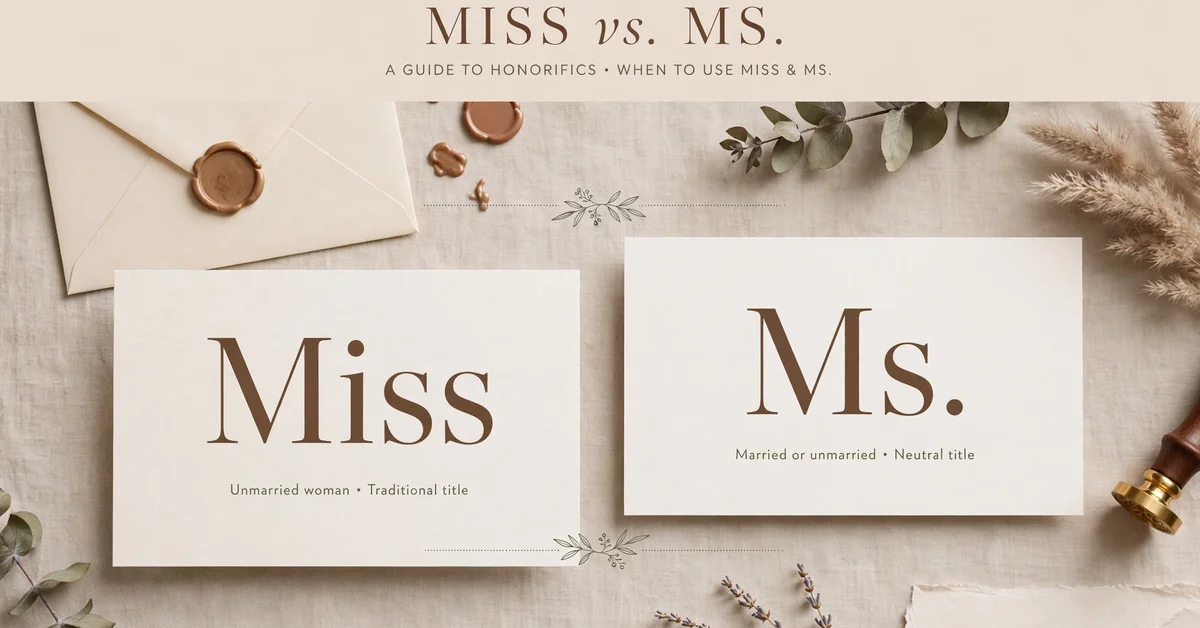
The single difference that matters is the marital-status signal. “Miss” declares that a woman is unmarried; “Ms.” declines to say anything about marital status at all. Every other difference — tone, formality, age association, professional suitability — flows from that one distinction. Choose “Miss” when you know the woman is unmarried and the context is social or informal. Choose “Ms.” everywhere else: in business, in formal writing, and whenever you are unsure.
Where Does “Mrs.” Fit In?
“Mrs.” completes the traditional trio. It is the title for a married woman — traditionally a woman who has taken her husband’s surname, though today it is also used by married women who kept their own names and by widows. Where “Miss” broadcasts “unmarried” and “Mrs.” broadcasts “married,” “Ms.” broadcasts nothing. Think of the three as a spectrum from most specific to least specific: “Miss” and “Mrs.” pin a woman to a relationship category, while “Ms.” treats her name the way “Mr.” treats a man’s name — as belonging to her, full stop. If a woman tells you she prefers “Mrs.,” use it; it is her name to style.
Miss vs Ms: Comparison at a Glance
| Feature | Miss | Ms. |
|---|---|---|
| Marital status signaled | Unmarried | None — neutral |
| Pronunciation | “miss” (sharp s) | “miz” (buzzing z) |
| Spelling style | Full word, no period | Abbreviation, always with a period |
| Historical origin | 1600s, shortened from “Mistress” | 20th century, coined for equality |
| Typical age association | Girls and young women | Adult women of any age |
| Professional default? | No — considered dated in business | Yes — the modern business standard |
| Use when marital status is unknown | No — it assumes unmarried | Yes — it assumes nothing |
| Use when marital status is known | Only if unmarried and informal | Always acceptable, even for married women |
| Trend | Declining in formal writing | Rising; recommended by major style guides |
How to Use “Miss” and “Ms.” in Different Situations
Courtesy titles live or die by context. The right choice in a classroom may be the wrong choice in a boardroom. The sections below walk through the three main settings where these titles actually appear, with practical guidance for each.
Everyday Conversation
In daily life, “Miss” survives mainly as a spoken, friendly form of address, often without a surname attached: “Excuse me, miss, you dropped your wallet.” In this casual register, it functions more like “sir” for men — a quick politeness marker rather than a formal title. In customer-service roles, teachers calling young students, and regional speech (particularly in the American South and parts of South Asia), “miss” is heard constantly and intended warmly. “Ms.” is rarely used in truly casual speech; it shows up when you need to name someone formally in conversation, as in “Ms. Thompson will see you now,” or when reading a name off a document. In speech, remember the pronunciation split — “miss” versus “miz” — because your listeners will hear the difference even when your text does not spell it out.
Work and Business
Business is where “Ms.” earned its place, and it is where it now rules. When you write to a woman you have not met — a client, a hiring manager, an editor, a supplier — and you do not know her title preference, “Ms.” is the correct default, full stop. “Dear Ms. Okafor” opens a cover letter without presuming anything about her personal life, while “Dear Miss Okafor” quietly presumes she has never married, and “Dear Mrs. Okafor” presumes she has. Neither presumption belongs in a professional email. If time permits, check how she styles her own name — her email signature, her LinkedIn profile, or her company bio will often show “Ms.,” “Mrs.,” or no title at all, and matching her choice is always the most respectful move. If she uses no title and you need one, fall back to “Ms.” Internal office culture matters too: some workplaces have dropped courtesy titles entirely in favor of first names, but when a title is required, “Ms.” is the one that fits every situation.
Formal and Academic Writing
In formal and academic writing — journal articles, legal documents, official reports, wedding stationery — precision is everything, and “Ms.” is the precision instrument. Academic journals routinely style female authors as “Ms.” unless a doctoral or professorial title applies; news organizations follow their style books, and both the AP and Chicago guides default to “Ms.” for women whose preference is unknown. In legal and medical forms, “Ms.” is increasingly offered as the standard women’s option alongside “Mr.,” precisely because forms should not force patients or clients to disclose marital status to receive service.
Common Mistakes to Avoid
Even careful writers slip on these titles. Here are the errors that show up most often — and how to dodge each one.
- Using “Miss” as a business default. The most common mistake of all. “Dear Miss Ahmed” in a job application assumes the hiring manager is unmarried. Unless you know that for a fact — and know she is comfortable with the title — write “Dear Ms. Ahmed.”
- Dropping the period after “Ms.” “Ms” without the period is a typo in both American and British style. The period marks it as an abbreviation, so it is always “Ms.” — never “Ms” and never “Ms,”.
- Writing “Miss.” with a period. “Miss” is a full word, not an abbreviation, so it never takes a period. “Miss.” is simply wrong.
- Guessing “Mrs.” for any older woman. Age is not a marital-status detector. An older woman may be unmarried, divorced, widowed, or married but preferring “Ms.” When her preference is unknown, “Ms.” is correct regardless of her age.
- Pronouncing “Ms.” as “miss” in speech. Saying “miss” when the name is styled “Ms.” changes the meaning your listener hears. Practice the “miz” sound — one syllable, buzzing z — so your speech matches your text.
- Ignoring a stated preference. If a woman signs her name “Mrs. Chen” or “Miss Novak,” that is her choice, and it outranks every rule in this article. Titles belong to the person, not to the writer.
- Mixing titles inconsistently for the same person. Calling someone “Ms. Rivera” in the email and “Miss Rivera” in the attached letter looks careless. Pick one title per document and stick with it.
Tricky Cases and Edge Cases
The rules above cover the straightforward situations. Real life, of course, is rarely that tidy. Here is how to handle the cases that trip people up.
When Marital Status Is Unknown
This is the single most common real-world situation — writing to a stranger — and it is exactly the situation “Ms.” was invented for. Unknown status means “Ms.” automatically: no research required, no assumptions made. I was wondering whether to write “Miss” or “Mrs.” is a question you should never have to ask, because the answer is always available without knowing anything personal about the recipient. The only exception is when the woman has stated a different preference — her signature, her published bio, or her own introduction. In that case, her stated preference wins, full stop.
Young Girls Versus Adult Women
“Miss” remains the standard, uncontroversial title for girls under eighteen. A school roster reads “Miss Priya Sharma,” and nobody blinks. The friction starts when the woman is an adult. Calling a thirty-five-year-old professional “Miss” can sound diminishing — it reads as youthful in a way she may not want, and it announces her unmarried status to a room that never asked. On the other hand, some adult women genuinely prefer “Miss,” particularly in social settings, and that preference deserves the same respect as any other. The guideline is simple: for children and teenagers, “Miss” is safe; for adult women whose preference you do not know, “Ms.” is safe; and whenever she tells you which she likes, believe her.
Regional Preferences
Usage is not uniform across the English-speaking world. In the United States, “Ms.” is thoroughly established as the business default, and most readers would find a business letter addressed to “Miss” old-fashioned. In South Asia, “Miss” remains common as a spoken politeness form — students address female teachers as “Miss,” and shopkeepers use it the way they use “sir” — which can confuse learners who were taught that “Ms.” is always the safer choice. The practical rule travels well: “Ms.” is understood and respected everywhere in formal and professional writing, so it is the best choice when you are writing across cultures and cannot be sure of local norms.
Pronunciation Mix-Ups in Speech
Because “Miss” and “Ms.” look alike and live in the same sentences, speakers blend them constantly. The most frequent mix-up is pronouncing a written “Ms.” as “miss” — which converts a neutral title into an unmarried-status claim out loud, undoing the writer’s careful neutrality. The reverse happens too: speakers who say “miz” may be heard as “Miss” by listeners unfamiliar with the “Ms.” pronunciation, especially in noisy rooms or on poor phone connections. When the title matters — introducing a speaker, for example — it is worth confirming: “Do you prefer Ms. or Miss?” takes three seconds and prevents a public mistake.
Frequently Asked Questions
Is “Ms.” or “Miss” more polite?
Neither title is inherently rude, but “Ms.” is the more reliably polite choice in modern formal and professional writing because it makes no assumptions about a woman’s personal life. “Miss” is perfectly polite in the right context — addressing a young girl, or an adult woman who prefers it — but as a default for a stranger it presumes she is unmarried, which many women find presumptuous. When politeness is the goal and you lack information, “Ms.” is the title that cannot offend.
How do you pronounce “Ms.,” and how is it different from “Miss”?
“Ms.” is pronounced “miz” — one syllable with a buzzing z sound at the end, rhyming roughly with “fizz.” “Miss” is pronounced “miss” — with a sharp, hissing s sound. The difference is small but meaningful: in speech, “miz” carries no marital-status signal, while “miss” tells your listener the woman is unmarried. Enunciating the z sound clearly is the easiest way to make sure your spoken title matches your intended one.
Can a married woman use “Ms.”?
Absolutely. “Ms.” is explicitly marital-status-neutral, so married women use it all the time — including married women who kept their maiden names, women who find the married/unmarried distinction irrelevant, and women who simply prefer the parallel with “Mr.” A married woman who signs her name “Ms. Alvarez” is following the title’s original design, not breaking a rule. The only title a married woman should not be assigned by default is “Mrs.,” unless she has chosen it herself.
Is it rude to call an adult woman “Miss”?
It depends entirely on context and preference. Calling a young girl “Miss” is standard and respectful. Calling an adult woman “Miss” when she prefers “Ms.” or “Mrs.” can feel dismissive, because it both mis-titles her and announces an unmarried status she may not claim. In professional settings, defaulting to “Miss” for adult women reads as dated at best. The safe path is the familiar one: use “Miss” for girls and teenagers, “Ms.” for adult women unless told otherwise, and always honor a stated preference.
When should I use “Mrs.” instead of “Ms.” or “Miss”?
Use “Mrs.” when you know the woman is married (or was married, as with widows) and she uses or prefers the title herself. Traditionally it accompanies a married surname — “Mrs. Thompson” — and it remains the correct choice on formal invitations and in social contexts where the woman has claimed it. But never guess: if you do not know her preference, “Ms.” is the default, not “Mrs.” The principle behind all three titles is the same — the person being addressed, not the writer, owns the choice.
Conclusion
The difference between “Miss” and “Ms.” comes down to one question: does this title say something about her marital status, or doesn’t it? “Miss” says she is unmarried; “Ms.” says nothing at all, and says it with the same quiet neutrality that “Mr.” has always offered men. That single distinction decides nearly every usage question — in business letters, in emails, on forms, and in formal writing, “Ms.” is the modern default precisely because it refuses to guess.
When you get the title right, nobody notices, and that is the point: courtesy titles should be invisible, frictionless, and respectful. Use “Miss” for girls and for the adult women who ask for it, use “Mrs.” for the married women who prefer it, and let “Ms.” carry every other case. Honor stated preferences above all, and you will never put a foot wrong.