
“Is it bigger then I thought, or bigger than I thought?” Almost every English writer has frozen over that exact question. The two words sound nearly identical in everyday speech — both can collapse into a quick “thun” in fast conversation — and they are separated in spelling by a single letter. It is no wonder that then or than is one of the most searched grammar confusions on the internet, and one of the most common errors in everything from school essays to professional emails.
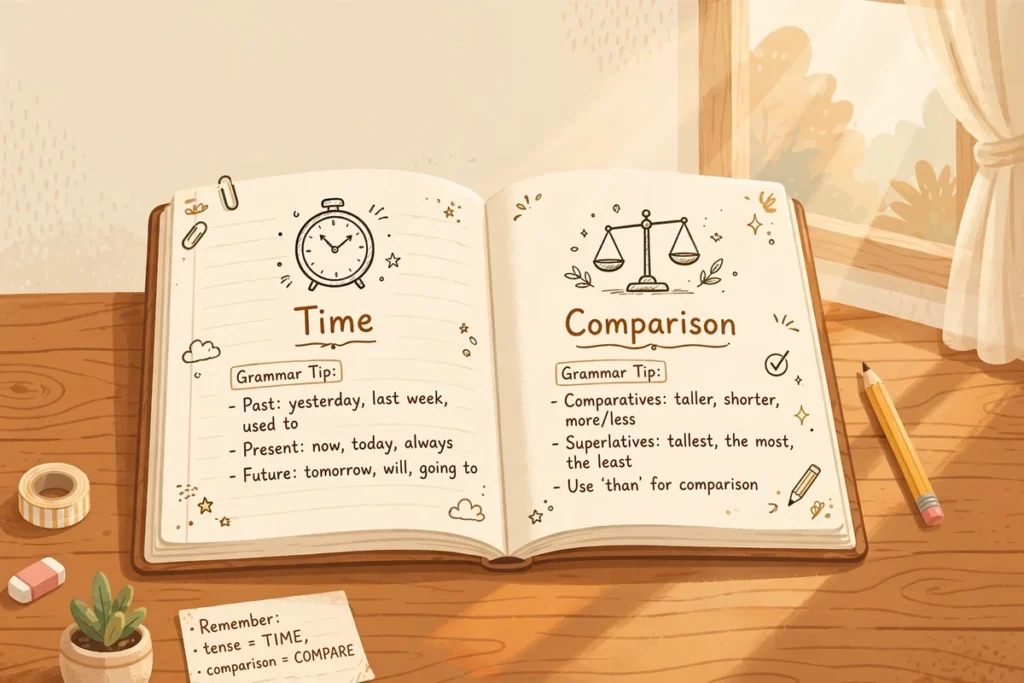
The good news is that this confusion has a clean, permanent fix. Unlike pairs of words whose meanings genuinely overlap, then and than do completely different jobs. One of them always points at time — when something happened, what happened next, or what follows from a condition. The other always points at comparison — which of two things is bigger, better, faster, or different. Once you learn to ask yourself a single question — Am I talking about time, or am I comparing? — the choice becomes automatic, and you will never have to guess again.
In this guide, we break down exactly what then means, what than means, and how the two differ in real writing. You will get a side-by-side comparison table, usage examples from everyday conversation, work emails, and formal academic prose, the most common mistakes to avoid, and the tricky edge cases — “other than,” “rather than,” “no sooner than,” and then used as an adjective. Five FAQs and a quick one-second test round things out.
What Does “Then” Mean?
Then is a word about time. It points to a moment — in the past or the future — to a step that comes next in a sequence, or to a result that follows from something else. Whenever you could replace the word with at that time, next, after that, or in that case, you almost certainly want then. Our full guide to then covers its standalone uses in detail, but the core idea is simple: if there is a clock, a calendar, or a sequence involved, then is the word.
Then wears several hats. Most often it is an adverb answering when: “We lived there then.” It is also a conjunction of sequence: “She smiled, then turned away.” And it appears in conditional logic as the second half of an if–then pair: “If it rains, then we stay home.” Through all these roles the meaning stays consistent — then never compares one thing against another.
Then as “At That Time”
The most basic job of then is to mean at that time. It can point backward into the past or forward into the future.
- Back then, the whole neighborhood gathered for dinner on Sundays.
- I will call you at six, and we can leave then.
- The price was fair then, but it has doubled since.
- If you knew then what you know now, would you have gone?
In all of these, then is interchangeable with at that time. Try the swap as a test: “Back at that time, the whole neighborhood gathered” works perfectly — and that tells you then is correct. This test almost never fails, which is why experienced editors reach for it first.
Then as “Next” or “After That”
Then is also the word for sequence — telling your reader what happened next. Narratives and instructions lean on this use constantly.
- He picked up the box, shook it, and then set it down carefully.
- Add the flour, stir for two minutes, and then add the milk.
- First she apologized; then she offered to fix the damage.
Here the test word is next or after that: “He picked up the box and next set it down” — close enough in meaning to confirm you want then. This sequential use is the one writers reach for most often in stories, how-to guides, recipes, and step-by-step instructions.
Then as “In That Case” — The If–Then Pattern
The third major use of then is in conditional statements, where it introduces a consequence or result: if X, then Y.
- If you finish your homework, then you can play outside.
- If the deadline moves, then we will need more staff.
- If not now, then when?
- If you want the job, then apply before Friday.
Note that the then in an if–then sentence is often optional — “If it rains, we stay home” is perfectly grammatical. But when it appears, it always signals the result half of the condition. The logic is time-like: the condition comes first, and then the consequence follows.
Then as an Adjective — “The Then President”
Here is a use that surprises many learners: then can act as an adjective meaning “at that time” or “former,” placed directly before a noun.
- The then president addressed the nation that evening.
- She interviewed the then mayor about the scandal.
- We moved into our then new apartment in March.
This is the one use of then that has nothing to do with a moving timeline — it freezes a moment in the past. But notice that it still relates to time, not comparison. You will mostly see it in journalism and historical writing, where it is completely standard.
What Does “Than” Mean?
Than is a word about comparison. It joins two things being weighed against each other and almost always shows up after a comparative adjective or adverb (bigger, faster, more carefully) or after words like more, less, other, and rather. If your sentence is holding two items up side by side — two people, two prices, two options — you want than.
Grammatically, than functions as a conjunction or preposition, linking the two halves of the comparison. Its meaning is fixed and narrow: it has no synonyms and no time sense at all. The quickest test is a question — if the sentence answers compared to what?, the word you need is than.
Than in Direct Comparisons
The most common use of than follows a comparative adjective or adverb. The comparative ends in -er or uses more/less, and than introduces the thing being compared against.
- This route is faster than the highway.
- She speaks more clearly than her predecessor did.
- The new policy is fairer than the old one.
- He arrived earlier than anyone expected.
Every one of these sentences is holding two things side by side: the route vs. the highway, her speaking vs. her predecessor’s. That side-by-side structure is the signature of than — whenever you see a comparative (faster, more clearly, fairer, earlier), the comparison word that follows is than, never then.
Than After “More,” “Less,” “Other,” and “Rather”
Certain words practically demand than as a partner. Memorizing these fixed pairings will prevent a whole category of mistakes.
- She has more than enough experience for the role.
- The repairs took less than a week.
- There was no one in the room other than the janitor.
- Rather than argue, he walked away.
- Would you rather than cancel? (No — this one is wrong! See the tricky cases below.)
More than and less than measure amounts and degrees. Other than means “except” — it carves an exception out of a group. Rather than presents an alternative: “Rather than argue, she called a cab” means instead of arguing. These pairings are so tight that spotting more, less, other, or rather should make your fingers type than on autopilot.
Than in “No Sooner … Than”
One fixed idiom deserves attention: no sooner … than, meaning one event followed another with no gap between them.
- We had no sooner left the house than it started raining.
- No sooner did she finish the exam than she felt relieved.
This is the one construction where than brushes up against the idea of time — but it is still a comparison at heart, comparing two moments: the sitting and the ringing, and declaring them essentially simultaneous. The than never changes, even though the sentence is about timing. (Some writers use “no sooner … when,” but “than” is the standard form.)
Then vs. Than: The Core Difference
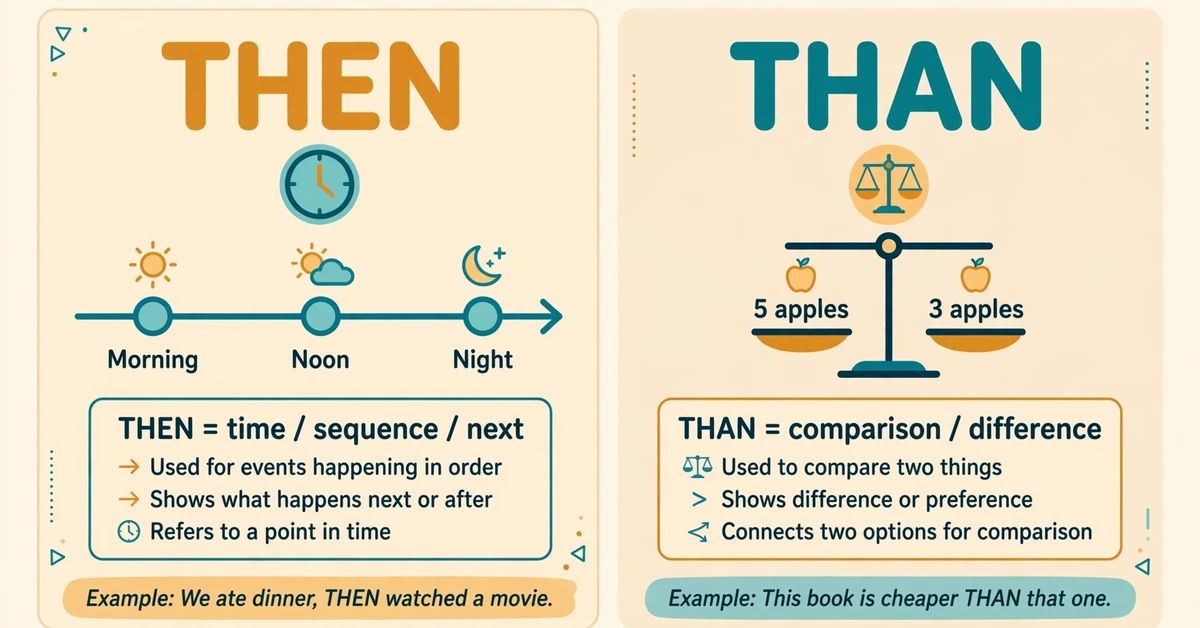
Put simply: then = time, than = comparison. On the other hand, it helps to see the full contrast laid out, because each word has uses the other never has. The table below covers the whole picture in one glance.
| Feature | Then | Than |
|---|---|---|
| Core meaning | Time, sequence, or consequence | Comparison between two things |
| Answers the question | When? What happened next? So what? | Compared to what? |
| Typical partners | if, and, since, until, just, back, now and … | bigger/faster/more (comparatives), other, rather, less, more |
| Replace-with test | Replace with at that time, next, or in that case — if the sentence still makes sense, use then | Replace with compared to — if the sentence still makes sense, use than |
| Example | “We ate, then we left.” (sequence) | “The cake is sweeter than the pie.” (comparison) |
| Example | “If you hurry, then you will make it.” (consequence) | “She is taller than her brother.” (comparison) |
| Example | “Back then, we wrote letters.” (time) | “Rather than complain, he helped.” (alternative) |
| As an adjective | Yes — “the then president” (former, at that time) | Never an adjective |
| Homophone? | Sounds like than in fast speech | Sounds like then in fast speech |
The fastest reliable test mid-sentence is the replacement trick. Ask: does this sentence involve a clock, a calendar, or a sequence? If yes, then. Ask: am I holding two things side by side to compare them? If yes, than.
Usage Examples Across Contexts
The same word can feel very different in a text message, a work email, and an academic paper. Here is how then and than behave across three registers of real writing.
Everyday Conversation
In casual speech and texting, both words are short, frequent, and — because of how fast we talk — easily swapped by accident.
- “I will text you when I leave, and then head over.”
- “If you are tired, then take a nap — no one will mind.”
- “This pizza is way better than the last one.”
- “Other than the noise, the apartment is perfect.”
Notice how in conversation then keeps things moving in time (leave, then head over) while than keeps comparing (better than). In speech both can sound like “thun,” which is exactly why the confusion starts in conversation and bleeds into writing.
Work and Business Writing
Professional writing rewards precision, and this is where a then/than mix-up does the most damage to credibility. These words show up constantly in emails, reports, and presentations.
- “The team will review the proposal, and then we will schedule a follow-up call.”
- “If the client approves, then the project moves to phase two.”
- “Our delivery times are now shorter than our competitors’.”
- “The revised budget is lower than last quarter’s by twelve percent.”
- “Rather than delay the launch, we will ship the core features first.”
In business prose, than almost always sits in comparisons of metrics — shorter than, lower than, higher than — while then keeps timelines and conditional plans straight. Mixing them up in a client report (“our costs are lower then last year”) is the kind of small error that makes a careful reader doubt the big numbers.
Formal and Academic Writing
Academic writing uses both words with stricter rules, and it is also where the unusual uses — like adjectival then — appear most often.
- “The participants completed the survey and then took part in the interview.”
- “If the hypothesis holds, then the results should show a clear trend.”
- “The treatment group scored significantly higher than the control group.”
- “There was no evidence, other than the witness’s account, to support the claim.”
- “No sooner had the data been collected than the analysis began.”
- “The then director of the program resigned in 2019.”
Academic prose also leans on polite-request softeners in correspondence — a sentence like “I was wondering whether you could share the dataset” is standard in formal emails (see our note on i-was-wondering). In formal writing, both words carry real argumentative weight: then builds logical chains, while than builds comparisons of evidence.
Common Mistakes to Avoid
1. “Bigger then” and other comparative errors. The single most common mistake is writing then after a comparative adjective: “She is smarter then me,” “It is cheaper then last time.” This is always wrong. A comparative (smarter, cheaper, better, faster) is a neon sign pointing at than. The fix is instant: if the word before it ends in -er or is a more/less phrase, the next word is than — full stop.
2. Swapping in sequence sentences. The reverse error appears in narratives: “First we ate, than we left.” Here than has no comparison to support it — nobody is being compared to anything. The sentence is pure sequence, so it needs then: “First we ate, then we left.” When a sentence lists events in order, then is the connector.
3. “More then” in measurements. Phrases of quantity trip people up: “It costs more then fifty dollars” should be “more than fifty dollars.” The word more is comparing an amount against a benchmark, so than follows. This one is worth memorizing as a fixed pair: more than, less than, fewer than.
4. “Rather then” for alternatives. When presenting an alternative — “Rather then complain, he helped” — the correct word is than: “Rather than complain, he helped.” Remember that rather always pairs with than, just like other pairs with than in “other than.”
5. The “if…then” logic chain. In formal reasoning, some writers drop or swap the then: “If sales fall, than we cut costs.” The condition-consequence pattern is an if–then construction. It helps to say the pair aloud — “if sales fall, in that case we cut costs” — and hear that in that case is the natural fit, not compared to.
Tricky Cases and Edge Cases
“Other Than” vs. “Other Then”
“Other than” is always spelled with than. It means “except”: “Nothing other than water was served.” There is no such construction as “other then” — if you catch yourself writing it, the than version is correct. The word other sets up an exclusion, which is a form of comparison (everything vs. the exception).
“Rather Than” — And the “Would Rather” Trap
“Rather than” (meaning instead of) always uses than: “Rather than fly, she drove.” But watch out for the nearby phrase “would rather,” which is followed by a bare verb and never by than at all: “I would rather stay home.” The trap sentence “Would you rather than cancel?” mashes the two patterns together. The correct versions are “Would you rather cancel?” or “Would you prefer to cancel rather than postpone?”
“No Sooner Than” — The One Time “Than” Talks About Time
As noted above, “no sooner … than” describes two events happening back to back. Beginners sometimes write “no sooner … then” because the sentence is about timing — but the idiom is frozen with than: “No sooner had we arrived than it began to snow.” This is the rare case where your time-instinct points the wrong way, so memorize the pair as a unit.
“Then” as a Noun and in Idioms
Then can also be a noun meaning “that time”: “Until then, we wait.” It appears in idioms like “now and then” (occasionally), “back then,” “just then,” and “and then some.” None of these have than versions. If you see than in one of these idioms (“now and than”), it is a typo.
Implied Comparisons — “Than” With a Missing Half
Comparisons do not always spell out both halves. In “She is taller than I am,” the full clause is “than I am tall” — the second half is implied but real. In casual speech you will hear “taller than me,” which is widely accepted in informal registers (though “than I” is preferred in strict formal writing). The than is correct in both because a comparison is happening, even when the second half is trimmed for brevity.
“Then” at the End of a Sentence
A then can close a sentence for emphasis or mild impatience: “Fine, have it your way then.” / “What do you want me to do, then?” This is a discourse use — it adds attitude rather than clock time — but it is still then, never than. If you can feel the slight shoulder-shrug in the sentence, the spelling is t-h-e-n.
Frequently Asked Questions
Is it “then” or “than” in “bigger than I thought”?
It is “bigger than I thought.” Bigger is a comparative adjective, and comparatives are always followed by than, never then. A quick test: you are comparing two things (the size you expected vs. the size you found), and comparisons belong to than. The “then” version — “bigger then I thought” — is one of the most common spelling errors in English writing.
How can I remember the difference between then and than?
Use the time-vs-comparison rule: then is about time, than is about comparison. A popular memory trick: then and when both end in “-en,” and both are about time — “when did it happen? It happened then.” Meanwhile, than and comparison both contain the letter “a.” Pair either trick with the replacement test: if you can swap in next or at that time, use then; if you can swap in compared to, use than.
Is it “other than” or “other then”?
It is “other than” — always. This phrase means “except” or “apart from,” as in “No one other than the manager has the key.” The word other is carving an exception out of a group, which is a comparison-like relationship, so than is the correct partner. “Other then” is simply a misspelling.
Is it “rather than” or “rather then”?
It is “rather than.” The phrase means instead of and presents an alternative: “Rather than wait, we left.” Rather is one of the fixed partners of than (along with more, less, and other). Be careful not to confuse this with “would rather,” which takes a plain verb and no than at all — “I would rather stay home.”
Can “then” and “than” ever be used interchangeably?
No. They are never interchangeable in standard English. Then always relates to time, sequence, or consequence; than always relates to comparison. The only overlap is in the ear: in fast speech, both can sound like “thun,” which is why the confusion exists at all. On the page, they live in different worlds — swapping them is always an error, even though it rarely changes the reader’s understanding of what you meant.
Conclusion
The then-or-than problem looks big only because the two words sound alike. Underneath, the rule is one of the tidiest in English: then is your time word — at that time, next, after that, in that case — and than is your comparison word — bigger than, other than, rather than. Ask which job the sentence needs, apply the replacement test when unsure, and the choice makes itself.
Make a habit of running this one-second check when time permits while polishing your drafts. Most people discover they have been making one of the five classic mistakes without ever noticing. Fix those, and this is one grammar worry you can cross off your list for good.