
Few English mix-ups are as sneaky as this one. The verbs look almost identical, the noun “lead” is pronounced exactly like the past tense “led,” and to complete the trap, the verb “lead” is pronounced completely differently from its own past tense. It is a triple knot of spelling, tense, and pronunciation — and writers tie themselves in it daily: “She lead the team to victory” appears in published articles more often than anyone wants to admit.
The confusion has a clear anatomy. The verb “to lead” (pronounced “leed”) means to guide or direct. Its past tense is “led” (pronounced “led,” rhyming with “red”). And then there is the noun “lead” — a heavy, soft metal — which is also pronounced “led.” So the sound “led” can be either the past tense of the verb or the metal, while the spelling “lead” can be either the present-tense verb (“leed”) or the metal (“led”). No wonder writers get tangled.
The core rule is short: “led” is the past tense of the verb “to lead,” and “lead” is the present tense (pronounced “leed”) or the metal (pronounced “led”). This guide untangles all three — the verb’s tenses, the noun’s two pronunciations, memory tricks that actually work, examples across every register, the mistakes to avoid, and answers to the five questions people ask most.

What Does “Led” Mean?
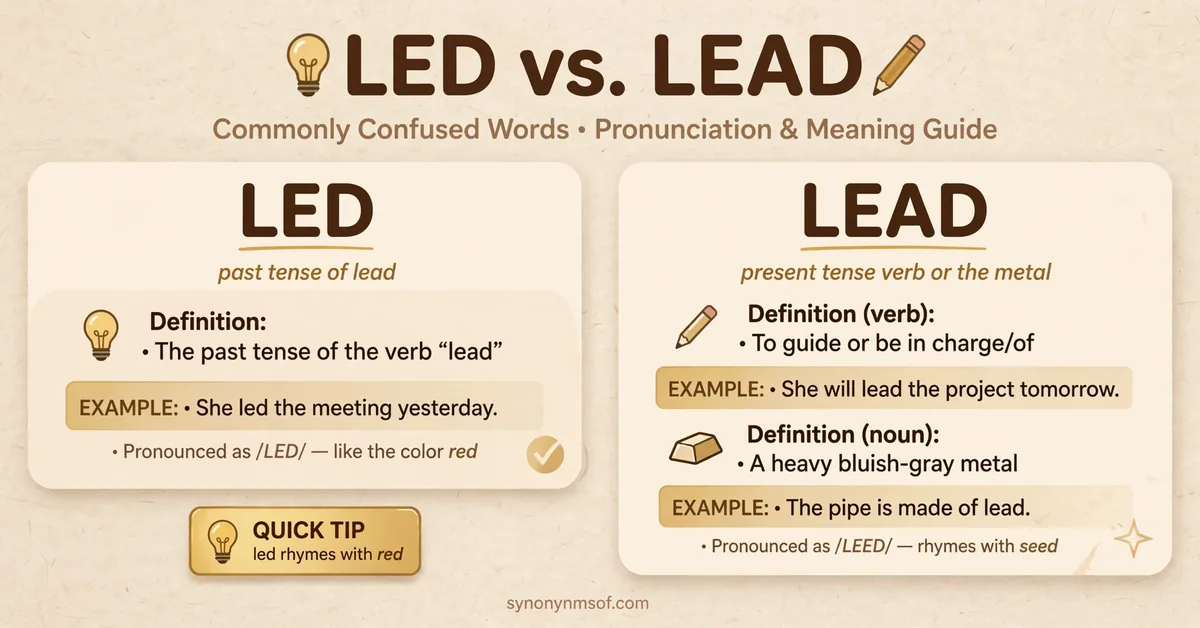
“Led” (pronounced “led,” rhyming with “red”) is the past tense and past participle of the irregular verb “to lead.” It describes guiding, directing, or being in charge — as something that already happened.
- “She led the team to victory last season.”
- “The guide led us through the old town.”
- “His research led to a breakthrough.”
- “They have led the market for a decade.” (past participle)
“Led” is always a verb, always past, and always pronounced “led.” It never refers to the metal — the metal is always spelled “lead,” even though it sounds the same. If the action already happened, “led” is your word.
Led as Simple Past Tense
The simple past is “led’s” most common job: a completed act of guiding or directing.
- “The captain led the expedition across the desert.”
- “Curiosity led her to open the letter.”
- “The path led straight to the lake.”
The substitution test: if you can replace the word with “guided” or “directed” and the sentence still works, “led” is correct. “The captain guided the expedition” ✓ — so “led” is right.
Led as Past Participle
“Led” is also the past participle, used with “have/has/had” in perfect tenses and in passive constructions.
- “She has led three successful campaigns.”
- “The project was led by a veteran engineer.” (passive)
- “He had led the discussion before the interruption.”
Note the trap: the past participle looks exactly like the simple past (“led” both times). That is normal for this verb — like “held” or “fed.” Do not invent a form like “leaded” for the guiding verb; “leaded” exists only for the metal (see below).
What Does “Lead” Mean?
“Lead” is the busy one — a single spelling with three distinct identities, split across two pronunciations.
Lead as a Present-Tense Verb (pronounced “leed”)
As a verb, “lead” (rhyming with “seed”) means to guide, direct, show the way, or be in charge — in the present or future.
- “She will lead the workshop tomorrow.”
- “Good habits lead to good results.”
- “This road will lead you back to town.”
- “I lead a team of twelve engineers.”
Conjugation: lead, leads, leading — and then the irregular jump to led for past and past participle. There is no “leaded” for this verb. Ever.
Common verb-based expressions: “take the lead” (move into first place), “lead the way” (go first, show the path), “lead by example” (influence through your own behavior).
Lead as a Noun: First Place (pronounced “leed”)
As a noun pronounced “leed,” “lead” means the foremost position — being ahead of others.
- “The marathon runner took the lead in the final mile.”
- “Our team has a four-point lead.”
- “She was cast in the lead role.” (also used as an adjective: “lead singer,” “lead actor,” “lead story”)
This is the “front-runner” sense — leadership as a position rather than an action.
Lead as a Noun: The Metal (pronounced “led”)
As a noun pronounced “led” (rhyming with “red” — exactly like the past-tense verb), “lead” is a heavy, soft, gray-blue metallic element (symbol Pb on the periodic table).
- “Old houses may still contain lead paint.”
- “Lead is dense but melts at a low temperature.”
- “Exposure to lead is a serious health hazard.”
This pronunciation overlap is the heart of the confusion: the metal “lead” and the past tense “led” sound identical. Spelling is the only thing separating them — and the rule is absolute: the metal is always spelled l-e-a-d.
Lead as a Verb for the Metal: “Leaded”
One more corner of the map: “lead” can be a regular verb meaning “to cover or treat with the metal lead” — and this one conjugates regularly.
- “The old windows were leaded.” (fitted with lead)
- “They leaded the fuel to boost octane.” (historical: added lead to gasoline)
Pronounced “led-ed,” spelled with the “-ed.” This verb has nothing to do with guiding anyone — it is about the metal. Then there is no excuse for writing “he leaded the team”: the guiding verb’s past is always “led.”
Led vs Lead: The Core Difference
The difference is tense — present versus past — plus one noun that complicates everything. Ask two questions:
1. When did the guiding happen? Now or in the future → lead (leed). Already happened → led.
2. Am I talking about the metal? → Always lead (pronounced “led”).
- “She leads the choir.” (present — lead)
- “She led the choir.” (past — led)
- “She will lead the choir.” (future — lead)
- “The choir’s robes contain lead.” (metal — lead)
The Pronunciation Map
Say the words aloud and the fog lifts. There are only two sounds and three spellings:
| Spelling | Pronunciation | Meaning |
|---|---|---|
| lead (verb, present) | “leed” (rhymes with seed) | to guide, direct |
| led (verb, past) | “led” (rhymes with red) | guided, directed |
| lead (noun, metal) | “led” (rhymes with red) | the metallic element |
| lead (noun, position) | “leed” (rhymes with seed) | first place |
The verb “lead” and its past “led” are not homophones — they sound different. Only the metal “lead” and the past tense “led” share a sound. If you say the sentence aloud, the pronunciation tells you which meaning you intend; then match the spelling to the meaning.
The “Read/Read” Trap
Many writers assume “lead” works like “read”: same spelling, different pronunciation for past tense (“read” pronounced “red”). It does not. “Read” keeps its spelling in the past; “lead” changes its spelling to “led.” The analogy is tempting and completely wrong — which is exactly why the error “she lead the team yesterday” is so widespread. Burn this into memory: the past tense of “lead” is spelled “led,” with no “a.”
Memory Tricks That Work
- “Led” rhymes with “red” — and both describe the past. Yesterday’s action, yesterday’s color. “Yesterday she led; the light was red.”
- The metal is heavy like “bread” — and “lead” (metal) rhymes with “bread.” Both are spelled with “ea” and pronounced “eh.”
- “Lead” the verb has the long “e” of “leader.” A leader leads (leed). The word “leader” itself reminds you of the pronunciation.
Led vs Lead: Comparison Table
| Feature | Led | Lead (verb) | Lead (noun, metal) |
|---|---|---|---|
| Part of speech | Verb (past) | Verb (present/future) | Noun |
| Pronunciation | “led” (rhymes with red) | “leed” (rhymes with seed) | “led” (rhymes with red) |
| Meaning | Guided, directed (past) | To guide, direct | Heavy metallic element (Pb) |
| Example | “He led the parade.” | “He will lead the parade.” | “The pipes contain lead.” |
| Past participle | led (“has led”) | — | — |
| Present participle | — | leading | — |
| Regular “-ed” form? | No (irregular) | No | Yes, but only as metal-verb: “leaded” |
| Common error | Writing “lead” for past | Writing “led” for present | Confusing with past-tense “led” |
Usage Examples in Real Life
Everyday Conversation
- “My older brother led the hike last summer.” (past)
- “Can you lead the way? I don’t know this neighborhood.” (present)
- “The recipe says the sauce will lead to — I mean, will result in — a thicker soup.” (present; note how “lead to” means “result in”)
- “This trail led us straight to the waterfall.” (past)
- “Don’t worry, the signs will lead you back.” (future/present)
In speech the pronunciation does the disambiguating automatically — nobody confuses “leed” and “led” aloud. The trouble starts only when fingers hit keyboards.
Work and Business Writing
- “She led the Q3 product launch to record sales.” (past)
- “He will lead the client presentation on Thursday.” (future)
- “Our company leads the market in customer satisfaction.” (present)
- “The investigation led to three policy changes.” (past)
- “The new director has led turnarounds at two previous firms.” (past participle)
Business writing is full of leadership language, so this pair appears constantly. “Led” in a resume bullet (“Led a team of eight”) is correct; “Lead a team of eight” in the experience section describes past work and should be “Led.”
Academic and Formal Writing
- “The study was led by Dr. Chen.” (passive, past participle)
- “These findings led researchers to revise the model.” (past)
- “Strong institutions lead to stable growth.” (present — “lead to” = result in)
- “The data led to a single conclusion.” (past)
- On the other hand, chemistry and physics papers use the metal constantly: “The samples were shielded with lead bricks.” Here the spelling never changes and the pronunciation is always “led.”
Formal writing also hosts the rarest sense — the regular verb “leaded”: “The stained glass was leaded in the traditional manner.” If you meet “leaded” in the wild, it is about the metal, never about guiding.
Led vs Lead Across Tenses: The Full Conjugation Picture
Most English verbs are polite: add “-ed” and you get the past tense. “Lead” refuses. It belongs to the vowel-changing club — the same family as “feed/fed” and “bleed/bled.” Once you see the full conjugation laid out, the pattern stops feeling random.
Here is the complete picture for the guiding verb “to lead”:
| Tense / Form | Spelling | Pronunciation | Example |
|---|---|---|---|
| Base form / infinitive | lead | “leed” | “They will lead the parade.” |
| Third-person singular | leads | “leeds” | “She leads the morning briefing.” |
| Present participle | leading | “leeding” | “He is leading the workshop.” |
| Simple past | led | “led” | “She led the workshop yesterday.” |
| Past participle | led | “led” | “They have led the division for years.” |
Notice what never appears: “leaded.” The guiding verb has no regular past form in any tense or English variety. If your fingers type “leaded” for guiding, delete the “a” — unless you are writing about the metal.
The third-person singular is where present-tense errors hide. “She leads the team” (habitual) and “She led the team” (completed) differ by one letter and one sound. Time markers are your bodyguards: “every day” and “now” call for “leads,” while “yesterday” and “last week” demand “led.”
Perfect tenses use the past participle — identical to the simple past here, which surprises writers expecting a different form. “She has led three expeditions,” “she had led two before that one,” “she will have led the team for a year by December”: all “led.” The passive matches: “The tour was led by a local historian.” Never “has leaded” or “was lead.”
Hypotheticals shift mood only: “If she leads the negotiations, we will finish early” (real possibility) versus “If she led the negotiations, we would finish early” (hypothetical — still “led”). After verbs like “insist,” use the bare infinitive: “The board insisted that she lead the inquiry” (“leed”).
Finally, the metal’s verb sits on its own shelf and conjugates regularly: lead, leads, leading, leaded, leaded — short “e” throughout. “The old tower’s joints were leaded against the weather.” Rare and mostly historical — but there the “-ed” is correct.
The decision flow is mechanical: find the time of the action, pick the row in the table, check your pronunciation. Present or future guiding is “lead” (leed); completed guiding is “led.” The metal never changes.
Common Mistakes to Avoid
Mistake 1: “Lead” for the past tense. “She lead the meeting yesterday” is the number-one error. Yesterday means past; the past of “lead” is led: “She led the meeting yesterday.” If you can put “yesterday” or “last week” in the sentence, you almost certainly need “led.”
Mistake 2: “Led” for the present tense. “He leds the team now” and “they led the project currently” are wrong in the other direction. Present and future guiding is always lead (leed): “He leads the team now.”
Mistake 3: “Leaded” for the guiding verb. “She leaded the discussion” is wrong — “leaded” belongs only to the metal (“the windows were leaded”). The guiding verb is irregular: lead → led → led. There is no “leaded” in its conjugation.
Mistake 4: Confusing the metal with the past tense in writing. “The paint contained led” is wrong — the metal is always spelled lead, even though it sounds like “led.” Sound is not spelling here; memorize the metal’s spelling separately.
Mistake 5: “Lead” pronounced “led” as a verb. Reading “I lead the team” aloud as “I led the team” changes the tense — and listeners will hear the past. The verb “lead” in present tense is always “leed.” This matters in presentations and speeches.
Mistake 6: The “read/read” analogy. Assuming “lead” keeps its spelling in the past because “read” does. It does not. “Read” is the exception; “lead” → “led” follows the normal irregular pattern (like “feed” → “fed,” “bleed” → “bled”).
Tricky Cases
LED (all caps) — the light. In capitals, LED is an acronym for “light-emitting diode”: “The screen uses LED backlighting.” It has nothing to do with guiding or with metal. Context (technology, lighting) makes it obvious, but the spelling collision confuses beginners.
“Get the lead out.” This idiom means “hurry up” — and it uses the metal: “Get the lead out and finish the report!” The image is of shaking heavy lead weights out of your shoes. Always spelled “lead,” pronounced “led.”
“Go over like a lead balloon.” Something that fails badly “goes over like a lead balloon” — the metal again (a balloon made of lead could never fly). Spelled “lead,” pronounced “led.”
“Lead the way” vs “led the way.” Both exist — tense decides. “Follow me; I’ll lead the way” (future). “She led the way through the crowd” (past). The idiom does not freeze the tense.
Newsroom “lede.” Journalists sometimes spell the opening paragraph of a story “lede” (pronounced “leed”) to avoid confusion with “lead” the metal in hot-type printing days. It is intentional jargon, not a misspelling — but outside newsrooms, stick with “lead.”
“Lead” as an adjective. “The lead singer,” “the lead role,” “the lead investigator” — pronounced “leed,” meaning “main” or “foremost.” It never becomes “led” in this role; adjectives do not have tenses.
British vs American usage. No regional split exists. “Led” and “lead” work identically in all English varieties — this pair is pure grammar and vocabulary, not spelling convention.
Practice: Test Yourself
Choose “led” or “lead” for each sentence, then check your answers. Say each sentence aloud first — the pronunciation (“leed” vs “led”) is your best clue.
1. She ___ the charity gala last spring.
2. Who will ___ the discussion tomorrow?
3. The old paint contained dangerous levels of ___.
4. His curiosity ___ him to try programming.
5. Good preparation ___ to good presentations.
6. They have ___ the league since October.
7. The guide will ___ us through the canyon at dawn.
8. She took the ___ in the final lap.
9. The investigation ___ to two arrests.
10. Please ___ the way to the exit.
Answers: 1. led (past — “last spring”). 2. lead (future — pronounced “leed”). 3. lead (the metal — pronounced “led”). 4. led (past). 5. lead (“lead to” = results in; present, pronounced “leed”). 6. led (past participle with “have”). 7. lead (future, pronounced “leed”). 8. lead (noun, first place — pronounced “leed”). 9. led (past). 10. lead (present imperative, pronounced “leed”).
Nine or ten correct means you have mastered the trio. If the metal questions tripped you, remember: the metal is always spelled l-e-a-d, no matter how it sounds.
Frequently Asked Questions
What is the difference between led and lead?
“Led” (pronounced “led”) is the past tense of the verb “to lead” — “she led the team.” “Lead” is the present-tense verb (pronounced “leed”) — “she will lead the team” — or the noun for the metal (pronounced “led”) — “lead pipes.” Tense and meaning decide the spelling.
Is it “led” or “lead” for the past tense?
Always “led.” The verb “to lead” is irregular: lead (present) → led (past) → led (past participle). There is no “leaded” for the guiding verb. If the action already happened, write “led.”
How do you pronounce “lead”?
It depends on the meaning. The verb “to lead” (to guide) is pronounced “leed,” rhyming with “seed.” The noun “lead” (the metal, or first place as in “take the lead”) — the metal is pronounced “led,” rhyming with “red,” while the first-place sense is pronounced “leed.” Context tells you which.
Is “leaded” a word?
Yes, but only for the metal. “Leaded” is the regular past tense of the verb “to lead” meaning “to treat with lead”: “leaded windows,” “leaded gasoline.” It never means “guided” — “she leaded the team” is always wrong.
What does LED in capital letters mean?
LED is an acronym for “light-emitting diode,” the technology in modern screens and bulbs. It is unrelated to the verb “to lead” and the metal “lead” — the identical letters are a coincidence. In tech contexts, “LED” almost always means the light.
Conclusion
Led and lead look like a typo waiting to happen, but they resolve into a clean system: “lead” (leed) guides in the present, “led” guides in the past, and “lead” (led) names the metal. Two pronunciations, three meanings, and one firm rule — the past tense of “to lead” is always spelled “led,” no matter how much it resembles “read.”
Say the sentence aloud to find your meaning, match the spelling to that meaning, and distrust the “read/read” analogy that causes most of the damage. With the tense test and the pronunciation map in hand, this triple knot unties itself — and stays untied. The same check-your-spelling habit pays off elsewhere — for example, our guide to benefitting or benefiting settles a common letter-doubling question. Binge-watchers take note: getting bingeing or binging right keeps your streaming reviews consistent. Gendered spellings can trip writers up too, as our breakdown of blond or blonde shows. And few pairs confuse as often as breath or breathe — a quick refresher there pays off every day.