

Gray or grey — which one is right? If you have ever hesitated before typing the color, you are not alone. This is one of the most searched spelling questions in English, and the answer is refreshingly simple: both are correct, but which one you should use depends on where you are writing.
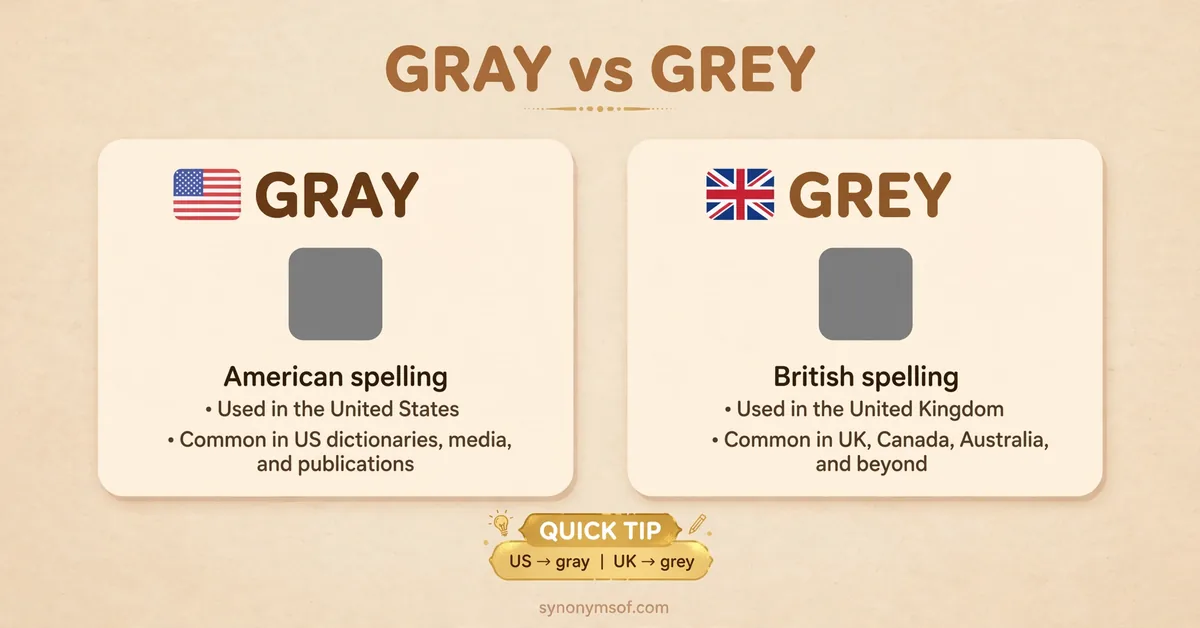
The difference between “gray” and “grey” is a matter of regional spelling convention, not meaning. American English prefers gray, while British English prefers grey. They describe the exact same color — the neutral tone between black and white — and they are pronounced identically. The choice is about audience and consistency, not correctness in any absolute sense.
Still, the details matter. Proper nouns like “Earl Grey tea” or the novel “Fifty Shades of Grey” keep their original spelling no matter where you live. And switching spellings mid-document looks careless, even though neither form is wrong. This guide covers the full picture: what each spelling means, the US vs UK rules, proper-noun exceptions, and plenty of real examples so you never hesitate again.

What Does “Gray” Mean?
“Gray” is the standard American English spelling of the color between black and white. It functions as an adjective (“a gray sky”), a noun (“a mix of grays”), and a verb (“his hair grayed early”).
- “The gray clouds rolled in before noon.” (adjective)
- “She painted the kitchen a soft gray.” (noun)
- “His beard started graying in his thirties.” (verb)
- “The interview covered a lot of gray areas.” (idiom: ambiguous topics)
Beyond color, “gray” carries figurative weight in American usage: “gray matter” (the brain), “gray area” (moral ambiguity), “gray market” (unofficial but legal trade). These idioms all use the American spelling in US publications.
Gray in American Usage
American style guides are unanimous. The AP Stylebook, the Chicago Manual of Style, and Merriam-Webster all list gray as the preferred spelling. If you write for an American audience — US publications, American companies, US school assignments — use “gray” consistently.
Then there is the matter of habit: most Americans have rarely seen “grey” in print, and using it can momentarily distract a US reader. Consistency with your audience’s expectations is part of good writing.
What Does “Grey” Mean?
“Grey” is the standard British English spelling of the same color. It works identically — adjective, noun, verb — and means exactly the same thing as “gray.”
- “A grey mist hung over the Thames.” (adjective)
- “The walls were a warm grey.” (noun)
- “Her hair greyed gracefully.” (verb)
- “It’s a grey area in the regulations.” (idiom)
The Oxford English Dictionary, BBC style, and UK publishers all use grey. Canadian, Australian, and New Zealand English generally follow the British convention too, though Canadian usage can be mixed.
Grey in British and Commonwealth Usage
British readers expect “grey” the way American readers expect “gray.” The Guardian, the BBC, and Penguin UK all use it without exception. On the other hand, American novels sold in the UK are often re-spelled by publishers — “Fifty Shades of Grey” keeps its E even in the US edition because it is a proper title (see below).
Gray vs Grey: The Core Difference
There is exactly one difference: geography. “Gray” is American; “grey” is British. Everything else — meaning, pronunciation, grammar — is identical.
- Spelling: gray (US) vs grey (UK)
- Meaning: identical — the color between black and white
- Pronunciation: identical — /ɡreɪ/
- Parts of speech: identical — adjective, noun, verb
- Figurative uses: identical — gray/grey area, gray/grey matter
The Regional Rule in One Line
Writing for Americans? Use gray. Writing for Britons (or Canadians, Australians)? Use grey. Writing for a global audience? Pick one and stay consistent — most international publications default to one variety’s spelling across the board.
Gray vs Grey: Comparison Table
| Feature | Gray | Grey |
|---|---|---|
| Region | American English | British English (also Canada, Australia, NZ) |
| Meaning | The color between black and white | The color between black and white |
| Pronunciation | /ɡreɪ/ | /ɡreɪ/ |
| Parts of speech | Adjective, noun, verb | Adjective, noun, verb |
| Example | “a gray suit” | “a grey suit” |
| Style guides | AP, Chicago, Merriam-Webster | OED, BBC, Guardian |
| Common error | Using it for a UK audience | Using it for a US audience |
Proper Nouns: The Big Exception
Proper nouns keep their original spelling regardless of your audience’s variety. This is the one place where the regional rule stops.
- Earl Grey tea — always “Grey,” even in the US. It is named for Charles Grey, the British prime minister.
- “Fifty Shades of Grey” — the novel’s title keeps the E in every edition worldwide.
- Grey’s Anatomy — the TV show title keeps its spelling (named for a character, Meredith Grey).
- Zane Grey — the American Western novelist spelled his name “Grey,” despite being American.
- Lady Jane Grey — the historical figure’s surname is fixed.
- Greyhound — the dog breed and the bus company are always “Greyhound.”
The rule: if it is someone’s name or a published title, spell it the way its owner spells it. If you are unsure, look it up — getting a proper noun wrong is a bigger error than picking the wrong regional variant of the color.
People Named Gray/Grey
Both surnames exist: Dorian Gray (Oscar Wilde’s character) vs. Charles Grey (the prime minister). Never “correct” a person’s name to match your regional spelling.
Usage Examples in Real Life
Everyday Conversation
- “The sky turned gray before the storm.” (US)
- “The sky turned grey before the storm.” (UK)
- “I bought a gray sweater on sale.”
- “Grandad’s hair went grey in his forties.”
Work and Business Writing
- “The report highlights several gray areas in compliance.” (US business)
- “The committee noted grey areas in the policy.” (UK business)
- “Our logo uses three shades of gray.”
Academic and Formal Writing
- “The study measured gray matter volume.” (US journals)
- “The study measured grey matter volume.” (UK journals — e.g., “grey matter” in The Lancet)
- “Participants sorted the gray swatches by lightness.”
Common Mistakes to Avoid
Mistake 1: Mixing both spellings in one document. “The gray clouds” in paragraph one and “the grey mist” in paragraph three looks sloppy. Pick one per document.
Mistake 2: Using “grey” for an American audience (or “gray” for a British one). Neither is wrong, but both can distract readers who expect their own variety.
Mistake 3: “Correcting” proper nouns. “Earl Gray tea” and “Fifty Shades of Gray” are wrong — proper nouns keep their spelling.
Mistake 4: Assuming one spelling is “more correct.” They are equal variants. Arguing that “grey” is fancier or “gray” is simpler is a style preference, not a rule.
Mistake 5: Forgetting the verb forms. “Grayed/greyed,” “graying/greying” follow the same regional pattern — keep them consistent with your chosen spelling. Some verbs accept two past-tense spellings, like burned or burnt.
Tricky Cases
Canadian English. Canada officially leans British (“grey”), but American influence means you will see both. Canadian government and media style generally prefer “grey.”
International organizations. The UN and many NGOs use British spelling (“grey”); American multinationals use “gray.” Follow your organization’s house style.
Dog breed vs color. “Greyhound” is always spelled with an E — it is a proper noun (the breed name), not the color + hound.
“Gray area” in legal writing. US legal writing uses “gray area”; UK legal writing uses “grey area.” Match the jurisdiction.
SEO and search. If your audience is American, “gray” will match their searches; “grey” matches British searches. Some sites include both in metadata for international reach.
Frequently Asked Questions
Which is correct: gray or grey?
Both are correct. “Gray” is the American English spelling and “grey” is the British English spelling. They mean the same color and are pronounced identically. Use the one that matches your audience.
Is it gray or grey in Canada?
Canadian English generally prefers “grey” (the British spelling), though American influence means “gray” appears too. Official and media style in Canada leans toward “grey.”
Why is it “Earl Grey” and not “Earl Gray”?
Because it is a proper noun named after Charles Grey, a British prime minister. Proper nouns keep their original spelling regardless of regional conventions — even in American writing.
Does gray/grey have different meanings?
No. The meaning is identical: the neutral color between black and white, plus the same figurative uses (“gray area,” “gray matter”). Only the spelling differs by region.
Which spelling should I use for an international audience?
Pick one and be consistent throughout the document. Many global publications default to American spelling (“gray”) for simplicity, but either is acceptable as long as you do not mix them.
Conclusion
Gray and grey are the same word wearing different regional outfits. American English dresses it as “gray”; British English as “grey.” The meaning, pronunciation, and grammar never change — only the audience’s expectation does.
Choose the spelling your readers expect, keep it consistent from the first paragraph to the last, and leave proper nouns exactly as their owners spell them. That is the entire rule, and it is one of the easiest in English to get right every time. Other spelling pairs, like engrained or ingrained, follow their own rules.