
Almost every English writer has paused mid-sentence and wondered: is it “whether or not,” or is plain “whether” enough? The phrase appears everywhere — in job applications, wedding invitations, business emails, and novels. “Let me know whether or not you can make it.” “We’re leaving whether or not you’re ready.” It sounds natural, yet many of us carry a nagging doubt that the “or not” might be unnecessary, or that “if” could have done the same job.
That doubt is understandable: “whether or not” works as a conjunction, frames choices, reports questions, and expresses the stubborn idea of “regardless.” Dictionaries give it more than one meaning, style guides disagree about when it is wordy, and learners mix it up with “if” more than almost any other pair.
The quick answer is reassuring: “whether or not” is perfectly correct English, and it earns its place whenever you want to stress that two opposite possibilities lead to the same outcome, or that you genuinely do not know which alternative is true. Below you will learn what the phrase means in each of its senses, how it differs from plain “whether” and “if,” the six grammar rules that govern it, and the mistakes even confident writers make.

What Does “Whether or Not” Mean?
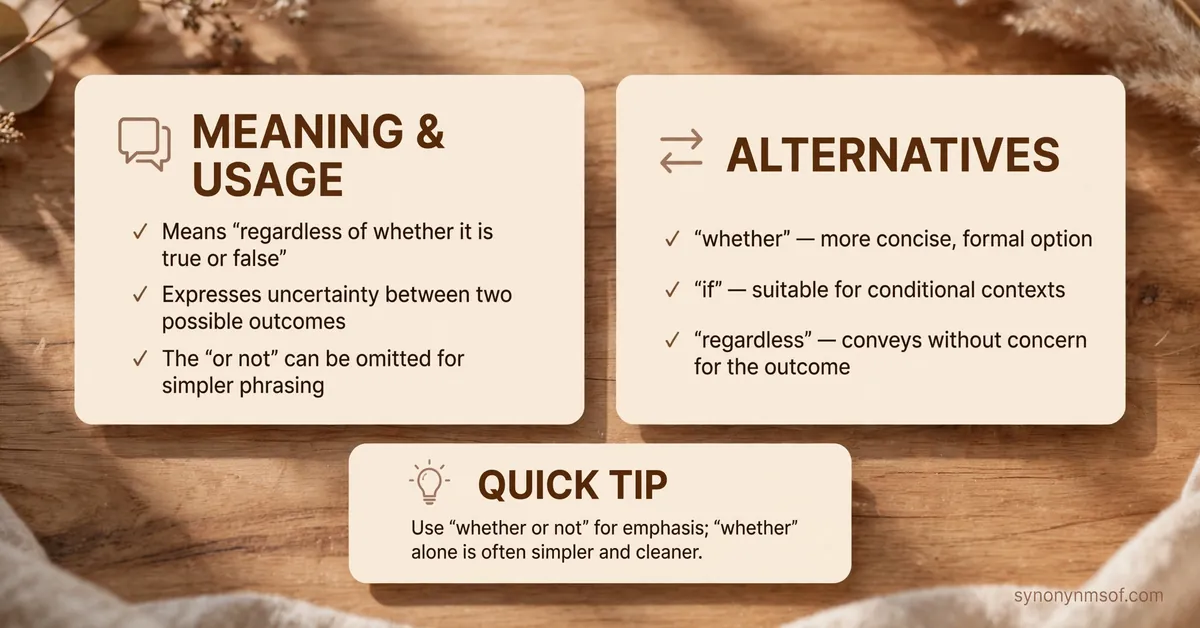
At its heart, “whether or not” is a conjunction built from “whether” plus an explicit “or not.” Where “whether” quietly implies two alternatives, “whether or not” puts the negative one on the table, so the reader sees both possibilities at once. Dictionaries recognize three closely related senses.
Sense 1: “Regardless Of” — The Concessive Use
The most common meaning of “whether or not” is “regardless of” or “no matter.” Here the phrase introduces a condition that will not change what happens next: the main clause states a fixed outcome, and the “whether or not” clause names something that might vary but does not matter. “We’re going to the beach whether or not it rains.” The rain is uncertain; the beach trip is certain. Both possibilities — rain and no rain — are covered, and the result is identical either way.
This is the language of determination. “She will finish the marathon whether or not her knee holds up.” “The shop opens at nine whether or not the delivery arrives.” If your sentence can be rephrased with “no matter” or “regardless,” this is the sense you are using — and it is the one where the full phrase is hardest to replace.
Sense 2: “If It Is True That” — The Uncertain-Outcome Use
The second sense appears in indirect questions, where the speaker reports uncertainty about a yes/no fact: “I’m not sure whether or not the train has left.” The phrase means roughly “if it is or was true that” — the speaker does not know the answer and is flagging that ignorance. You will recognize this pattern by the verbs that introduce it: wonder, ask, check, find out, doubt, decide. “She wondered whether or not the store was still open.” “Please check whether or not your passport is valid.”
Notice how close this sense is to plain “whether”: “I’m not sure whether the train has left” says nearly the same thing. The “or not” simply makes the two-sided nature of the question explicit, adding emphasis or a more natural spoken rhythm.
Sense 3: Choices and To-Infinitives
The third sense shows up with decisions: “He couldn’t decide whether or not to take the job.” The choice is between two paths — take the job, or don’t. This pattern almost always pairs the phrase with a to-infinitive: whether or not to go, whether or not to tell her, whether or not to invest.
One useful detail: “whether” is the only one of the whether/if pair that can be followed directly by a to-infinitive. “I don’t know if to call him” is ungrammatical; “I don’t know whether to call him” is perfect. Adding “or not” changes nothing about that rule — “whether or not to call him” is equally correct, and it adds a thoughtful, weighing tone many writers prefer.
“Whether” vs “Whether or Not”: What’s the Difference?
If “whether” already implies two alternatives, why does English bother with “whether or not”? The two forms overlap heavily — in many sentences you can use either and no reader will notice. But where a difference exists, it is about focus and force.
When Plain “Whether” Is the Right Call
Plain “whether” is the quieter, more economical choice, and the default in formal writing. When the alternatives are already named, adding “or not” is dead weight: “She asked whether the meeting was on Tuesday or Wednesday.” Similarly, “I don’t know whether he’s coming” is complete — the “not coming” alternative is implied in the word itself.
Style guides for academic, legal, and technical writing generally prefer this leaner form. It is not that “whether or not” is wrong there; it is simply wordier, and formal prose rewards concision.
When “Whether or Not” Earns Its Place
“Whether or not” earns its place in three situations. First, to stress indifference to the outcome — the “regardless” sense: “Whether or not you approve, the project moves forward” hits harder than the shorter version. Second, when spelling out both sides improves rhythm or clarity; in speech, “Let me know whether or not you’re coming” sounds more complete. Third, when “or not” sits at the end of a long clause for balance and finality — “Do it whether you like it or not.”
Why “Or Not” Is Often Called Redundant
Critics argue “or not” is redundant because “whether” already contains the idea within itself — and strictly speaking, they are right. But redundancy is not always a flaw: English keeps useful redundancies that add emphasis, rhythm, or clarity. “Whether or not” is standard, idiomatic, and used by the best writers. Practical advice: in tight formal prose, trim it to “whether” when it adds nothing; everywhere else, use whichever sounds better.
The Core Grammar Rules of “Whether or Not”
With the meaning settled, here are the six rules that govern how “whether or not” behaves in real sentences.
Rule 1: The Concessive Clause — The Outcome Happens Anyway
The most distinctive use is the concessive clause: a dependent clause admitting an uncertainty while the main clause declares a fixed result. “Whether or not it rains, the match will go on.” These clauses can open the sentence (“Whether or not you like it, we’re leaving at six”) or follow it (“We’re leaving at six, whether or not you like it”). Fronted clauses need a comma. The test: if “regardless of whether” or “no matter” works as a paraphrase, your grammar is sound.
Rule 2: Indirect Questions — Reporting Yes/No Uncertainty
“Whether or not” introduces noun clauses that report yes/no questions. The direct question “Is the shop open?” becomes “She asked whether or not the shop was open”: word order flips to statement order (subject before verb), and the question mark disappears. The classic error is keeping question order — “She asked whether or not was the shop open.” The fix is mechanical: after “whether or not,” write the clause as a plain statement.
Rule 3: “Whether or Not” Before a To-Infinitive
“Whether or not” pairs naturally with to-infinitives to express deliberation: “They debated whether or not to expand the business.” This construction belongs to “whether” alone — “if” cannot introduce a to-infinitive, and “if or not to expand” is doubly wrong. Here “or not” may drop out with no change in meaning, but keeping it adds a thoughtful tone.
Rule 4: “Or Not” Can Sit Right After “Whether” or at the End
English gives you two slots for “or not”: right after “whether” (“whether or not he’ll come”) or at the end of the clause (“whether he’ll come or not”). Both are correct. One constraint: “if or not” is ungrammatical. But “if” can carry “or not” at the clause end — “He didn’t say if he’ll come or not” is fine. If you catch yourself writing “if or not,” move it to the end or switch to “whether.”
Rule 5: “Whether or Not” After Prepositions
After a preposition, “whether” is mandatory — “if” is not allowed. “There was a debate about whether or not to proceed” is correct; “about if or not to proceed” is not. This covers phrases like “the question of whether or not” and “regardless of whether or not.” Memorize it: preposition + whether, always.
Rule 6: Sentence Position — Front, Middle, or End
“Whether or not” clauses can open a sentence (“Whether or not they agree, the merger is happening”), sit in the middle (“The merger, whether or not they agree, is happening”), or close it (“The merger is happening whether or not they agree”). Front position gives the condition maximum prominence — ideal for warnings. End position feels like a casual shrug. Middle position, set off by commas, works as a parenthetical aside.
“Whether or Not” vs “If”: Where They Overlap and Where They Don’t
In casual speech people swap “if” and “whether” constantly — “Let me know if you’re coming” and “Let me know whether you’re coming” both sound fine. But “if” is the more limited word. First, “if” expresses a condition: “If it rains, I’ll stay home” means staying home depends on the rain. “I’ll stay home whether or not it rains” means the rain is irrelevant. Mixing these up changes the meaning entirely.
Second, “if” cannot do several jobs “whether” does: introduce a subject clause, sit directly before “or not,” introduce a to-infinitive, or follow a preposition. These are hard grammatical boundaries. Practical rule: “if” for true conditions (“If you study, you’ll pass”); “whether” or “whether or not” for open alternatives and reported uncertainty. In formal writing, “whether” is the safer choice.
At a Glance: “Whether or Not” Cheat Table
| Feature | Whether | Whether or not | If |
|---|---|---|---|
| Core job | Presents alternatives | Alternatives, both spelled out | States a condition |
| Meaning flavor | Uncertainty, choice | Uncertainty + “regardless” emphasis | “In the event that” |
| Before a to-infinitive | Yes (“whether to go”) | Yes (“whether or not to go”) | No |
| Directly before “or not” | N/A | Yes | No (“if or not” is wrong) |
| “Or not” at clause end | Yes (“whether you go or not”) | N/A | Yes (“if you go or not”) |
| After a preposition | Yes (“about whether”) | Yes (“about whether or not”) | No |
| As sentence subject | Yes | Rare | No |
| Formality | Neutral to formal | Neutral (wordier) | Neutral to informal |
| Example | “Ask whether she’s ready.” | “Ask whether or not she’s ready.” | “Ask if she’s ready.” |
Usage Examples in Real Life
Grammar rules stick best when you see them in the wild. Here is how “whether or not” behaves across the registers of real life.
Everyday Conversation
In speech, “whether or not” softens questions and states intentions: “Call me when you land, whether or not it’s late.” “I haven’t decided whether or not to bring a gift.” It also does emotional work: “I love you whether or not you get the promotion” is about reassurance, and trimming it to plain “whether” would drain the warmth. Here the full phrase earns its syllables.
Work and Business Writing
Professional writing uses “whether or not” for clarity, especially in policies and instructions: “Please confirm whether or not you will attend by Friday.” “Refunds are issued whether or not the product has been opened.” Spelling out both alternatives removes ambiguity. One caution: many corporate style guides prefer leaner “whether” in contracts, where the shorter form is harder to misread. In emails and reports, though, “whether or not” is completely at home.
Academic and Formal Writing
Academic prose favors precision, and the concessive “whether or not” does precise work: “The results held whether or not participants had prior training.” The point is exactly that both alternatives lead to the same conclusion. That said, journal editors often strike “or not” from simple indirect questions — “The study examined whether participants improved.” Use the full phrase for genuine “regardless” meanings; consider trimming it in reported questions.
Common Mistakes to Avoid
Mistake 1: Writing “if or not.” Simply ungrammatical. “❌ Let me know if or not you’re coming” must become “✅ Let me know whether or not you’re coming” or “✅ Let me know if you’re coming or not.” The “or not” can only sit directly after “whether,” never after “if.”
Mistake 2: Keeping question word order in indirect questions. “❌ She asked whether or not was the meeting cancelled” scrambles the order. Use statement order: “✅ She asked whether or not the meeting was cancelled.” After “whether or not,” always write subject-then-verb.
Mistake 3: Using “if” after a preposition. “❌ There was debate about if or not to continue” breaks two rules at once. Prepositions demand “whether”: “✅ There was debate about whether or not to continue.” Memorize it: preposition + whether, always.
Mistake 4: Confusing “whether or not” with “weather.” The homophone trap. “❌ The match goes on weather or not it rains” is wrong — “weather” is about the sky. Spellcheckers never catch this swap because both are real words.
Mistake 5: Double negatives. “❌ I’m not sure whether or not he doesn’t want to come” stacks negatives until the meaning collapses. Rewrite as “✅ I’m not sure whether he wants to come.” If you find yourself writing “not … or not … n’t,” stop and rebuild the sentence.
Mistake 6: “Whether or not” for pure conditions. “❌ Whether or not you water the plants, they will grow” says the watering is irrelevant. For true conditions use “if”: “✅ If you water the plants, they will grow.”
Mistake 7: Forgetting the comma with fronted clauses. “❌ Whether or not you’re ready the bus leaves at seven” runs together. A fronted “whether or not” clause needs a comma: “✅ Whether or not you’re ready, the bus leaves at seven.”
Tricky Cases
Is “whether or no” ever correct? You may meet it in very old literature — Thomas Hardy used it in the 19th century. It is archaic now; in modern writing always use “whether or not.”
“Regardless of whether or not” — too wordy? Strict editors trim it to “regardless of whether it rains.” In formal prose take their advice; in conversation nobody will mind.
British vs American usage. There is no transatlantic split — “whether or not” is spelled and used identically in British, American, Canadian, and Australian English.
“Whether or not” in negative main clauses. “It doesn’t matter whether or not you come” is perfectly correct — the negative sits in the main clause while the “whether” clause stays neutral. Problems only arise when negatives pile up inside the “whether” clause itself.
Can “whether or not” start a sentence? Absolutely. “Whether or not you agree, the decision is final” is one of the most natural patterns in English. Just remember the comma after the introductory clause.
“Whether or not” vs “no matter whether.” Near-synonyms in the concessive sense: “No matter whether it rains, we’re going” says the same thing as “Whether or not it rains, we’re going.” “No matter whether” is slightly more emphatic and informal. Either is correct — pick the one that fits your sentence’s rhythm.
Frequently Asked Questions
What does “whether or not” mean in simple words?
It means “no matter which of the two possibilities is true,” or “if it is true or if it isn’t.” In “We’re leaving whether or not you’re ready,” your readiness will not change the plan. In “I don’t know whether or not she’s coming,” it reports uncertainty about a yes/no question. The phrase always frames two opposite alternatives and says something about both at once.
Is it correct to say “whether or not,” or should I just say “whether”?
Both are correct. Plain “whether” already implies two alternatives, so “or not” is technically redundant — but it is standard, idiomatic English. Use “whether or not” for the “regardless” emphasis or when it sounds more natural in speech; in tight formal writing, trim to “whether” in simple indirect questions.
What’s the difference between “whether or not” and “if”?
“Whether or not” presents two alternatives and often means “regardless”; “if” states a condition something depends on. “I’ll go whether or not it rains” means the rain doesn’t matter, while “I’ll go if it rains” makes going depend on rain. Grammatically, “whether” can do things “if” cannot: take “or not” directly, introduce a to-infinitive, follow a preposition, or act as a sentence subject.
Can “or not” go at the end of the clause instead?
Yes. “He didn’t say whether he’ll come or not” is just as correct as “He didn’t say whether or not he’ll come.” The end position is the only one where “if” can join in: “if he’ll come or not” is fine, but “if or not he’ll come” is wrong. Front placement feels a touch more formal; end placement a touch more conversational.
Is “whether or not” formal or informal?
It is neutral — correct in every register, from text messages to academic papers. Formal style guides often prefer the shorter “whether” in indirect questions for concision. The full “whether or not” shines brightest in the “regardless” sense, where its emphasis is the whole point. Match your choice to context: full form in speech and email, leaner in journals and contracts.
Conclusion
“Whether or not” looks simple until you examine it — then reveals itself as a small masterpiece of English efficiency. In a few syllables it can declare defiance (“whether or not you approve”), report uncertainty (“whether or not she’s coming”), and weigh a decision (“whether or not to go”). Its three senses, six grammar rules, and relationship with “if” all follow from one idea: two alternatives, considered together, with the outcome stated plainly.
The practical takeaway fits in a pocket. Use “whether or not” for the force of “regardless,” when both alternatives deserve naming, or when the sentence’s rhythm asks for it. Trim to “whether” in formal indirect questions, never write “if or not,” and keep “if” for true conditions. Do that, and the mid-sentence hesitation that brought you here will quietly disappear from your writing for good.